
Could Bitcoin Really Hit $1 Million? Unpacking the Predictions and Potential
Exploring the factors, forecasts, and feasibility behind the ultimate Bitcoin price target amidst market speculation.
The idea of a single Bitcoin reaching a value of $1 million USD captures the imagination, fueling debates among investors, analysts, and enthusiasts. While Bitcoin's journey has been marked by dramatic volatility and speculative fervor, several prominent voices and analytical models suggest this milestone isn't just fantasy. But how realistic is this target? What needs to happen for Bitcoin to achieve such a valuation?
Highlights: The Road to Seven Figures
- Massive Adoption is Key: Reaching $1 million likely requires Bitcoin to be embraced by institutions, corporations, and retail investors on a scale comparable to or exceeding gold, potentially driving its market capitalization towards $20 trillion.
- Scarcity as a Driver: Bitcoin's fixed supply of 21 million coins, combined with periodic 'halving' events that reduce the rate of new coin creation, forms a core argument for long-term price appreciation if demand continues to grow.
- Divergent Timelines: Predictions range significantly, with hyper-optimists suggesting $1 million is possible as early as 2025 under certain conditions, while others point towards 2030 or even later, with more conservative estimates focusing on $100k-$250k in the medium term.
The Million Dollar Question: Possibility vs. Probability
Is $1 Million Bitcoin Truly Possible?
Yes, theoretically, it's possible for Bitcoin to reach $1 million per coin. Several experts and financial institutions have outlined scenarios where this could occur. However, possibility doesn't equate to certainty. Achieving this valuation is contingent on a confluence of significant factors aligning favorably.
For Bitcoin to hit $1 million, its total market capitalization would need to surge dramatically. With a maximum supply of 21 million coins (and currently around 19.7 million in circulation), a $1 million price tag implies a market cap of roughly $20 trillion. To put this in perspective, the entire market capitalization of gold, a traditional store of value asset that Bitcoin is often compared to, hovers around $14-15 trillion. Therefore, reaching $1 million per coin essentially requires Bitcoin to significantly capture or exceed gold's status as a global store of value, alongside substantial adoption by corporations and retail investors worldwide.
A physical collectible representing Bitcoin, symbolizing its growing presence.
Key Catalysts for Exponential Growth
Several fundamental drivers are frequently cited by proponents of the $1 million Bitcoin thesis. These factors collectively paint a picture of increasing demand meeting a fundamentally limited supply.
Institutional Embrace: The "Digital Gold" Narrative
A major pillar of the bullish case rests on large-scale institutional adoption. If major pension funds, endowments, sovereign wealth funds, and asset managers allocate even a small percentage of their portfolios to Bitcoin, treating it as a digital alternative or complement to gold, it could inject trillions of dollars into the market. The approval and growing inflows into spot Bitcoin Exchange-Traded Funds (ETFs) in major markets like the U.S. are seen as critical first steps in facilitating this institutional access and legitimizing Bitcoin as an asset class.
Corporate & Retail Expansion
Beyond financial institutions, adoption by corporations for their treasuries (following examples like MicroStrategy) and continued growth in retail investment, particularly in emerging markets seeking hedges against local currency instability, are also seen as vital demand sources. Widespread integration into payment systems or as collateral could further bolster demand.
The Power of Scarcity: Fixed Supply and Halving
Bitcoin's core design incorporates absolute scarcity. There will only ever be 21 million Bitcoins created. This fixed supply contrasts sharply with fiat currencies, which can be printed at will by central banks. This inherent scarcity is a powerful draw for those seeking a hedge against inflation.
Furthermore, the Bitcoin protocol includes "halving" events, occurring approximately every four years (the most recent was in April 2024). Each halving cuts the reward issued to miners for validating transactions in half, effectively reducing the rate at which new Bitcoins enter circulation. Historically, periods following halvings have often seen significant price appreciation, as the reduced supply growth meets stable or increasing demand.

Bitcoin's finite supply, often represented visually, is central to its value proposition.
Macroeconomic Tailwinds
Broader economic conditions can also influence Bitcoin's price. Periods of high inflation, weakening fiat currencies, geopolitical instability, or lack of trust in traditional financial systems can drive investors towards alternative assets like Bitcoin, seeking a non-sovereign store of value.
Mapping the Path: Drivers and Dependencies
The journey towards a potential $1 million valuation is complex, involving interconnected factors. The mindmap below illustrates the key drivers, the hurdles that must be overcome, and the range of predictions surrounding Bitcoin's future price.
(Supply Reduction)"] id2["Demand Growth"] id2a["Institutional Adoption
(ETFs, Funds)"] id2b["Corporate Treasuries"] id2c["Retail Investment
(Global)"] id3["Macro Factors"] id3a["Inflation Hedge"] id3b["Fiat Currency Weakness"] id3c["Geopolitical Uncertainty"] id4["Technology & Network"] id4a["Store of Value Narrative
('Digital Gold')"] id4b["Network Effects"] id4c["Payment Rails / Collateral"] Hurdles id5["Volatility"] id6["Regulation"] id6a["Uncertainty / Lack of Clarity"] id6b["Potential Crackdowns"] id7["Competition"] id7a["Other Crypto Assets"] id7b["Traditional Assets"] id7c["CBDCs"] id8["Adoption Scale"] id8a["Need for Mass Market Usage"] id8b["Scalability / Usability"] Predictions & Timelines id9["Hyper-Optimistic
($1M by 2025-2030)"] id9a["Samson Mow, PlanB"] id9b["Cathie Wood, Jack Dorsey"] id10["Pragmatic
($100k-$500k by 2025-2030)"] id10a["Standard Chartered, Bernstein"] id10b["Various Analysts"] id11["Long-Term / Cautious
($1M post-2030/2035+)"] id11a["Nasdaq Analysts"] id11b["Algorithmic Models"]
This map highlights that reaching the $1 million mark is not a simple trajectory but depends on successfully leveraging drivers while navigating significant obstacles.
Hurdles on the Path to $1 Million
Despite the bullish catalysts, several significant challenges could impede or delay Bitcoin's ascent to the $1 million mark. Acknowledging these risks is crucial for a realistic assessment.
Navigating the Regulatory Maze
The regulatory landscape for cryptocurrencies remains fragmented and evolving globally. While some jurisdictions are creating frameworks to foster innovation, others may impose strict regulations or outright bans. Negative regulatory developments, such as restrictions on exchanges, mining, or institutional participation, could severely dampen investor sentiment and hinder adoption.
Volatility: The Bitcoin Rollercoaster
Bitcoin is notoriously volatile. While this volatility has created opportunities for immense gains, it also presents significant risks. Sharp price corrections are common and can be triggered by macroeconomic events, regulatory news, or shifts in market sentiment. Such volatility can deter risk-averse institutional investors and make Bitcoin less suitable as a stable store of value or medium of exchange in the short term. Historical price cycles often show periods of euphoric rises followed by deep corrections.
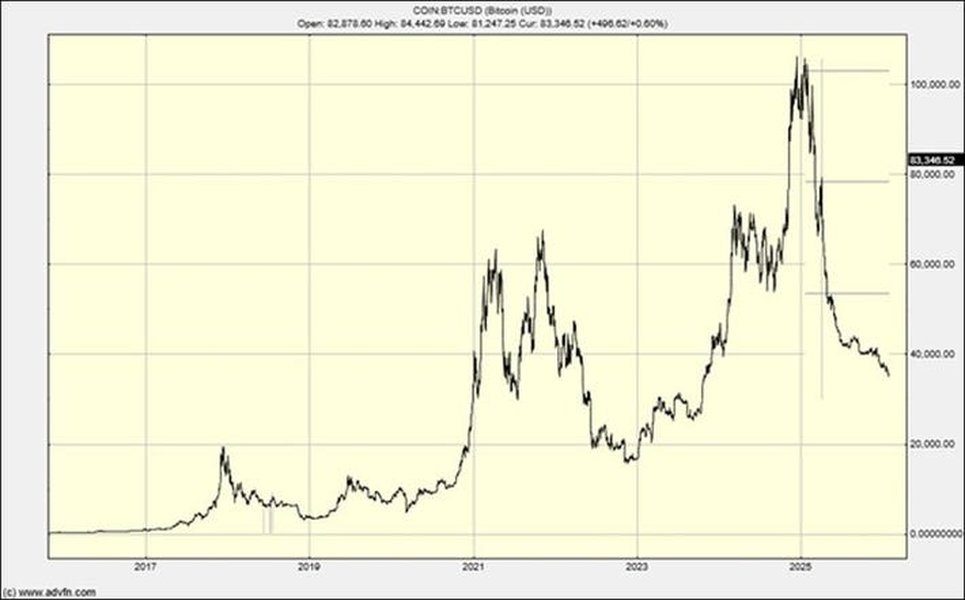
Bitcoin's price history is characterized by distinct cycles of boom and bust.
Competition and Market Maturity
Bitcoin operates within a dynamic ecosystem. Competition from other cryptocurrencies offering different technological features (e.g., faster transactions, smart contracts) could divert investment. Additionally, the emergence of Central Bank Digital Currencies (CBDCs) or improvements in traditional financial systems could challenge Bitcoin's use cases. As the market matures, the explosive growth rates seen in the past may become harder to sustain.
Adoption Hurdles
While adoption is growing, achieving the scale required for a $1 million price tag necessitates overcoming significant hurdles. These include improving user experience, addressing scalability limitations (though solutions like the Lightning Network are progressing), enhancing security, and achieving widespread understanding and trust among the general public and institutions.
Expert Predictions & Timelines: A Spectrum of Views
Forecasts for Bitcoin's future price vary dramatically, reflecting the asset's speculative nature and the uncertainty surrounding its key drivers and hurdles. Here's a look at the different perspectives:
Comparing Potential Scenarios
The likelihood and timeline for Bitcoin reaching different price milestones depend heavily on the interplay of the factors discussed earlier. The radar chart below provides an opinionated visualization comparing the relative strength required across key dimensions for Bitcoin to potentially reach $150k, $500k, or $1 million.
This chart illustrates that achieving higher price targets necessitates significantly stronger performance across all major adoption, regulatory, macroeconomic, and technological factors.
A Spectrum of Forecasts
Predicting Bitcoin's price is inherently difficult. However, numerous analysts, executives, and investment firms have offered their perspectives, ranging from cautious optimism to bold proclamations.
The Optimists' View: Aiming for the Moon
A vocal group of proponents believes $1 million is not only possible but perhaps even inevitable, potentially within this decade.
- Cathie Wood (CEO, Ark Invest): Has consistently predicted Bitcoin could reach $1 million to $1.5 million by 2030, driven by institutional adoption and its role as "digital gold."
- Jack Dorsey (Co-founder, Block): Foresees Bitcoin exceeding $1 million by 2030, emphasizing its potential as a native internet currency and store of value.
- PlanB (Creator, Stock-to-Flow Model): Suggested Bitcoin could hit $500k-$1M based on scarcity models, potentially around 2025, though these models have faced criticism.
- Samson Mow (CEO, JAN3), Arthur Hayes (Co-founder, BitMEX), Jack Mallers (CEO, Strike): Have suggested $1 million could happen relatively quickly (even within the current market cycle or by 2025), often citing catalysts like ETF inflows, fiat currency debasement, or specific policy changes.
- Michael Saylor (Executive Chairman, MicroStrategy): Holds a long-term view of Bitcoin potentially reaching $5 million per coin or higher as it absorbs value from other asset classes.
The Pragmatists' Perspective: Strong Growth, Measured Targets
Other analysts and institutions, while still bullish, offer more conservative near-to-medium-term targets, seeing $1 million as a longer-term possibility.
- Standard Chartered: Projected Bitcoin reaching $200,000 by the end of 2025.
- Bernstein Research: Forecasted $150,000 driven by ETF demand and supply constraints.
- H.C. Wainwright: Predicted a rise to $225,000 by the end of 2025.
- Nasdaq Analysts / Algorithmic Models: Some analyses suggest reaching $1 million is unlikely before 2035 or even 2040, assuming a more gradual adoption curve. CoinCodex's algorithm, for example, pointed towards July 2040.
- Binance Predictions: Algorithmic forecasts suggested a more modest average price around $118,000 by 2030.
Summary of Key Predictions
The table below consolidates some prominent predictions, highlighting the diversity of opinions on Bitcoin's price potential and timeline.
| Predictor / Source | Price Target | Estimated Timeline | Key Rationale Summary |
|---|---|---|---|
| Cathie Wood / Ark Invest | $1M - $1.5M | By 2030 | Institutional adoption, Digital Gold narrative, Scarcity |
| Jack Dorsey | >$1M | By 2030 | Network effects, Institutional scale ($20T market cap goal) |
| Optimists (Mow, Hayes, PlanB, Mallers) | $500k - $1M | ~2025 / Near-term Cycle | Scarcity models, ETF inflows, Fiat devaluation, Policy shifts |
| Standard Chartered | $200k | By end of 2025 | ETF demand, Halving impact, Favorable policy outlook |
| Bernstein Research / H.C. Wainwright | $150k - $225k | By end of 2025 | Strong ETF inflows, Supply constraints post-halving |
| Nasdaq Analysts / Algorithms (e.g., CoinCodex) | $1M | Post-2035 / 2040 | Assumes slower, more gradual mass adoption path |
| Michael Saylor (Long-term view) | $5M+ | Long-term | Ultimate Store of Value, absorbing value from other assets |
Visualizing the Bull Case: A Look at Optimistic Forecasts
Many voices in the crypto space are vocal about the potential for Bitcoin to reach $1 million, often citing rapid adoption cycles and the impact of institutional money. The video below features Samson Mow, a prominent Bitcoin advocate, discussing his perspective on why a $1 million Bitcoin might arrive sooner than many expect.
Views like Mow's emphasize potential catalysts like hyper-demand from ETFs overwhelming the available supply, or significant failures in traditional fiat systems pushing capital towards Bitcoin "violently." While highly optimistic, these perspectives contribute to the broader range of possibilities considered by the market.
Frequently Asked Questions (FAQ)
What are the main arguments driving the $1 million Bitcoin predictions?
What are the biggest risks or challenges to Bitcoin reaching $1 million?
How does Bitcoin's fixed supply realistically impact its long-term price potential?
Are there serious predictions for Bitcoin going even *higher* than $1 million?
What might be a more realistic price range for Bitcoin in the next 5 years (by ~2030)?
References
- When Will Bitcoin Be Worth $1 Million? - Investopedia
- Jack Dorsey Predicts Bitcoin Will Hit $1 Million by 2030—But How Realistic Is That? - TheStreet
- Cathie Wood Still Sees Bitcoin Reaching $1 Million - The Motley Fool
- Experts Forecast Bitcoin To Hit $1 Million Within A Decade Amid Crypto Boom - Forbes
- Bitcoin Price Prediction 2024-25: Plan B Forecasts BTC at $1 Million By 2025? - KuCoin Insights
- Bitcoin Price Prediction 2024 – 2040 - Cryptonews.com
- Bitcoin will reach $1 million 'violently,' possibly by year-end - Yahoo Finance
Recommended
Last updated April 23, 2025