
Unveiling the Secrets of Bivariate Functions: How Double Infinite Products Revolutionize Factorization
An in-depth look at the groundbreaking work of Mohamed Elewoday and Harry Gingold in decomposing complex two-variable functions.
Highlights: Key Insights into Bivariate Factorization
- Understanding a New Dimension of Factorization: Bivariate functions, particularly those expressed as Taylor series, can be intricately decomposed into double infinite products of simpler, elementary factors. This offers a powerful alternative to traditional factorization methods.
- Pioneering Methodologies: The core techniques driving this advanced factorization are Power Product Expansions (PPE) and Inverse Power Product Expansions (IPPE). These were significantly developed and explored in the research of Mohamed Elewoday, notably in his dissertation, and his collaborations with Harry Gingold.
- Broad Applications and Significance: This sophisticated approach to factorization is not merely theoretical; it holds substantial importance in diverse fields such as symbolic computation, number theory (especially partition theory), the analysis of modular functions, and the factorization of matrix functions.
Delving into Bivariate Function Factorization
In mathematics, a bivariate function, often denoted as \(f(x,y)\), is a function that depends on two independent variables, \(x\) and \(y\). These functions are ubiquitous in various scientific and engineering disciplines, modeling phenomena from heat distribution on a surface to economic models with multiple inputs. Analyzing the structure of such functions is crucial, and factorization plays a key role in this analysis.
Traditionally, factorization might bring to mind breaking down polynomials into products of simpler polynomials. However, for a broader class of functions, particularly analytic functions often represented by bivariate Taylor series of the form:
\[ f(x,y) = \sum_{m=0}^{\infty} \sum_{n=0}^{\infty} c_{m,n} x^{m} y^{n} \]a more nuanced approach is required. The concept of factorization via double infinite products emerges as a powerful tool, allowing these complex functions to be expressed as an infinite product indexed over two variables. This method, significantly advanced by Mohamed Elewoday and Harry Gingold, offers a way to decompose functions into elementary "building blocks," providing deeper insights into their structure and properties.
The Pioneers: Mohamed Elewoday and Harry Gingold
The exploration of bivariate function factorization through infinite products owes much to the dedicated work of Mohamed Elewoday and Harry Gingold. Their research has provided a robust theoretical framework and practical methodologies for this complex area.
Mohamed Elewoday's Contributions and Dissertation
Mohamed Elewoday's research, particularly his dissertation titled "Algebraic, Analytic, and Combinatorial Properties of Power Product Expansions in Two Independent Variables," stands as a cornerstone in this field. His work meticulously investigates how bivariate functions, especially Taylor series, can be represented and factorized using power product expansions. Elewoday's studies delve into:
- The development of algorithms for converting power series (including those with matrix coefficients) into infinite products of elementary factors.
- The analysis of expansions where series are represented as the inverse of an infinite product.
- The crucial interplay between the algebraic, analytic, and combinatorial properties inherent in these expansions.
His collaborations with Harry Gingold further solidified these concepts, leading to influential publications on factorizing bivariate Taylor series via both power products and inverse power products.
Harry Gingold's Foundational Work
Harry Gingold, an expert in complex analysis, differential equations, and infinite product representations, brought extensive experience to this collaborative effort. His research has often focused on applying analytic techniques to decompose functions and solve complex mathematical problems. In the context of bivariate factorization, Gingold's contributions include:
- Laying theoretical groundwork for power product expansions, extending classical ideas like Weierstrass factorization to multivariate contexts.
- Investigating convergence criteria for these infinite product representations, ensuring their mathematical validity and utility.
- Exploring the factorization of matrix functions and their inverses using similar infinite product techniques.
Together, Elewoday and Gingold have significantly advanced our understanding of how to break down complex bivariate analytic functions into more manageable and insightful product forms.
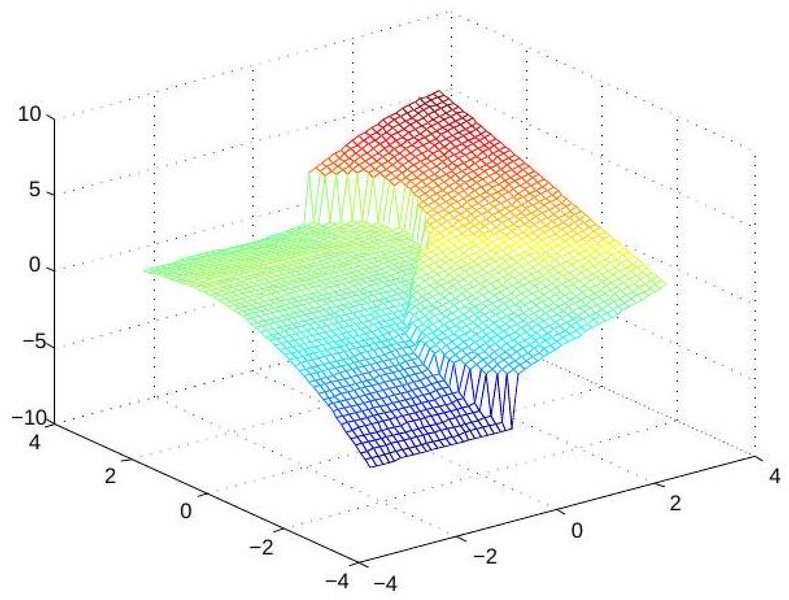
A visual representation of approximations for a bivariate piecewise-smooth function, illustrating the complexity that advanced factorization techniques aim to address.
Core Concepts: Power and Inverse Power Product Expansions
The methodologies developed by Elewoday and Gingold primarily revolve around two types of infinite product expansions: Power Product Expansions (PPE) and Inverse Power Product Expansions (IPPE).
Power Product Expansions (PPE)
Decomposing Functions into Multiplicative Building Blocks
Power Product Expansions involve expressing a function as an infinite product of elementary terms, often monomials or factor-like expressions raised to certain powers. For a bivariate function \(f(x,y)\), a PPE might take a general form where the function is represented as a product of terms involving \(x^m y^n\).
This approach seeks to find a representation like:
\[ f(x,y) = \prod_{m=0}^{\infty} \prod_{n=0}^{\infty} (1 - \alpha_{m,n} x^{m} y^{n})^{\beta_{m,n}} \]or a similar structure, where \(\alpha_{m,n}\) and \(\beta_{m,n}\) are coefficients or exponents derived from the original function's Taylor series coefficients \(c_{m,n}\). The goal is to break down the function into factors that are, in some sense, simpler or more fundamental.
Inverse Power Product Expansions (IPPE)
Factorization Using Inverse Structures
Inverse Power Product Expansions extend this idea by considering factorizations that involve the inverses of elementary factors. This means the function might be expressed as a product of terms like \((1 - d_k x^{p_k} y^{q_k})^{-1}\). This approach is particularly useful for functions that might have poles or specific types of singular behavior, or where representing the function as an inverse product is more natural or computationally efficient.
The "Double Infinite" Aspect
Products Indexed Over Two Variables
The term "double infinite product" specifically refers to the fact that these products are indexed over two independent variables, typically corresponding to the powers of \(x\) and \(y\) in the bivariate function. A common form, as discussed in the literature, particularly in the context of work by Elewoday and Gingold, is:
\[ f(x,y) = \prod_{m=0}^{\infty} \prod_{n=0}^{\infty} (1 - x^{m} y^{n})^{a_{m,n}} \]Here, the exponents \(a_{m,n}\) are crucial and are systematically derived from the coefficients of the bivariate Taylor expansion of \(f(x,y)\). This structure inherently captures the two-dimensional nature of bivariate functions.
Visualizing the Interconnections: A Mindmap
To better understand the relationships between these concepts, the key researchers, methodologies, and applications, the following mindmap provides a visual overview of the factorization of bivariate functions via double infinite products:
Bivariate Functions"] id1["Double Infinite Products"] id1_1["Represents function as
Πm Πn factors"] id1_2["General form:
f(x,y) = Πm,n(1 - xmyn)am,n"] id2["Key Researchers"] id2_1["Mohamed Elewoday"] id2_1_1["Dissertation: Algebraic, Analytic,
and Combinatorial Properties of
Power Product Expansions"] id2_1_2["Focus on Bivariate Taylor Series"] id2_2["Harry Gingold"] id2_2_1["Expertise in complex analysis,
infinite products, matrix functions"] id2_2_2["Collaborations on PPE & IPPE"] id3["Core Methodologies"] id3_1["Power Product Expansions (PPE)"] id3_1_1["Decomposition into
elementary multiplicative factors"] id3_2["Inverse Power Product Expansions (IPPE)"] id3_2_1["Utilizes inverse forms
for factorization, e.g., (1 - term)-1"] id4["Key Characteristics & Considerations"] id4_1["Convergence Criteria"] id4_2["Algebraic Properties (Ring Theory)"] id4_3["Analytic Properties (Complex Analysis)"] id4_4["Combinatorial Insights (Coefficients)"] id5["Applications & Significance"] id5_1["Symbolic Computation (Efficient Algorithms)"] id5_2["Partition Theory (Generating Functions)"] id5_3["Analysis of Modular Functions"] id5_4["Factorization of Matrix Functions"] id5_5["Theoretical Mathematics (Extending Univariate Concepts)"]
This mindmap illustrates how the central idea of factorizing bivariate functions branches out into the specific techniques of double infinite products, the pivotal roles of Elewoday and Gingold, the core methodologies they developed (PPE and IPPE), the critical properties that need consideration, and the wide-ranging applications of this research.
Key Properties and Considerations
The factorization of bivariate functions into double infinite products is not just a matter of algebraic manipulation; it involves careful consideration of several mathematical properties:
- Convergence: A fundamental aspect is ensuring that the infinite product actually converges to the original function within a specific domain. Elewoday and Gingold's work addresses the conditions under which these double infinite product expansions are valid and accurately represent the function.
- Analyticity: The methods are typically applied to analytic functions, and the resulting factorizations must preserve the analytic properties of the original function. The relationship between the coefficients of the Taylor series and the exponents in the product expansion is key here.
- Algebraic Structure: These factorizations connect to deeper algebraic structures, such as rings of formal power series and factorization properties in multivariate polynomial or analytic function rings. The "elementary factors" in the product often have specific algebraic meanings.
- Combinatorial Insights: The exponents \(a_{m,n}\) in the product expansion often exhibit combinatorial patterns and relationships, which can be exploited for both theoretical understanding and computational efficiency. Elewoday's dissertation, for instance, highlights these combinatorial properties.
- Uniqueness: Questions about the uniqueness of such factorizations are also relevant, analogous to the uniqueness of prime factorization for integers or irreducible factorization for polynomials.
Comparative Analysis of Factorization Approaches
To appreciate the unique aspects of double infinite product factorization as developed by Elewoday and Gingold, it's useful to compare it with traditional polynomial factorization. The following radar chart visually contrasts these two approaches across several key dimensions. "Infinite Product Factorization" refers to the Elewoday/Gingold methods, while "Traditional Polynomial Factorization" refers to standard algebraic techniques for polynomials.
Interpretation of the Radar Chart:
- Analytic Structure Handling: Infinite product methods excel at handling the complex structures of general analytic functions.
- Scope (Analytic Functions): These methods are specifically designed for analytic functions, offering broader applicability than polynomial factorization, which is confined to polynomials.
- Representation Nature: Infinite products inherently provide an infinite representation, contrasting with the finite representation of polynomial factors. (Values here reflect this characteristic: 9 for infinite, 3 for finite, on a scale favoring applicability to broader function classes).
- Computational Aspects: While powerful, computing infinite product expansions can be theoretically complex, whereas established algorithms exist for polynomial factorization.
- Theoretical Depth: Both have significant theoretical underpinnings, but infinite product factorizations draw heavily from advanced complex analysis and number theory.
Comparing Factorization Techniques for Bivariate Functions
The table below further clarifies the distinctions between factorization via double infinite products and traditional polynomial factorization, focusing on their core characteristics when applied to bivariate functions.
| Feature | Double Infinite Product Factorization (Elewoday/Gingold) | Traditional Polynomial Factorization |
|---|---|---|
| Type of Factors | Elementary, often simpler building-block functions or terms like \((1 - x^m y^n)\). | Irreducible polynomials over a specific field. |
| Nature of Product | Infinite, typically a double product indexed by two variables (\(m, n\)). | Finite product of polynomial factors. |
| Typical Functions Addressed | Bivariate analytic functions, Taylor series, generating functions, matrix functions. | Bivariate polynomials with coefficients in integers, rationals, finite fields, etc. |
| Primary Goal | Decompose into fundamental multiplicative components, reveal analytic structure, connect to number-theoretic properties. | Find roots (implicitly), simplify algebraic expressions, solve polynomial systems. |
| Mathematical Basis | Complex analysis (infinite product theory, properties of analytic functions), formal power series, combinatorics. | Abstract algebra (ring theory, field theory, properties of polynomials), computational algebra. |
| Representation of Complexities | Through the infinite sequence of exponents \(a_{m,n}\) and the structure of the elementary factors. | Through the degree, number, and coefficients of the irreducible polynomial factors. |
Significance and Applications
The factorization of bivariate functions via double infinite products is more than an elegant mathematical theory; it has profound significance and diverse applications:
- Symbolic Computation: These methods can lead to more efficient algorithms for handling and simplifying complex analytic expressions in computer algebra systems. They can help avoid "intermediate expression swell," a common problem where calculations become unwieldy.
- Partition Theory and Number Theory: Many generating functions in partition theory and other areas of number theory naturally lend themselves to infinite product representations (e.g., Euler's pentagonal number theorem, Jacobi triple product). Extending these ideas to bivariate cases opens new avenues for discovery. Theta functions and modular functions, with their rich product structures, are also relevant.
- Analysis of Analytic Functions: This factorization provides a powerful tool for studying the structure of bivariate analytic functions, including their zeros, singularities, and asymptotic behavior. It generalizes classical univariate results like the Weierstrass factorization theorem to two variables, a non-trivial extension.
- Matrix Function Factorization: The concepts of power product and inverse power product expansions have also been applied to factorize matrix functions, which are important in systems theory, control engineering, and numerical analysis.
- Bridging Analysis and Algebra: The approach elegantly connects analytic properties (convergence, Taylor series) with algebraic structures (factorization in rings of power series), fostering a unified understanding.
Exploring Factorization Further: An Introduction to Infinite Products
To grasp the essence of infinite product factorizations, it's helpful to understand the concept of an infinite product itself. The following video provides an engaging introduction to a simple infinite product, illustrating the core idea of representing a value or function as a product of infinitely many terms. While it focuses on a univariate case, the fundamental principles are foundational for the more complex bivariate infinite products developed by Elewoday and Gingold.
This video explores how an infinite product can converge to a finite value, showcasing the beauty and power of such representations. The work on bivariate functions builds upon these foundational concepts, extending them to two dimensions and more complex functional forms.
Frequently Asked Questions (FAQ)
What exactly is a bivariate function?
A bivariate function is a function that depends on two independent variables. If we call these variables \(x\) and \(y\), the function is typically denoted as \(f(x,y)\). Its value changes based on the values of both \(x\) and \(y\). For example, the area of a rectangle, \(A = \text{length} \times \text{width}\), is a bivariate function if length and width are considered independent variables. In more complex settings, bivariate functions can describe surfaces in three-dimensional space.
How does a "double infinite product" differ from a standard infinite product?
A standard infinite product is typically indexed by a single variable, like \(\prod_{n=1}^{\infty} u_n = u_1 \cdot u_2 \cdot u_3 \cdots\). A "double infinite product," in the context of bivariate functions \(f(x,y)\), is indexed by two independent variables, say \(m\) and \(n\). This means the product takes the form \(\prod_{m=0}^{\infty} \prod_{n=0}^{\infty} u_{m,n}\). It's essentially an infinite product of infinite products, reflecting the two-dimensional nature of the input variables \(x\) and \(y\).
What were the main contributions of Mohamed Elewoday and Harry Gingold to this field?
Mohamed Elewoday, particularly in his dissertation and joint work, focused on developing and analyzing Power Product Expansions (PPE) and Inverse Power Product Expansions (IPPE) for bivariate Taylor series and matrix functions. He explored their algebraic, analytic, and combinatorial properties. Harry Gingold provided foundational expertise in infinite products and analytic function theory, collaborating to extend these factorization techniques to two variables, establish convergence criteria, and explore their applications. Together, they significantly advanced the theoretical framework and practical methods for these types of factorizations.
Can you explain Power Product Expansions (PPE) in simpler terms?
Imagine you have a complex function. Instead of describing it by adding many simple terms together (like in a Taylor series sum), a Power Product Expansion tries to describe it by multiplying many simple "building block" terms together. For a bivariate function \(f(x,y)\), these building blocks often look like \((1 - x^m y^n)\) raised to some power. The "power" part refers to these exponents, and the "product" part means you're multiplying an infinite number of these blocks. The goal is to find the right set of building blocks and their powers to reconstruct the original function.
What are some practical applications of factorizing bivariate functions this way?
This factorization method has several practical uses:
- Symbolic Computation: It can lead to more efficient algorithms in computer algebra systems for simplifying and manipulating complex mathematical expressions involving bivariate analytic functions.
- Number Theory: It's useful for studying generating functions in areas like partition theory, where functions encoding combinatorial information often have natural infinite product forms.
- Mathematical Physics and Engineering: Functions describing physical systems often involve multiple variables. Factorization can help in understanding the system's fundamental components or modes.
- Analysis of Special Functions: Many special functions (like theta functions or modular forms) have known infinite product representations, and these techniques can help generalize or analyze them in a bivariate context.
Recommended Further Exploration
If you wish to delve deeper into this fascinating area of mathematics, consider exploring these related queries:
- How do power product expansions relate to classical Weierstrass factorization?
- What are the convergence conditions for double infinite product factorizations of bivariate functions?
- Explore applications of bivariate function factorization in theoretical physics or engineering.
- Investigate algorithms for computing the exponents in double infinite product expansions.
References
The information presented is synthesized from research contributions in the field, including works by Mohamed Elewoday and Harry Gingold. For further reading, consult academic databases and the following key publications:

Last updated May 17, 2025