
What Happens Within a Black Hole
Exploring the Mysterious Interior of a Cosmic Enigma
Key Takeaways
- Event Horizon and Tidal Forces: The boundary where gravity’s pull becomes inescapable, leading to extreme stretching of matter.
- Singularity and Theoretical Challenges: At the core, matter is compressed to an incredibly tiny region where conventional physics fails.
- Quantum and Alternative Theories: The interplay between classical general relativity and quantum effects invites alternative models and unresolved puzzles like the information paradox.
Understanding Black Holes: An Overview
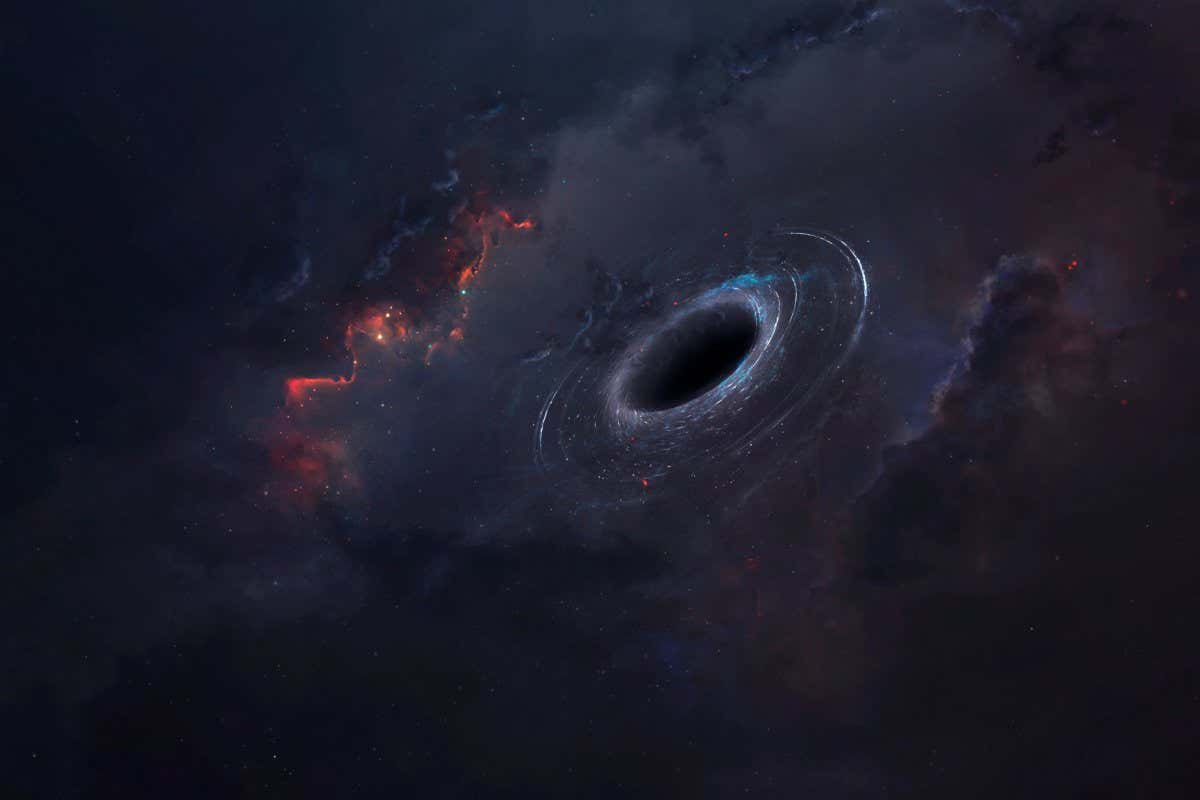
Black holes are among the universe’s most fascinating and enigmatic objects. Formed by the collapse of massive stars, these cosmic entities are defined primarily by their immense gravitational fields – so powerful that nothing, not even light, can escape once it crosses a critical threshold. This threshold is known as the event horizon, the point of no return. Inside a black hole, the fabric of spacetime is distorted beyond our standard comprehension, and what lies within continues to challenge both observation and theory.
Our understanding of black hole interiors comes largely through theoretical models. The phenomenon is governed by Einstein’s general relativity under extreme conditions, yet the predictions of classical physics eventually run into paradoxes and infinities. As matter plunges past the event horizon, its journey is neither straightforward nor entirely understood; it is a progression that involves dramatic stretching (spaghettification), compression toward a singularity, and a host of quantum effects that force scientists to rethink the structure of space and time.
The Journey Through a Black Hole
Event Horizon: The Point of No Return
The event horizon is the defining boundary of a black hole. It represents the location where the gravitational pull becomes so overwhelming that even electromagnetic radiation (light) cannot escape. From an outside observer’s perspective, an object falling toward a black hole appears to slow down as it approaches this limit, due to intense gravitational time dilation. However, in the reference frame of the falling object, the crossing is completed in finite proper time.
At this boundary, the conventional understanding of time and space begins to blur. The event horizon does not have a tangible surface; instead, it is a region delineated by the escape velocity reaching the speed of light. Once an object passes through this invisible barrier, all trajectories inevitably lead toward the center. This marks the commencement of the internal dynamics that define the black hole's inner environment.
Inside the Black Hole: From Tidal Forces to the Singularity
Stepping beyond the event horizon plunges one into a realm where familiar physics is radically transformed. Within this sphere, gravity is so strong that it not only alters the pathways of matter but also warps the very structure of spacetime. Here, the gravitational pull is non-uniform, leading to a phenomenon called spaghettification—where the difference in gravitational force between the nearer and farther parts of an object causes it to stretch into a long, thin shape.
Spaghettification: The Stretching Effect
As an object gets closer to the black hole’s core, the difference in gravitational forces (tidal forces) acting on its near side versus its far side becomes enormous. This differential pull literally stretches the object along the direction of the gravitational gradient while squeezing it perpendicularly. The outcome of this process is humorously termed “spaghettification,” where matter is elongated into an almost noodle-like form. In stellar-mass black holes, this effect is so pronounced that any object or living being would be torn apart long before reaching the central region.
Despite its dramatic nature, spaghettification serves as an important indicator of the incredible gravitational gradients present inside black holes. It illustrates how extreme tidal forces overcome the structural integrity of matter, reducing it ultimately to subatomic constituents before these components are driven towards the black hole’s center.
The Singularity: Where Conventional Physics Collapses
At the very heart of a black hole lies what is known as the singularity. According to classical general relativity, the singularity is a point of infinite density and zero volume where all the mass of the black hole is concentrated. At this extreme, the curvature of spacetime becomes infinite, and the laws of physics as they are currently understood no longer apply.
The singularity remains one of the most puzzling aspects of black hole physics. Its existence is a prediction of general relativity; however, this prediction leads to mathematical infinities that signal the limits of our present theories. In a region where traditional concepts of distance, time, and matter break down, the singularity challenges both our technological capacity to observe and our intellectual capacity to fully comprehend.
The need for a more complete theory, one which incorporates quantum mechanics alongside gravity—a quantum theory of gravity—has led to various speculative models. These include the possibility that the singularity might not be a true “point” but rather an extremely dense and dynamic region where known laws are replaced by quantum phenomena.
Quantum Mechanics and Theoretical Alternatives
While general relativity provides a robust framework for understanding the gravitational pull and the macroscopic features of black holes, it falls short in explaining what occurs at the smallest scales near the singularity. Quantum effects become significant as matter is compressed to densities approaching the Planck scale—a domain where classical theories lose their predictive power.
Several proposals have emerged in attempts to reconcile these conflicting perspectives:
Quantum Gravity Approaches
The quest for a unified theory that integrates quantum mechanics with general relativity has driven innovations like string theory and loop quantum gravity. These frameworks suggest that spacetime might have a discrete structure at the smallest scales, effectively replacing the singularity with a “quantum bounce” or another form of non-singular core. In this scenario, instead of a point of infinite density, the interior structure is regulated by quantum effects that prevent the formation of true singularities.
Such theories also offer potential resolutions to the long-standing information paradox, which asks whether information that falls into a black hole is forever lost or somehow preserved. Quantum principles imply that information cannot be destroyed, and models like black hole complementarity and the holographic principle have been advanced to address this paradox.
Alternative Models: Planck Stars and Gravastars
Beyond the quantum gravity frameworks, alternative models have been proposed to explain the nature of the black hole’s innermost structure. One such model is the concept of the Planck star, which posits that matter may be compressed only up to the Planck length (the smallest measurable unit in the universe) before rebounding rather than forming a singularity. Another intriguing possibility is that of gravastars, theoretical constructs that replace the singularity with a core of dark energy or an exotic state of matter.
Both of these ideas remain highly speculative but serve to highlight the profound uncertainties that still surround our understanding of black hole interiors. They underscore the idea that the singularity predicted by classical physics might be an artifact of extrapolating current theories beyond their domain of validity.
Accretion Disks and Radiation
Although the inner workings of a black hole remain hidden behind the veil of the event horizon, the region immediately surrounding it offers indirect observational insights. As matter falls towards the black hole, it often forms an accretion disk—a swirling, superheated disk of gas, dust, and stellar debris. Due to intense friction and gravitational compression, the disk’s material heats to extremely high temperatures and emits vast amounts of radiation.
The radiation observed from these disks not only provides clues about the behavior of matter in extreme gravitational fields but also serves as a critical marker for identifying black holes in the cosmos. Interestingly, while matter and radiation generated within the accretion disk can eventually escape, anything that crosses the event horizon becomes irretrievably trapped.
Gravitational Time Dilation: The Warping of Time and Space
One of the most mind-bending aspects of black hole physics is the phenomenon of gravitational time dilation. According to general relativity, the strong gravitational field near a black hole can significantly slow down the passage of time relative to a distant observer. As objects approach the event horizon, time appears to stretch, and processes seem to occur at an increasingly sluggish pace from the external viewpoint.
For an observer falling into the black hole, however, the passage of time would feel normal, even as the external universe appears to speed up. This discrepancy underscores the profound distortions in spacetime induced by intense gravitational fields. The interplay between space and time in such extreme environments continues to be a fertile area of theoretical investigation, as it raises questions about the very nature of causality and the limits of physical laws.
A Closer Look: Black Hole Characteristics
In order to better understand the complexity of black holes, it is useful to examine their key features side by side. The following table summarizes some of the main characteristics associated with black holes and their observable or theoretical effects:
| Feature | Description | Observational/Conceptual Impact |
|---|---|---|
| Event Horizon | The boundary beyond which nothing can escape the gravitational pull. | Identified by time dilation effects and accretion disk behavior. |
| Spaghettification | Extreme tidal forces stretch and compress objects as they near the core. | Illustrative of the differential gravitational pull inside a black hole. |
| Singularity | A central region of infinite density where known physics breaks down. | Represents the limit of classical theories and motivates quantum gravity research. |
| Quantum Effects | Phenomena such as Hawking radiation indicate that black holes can emit energy. | Challenge classical predictions and feed into theories resolving the information paradox. |
| Accretion Disk | A disk of superheated material orbiting the black hole before being consumed. | Provides indirect observational evidence through emitted X-rays and radiation. |
The Information Paradox and Observational Challenges
One of the most provocative puzzles in modern astrophysics is the so-called “information paradox.” When matter falls into a black hole, the information about its physical state seems to vanish behind the event horizon. However, the principles of quantum mechanics insist that information cannot be destroyed. This discrepancy has led to numerous theoretical propositions, such as the holographic principle and black hole complementarity, to resolve the tension between gravity and quantum theory.
Despite our inability to observe the very interior of a black hole directly (owing to the causal disconnection imposed by the event horizon), astronomers and theoretical physicists rely on indirect methods. Observations of accretion disks, gravitational lensing, and even the detection of gravitational waves from black hole mergers provide important clues about the nature of these extraordinary objects. Such indirect evidence continually refines our theoretical models and challenges our conventional understanding of the interplay between matter, energy, and spacetime.
Astrophysical Implications and the Future of Black Hole Research
Linking Theory and Observation
The study of black holes is at the crossroads of theoretical physics and observational astronomy. While the predictions of general relativity lay the groundwork for understanding extreme gravitational environments, observational evidence from space-based telescopes and gravitational wave observatories is critical in testing these theories. For example, the study of a star’s orbit around an unseen massive object has provided compelling evidence for the existence of black holes in our own galaxy.
As technology advances, future missions and more sensitive detectors are expected to yield data that could either confirm existing models or reveal entirely new phenomena. The iterative process between theory and observation ensures that our understanding of what happens within a black hole remains a dynamic and evolving field of research.
The Intersection of Disciplines: Relativity Meets Quantum Mechanics
At its core, the mystery of black holes serves as a natural laboratory for studying the union of quantum mechanics and general relativity. The extreme conditions prevailing within black holes push these theories to their limits, demonstrating where our current scientific frameworks merge and where they fall apart. This intersection is not merely academic; it has profound implications for our understanding of the universe, influencing everything from the birth and death of stars to the ultimate fate of cosmic structures.
The journey toward a unified theory of quantum gravity is one of the most ambitious goals in modern physics. Each insight, be it theoretical conjecture or an observational breakthrough, brings us a step closer to unraveling the secrets locked inside a black hole. Researchers remain optimistic that advances in both mathematical frameworks and experimental techniques will eventually offer a more complete picture of these enigmatic objects.
Conclusion
In summary, the interior of a black hole remains one of the greatest mysteries in modern astrophysics. At the boundary known as the event horizon, objects experience extreme gravitational effects that result in spaghettification—a dramatic stretching induced by intense tidal forces. Once past this boundary, matter seems destined to converge at the singularity, a region where densities become infinite and our conventional understanding of physics fails.
The theoretical models we currently rely on—rooted in general relativity—predict the existence of a singularity, yet these same models break down at the smallest scales. Here, quantum effects are no longer negligible, prompting alternative proposals such as quantum bounce mechanisms, Planck stars, and even gravastars. Furthermore, the phenomenon known as Hawking radiation hints at the possibility that black holes might not be eternal, gradually evaporating over immense timescales.
Our comprehension of what happens within a black hole is gleaned indirectly through associated phenomena such as accretion disks, gravitational time dilation, and the gravitational waves produced during black hole mergers. These observations help bridge the gap between theory and empirical evidence, even as they underscore the urgent need for a unified theory that can reconcile the discrepancies between general relativity and quantum mechanics.
As our observational capabilities improve and our theoretical models become more refined, the secrets of black holes will continue to unfold. The complexities of their interiors not only expand our understanding of gravity and spacetime but also challenge us to rethink the fundamental laws that govern the cosmos.
References
- What Happens at a Black Hole’s Center - Space.com
- What’s Inside a Black Hole - Sky & Telescope
- What Happens to Matter Inside a Black Hole - Nature
- Inside a Black Hole - NASA
- Black Holes Explained - University of Chicago News
- Anatomy of Black Holes - NASA Science
More
Last updated February 18, 2025