
Beyond Sight: Can Blind Individuals Conquer the World of Motorcycling?
Exploring the remarkable journeys, adaptive techniques, and inherent challenges faced by visually impaired motorcycle enthusiasts.
The idea of a blind person riding a motorcycle might seem counterintuitive, given the intense visual demands of navigating roads and controlling a powerful machine. However, the human spirit's capacity for adaptation and the support of dedicated communities and technologies have led to some truly astonishing achievements. This exploration delves into whether blind individuals can ride motorcycles, both in controlled environments like racetracks and in the complexities of the real world, drawing upon inspiring examples and practical realities.
Key Highlights: Riding Beyond Visual Limits
- Controlled Environments are Key: Blind individuals have successfully ridden motorcycles, primarily in secure, controlled settings like racetracks, with extensive support systems and safety measures in place.
- Adaptation and Assistance are Crucial: Success relies heavily on heightened remaining senses, advanced communication with sighted guides, specialized training, and sometimes, sensory substitution technologies.
- Real-World Independent Riding is a Major Hurdle: While stories of assisted riding exist, fully independent motorcycle operation by a blind person on public roads faces immense safety, legal, and practical barriers.
Conquering the Track: Riding in Controlled Environments
Controlled environments, such as dedicated racetracks or private motorparks, offer the safest and most feasible avenue for blind individuals to experience the thrill of motorcycle riding. These settings minimize unpredictable variables like traffic, pedestrians, and unexpected road hazards, allowing riders to focus on the mechanics of riding and their connection with the machine under guided supervision.
The BlindZA.com Racetrack Experience: A Case Study
A compelling example, as highlighted in your query, comes from BlindZA.com, detailing a South African man, completely blind, who successfully rode a Suzuki SV650 motorcycle around a 4.2-kilometer racetrack. This achievement was not spontaneous but the result of meticulous preparation, innovative adaptation, and robust support:
- Preparation: Initial practice occurred in highly controlled, low-risk areas like skid pans and private plots to build foundational skills.
- Guidance System: The rider was accompanied by a "motorcycle guide dog" – a sighted companion rider who provided continuous verbal instructions via a wireless helmet-to-helmet intercom system. This system utilized a numbered dial analogy for directions (e.g., "5" for straight ahead, "4" for a slight left turn, "6" for a slight right turn), along with updates on speed and corner approach.
- Sensory Substitution: The rider utilized "The vOICe for Android" app on smart glasses. This technology converts visual information captured by the glasses' camera into "soundscapes," providing auditory cues about the surrounding environment and enhancing spatial awareness.
- Safety Protocols: Full protective gear was worn at all times, speeds were kept moderate (around 20-40 km/h on the track), and extensive practice preceded the main event.
- Outcome: The rider successfully completed four full laps of the racetrack without incident, later participating in a group ride, demonstrating the viability of this assisted riding model in a secure setting.
This endeavor was a collaborative effort, involving support from motorcycle clubs, sponsors, and organizations dedicated to the blind, all working to create a safe and empowering framework.

Riders participating in a track day event, similar to those that provide controlled environments for assisted blind motorcycling.
Other initiatives, like the "RIDING BLIND PROJECT" supported by Queensland Motorcycling and Motorcycling Australia, also aim to provide blind and visually impaired individuals with the opportunity to ride in controlled motorpark environments, fostering skill development and a love for the sport.
Pioneers of Persistence: Notable Blind Motorcyclists
Several blind individuals have pushed boundaries and achieved remarkable feats in motorcycling, showcasing incredible determination and adaptive skills.
Ben Felten: The World's Fastest Blind Motorcyclist
Ben Felten, an Australian who lost his sight due to Retinitis Pigmentosa, holds the Guinness World Record as the fastest blind motorbike rider. He achieved a staggering speed of 266.685 km/h on a Kawasaki motorcycle. Felten's journey, chronicled in the documentary "Dark Rider," involved returning to motorcycling decades after losing his sight and competing on vast salt flats like Lake Gairdner, relying on meticulous team support and heightened auditory cues. His story is a testament to pursuing ambitious dreams despite profound challenges.

Ben Felten, a symbol of determination in blind motorsports.
Christopher Venter: The Transcontinental Scooterist
Christopher Venter, also known as "The Blind Scooter Guy," undertook an epic 32,000-kilometer charity scooter journey from Cape Town, South Africa, to Dublin, Ireland, riding a 150cc scooter. While details of his direct control after becoming totally blind suggest significant team support, his journey highlights the possibility of extensive long-distance motorcycling engagement for visually impaired individuals.
Cathy Birchall: Global Circumnavigator
Cathy Birchall is recognized as the first blind person to circumnavigate the globe on a motorcycle. Such an endeavor would have undoubtedly required extensive planning, a dedicated support team, and adaptive strategies for navigation and safety across diverse terrains and conditions.
Chass Moller-Nielson: Licensed to Ride
Chass Moller-Nielson, who was born totally blind, notably obtained a Queensland, Australia, motorcycle license. This indicates that, under specific circumstances and likely with certain restrictions or requirements for assistance, some level of official licensing can be achieved by blind individuals.
The Labyrinth of Real-World Riding
Transitioning from controlled tracks to the unpredictable nature of public roads presents a monumental increase in complexity and risk for any motorcyclist, let alone one who is blind. Independent, unassisted riding by a blind individual in real-world traffic is generally considered exceptionally dangerous and is typically not legally permissible.
Inherent Dangers and Sensory Demands
Safe motorcycle operation hinges on constant visual input for:
- Hazard Perception: Identifying potholes, debris, oil slicks, and erratic movements of other vehicles.
- Depth Perception: Accurately judging distances to vehicles, turns, and obstacles.
- Peripheral Awareness: Monitoring surrounding traffic and potential threats from multiple directions.
- Rapid Decision Making: Processing visual information quickly to react to changing road conditions.
While individuals with monocular vision (blind in one eye) may adapt to ride, they often report challenges with depth perception, which underscores the criticality of full visual faculty for navigating public roads safely. For fully blind riders, these challenges are exponentially magnified.
Assisted Real-World Riding
There are anecdotal accounts, such as reports of a blind man in China riding a motorcycle with his wife providing verbal instructions from the pillion seat. While demonstrating a form of real-world assisted riding, such methods operate in a high-risk, legally grey area and are far from the norm or advisable practice.
Mindmap: Navigating the World of Blind Motorcycling
This mindmap illustrates the interconnected factors involved in blind motorcycle riding, from the environments and adaptations to the notable individuals and inherent challenges. It provides a visual overview of the multifaceted nature of this topic.
Adaptive Strategies and Technologies
The ability of blind individuals to participate in motorcycling, especially in controlled settings, is heavily reliant on a combination of heightened senses, human collaboration, and technological aids.
Sensory Compensation
Visually impaired riders often develop and rely on their other senses to an extraordinary degree.
- Auditory Acuity: Listening to engine revs for speed and gear cues, tire noise for traction feedback, and the sounds of the environment (though complex in noisy settings).
- Tactile Feedback: Feeling the motorcycle's vibrations, balance, and responses to control inputs.
- Echolocation: While more prominently demonstrated by blind cyclists like Daniel Kish, who navigates using clicks and interpreting the returning echoes, the underlying principle of using sound to perceive space can be an auxiliary skill.
The Indispensable Human Guide
A sighted, experienced guide rider is paramount. This "guide dog on a motorcycle" provides:
- Real-time Navigation: Verbal cues for turns, acceleration, braking, and line choice.
- Hazard Warning: Alerting the rider to track conditions or obstacles.
- Pacing and Reassurance: Maintaining appropriate speeds and offering encouragement.
Technological Assistance
Technology plays a supportive role:
- Sensory Substitution Devices: Systems like "The vOICe" attempt to translate visual information into auditory or tactile signals, offering an alternative way to "see" the environment.
- GPS and Navigation Aids: For long-distance, supported journeys, GPS can assist the support team, which then relays information to the rider.
- Advanced Rider-Assistance Systems (ADAS): While technologies like blind-spot detection systems (e.g., INNOVV ThirdEYE, Bosch Side View Assist) are designed for sighted riders to augment their vision, they represent the type of sensor technology that, with further development, could potentially be adapted for riders with visual impairments in specific contexts. These systems typically use radar or cameras to detect objects in a motorcycle's blind spots and provide alerts.
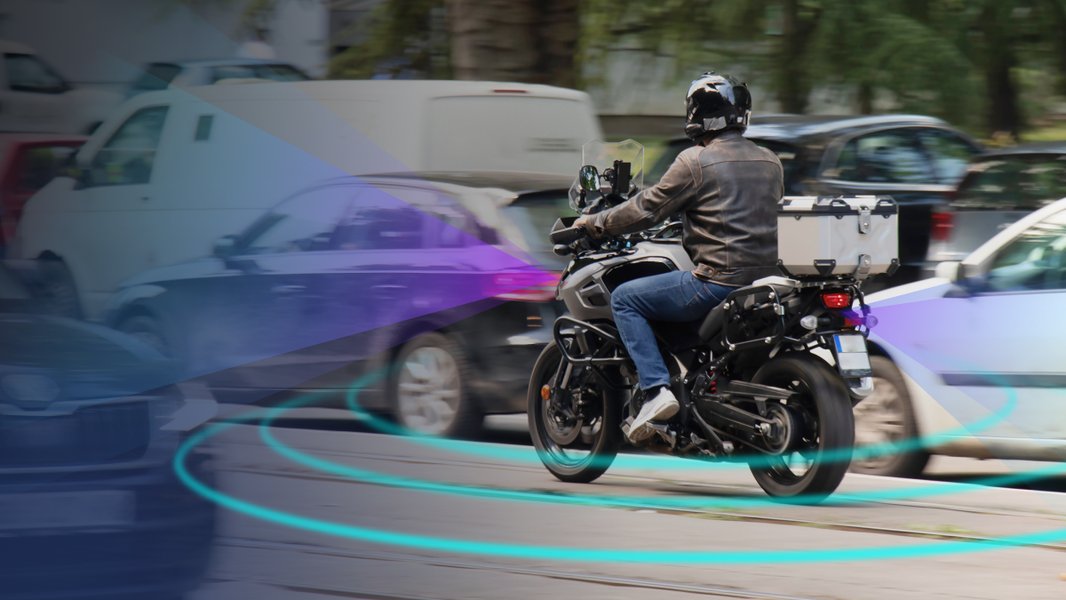
Illustrative example of blind spot detection technology, a type of ADAS that enhances rider awareness.
Comparing Riding Scenarios: A Visual Analysis
The radar chart below provides a comparative visualization of key factors influencing motorcycle riding for blind individuals in two distinct scenarios: "Assisted Track Riding" (like the BlindZA.com example) and "Hypothetical Independent Road Riding." The scores (on a scale of 1 to 10, where 10 is highest/most) are based on the synthesis of information regarding feasibility, safety, and reliance on various aids.
This chart visually underscores that while assisted track riding can achieve high levels of safety and environmental predictability with maximum support, the prospect of independent road riding presents near-insurmountable challenges in safety and predictability, even if hypothetical advanced technology were available.
Spotlight on a Vision: Blind Motorbike Riders Experience
The following video offers a glimpse into initiatives that enable blind and visually impaired individuals to experience the thrill of motorcycling. It showcases the joy and empowerment these programs can bring, emphasizing community support and adaptive approaches to make riding accessible.
Video showcasing blind and visually impaired individuals experiencing motorcycle riding through a supportive program.
Such programs often involve tandem rides with sighted riders or guided sessions in controlled areas, allowing participants to feel the dynamics of the motorcycle and the freedom of the ride in a secure manner.
Navigating the Legal Landscape and Safety Imperatives
The legal right to operate a motorcycle on public roads is almost universally contingent upon meeting specific visual acuity standards. These regulations exist to ensure the safety of the rider and the public.
- Licensing Requirements: Vision tests are a standard part of obtaining a motorcycle license. Waivers or special provisions for totally blind individuals to ride independently on public roads are practically non-existent due to safety imperatives.
- Amplified Risks: Motorcycling inherently carries more risk than driving a car. Visual impairments significantly amplify these risks, particularly concerning hazard detection, spatial judgment, and reaction times.
- Responsibility: The onus of safe operation falls on the rider. Any impairment that compromises this ability is a critical safety concern.
Community and Support: Riding Together
The motorcycling community has shown instances of remarkable inclusivity and support for visually impaired enthusiasts.
-
RIDE2SHARE Project: Originating in Lithuania and expanding internationally, RIDE2SHARE organizes free motorcycle rides for blind and visually impaired individuals as passengers. This initiative fosters connection, shares the joy of motorcycling, and breaks down barriers.
-
Club Involvement: As seen in the BlindZA.com example, local motorcycle clubs and organizations often play a crucial role in providing the resources, expertise, and controlled environments necessary for such adaptive riding events.
-
Advocacy and Awareness: Stories of blind riders help raise awareness about the capabilities of visually impaired individuals and promote adaptive sports.
Comparative Overview: Riding Scenarios for Blind Individuals
The table below summarizes the key differences between riding in controlled environments versus attempting to ride on public roads for blind individuals, based on the discussed factors.
| Feature | Controlled Environment (e.g., Racetrack with Full Support) | Real-World Public Roads (Attempting Independent Riding) | Real-World Public Roads (Directly Assisted by Pillion Guide) |
|---|---|---|---|
| Primary Feasibility | Demonstrably Possible with extensive planning & support | Extremely Low / Generally Considered Unfeasible & Unsafe | Highly Complex, Risky, Legally Questionable |
| Safety Level | Manageable; can be high with strict protocols & expert guidance | Extremely High Risk to rider and public | Very High Risk, heavily dependent on guide's skill and road conditions |
| Legal Status | Permissible within organized event rules & private property | Generally Illegal due to unmet vision standards for licensing | Legally Ambiguous at best; likely violates licensing terms |
| Support Needed | Sighted guide rider, advanced communication, sensory tech, track marshals | (Hypothetically) Extremely advanced autonomous vehicle technology not yet existing for motorcycles | Constant, precise verbal/physical cues from a pillion passenger guide |
| Key Technologies Used | Helmet intercoms, sensory substitution (e.g., The vOICe), GPS for guide | (Hypothetical) Sophisticated AI, environmental sensors, autonomous controls | Basic communication (shouting, pre-set signals if any) |
| Notable Examples | BlindZA.com track ride, Ben Felten (speed records on salt flats) | No documented cases of safe, sustained independent riding by a totally blind person | Anecdotal reports (e.g., spouse on pillion giving directions) |
Frequently Asked Questions (FAQ)
Can a completely blind person legally ride a motorcycle independently on public roads?
What is the fastest speed a blind motorcyclist has achieved?
How do blind riders navigate on a racetrack with assistance?
Are there organizations that specifically help blind people experience motorcycling?
Conclusion: A Testament to Human Potential
While the prospect of a blind individual independently navigating the chaotic real world on a motorcycle remains largely beyond current practical and safe limits, the achievements in controlled environments are nothing short of inspiring. Through a combination of courage, rigorous training, sophisticated human guidance, adaptive techniques, and emerging technologies, blind individuals have indeed ridden motorcycles, experiencing the exhilaration and freedom that these machines offer. These endeavors underscore the profound human capacity to adapt and overcome challenges, pushing the boundaries of what is thought possible and reminding us that passion knows no visual limits when coupled with ingenuity and support.
