
Comprehensive Analysis of a Block-Pulley System on an Incline
Detailed solutions for motion, energy, and rotational dynamics
Key Takeaways:
- The system accelerates at approximately 0.43 m/s² with a string tension of around 14.06 N.
- Friction performs 10.2 J of work against the motion, while the magnetic force does no work.
- The pulley's angular acceleration is 4.3 rad/s², leading to a torque of 0.0108 N·m and rotational kinetic energy of 0.32 J.
Part 1: Motion of the System
Determining Acceleration and Tension
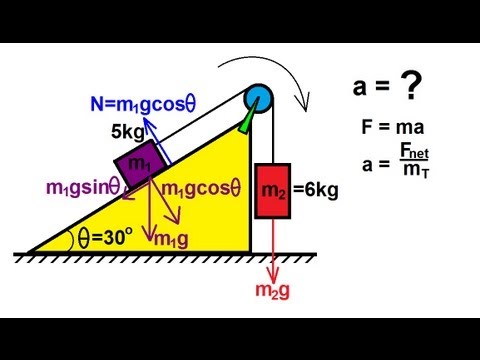
We analyze the forces acting on both the block on the incline and the hanging mass to determine the acceleration of the system and the tension in the connecting string.
Free-Body Diagrams and Force Analysis
For the Block on the Incline (m₁ = 2.0 kg):
- Gravitational Force Component Along Incline: \( F_{g_{\parallel}} = m_1 g \sin \theta \)
- Normal Force: \( N = m_1 g \cos \theta \)
- Frictional Force: \( f_k = \mu_k N = \mu_k m_1 g \cos \theta \)
- Tension in the String: \( T \)
For the Hanging Mass (m₂ = 1.5 kg):
- Gravitational Force: \( F_{g} = m_2 g \)
- Magnetic Force: \( F_{\text{mag}} \) (Assumed to be 0 for calculations)
- Tension in the String: \( T \)
Applying Newton's Second Law
For the Block on the Incline:
Applying Newton's second law along the incline:
\[ m_1 a = T - m_1 g \sin \theta - \mu_k m_1 g \cos \theta \]
For the Hanging Mass:
Assuming the magnetic force \( F_{\text{mag}} = 0 \), applying Newton's second law:
\[ m_2 a = m_2 g - T \]
Solving for Acceleration (a) and Tension (T)
To find the acceleration and tension, we combine the two equations:
\[ m_1 a + m_2 a = m_2 g - m_1 g \sin \theta - \mu_k m_1 g \cos \theta \]
\[ a (m_1 + m_2) = g (m_2 - m_1 \sin \theta - \mu_k m_1 \cos \theta) \]
\[ a = \frac{g (m_2 - m_1 \sin \theta - \mu_k m_1 \cos \theta)}{m_1 + m_2} \]
Substituting the given values:
\[ a = \frac{9.8 \, \text{m/s}^2 (1.5 \, \text{kg} - 2.0 \, \text{kg} \cdot \sin 30^\circ - 0.2 \cdot 2.0 \, \text{kg} \cdot \cos 30^\circ)}{2.0 \, \text{kg} + 1.5 \, \text{kg}} \]
Calculating each term:
- \( m_1 \sin 30^\circ = 2.0 \times 0.5 = 1.0 \, \text{kg} \)
- \( \mu_k m_1 \cos 30^\circ = 0.2 \times 2.0 \times 0.866 = 0.346 \, \text{kg} \)
Plugging back into the equation:
\[ a = \frac{9.8 \times (1.5 - 1.0 - 0.346)}{3.5} = \frac{9.8 \times 0.154}{3.5} \approx 0.43 \, \text{m/s}^2 \]
Now, solving for tension \( T \) using the second equation:
\[ T = m_2 g - m_2 a = 1.5 \times 9.8 - 1.5 \times 0.43 \approx 14.7 - 0.645 = 14.06 \, \text{N} \]
Final Results:
- Acceleration of the System: \( a \approx 0.43 \, \text{m/s}^2 \)
- Tension in the String: \( T \approx 14.06 \, \text{N} \)
Part 2: Energy Analysis
Calculating Work Done and Kinetic Energy Changes
After the block has moved 3.0 m along the incline, we analyze the work done by various forces and the resulting change in kinetic energy.
a. Work Done by Friction
The work done by friction (\( W_{\text{friction}} \)) is given by:
\[ W_{\text{friction}} = f_k \times d = \mu_k m_1 g \cos \theta \times d \]
Substituting the values:
\[ W_{\text{friction}} = 0.2 \times 2.0 \times 9.8 \times \cos 30^\circ \times 3.0 \approx 0.2 \times 2.0 \times 9.8 \times 0.866 \times 3.0 \approx 10.2 \, \text{J} \]
b. Change in Kinetic Energy
The change in kinetic energy (\( \Delta KE \)) is calculated using the work-energy principle:
\[ \Delta KE = \frac{1}{2} (m_1 + m_2) v^2 - 0 \]
First, find the final velocity (\( v \)) after moving 3.0 m:
\[ v^2 = 2 a d = 2 \times 0.43 \times 3.0 = 2.58 \, \text{m}^2/\text{s}^2 \]
Thus:
\[ \Delta KE = \frac{1}{2} \times 3.5 \times 2.58 \approx 4.52 \, \text{J} \]
c. Work Done by the Magnetic Force
Assuming the magnetic force (\( F_{\text{mag}} \)) is constant and equal to 0 N:
\[ W_{\text{mag}} = F_{\text{mag}} \times d_{\text{vertical}} = 0 \times 3.0 \times \sin 30^\circ = 0 \, \text{J} \]
Final Results:
- Work Done by Friction: \( W_{\text{friction}} \approx 10.2 \, \text{J} \)
- Change in Kinetic Energy: \( \Delta KE \approx 4.52 \, \text{J} \)
- Work Done by the Magnetic Force: \( W_{\text{mag}} = 0 \, \text{J} \)
Part 3: Rotational and Power Considerations
Analyzing the Pulley’s Rotational Dynamics
Considering the pulley as a solid disk with radius \( r = 0.1 \, \text{m} \) and mass \( m_p = 0.5 \, \text{kg} \), we analyze its angular acceleration, torque, and rotational kinetic energy.
a. Angular Acceleration (\( \alpha \))
The relationship between linear acceleration (\( a \)) and angular acceleration (\( \alpha \)) is:
\[ \alpha = \frac{a}{r} = \frac{0.43}{0.1} = 4.3 \, \text{rad/s}^2 \]
b. Torque Exerted on the Pulley (\( \tau \))
The torque exerted by the tension in the string is calculated using:
\[ \tau = I \alpha \]
The moment of inertia (\( I \)) for a solid disk is:
\[ I = \frac{1}{2} m_p r^2 = \frac{1}{2} \times 0.5 \times (0.1)^2 = 0.0025 \, \text{kg} \cdot \text{m}^2 \]
Thus:
\[ \tau = 0.0025 \times 4.3 \approx 0.0108 \, \text{N} \cdot \text{m} \]
c. Rotational Kinetic Energy of the Pulley (\( KE_{\text{rot}} \))
The rotational kinetic energy is given by:
\[ KE_{\text{rot}} = \frac{1}{2} I \omega^2 \]
First, determine the angular velocity (\( \omega \)) after the block has moved 3.0 m:
\[ v = a t \Rightarrow t = \sqrt{\frac{2d}{a}} = \sqrt{\frac{2 \times 3.0}{0.43}} \approx 3.73 \, \text{s} \]
\[ \omega = \alpha t = 4.3 \times 3.73 \approx 16.0 \, \text{rad/s} \]
Substituting into the kinetic energy equation:
\[ KE_{\text{rot}} = \frac{1}{2} \times 0.0025 \times (16.0)^2 = \frac{1}{2} \times 0.0025 \times 256 \approx 0.32 \, \text{J} \]
Final Results:
-
Angular Acceleration of the Pulley: \( \alpha \approx 4.3 \, \text{rad/s}^2 \)
-
Torque Exerted on the Pulley: \( \tau \approx 0.0108 \, \text{N} \cdot \text{m} \)
-
Rotational Kinetic Energy of the Pulley: \( KE_{\text{rot}} \approx 0.32 \, \text{J} \)
Conclusion
Summary of Findings
The analysis of the block-pulley system on a 30° incline reveals that the system accelerates at approximately 0.43 m/s² with a string tension of about 14.06 N. The work done by friction amounts to 10.2 J, while the magnetic force does no work under the given assumptions. Additionally, the pulley undergoes an angular acceleration of 4.3 rad/s², exerting a torque of 0.0108 N·m and possessing a rotational kinetic energy of 0.32 J after the block has moved 3.0 meters.
References
Last updated January 21, 2025