
Comparing Bond Funds and Bank Fixed Deposits in India
Understanding Returns Over 3, 5, and 10 Years
Key Highlights
- Fixed Deposits (FDs) offer guaranteed, predictable returns with lower risk, making them suitable for conservative investors.
- Bond Funds, particularly long-duration and dynamic bond funds, have the potential for higher returns, especially in a declining interest rate environment, but come with market risk.
- Historical data suggests that Debt Funds (which include bond funds) have often outperformed FDs over similar tenures, especially in the 3 and 5-year horizons, while long-term performance can vary based on market conditions and fund strategy.
Introduction to Fixed Deposits and Bond Funds
When considering investment options in India, Fixed Deposits (FDs) and Bond Funds are two popular avenues for investors seeking fixed income or lower-risk profiles. While both involve investing in debt instruments, they differ significantly in their structure, returns, risks, and liquidity. Understanding these differences is crucial for making informed investment decisions aligned with your financial goals and risk appetite.
Fixed Deposits are traditional investment instruments offered by banks and Non-Banking Financial Companies (NBFCs) in India. They are known for their simplicity, safety, and guaranteed returns. When you invest in an FD, you deposit a fixed sum of money for a predetermined period, ranging from 7 days to typically 10 years, at a fixed interest rate. The interest can be received periodically (monthly, quarterly, annually) or accumulated and paid at maturity.
Bond Funds, on the other hand, are a type of mutual fund that primarily invests in fixed-income securities like government bonds, corporate bonds, debentures, and money market instruments. Unlike FDs, the returns from bond funds are not fixed but are market-linked, meaning they can fluctuate based on interest rate movements and the creditworthiness of the issuers. Bond funds offer diversification across various debt instruments, managed by professional fund managers.
This comparison will delve into how these two investment options stack up against each other, specifically focusing on their historical and potential returns over 3, 5, and 10-year periods in the Indian context.
Understanding Fixed Deposit Returns in India
Fixed Deposits have long been a staple in Indian households due to their perceived safety and predictable returns. The interest rates offered on FDs are fixed for the entire tenure of the deposit, providing a sense of security to investors. In 2025, fixed deposit interest rates in India generally range between 5.5% to 7.75% for regular citizens, with slightly higher rates often offered to senior citizens. The specific rate depends on the bank or NBFC and the chosen tenure.
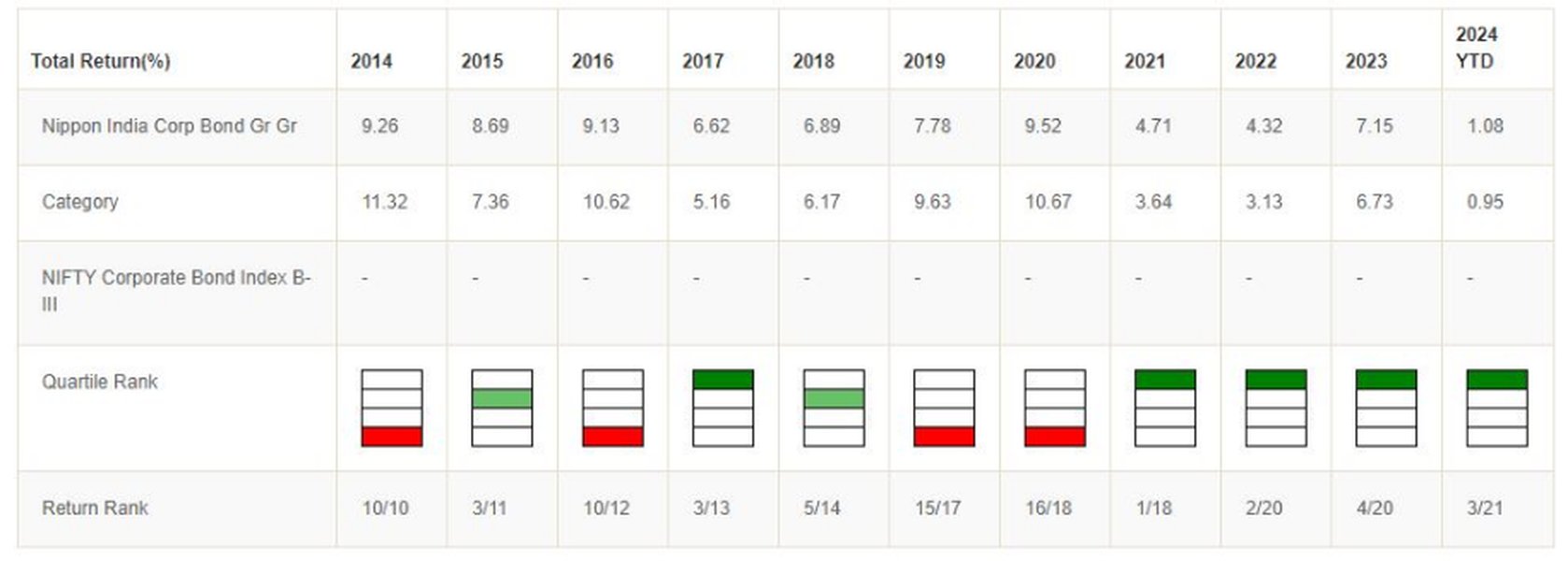
A chart showing the annual performance of corporate bond funds.
FD Tenures and Compounding
FD tenures can be as short as 7 days and extend up to 10 years. The interest on FDs is typically compounded quarterly, which means the interest earned in each quarter is added to the principal, and the next quarter's interest is calculated on the new, larger principal amount. This compounding effect can lead to higher returns over longer tenures compared to simple interest.
While the interest rates are fixed at the time of investment, the actual return over a period like 3, 5, or 10 years will depend on the prevailing rates when the FD was initially opened and the power of compounding over that duration. For example, an FD opened when interest rates were high will yield better returns than one opened when rates were low.
Taxation of FD Interest
It's important to note that the interest earned on Fixed Deposits in India is fully taxable as per the investor's income tax slab. Tax Deducted at Source (TDS) is applicable if the interest earned exceeds a certain threshold in a financial year. This tax implication reduces the effective return from FDs, especially for individuals in higher tax brackets.

Visual representation related to the process of opening a Fixed Deposit in an Indian bank.
Liquidity Considerations
While FDs offer liquidity through premature withdrawal, this usually comes with a penalty, which can impact the overall returns, especially for longer-term FDs broken before maturity. This limited liquidity compared to some other investment options is a factor to consider, particularly for those who might need access to their funds before the tenure ends.
Exploring Returns from Bond Funds in India
Bond Funds, as a category of debt mutual funds, offer investors exposure to a diversified portfolio of debt instruments. Their returns are not fixed like FDs and are influenced by various factors, including interest rate movements, the credit quality of the underlying bonds, and the fund manager's expertise.
Types of Bond Funds Relevant to Long-Term Investment
For a comparison over 3, 5, and 10 years, several types of bond funds are relevant:
-
Corporate Bond Funds: These funds primarily invest in debt issued by corporations with varying credit ratings. They generally aim for stable returns with relatively low default risk, often seen as an alternative to corporate fixed deposits.
-
Long Duration Funds: These funds invest in bonds with longer maturities. They are particularly sensitive to interest rate changes; falling interest rates can lead to higher returns due to the increasing value of existing bonds with higher coupon rates.
-
Dynamic Bond Funds: These funds offer fund managers the flexibility to actively manage the portfolio based on their outlook on interest rate movements. They can switch between bonds of different maturities and credit qualities to potentially optimize returns.
-
Gilt Funds: These funds invest primarily in government securities (G-Secs), which are considered among the safest debt instruments due to zero default risk. Their returns are also influenced by interest rate movements.
Historical Returns of Bond Funds
Historical data suggests that debt funds, including various types of bond funds, have often shown the potential to outperform FDs over similar tenures, although past performance is not indicative of future results. For example, some sources indicate that debt funds have generally delivered better annualized returns over 1, 3, and 5-year periods compared to typical bank FD rates during those times. Long-duration funds, in particular, have seen significant returns during periods of declining interest rates, such as the one observed in early 2025 when the RBI cut the repo rate.
As of early 2025, some Long Duration Funds have delivered average annualized returns of over 12% in the last 1 year, with 3 and 5-year annualized returns also being notable, though generally lower than the 1-year returns, reflecting the impact of interest rate cycles. Corporate bond funds have also been highlighted as offering moderate returns without high risks, serving as a potential replacement for conventional fixed deposits.

Visual material comparing Bonds, Equity, and FD as investment options.
Risk and Volatility
Unlike the guaranteed returns of FDs, bond funds are subject to market risk. The Net Asset Value (NAV) of bond funds can fluctuate due to changes in interest rates, credit ratings of the underlying securities, and overall market liquidity. This means the return is not fixed, and there is a possibility of capital depreciation, although typically lower than equity investments.
Different types of bond funds carry varying levels of risk. For instance, long-duration funds are more susceptible to interest rate risk than short-duration funds. Corporate bond funds carry credit risk, which is the risk of the issuer defaulting on interest or principal payments, although funds investing in high-rated corporate bonds have lower default risk.
Taxation of Bond Fund Returns
The taxation of returns from bond funds is different from that of FDs. Gains from debt mutual funds are taxed based on the holding period. For investments held for more than 3 years, the gains are treated as long-term capital gains and are taxed at 20% with indexation benefits. For investments held for 3 years or less, the gains are treated as short-term capital gains and are taxed as per the investor's income tax slab. Tax-free bonds, if held directly or through certain funds, can offer tax advantages.
Comparison of Returns Over Different Time Horizons (3, 5, and 10 Years)
Comparing the returns of bond funds and fixed deposits over specific time horizons like 3, 5, and 10 years requires considering both historical performance and the nature of these instruments.
3-Year Returns
Over a 3-year period, debt funds, including various bond fund categories, have historically shown competitive or potentially higher returns compared to bank FDs. This can be attributed to factors like interest rate movements and the fund manager's ability to capitalize on market opportunities. For instance, during periods where interest rates have been declining or stable at favorable levels, bond funds with appropriate strategies could have delivered better annualized returns than the fixed rates offered by FDs over the same period. However, in a rising interest rate scenario, bond funds, especially those with longer durations, might see their NAVs decrease, potentially leading to lower returns over this shorter term. Bank FDs provide a guaranteed, although potentially lower, return over the 3-year period, shielding investors from market volatility.
5-Year Returns
Extending the horizon to 5 years allows for a more significant impact of compounding in FDs and potentially smoother performance from bond funds compared to shorter durations. Historically, debt funds have also demonstrated the potential for outperformance over a 5-year period, with average annualized returns for some categories being higher than prevailing FD rates. The benefit of indexation on long-term capital gains from debt funds held for over 3 years can also make them more tax-efficient than FDs over this timeframe, especially for investors in higher tax brackets. However, the actual performance of bond funds over 5 years is still subject to the interest rate cycle and market conditions throughout that period. FDs offer a predictable return over 5 years, eliminating market risk.
10-Year Returns
Over a longer horizon of 10 years, the comparison becomes more nuanced. Both FDs and certain debt funds offer tenures extending up to or beyond 10 years. The compounding effect in FDs becomes more significant over a decade. For bond funds, the returns over 10 years would be a cumulative result of various interest rate cycles and market conditions experienced during that period. While historically, some debt fund categories might have outperformed FDs over the long run, the volatility inherent in market-linked investments means there's no guarantee of higher returns. The choice for a 10-year horizon depends heavily on the investor's risk tolerance and outlook on the long-term interest rate environment. Long-duration bond funds are particularly sensitive to long-term interest rate trends over such extended periods. Bank FDs provide absolute certainty of returns over the entire 10-year period.
Key Differences Between Fixed Deposits and Bond Funds
To summarize the comparison, here is a table highlighting the key differences between Fixed Deposits and Bond Funds in India:
| Feature | Fixed Deposits (FDs) | Bond Funds |
|---|---|---|
| Nature | Type of deposit with banks/NBFCs | Type of mutual fund investing in debt instruments |
| Returns | Fixed and guaranteed interest rate | Market-linked, variable returns |
| Risk Level | Low risk, principal and interest insured up to ₹5 lakhs per bank (DICGC) | Moderate risk, subject to interest rate risk and credit risk |
| Liquidity | Limited; premature withdrawal usually incurs penalties | Generally high; units can be redeemed at prevailing NAV (exit loads may apply) |
| Taxation | Interest is fully taxable as per income slab | Gains taxed as per holding period (short-term vs. long-term capital gains) with potential indexation benefits for long-term gains |
| Tenure | Ranges from 7 days to 10 years (or more in some cases) | No fixed tenure; investment duration depends on the investor's choice |
| Minimum Investment | Varies by bank, typically starts from ₹1,000 or ₹5,000 | Varies by fund house, typically starts from ₹100 or ₹500 for SIPs, and ₹1,000 or ₹5,000 for lump sum |
| Suitability | Conservative investors prioritizing safety and predictable income | Investors seeking potentially higher returns than FDs and willing to take on moderate market risk |
A video discussing hybrid vs fixed income mutual funds in the context of falling interest rates.
Factors to Consider When Choosing
The choice between Fixed Deposits and Bond Funds in India for 3, 5, or 10-year investments depends on several factors:
Risk Appetite
Investors with a low-risk tolerance who prioritize capital safety and guaranteed returns will find FDs more suitable. Those willing to take on moderate market risk for the potential of higher returns may prefer bond funds.
Financial Goals and Investment Horizon
The investment horizon is a critical factor. For short-term goals (e.g., less than 3 years), FDs or short-duration bond funds might be considered. For medium to long-term goals (3, 5, or 10 years and beyond), both options are viable, but the potential for growth in bond funds might be more appealing for some, while the certainty of FDs suits others. Retirement planning or other long-term financial goals could utilize either, depending on the desired risk exposure.
Liquidity Needs
If you anticipate needing access to your funds before maturity, bond funds generally offer better liquidity than FDs, although exit loads can apply for redemptions within a certain period. Premature withdrawal from FDs typically incurs a penalty.
Taxation
The tax implications of both instruments should be carefully evaluated, especially for investors in higher tax brackets. The potential for indexation benefits on long-term capital gains from debt funds can make them more tax-efficient than FDs for holding periods over 3 years. Tax-saving FDs (with a 5-year lock-in) offer Section 80C benefits, but the interest is still taxable.
Interest Rate Environment
The prevailing and expected interest rate environment plays a significant role, particularly for bond funds. In a declining interest rate scenario, long-duration and dynamic bond funds may perform well. In a rising interest rate environment, short-duration funds might be preferred. FDs lock in the interest rate for the tenure, which can be advantageous if rates are expected to fall after you invest, but disadvantageous if rates rise significantly.
Conclusion
In conclusion, both bond funds and bank fixed deposits are viable fixed-income investment options in India, each with its own set of characteristics. Fixed Deposits offer safety, predictability, and guaranteed returns, making them ideal for conservative investors and those with short-term financial needs where capital preservation is paramount. Their simplicity and ease of investment are also attractive.
Bond Funds, while carrying moderate market risk, offer the potential for higher returns than FDs, especially over medium to long-term horizons and in favorable interest rate environments. They also provide diversification and professional management. Different types of bond funds cater to various risk profiles and investment objectives within the debt space.
Over 3, 5, and 10-year periods, historical trends suggest that debt funds have often delivered competitive or better returns than FDs, but this is not a guarantee, and market fluctuations can impact performance. The tax efficiency of bond funds for long-term holdings can also be a deciding factor for some investors.
Ultimately, the choice between bond funds and fixed deposits, or even a combination of both, depends on an individual investor's risk tolerance, financial goals, investment horizon, liquidity needs, and tax situation. It is often recommended to consult with a financial advisor to determine the best allocation strategy based on your specific circumstances.
Frequently Asked Questions
Are Fixed Deposits completely risk-free?
While often considered very safe, FDs are not entirely risk-free. There is a minimal risk of bank default, although deposits in scheduled banks are insured up to ₹5 lakhs per depositor per bank under the DICGC (Deposit Insurance and Credit Guarantee Corporation) scheme.
Are bond funds riskier than fixed deposits?
Yes, bond funds are generally considered riskier than fixed deposits because their returns are market-linked and subject to interest rate risk and credit risk. FDs offer guaranteed returns regardless of market movements.
Can I lose money in bond funds?
Yes, it is possible to lose money in bond funds if the NAV decreases due to unfavorable market conditions, such as rising interest rates or a downgrade in the credit rating of the bonds held by the fund.
Which is more tax-efficient for long-term investment (over 3 years)?
For investments held for more than 3 years, debt mutual funds (including bond funds) can be more tax-efficient than FDs due to the benefit of indexation on long-term capital gains, which reduces the taxable gain and the effective tax rate compared to the full taxation of FD interest at your income slab rate.
Is it better to invest in bond funds when interest rates are falling?
Generally, yes. When interest rates fall, the market value of existing bonds with higher coupon rates tends to increase. This benefits bond funds, especially those with longer durations, potentially leading to higher returns.
References
Last updated May 8, 2025