
Unlock Crypto Markets 24/7: Building Your AI-Powered Automated Trading Bot
A comprehensive guide to developing a sophisticated crypto bot with 15 strategies, AI integration, and advanced models.
Automated cryptocurrency trading bots offer a way to navigate the volatile, 24/7 crypto market without constant manual oversight. Building a sophisticated bot, especially one incorporating Artificial Intelligence (AI) and multiple trading strategies, is a complex but potentially rewarding endeavor. This guide provides a refined explanation of the process, blending insights from software development, financial strategy, and machine learning.
Key Highlights for Building Your Bot
- Multi-Strategy Approach: Incorporate a diverse set of 15 distinct trading strategies, ranging from classic technical indicators to complex AI-driven models, allowing adaptability across various market conditions.
- AI Integration is Crucial: Leverage AI and machine learning (ML) for pattern recognition, predictive analysis, sentiment analysis, and real-time strategy optimization, enhancing decision-making beyond static rules.
- Robust Development Lifecycle: Follow a structured process including planning, architecture design, rigorous backtesting, secure deployment, and continuous monitoring/improvement for a reliable and effective trading system.
Understanding the Foundations: What is an AI Crypto Trading Bot?
At its core, a crypto trading bot is a software program designed to interact directly with cryptocurrency exchanges via Application Programming Interfaces (APIs). It automates the process of buying and selling digital assets based on a predefined set of rules or algorithms. Standard bots operate based on fixed parameters.
An AI-integrated crypto trading bot takes this concept significantly further. It employs sophisticated mathematical models and machine learning algorithms to analyze vast quantities of market data (prices, volume, order books, even news sentiment) in real-time. Unlike simpler bots, AI-powered systems can:
- Learn and Adapt: Continuously learn from new data and market dynamics, refining strategies over time.
- Identify Complex Patterns: Detect subtle patterns and correlations that might be invisible to human traders or basic algorithms.
- Optimize Decisions: Dynamically adjust trading parameters (like entry/exit points, position sizes) based on changing market conditions and risk assessments.
- Operate at High Speed: Execute trades far faster than humanly possible, capitalizing on fleeting opportunities.
Building a bot with 15 built-in strategies means designing a system capable of managing, evaluating, and potentially combining multiple trading logics simultaneously, with AI often acting as an overseer or enhancer for these strategies.

Conceptual flow of a crypto trading bot.
The Blueprint: Step-by-Step Bot Development Process
Creating a sophisticated AI trading bot requires a methodical approach, blending programming skills, financial acumen, and data science expertise.
Phase 1: Planning and Design
1. Define Scope and Objectives
- Clearly outline your trading goals (e.g., profit maximization, risk minimization, specific asset focus).
- Select the target cryptocurrencies and exchanges (e.g., Binance, Kraken, Coinbase Pro) your bot will interact with. Ensure they offer robust APIs.
- Establish performance benchmarks and risk tolerance levels.
2. Choose the Technology Stack
- Programming Language: Python is highly recommended due to its extensive libraries for data analysis (Pandas, NumPy), API interaction (CCXT), AI/ML (TensorFlow, PyTorch, Scikit-learn), and backtesting (Backtrader, Zipline). Java or JavaScript are alternatives.
- Database: Select a database (e.g., PostgreSQL, MongoDB) for storing trade history, logs, market data, and model states.
- Infrastructure: Plan for deployment (e.g., Cloud servers like AWS, GCP for 24/7 uptime; Docker for containerization).
3. Design the Bot Architecture
A modular architecture is essential for managing complexity:
- Data Collector: Ingests real-time market data (price feeds, order books, volume) via exchange APIs.
- Strategy Engine: Houses the logic for the 15 distinct trading strategies.
- AI/ML Module: Contains the trained models for analysis, prediction, and decision support.
- Risk Management Module: Implements rules for position sizing, stop-loss orders, take-profit targets, and overall portfolio exposure.
- Order Execution Module: Interfaces with exchange APIs to place, modify, and cancel orders securely.
- Backtesting Engine: Simulates strategy performance against historical data.
- Monitoring & Logging System: Tracks performance, errors, and system health, potentially with alerts.
Phase 2: Implementation
4. Implement the 15 Trading Strategies
Develop the logic for each strategy. AI can be integrated to dynamically select strategies, optimize their parameters, or provide confirming signals. Here is a diverse set of 15 strategies often employed, drawing inspiration from common practices:
| # | Strategy Name | Description | Potential AI Enhancement |
|---|---|---|---|
| 1 | Moving Average Crossover (SMA/EMA) | Uses crossovers of short-term and long-term Simple or Exponential Moving Averages to signal trend changes. | AI optimizes MA periods based on market volatility; predicts crossover probability. |
| 2 | Relative Strength Index (RSI) | Identifies overbought (>70) or oversold (<30) conditions. | ML models predict RSI levels or identify divergences more accurately. |
| 3 | MACD (Moving Average Convergence Divergence) | Uses the relationship between two EMAs to signal momentum shifts (MACD line vs. Signal line crossover). | AI filters false signals; combines MACD with other indicators using ensemble methods. |
| 4 | Bollinger Bands | Trades based on price touching or breaking upper/lower volatility bands. | AI predicts band breaches or mean reversion likelihood based on patterns. |
| 5 | Fibonacci Retracement | Identifies potential support/resistance levels based on Fibonacci ratios after a significant price move. | AI validates retracement levels using historical pattern matching. |
| 6 | Grid Trading | Places buy/sell orders at preset intervals above/below a price level to profit from volatility. | AI dynamically adjusts grid spacing and range based on predicted volatility. |
| 7 | Dollar-Cost Averaging (DCA) | Invests a fixed amount at regular intervals, regardless of price. | AI optimizes investment timing or amount based on trend analysis or dips. |
| 8 | Arbitrage | Exploits price discrepancies of the same asset across different exchanges or pairs. | AI rapidly scans multiple exchanges/pairs for fleeting opportunities, accounting for fees/latency. |
| 9 | Momentum Trading | Enters trades in the direction of a strong existing trend, often based on price acceleration and volume. | AI models gauge momentum strength and predict potential exhaustion points. |
| 10 | Mean Reversion | Assumes prices will revert to their historical average over time; trades counter-trend. | AI identifies statistically significant deviations and optimal entry points for reversion. |
| 11 | Volume Weighted Average Price (VWAP) | Uses VWAP as a benchmark; buy below, sell above. Often used for institutional execution. | AI predicts intraday VWAP trajectory to optimize execution timing. |
| 12 | Sentiment Analysis | Trades based on market sentiment derived from news headlines, social media (Twitter, Reddit). | NLP models process text data to generate real-time sentiment scores as trade signals. |
| 13 | Pattern Recognition (Candlestick/Chart) | Identifies classic chart patterns (e.g., head & shoulders, flags) or candlestick patterns (e.g., doji, engulfing). | Deep learning (CNNs) automatically detects complex visual patterns in price charts. |
| 14 | Machine Learning Forecasting | Uses models (e.g., LSTM, ARIMA, Prophet) to directly predict future price movements or trends. | Models are trained on historical data and technical indicators to generate predictive signals. |
| 15 | Reinforcement Learning (RL) Agent | An AI agent learns optimal trading actions (buy/sell/hold) through trial-and-error in a simulated market environment to maximize a reward function (e.g., profit). | The RL agent itself becomes the strategy, adapting continuously. |
This table outlines common strategies; the specific implementation details can vary significantly.
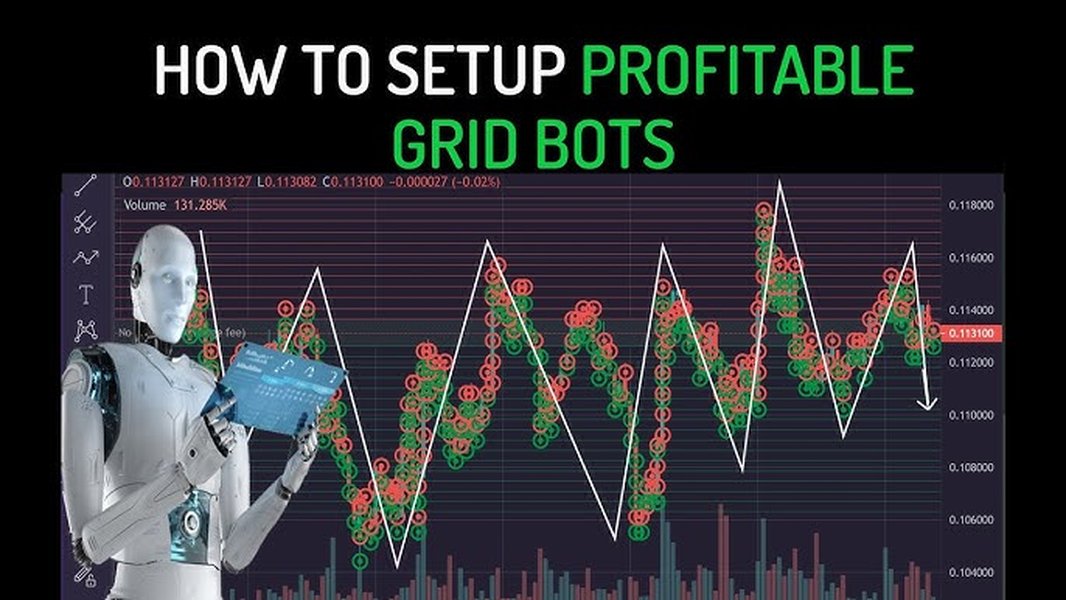
User interface example for a Grid Trading strategy bot.
5. Integrate AI and Machine Learning Models
- Data Preparation: Collect, clean, and preprocess large volumes of historical and real-time market data. Feature engineering (creating relevant inputs like technical indicators, price volatility, volume changes) is critical.
- Model Selection: Choose appropriate ML models based on the task (e.g., Random Forests/Gradient Boosting for classification/regression, LSTMs/CNNs for time-series analysis and pattern recognition, NLP models for sentiment, RL agents for adaptive strategies).
- Training & Validation: Train models using historical data, employing techniques like walk-forward validation or cross-validation to prevent overfitting. Evaluate model performance rigorously.
- Real-time Inference: Integrate trained models into the bot to generate predictions or signals based on live data streams with low latency.
6. Develop API Integration and Execution Logic
- Use libraries like CCXT to interact with multiple exchange APIs consistently for fetching data and placing orders.
- Implement robust error handling for API failures, network issues, or unexpected responses from the exchange.
- Code the logic for order placement (market, limit), modification, cancellation, and status tracking.
Phase 3: Testing and Validation
7. Rigorous Backtesting
- Use a reliable backtesting framework to simulate how each strategy (and the combined system) would have performed on historical data.
- Account for realistic factors like transaction fees, slippage (difference between expected and execution price), and latency.
- Analyze key performance metrics: Profit Factor, Sharpe Ratio, Maximum Drawdown, Win Rate, etc.
- Use backtesting results to refine strategies and model parameters.
8. Paper Trading (Forward Testing)
- Run the bot in a simulated live environment using real-time data but without risking real capital.
- Verify that the bot behaves as expected under live market conditions.
Phase 4: Deployment and Maintenance
9. Implement Security and Risk Management
- Secure API keys diligently; consider IP whitelisting.
- Implement strict risk controls: stop-loss orders, position sizing limits (e.g., percentage of capital per trade), maximum portfolio drawdown limits.
- Include circuit breakers to halt trading during extreme market events or unexpected bot behavior.

Automated bots aim to streamline trading decisions.
10. Deploy the Bot
- Deploy the bot on a reliable server, preferably a cloud platform (AWS, Google Cloud, Azure) for 24/7 availability and scalability.
- Use containerization (Docker) for easier deployment and management.
11. Monitor and Optimize Continuously
- Set up real-time monitoring dashboards and alerting systems to track performance, resource usage, and errors.
- Regularly review trade logs and performance metrics.
- Periodically retrain AI models with new data to adapt to changing market regimes ("concept drift").
- Continuously research and potentially add or refine strategies.
Visualizing Bot Development Complexity
Building a sophisticated AI trading bot involves balancing various factors. The radar chart below provides an opinionated comparison of different aspects influencing the development effort and potential outcomes. Higher values indicate greater complexity, potential, or requirement.
This chart illustrates that building an advanced AI bot with numerous strategies demands significant time, diverse expertise (coding, AI, trading), and resources, but potentially offers the highest adaptability and performance ceiling, albeit with associated risks.
Mapping the Bot Building Journey
The development process can be visualized as a structured journey with interconnected phases. The mindmap below outlines the key stages involved in bringing your AI trading bot to life.
(Python, CCXT, TensorFlow...)"] id1c["Design Architecture
(Modular Components)"] id1d["Choose Exchanges & APIs"] id2["Phase 2: Implementation"] id2a["Code Core Modules
(Data, Execution, Risk)"] id2b["Develop 15 Strategies
(MA, RSI, Grid, Arbitrage...)"] id2c["Integrate AI/ML Models
(Train, Validate, Infer)"] id2d["Implement API Connections"] id3["Phase 3: Testing & Validation"] id3a["Rigorous Backtesting
(Historical Data, Fees, Slippage)"] id3b["Performance Analysis
(Metrics: Sharpe, Drawdown)"] id3c["Paper Trading
(Simulated Live Market)"] id4["Phase 4: Deployment & Operation"] id4a["Implement Security Measures
(API Keys, 2FA)"] id4b["Deploy to Cloud Server
(AWS, GCP, Azure)"] id4c["Setup Monitoring & Alerts"] id5["Phase 5: Maintenance & Optimization"] id5a["Continuous Monitoring"] id5b["Regular Model Retraining"] id5c["Strategy Refinement"] id5d["Performance Review"]
This mindmap highlights the cyclical nature of development, particularly the ongoing need for monitoring and optimization after deployment.
Code Implementation Glimpse: Python Example
While building a full-fledged bot is extensive, here are simplified Python code snippets illustrating basic concepts using the `python-binance` library (as a hypothetical example similar to CCXT) and `scikit-learn` for a rudimentary AI integration. Note: This is conceptual and requires significant expansion for a real bot.
Connecting to an Exchange and Fetching Data
# Import necessary libraries
import pandas as pd
# from binance.client import Client # Example library
import ccxt # Recommended for multi-exchange support

# --- Using CCXT (Recommended) ---
# Initialize exchange (e.g., Binance)
# Ensure API keys are handled securely (e.g., environment variables)
exchange_id = 'binance'
exchange_class = getattr(ccxt, exchange_id)
exchange = exchange_class({
    'apiKey': 'YOUR_API_KEY',
    'secret': 'YOUR_SECRET',
    # 'enableRateLimit': True, # Optional: handle rate limits
})

# Fetch historical OHLCV (Open, High, Low, Close, Volume) data
symbol = 'BTC/USDT'
timeframe = '1h' # 1-hour candles
limit = 100 # Number of candles

try:
    ohlcv = exchange.fetch_ohlcv(symbol, timeframe, limit=limit)
    df = pd.DataFrame(ohlcv, columns=['timestamp', 'open', 'high', 'low', 'close', 'volume'])
    df['timestamp'] = pd.to_datetime(df['timestamp'], unit='ms')
    df.set_index('timestamp', inplace=True)
    print(f"Successfully fetched {len(df)} data points for {symbol}")
    # print(df.tail())

except ccxt.NetworkError as e:
    print(f"Network error: {e}")
except ccxt.ExchangeError as e:
    print(f"Exchange error: {e}")
except Exception as e:
    print(f"An unexpected error occurred: {e}")

# --- Basic Strategy Example: Moving Average Crossover ---
def apply_ma_strategy(df, short_window=20, long_window=50):
    df['SMA_short'] = df['close'].rolling(window=short_window).mean()
    df['SMA_long'] = df['close'].rolling(window=long_window).mean()

    # Generate signals (simplified: 1 for buy, -1 for sell)
    df['Signal'] = 0
    df.loc[df['SMA_short'] > df['SMA_long'], 'Signal'] = 1
    df.loc[df['SMA_short'] < df['SMA_long'], 'Signal'] = -1

    # Identify crossover points
    df['Position'] = df['Signal'].diff()
    return df

if 'df' in locals(): # Check if DataFrame exists
    df_strategy = apply_ma_strategy(df.copy())
    # print(df_strategy[['close', 'SMA_short', 'SMA_long', 'Position']].tail())
Conceptual AI Integration (Feature-Based Prediction)
# --- Simplified AI Model Integration Example ---
from sklearn.model_selection import train_test_split
from sklearn.ensemble import RandomForestClassifier
from sklearn.metrics import accuracy_score

def prepare_features(df):
    # Example feature engineering: price change, volatility
    df['price_change'] = df['close'].pct_change()
    df['volatility'] = df['close'].rolling(window=10).std()
    # Target variable: Did the price go up (1) or down (0) in the next period? (Simplified)
    df['target'] = (df['close'].shift(-1) > df['close']).astype(int)
    df.dropna(inplace=True)
    return df

def train_prediction_model(df):
    features = ['price_change', 'volatility', 'SMA_short', 'SMA_long'] # Example features
    X = df[features]
    y = df['target']

    if len(X) < 20: # Need sufficient data
        print("Not enough data to train model.")
        return None

    X_train, X_test, y_train, y_test = train_test_split(X, y, test_size=0.2, shuffle=False) # Time series data should not be shuffled

    model = RandomForestClassifier(n_estimators=100, random_state=42)
    model.fit(X_train, y_train)

    # Evaluate (basic example)
    predictions = model.predict(X_test)
    accuracy = accuracy_score(y_test, predictions)
    print(f"Model Accuracy on Test Set: {accuracy:.2f}")

    return model

if 'df_strategy' in locals(): # Check if DataFrame exists
    df_features = prepare_features(df_strategy.copy())
    # trained_model = train_prediction_model(df_features)

    # --- Using the model for decisions (Conceptual) ---
    # if trained_model:
    #     latest_features = df_features[features].iloc[-1:].values # Get latest features
    #     prediction = trained_model.predict(latest_features)
    #     if prediction == 1:
    #         print("AI Model predicts price UP - potential BUY signal enhancement")
    #         # Combine with strategy signal for final decision
    #     else:
    #         print("AI Model predicts price DOWN - potential SELL signal enhancement")
    #         # Combine with strategy signal for final decision
These snippets illustrate basic API usage, strategy calculation, and a conceptual machine learning model integration. A real bot would require significantly more robust code, error handling, state management, security, risk management logic, and sophisticated AI models.
Relevant Learning Resource: Building a Python Bot
For a practical look into coding a bot, tutorials focusing on specific aspects like using Python and connecting to exchanges can be very insightful. The video below offers a step-by-step guide on building an automated crypto trading bot using Python, covering strategy coding and deployment aspects.
This tutorial provides a hands-on perspective, demonstrating how to implement trading logic and automate interactions with an exchange like Bitget using Python, including setting up cloud infrastructure for continuous operation. Watching such guides can help solidify the concepts involved in bot development.
Frequently Asked Questions (FAQ)
Is it necessary to know how to code to build such a bot?
Building a custom bot with 15 specific strategies and deep AI integration almost certainly requires strong programming skills, particularly in languages like Python, along with knowledge of APIs, databases, and potentially cloud deployment. While no-code/low-code platforms (like 3Commas, Cryptohopper) exist, they offer less flexibility and customization compared to building from scratch.
What are the main risks involved in using automated trading bots?
Risks include:
- Market Risk: Crypto markets are highly volatile; even sophisticated bots can incur significant losses.
- Technical Risk: Bugs in the code, API failures, server downtime, or latency issues can lead to unintended trades or missed opportunities.
- Strategy Risk: A strategy that worked well historically (backtesting) may fail in live market conditions. AI models can also make poor predictions.
- Security Risk: Compromised API keys can lead to theft of funds.
- Overfitting Risk: Strategies or AI models might be tuned too closely to historical data and perform poorly on new, unseen data.
How much capital is needed to start using a trading bot?
This varies greatly depending on the exchange's minimum trade sizes, the chosen strategies, and risk management approach. While some strategies might technically work with small amounts, transaction fees can significantly impact profitability on low capital. More importantly, only risk capital you can afford to lose. Start with paper trading and then deploy with a small amount of real capital for testing before scaling up.
How long does it take to build a bot like this?
Building a bot with the described complexity (15 strategies, AI integration, robust testing, deployment) is a substantial project. For an experienced developer or a small team, it could take several months to develop, test, and refine the system to a production-ready state. The ongoing maintenance and optimization phase is also continuous.
References
- How Do AI Crypto Trading Bots Work? - CoinMarketCap Academy
- Crypto AI Trading Bots: A Beginner's Guide - Kraken Learn
- How to Create A Crypto Trading Bot [7 easy Steps] - SoluLab
- Best Crypto AI Trading Bots Of April 2025: Top Picks! - Coin Bureau
- Top 10 Crypto Trading Bot Strategies To Follow in 2024 - Maticz
- How To Make A Crypto Trading Bot: 5 Steps - Koinly
- How to Create a Crypto Trading Bot: A Step-by-Step Guide - 4ire Labs
Recommended Reading

Last updated April 21, 2025