
Unveiling the Intricate Path to Building a Quantum Computer
A deep dive into the complex science, engineering, and challenges behind creating the next generation of computation.
Building a quantum computer is one of the most ambitious technological endeavors of our time. It involves harnessing the counterintuitive phenomena of quantum mechanics to perform calculations impossible for even the most powerful classical supercomputers. While the user requested "original ideas," constructing a functional quantum computer relies heavily on established physics principles and cutting-edge engineering, not speculation. This guide synthesizes current knowledge to outline the intricate process.
Highlights: Key Insights into Quantum Construction
- Quantum Foundations are Crucial: Understanding principles like superposition (qubits existing in multiple states at once) and entanglement (linked qubit fates) is the first step.
- Multi-faceted Engineering Challenge: Building involves selecting qubit types (like superconducting or trapped ions), precise fabrication, sophisticated control systems, and extreme operating conditions (like near absolute zero temperatures).
- Error Correction is Non-Negotiable: Quantum states are incredibly fragile (decoherence). Robust quantum error correction (QEC) techniques are essential for reliable computation but significantly increase complexity.
Laying the Quantum Groundwork: Essential Concepts
Why Quantum is Different
Classical computers operate using bits, which can represent either a 0 or a 1. Quantum computers, however, utilize qubits. Thanks to the principle of superposition, a qubit can represent 0, 1, or a combination of both simultaneously. This ability allows quantum computers to explore a vast number of possibilities in parallel.
Furthermore, qubits can be linked through a phenomenon called entanglement. When qubits are entangled, their fates are intertwined, regardless of the distance separating them. Measuring the state of one entangled qubit instantly influences the state of the others. Superposition and entanglement are the twin pillars that give quantum computers their potential power, enabling them to run specialized quantum algorithms like Shor's (for factoring large numbers) and Grover's (for searching unsorted databases) far more efficiently than classical algorithms.
Conceptualizing Quantum States
The image above offers a visual metaphor for the complex world of quantum information, hinting at the unique states and interactions that define qubit behavior.
The Blueprint: Constructing a Quantum Machine
Building a quantum computer isn't a simple assembly line process. It requires careful consideration of the underlying physics, materials science, and engineering challenges at each stage.
Choosing Your Qubit Technology: The Heart of the Machine
The first critical decision is selecting the type of qubit technology. Several approaches exist, each with its own set of advantages and disadvantages:
- Superconducting Qubits: These are currently one of the most popular and well-researched approaches. Tiny circuits made from superconducting materials (like aluminum or niobium) are fabricated on silicon chips. They operate at extremely low temperatures (milli-Kelvin range, near absolute zero) inside specialized dilution refrigerators.
- Pros: Relatively fast gate operations, leverage existing semiconductor fabrication techniques, potential for scalability.
- Cons: Require complex and expensive cryogenic cooling, susceptible to noise and decoherence, shorter coherence times compared to some other types.
- Trapped Ion Qubits: Individual atoms (ions) are suspended in vacuum using electromagnetic fields. Lasers are used to manipulate the quantum states of these ions.
- Pros: Very long coherence times (qubits maintain their quantum state for longer), high gate fidelity (accuracy).
- Cons: Gate operations are relatively slow, scaling up the number of ions while maintaining control is challenging, requires complex laser systems.
- Photonic Qubits: Qubits are encoded in the properties of single photons (particles of light), such as their polarization. Operations are performed using optical components like beam splitters and phase shifters.
- Pros: Qubits can travel long distances with low decoherence (useful for networking), can operate at room temperature in some designs.
- Cons: Generating and detecting single photons reliably is difficult, interaction between photons for two-qubit gates is challenging to engineer efficiently.
- Topological Qubits: A more theoretical approach aiming to encode quantum information in the topological properties of quasiparticles (like Majorana fermions). The idea is that these properties would be inherently robust against local disturbances.
- Pros: Potentially very high fault tolerance.
- Cons: Experimental realization is extremely difficult; the existence and control of the necessary quasiparticles are still active areas of research.
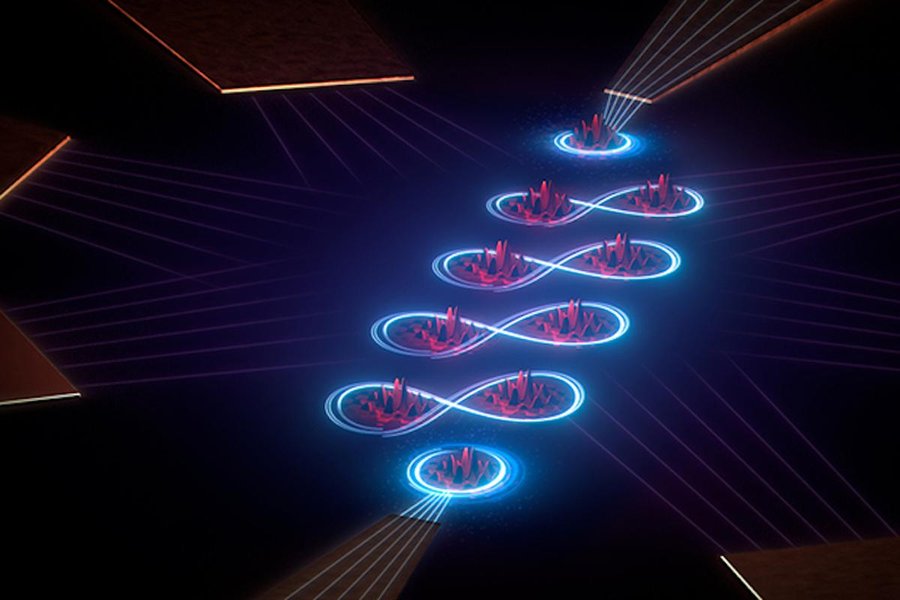
An Atomic-Scale Quantum Circuit
This image showcases the microscopic scale at which quantum circuits operate, highlighting the precision engineering required.
Fabricating the Quantum Core: Precision Engineering
Once a qubit type is chosen, the physical hardware must be fabricated. This process often requires:
- Cleanroom Facilities: Similar to classical semiconductor manufacturing, building qubits (especially superconducting ones) demands environments with extremely low levels of dust and contaminants.
- Specialized Materials: High-purity superconducting metals, specific silicon isotopes, or precisely engineered optical components are needed depending on the qubit type.
- Advanced Fabrication Techniques: Processes like photolithography, etching, and deposition are used to create the intricate structures required at the nanoscale.
- Cryogenic Environments: For technologies like superconducting qubits, powerful dilution refrigerators are essential to cool the quantum processor down to temperatures colder than outer space (typically below 20 milli-Kelvin) to minimize thermal noise and allow superconductivity.
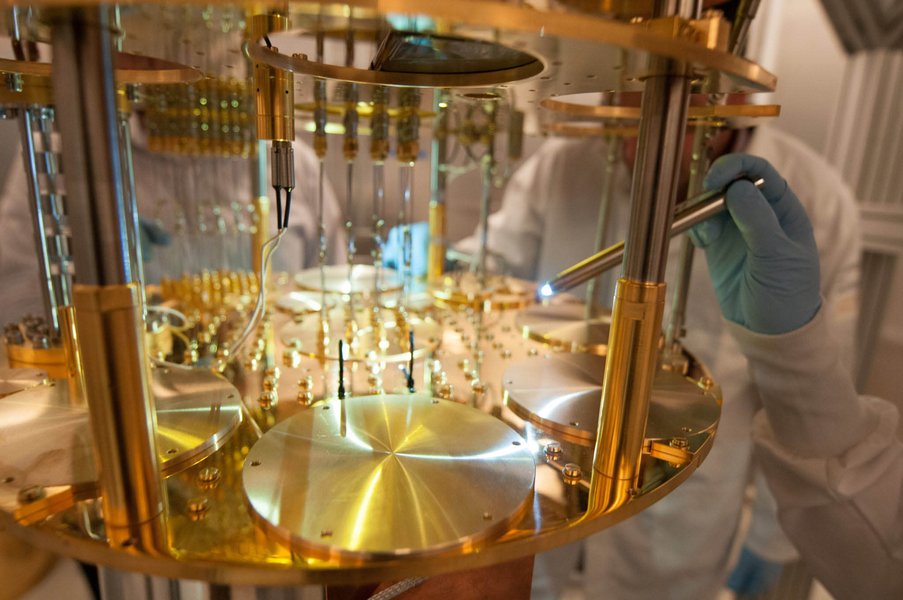
Inside a Dilution Refrigerator
The image displays the complex internal structure of a dilution refrigerator, critical infrastructure for cooling certain types of quantum computers to near absolute zero.
Weaving the Quantum Circuit: Gates and Connections
Individual qubits are not enough; they must be connected and manipulated to perform computations. This involves:
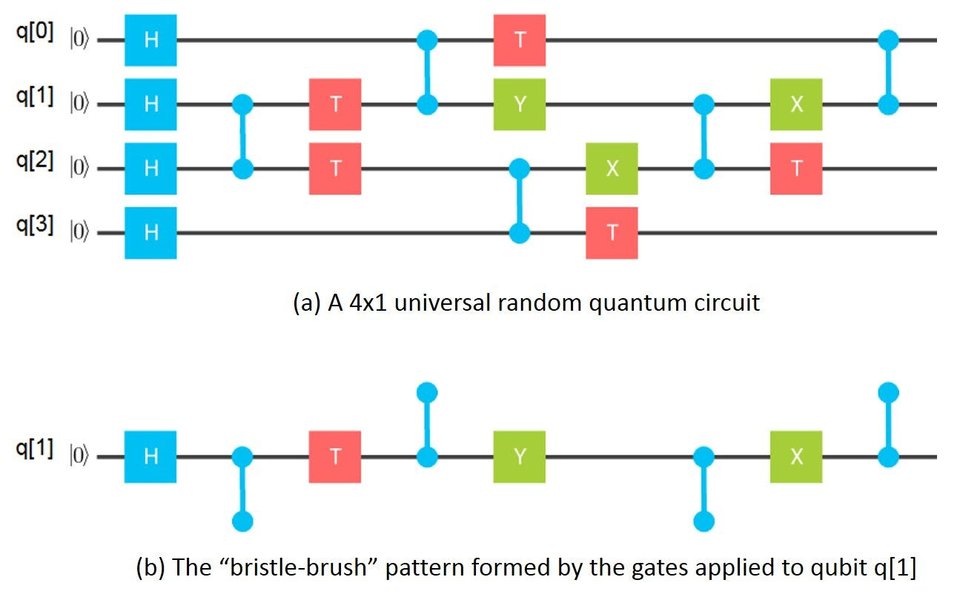
- Quantum Gates: These are the quantum equivalent of classical logic gates (like AND, OR, NOT). They perform specific operations on one or more qubits. Examples include the Hadamard gate (creates superposition) and the CNOT gate (creates entanglement between two qubits). These gates are often implemented using precisely timed microwave pulses (for superconducting qubits) or laser pulses (for trapped ions).
- Quantum Circuits: A sequence of quantum gates applied to a set of qubits constitutes a quantum algorithm or circuit. Designing efficient quantum circuits is a key aspect of quantum programming.
- Connectivity: Qubits need to be physically or effectively linked so that multi-qubit gates can be performed between them. The architecture defining which qubits can interact influences the types of algorithms that can be run efficiently.
Orchestrating the Quantum Symphony: Control Systems
A quantum processor cannot function in isolation. It requires a sophisticated classical control system to:
- Initialize Qubits: Prepare the qubits into a known starting state (usually the |0⟩ state).
- Send Control Signals: Generate and transmit the precise microwave or laser pulses needed to execute quantum gates. This requires high-speed, high-precision electronics.
- Read Out Results: Measure the final state of the qubits after the computation is complete. This measurement collapses the superposition into a classical outcome (0 or 1).
- Process Data: Interpret the classical measurement results and potentially feed them back into subsequent computations or classical processing steps.
- Interface with Users: Provide a way for programmers to define quantum circuits and algorithms, submit them to the hardware, and receive the results.
Uniformity in qubit fabrication is highly desirable, as it reduces the need to customize control signals for each individual qubit, simplifying the overall control challenge.
Taming Quantum Chaos: Error Correction and Decoherence
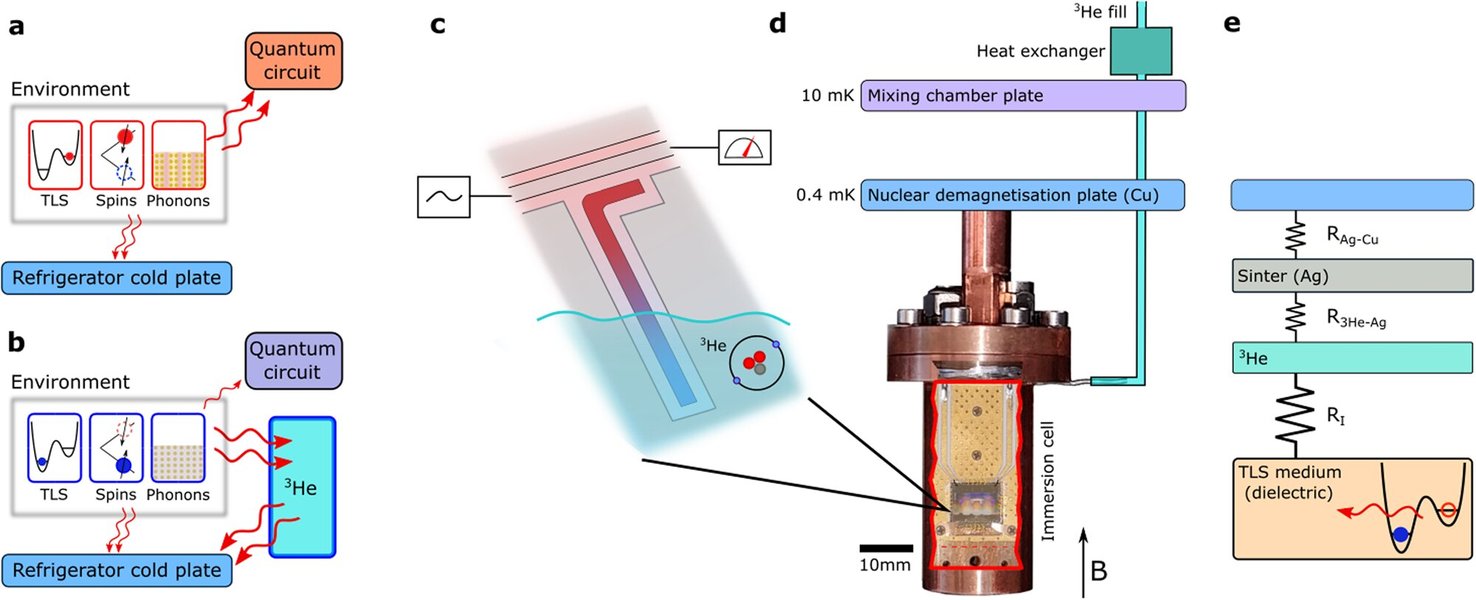
Perhaps the biggest hurdle in building large-scale, fault-tolerant quantum computers is dealing with noise and errors. Qubits are extremely sensitive to their environment.
- Decoherence: Interactions with the surroundings (e.g., thermal vibrations, stray electromagnetic fields) can cause a qubit to lose its quantum properties (superposition and entanglement). This process is called decoherence and limits the time available for computation.
- Gate Errors: Control pulses are never perfectly precise, leading to small errors in the execution of quantum gates.
- Measurement Errors: Reading the state of a qubit is also prone to errors.
To combat these issues, Quantum Error Correction (QEC) is essential. QEC codes, like the surface code or concatenated codes, use multiple physical qubits to encode a single logical (error-protected) qubit. By measuring syndromes (error signatures) on ancillary qubits, errors on the logical qubit can be detected and corrected without disturbing the encoded quantum information. However, QEC significantly increases the overhead, requiring thousands or even millions of physical qubits to create a modest number of highly reliable logical qubits.
Wiring a Quantum Processor
This image illustrates the dense network of connections required to control and measure the qubits on a superconducting quantum chip, hinting at the complexity of the control systems.
Visualizing the Quantum Building Blocks
To better understand the relationships between the core concepts involved in building a quantum computer, the following mindmap outlines the key stages and components discussed.
(Shor's, Grover's)"] id2["2. Qubit Technology Selection"] id2a["Superconducting Qubits"] id2a1["Pros: Scalability, Speed"] id2a2["Cons: Cryogenics, Coherence"] id2b["Trapped Ions"] id2b1["Pros: Coherence, Fidelity"] id2b2["Cons: Speed, Scalability"] id2c["Photonic Qubits"] id2c1["Pros: Networking, Room Temp (potential)"] id2c2["Cons: Generation, Interaction"] id2d["Topological Qubits"] id2d1["Pros: Fault Tolerance (theoretical)"] id2d2["Cons: Experimental Difficulty"] id3["3. Fabrication & Assembly"] id3a["Cleanroom Facilities"] id3b["Specialized Materials"] id3c["Cryogenic Cooling (Dilution Refrigerators)"] id3d["Quantum Gates (Hadamard, CNOT)"] id3e["Quantum Circuits"] id4["4. Control Systems"] id4a["Classical Hardware Interface"] id4b["Precise Signal Generation (Microwave/Laser)"] id4c["Qubit Initialization"] id4d["Measurement & Readout"] id5["5. Overcoming Challenges"] id5a["Decoherence"] id5b["Quantum Error Correction (QEC)"] id5a1["Surface Codes"] id5a2["Logical Qubits"] id5c["Scalability"] id5d["Gate & Measurement Fidelity"] id6["6. Testing & Simulation"] id6a["Classical Simulators"] id6b["Benchmarking Algorithms"]
This mindmap illustrates the interconnected nature of the quantum computer construction process, from fundamental physics principles to complex engineering challenges like fabrication, control, and error correction.
Comparing Qubit Modalities: A Radar Chart Analysis
Choosing the right qubit technology involves balancing various competing factors. The radar chart below provides a qualitative comparison of some leading qubit modalities based on key performance and implementation criteria. Note that these are generalized assessments, and specific implementations can vary significantly. Scores are relative, with higher values generally being more desirable (except for Operating Temperature, where lower is often required but harder).
This chart highlights the trade-offs: Superconducting qubits excel in speed and leverage existing fabrication methods but struggle with coherence and require extreme cold. Trapped ions boast high fidelity and coherence but are slower and harder to scale. Photonic qubits offer potential for networking and room-temperature operation but face challenges in generation and interaction. The "best" choice depends on the specific application and technological maturity.
Key Challenges in Quantum Construction
Building and operating quantum computers involves overcoming significant scientific and engineering hurdles. The table below summarizes some of the most critical challenges:
| Challenge | Description | Impact | Mitigation Strategies |
|---|---|---|---|
| Decoherence | Loss of quantum state (superposition/entanglement) due to environmental interaction (noise, temperature). | Limits computation time and accuracy; causes errors. | Cryogenic cooling, vacuum chambers, electromagnetic shielding, material improvements, QEC. |
| Scalability | Increasing the number of high-quality qubits while maintaining control and connectivity. | Limits the size of problems solvable; increases complexity and error rates. | Improved fabrication techniques, modular architectures, advanced interconnects, architectural innovations. |
| Quantum Error Correction (QEC) | Implementing codes to detect and correct errors without destroying quantum information. | Requires massive qubit overhead (many physical qubits per logical qubit), complex control and measurement. | Development of efficient codes (e.g., surface codes, LDPC codes), improved physical qubit fidelity, fault-tolerant architectures. |
| Control Complexity | Precisely manipulating and measuring large numbers of qubits simultaneously. | Requires sophisticated classical hardware and software, calibration challenges. | Advanced electronics (cryo-CMOS), optimized pulse shaping, machine learning for calibration, improved wiring/interconnects. |
| Cost and Infrastructure | High cost of specialized equipment (dilution refrigerators, lasers, cleanrooms) and operation. | Limits accessibility and widespread development. | Technological advancements reducing component costs, cloud quantum computing platforms, shared research facilities. |
This table underscores that building a useful quantum computer requires tackling challenges across physics, materials science, engineering, and computer science. Progress relies on continuous innovation in all these areas.
Understanding the Quantum Leap: A Beginner's Guide
For a foundational understanding of what quantum computing is and why it's such a transformative field, this video featuring Dr. Talia Gershon from IBM Research provides an excellent overview. It explains the core concepts like qubits, superposition, and entanglement in an accessible way, setting the stage for understanding the complexities involved in building these machines.
Context and Relevance
This video provides essential background knowledge, explaining the fundamental principles that builders of quantum computers must manipulate. It clarifies *why* these machines are different and potentially powerful, highlighting the motivation behind the complex construction efforts described. Understanding these basics is crucial before delving into the specific hardware challenges.
The Reality Check: Can You Build One at Home?
While the enthusiasm for quantum computing is high, and DIY electronics projects are common, building a functional quantum computer—especially one based on leading technologies like superconducting qubits or trapped ions—is currently far beyond the capabilities of a home setup. The search results consistently emphasize this point.
The primary reasons include:
- Extreme Environmental Requirements: Technologies like superconducting qubits need temperatures near absolute zero, requiring expensive and complex dilution refrigerators. Trapped ion systems need sophisticated vacuum chambers and precisely controlled laser systems.
- Specialized Equipment: Access to cleanrooms for fabrication, high-frequency electronics for control, sensitive measurement devices, and powerful lasers are necessary.
- Cost: The components and infrastructure cost millions of dollars.
- Expertise: Building and operating these systems requires deep knowledge across multiple fields, including quantum physics, materials science, electrical engineering, and computer science.
While some conceptual or educational models using simpler principles (like NMR or potentially basic optical setups with a significant budget, as mentioned in one source) might be explored by dedicated hobbyists, they do not possess the computational power or characteristics of the quantum computers being developed by major research labs and companies. For practical experience, using cloud-based quantum computing platforms offered by companies like IBM, Google, Rigetti, and others is the most accessible route for learning and experimentation.
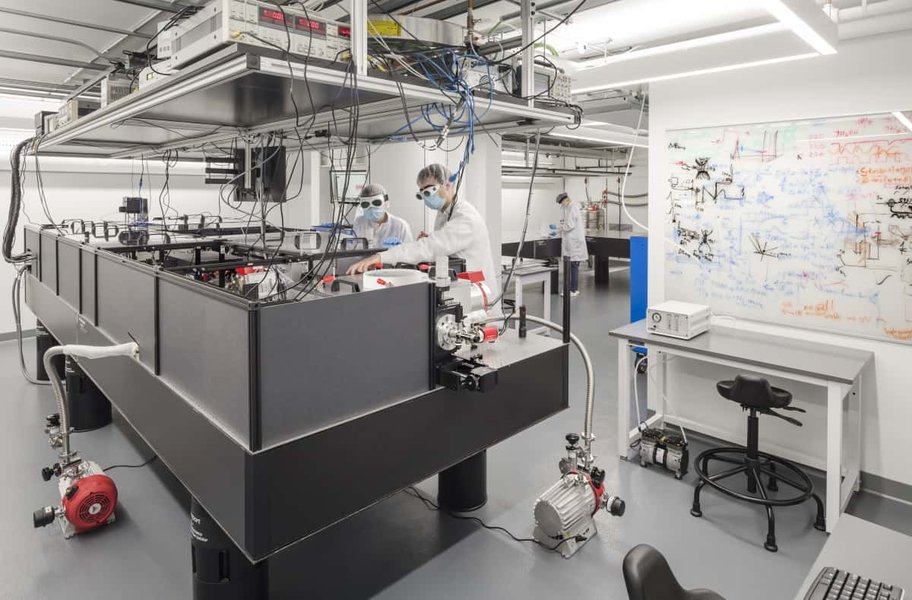
A Glimpse into a Quantum Lab
This image of a quantum science laboratory underscores the complexity and scale of the equipment needed, illustrating why home construction is impractical.
Frequently Asked Questions (FAQ)
What is a qubit?
A qubit, or quantum bit, is the basic unit of quantum information. Unlike a classical bit which can only be 0 or 1, a qubit can be 0, 1, or a superposition of both states simultaneously. This property allows quantum computers to process information in a fundamentally different way.
Why do quantum computers need to be so cold?
Many leading quantum computing technologies, particularly superconducting qubits, require extremely low temperatures (near absolute zero, often below 20 milli-Kelvin). This is necessary to minimize thermal noise (vibrations) that can disrupt the fragile quantum states (decoherence) and to allow the materials used for the qubits to exhibit superconductivity, which is essential for their operation.
What is quantum error correction (QEC)?
Quantum states are very sensitive to noise and errors (decoherence, gate inaccuracies). Quantum Error Correction (QEC) is a set of techniques designed to protect quantum information from these errors. It typically involves encoding the information of a single 'logical' qubit across multiple 'physical' qubits. By performing measurements on auxiliary qubits, errors can be detected and corrected without destroying the primary quantum information, enabling more reliable, fault-tolerant quantum computation.
Can I realistically build a quantum computer at home?
No, building a quantum computer capable of useful computation is not feasible for a home DIY project. The required infrastructure (ultra-low temperatures, vacuum systems, complex laser/microwave control), specialized materials, fabrication facilities (cleanrooms), and deep multidisciplinary expertise are currently only available in well-funded research institutions and corporations. Exploring quantum concepts via cloud platforms or simulators is the accessible way for individuals.
What are quantum simulators used for?
Quantum simulators are typically classical computer programs that emulate the behavior of a quantum computer. They allow researchers and developers to design, test, and debug quantum algorithms and circuits before running them on actual quantum hardware. While simulators are limited by the memory and processing power of classical computers (they cannot efficiently simulate large numbers of qubits), they are invaluable tools for development and education in the quantum computing field.
References
- How to Build A Quantum Computer? Step-by-Step Guide - SpinQ
- Here's a Blueprint for a Practical Quantum Computer - IEEE Spectrum
- Guide to the World of Quantum Qubits: High-Level Guide to Building a Quantum Computer - ResearchGate
- How to Build a Quantum Computer: A Step-by-Step Guide - AITechTrend
- How to build a quantum computer in your house? - Quantum Computing Stack Exchange
- What Is Quantum Computing? - IBM
- A DIY Guide to Building a Quantum Computer - Illinois Science Council
Recommended

 tommywennerstierna.wordpress.com
Last updated April 13, 2025