
Visualizing a Modern Marvel: A Bullet Train's Majestic Journey Across Mountain Bridges
A detailed tapestry of engineering prowess meeting nature's grandeur, envisioning a high-speed rail traversing breathtaking mountain vistas.
While I cannot directly generate an image, I can provide a rich, detailed description of a bullet train traversing a bridge through a mountainous landscape. This vision combines sleek, modern technology with the raw beauty of nature, creating a scene that is both awe-inspiring and dynamic. This description can serve as inspiration for an artist, a graphic designer, or an AI image generation tool.
Scene Highlights: The Essence of the Spectacle
- Technological Elegance: A state-of-the-art bullet train, characterized by its aerodynamic design and high-speed capabilities, serves as the focal point, symbolizing human ingenuity.
- Engineering Grandeur: An imposing bridge structure, a testament to modern engineering, carves a path through challenging mountain terrain, connecting distant points.
- Natural Majesty: The rugged beauty of towering mountains, deep valleys, and lush forests provides a dramatic and awe-inspiring backdrop to the train's journey.
Crafting the Vision: A Detailed Depiction
Imagine a scene where technology and nature coalesce into a breathtaking panorama. Here’s a detailed breakdown of the elements that form this striking image:
The Bullet Train: A Symphony of Speed and Design
The star of our scene is a sleek, aerodynamic bullet train, its form reminiscent of Japan's Shinkansen or the advanced trains planned for projects like India's Mumbai-Ahmedabad High-Speed Rail. Its exterior, perhaps a gleaming white or polished silver with vibrant accent stripes (e.g., blue or red), reflects the ambient light, emphasizing its smooth contours. The train, consisting of multiple interconnected cars (typically 10-16), features large, panoramic windows, offering passengers breathtaking views of the passing landscape. Its pointed nose is designed to minimize air resistance, allowing it to glide effortlessly at speeds potentially reaching 320 km/h (around 200 mph). A subtle motion blur could trail the train, underscoring its incredible velocity as it streaks across the bridge.
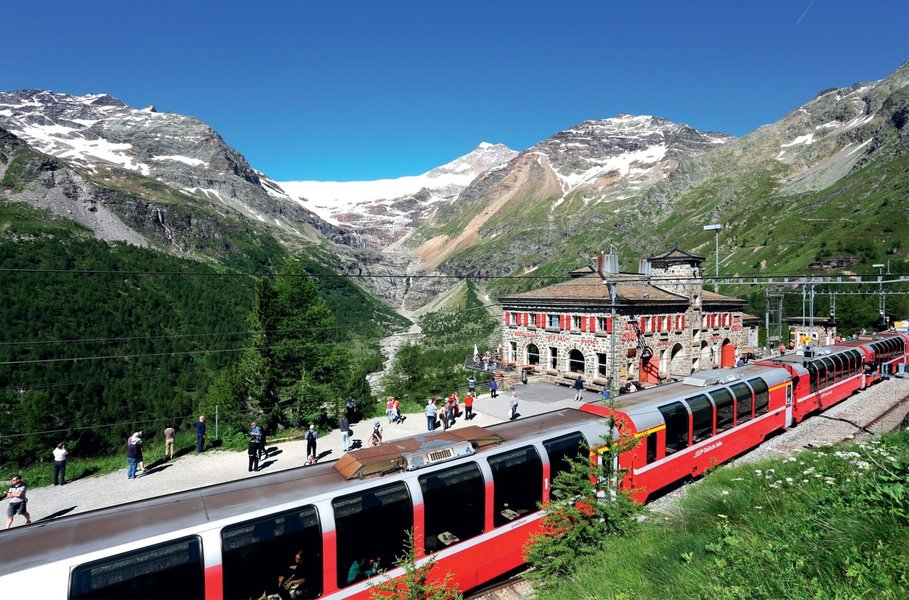
A train traverses a multi-arched viaduct amidst rolling green hills and mountains, illustrative of high-speed rail in scenic landscapes.
The Bridge: An Engineering Marvel Spanning the Abyss
The train travels upon a magnificent bridge, a testament to human engineering scaling challenging terrains. This structure, possibly hundreds of meters long (e.g., 200-280 meters), could be a pre-stressed concrete girder bridge or a soaring steel arch design, similar to those constructed for high-speed rail lines in mountainous regions globally. It spans a deep valley, a wide river, or a rugged gorge with an air of graceful resilience. Tall, sturdy piers, potentially 15-20 meters high, elevate the trackway, allowing the train to maintain its trajectory over uneven ground. The bridge's deck is flawlessly engineered for high-speed travel, perhaps flanked by noise barriers or wind deflectors, ensuring a smooth and safe passage. Its design would appear robust yet elegant, harmonizing with the natural environment while showcasing structural prowess.
The Mountainous Backdrop: Nature's Grand Canvas
The setting is a dramatic mountain range, with towering, jagged peaks that pierce the sky. These mountains, inspired by real-world locations like the European Alps, the Tibetan Plateau, or California's Sierra Nevada, are cloaked in a rich tapestry of vegetation – dense evergreen forests of pine and cedar on the lower slopes, giving way to rocky crags and perhaps even snow-capped summits in the distance. A river might carve its way through the valley floor far below the bridge, its waters reflecting the sky and the fleeting passage of the train. The air might hold a light mist in the valleys, adding depth and atmosphere, with wisps of clouds caressing the higher peaks. The scale of the mountains emphasizes the boldness of the railway engineering project.
Composition and Atmosphere: Capturing the Moment
The overall composition aims to lead the viewer's eye, with the train as the primary moving element drawing focus. The bridge acts as a leading line, guiding the gaze across the chasm and into the vastness of the mountains. Lighting plays a crucial role; consider the warm glow of the golden hour (sunrise or sunset), casting long shadows and highlighting the textures of the mountains and the metallic sheen of the train. The sky could be a clear, vibrant blue, or perhaps dotted with dramatic cloud formations. The scene should evoke a sense of awe, blending the thrill of high-speed travel with the serene grandeur of the natural world, showcasing how human innovation can coexist with, and even accentuate, the beauty of the environment.
Visualizing Key Attributes of the Scene
To better understand the interplay of elements in this imagined scene, the following chart provides an opinionated analysis of its core attributes. These scores reflect the perceived intensity or quality of each aspect within the described visual.
This chart highlights how different facets like the train's advanced technology, the imposing nature of the bridge, and the breathtaking scenery contribute to the overall powerful image. The "Overall Scene Impression" aims for high scores across the board, indicating a balanced and impactful visual experience.
Mapping the Scene's Core Components
The scene of a bullet train crossing a mountain bridge is a composite of several key elements, each with its own distinct characteristics. The mindmap below illustrates the relationships between these components, providing a structured overview of the envisioned spectacle.
This mindmap shows how the central theme branches out into the specifics of the train itself, the impressive bridge it traverses, the majestic mountain environment, and the artistic elements that bring the scene to life.
Real-World Inspirations: High-Speed Rail in Challenging Terrains
The vision of a bullet train conquering mountainous landscapes is not purely fantastical. Numerous high-speed rail projects around the world navigate incredibly challenging terrains, requiring sophisticated engineering for tunnels and bridges. These real-world examples provide tangible context for our imagined scene.
| Project Name / Region | Country/Region | Key Mountainous Features Traversed | Noteworthy Engineering Aspects |
|---|---|---|---|
| Mumbai-Ahmedabad High Speed Rail | India | Varied terrain including hilly areas requiring tunnels and numerous river crossings. | Extensive use of viaducts, river bridges (e.g., over Par, Auranga, Dhadhar rivers), and mountain tunnels. Steel bridges are also integral. |
| California High-Speed Rail | USA | Diablo Range (Pacheco Pass), Tehachapi Mountains, San Gabriel Mountains. | Significant tunneling, construction of numerous viaducts, overcrossings, and complex geological conditions. |
| Lhasa-Nyingchi Railway | Tibet, China | High-altitude Tibetan Plateau, deep valleys like Yarlung Zangbo Grand Canyon. | Numerous tunnels and long-span bridges, operating in extreme altitudes and permafrost regions. |
| Xi'an-Chengdu High-Speed Railway | China | Qinling Mountains. | China's first HSR to traverse a major mountain range, involving extensive tunnels and bridges to manage steep gradients and complex geology. |
| Gotthard Base Tunnel Lines | Switzerland | Swiss Alps. | Features the world's longest railway tunnel, enabling high-speed travel through the heart of the Alps. |
These projects demonstrate that the construction of high-speed railways through mountains, while immensely challenging, is an ongoing reality, pushing the boundaries of civil engineering.
Engineering Marvels: Bridging the Gaps
The construction of railway bridges, especially in mountainous regions for high-speed trains, is a feat of modern engineering. The following video showcases the Chenab Rail Bridge in India, which stands as the world's highest railway bridge, illustrating the scale and complexity involved in such projects. While not exclusively for a bullet train in this video, it provides a stunning example of railway bridge engineering in challenging terrain.
This video provides context on how engineers overcome immense geographical obstacles to create vital transport links. The Chenab Rail Bridge, towering 359 meters above the riverbed, highlights the ambition and capability behind modern infrastructure projects, similar to what would be required for a bullet train traversing a high mountain bridge.
Frequently Asked Questions (FAQ)
How can such a detailed scene be visually created?
Visualizing this scene can be approached in several ways:
- Digital Art & 3D Modeling: Software like Adobe Photoshop (for 2D painting/compositing) or Blender (for 3D modeling and rendering) allows artists to create the scene from scratch, offering full control over details, lighting, and composition.
- AI Image Generation: Tools based on diffusion models (e.g., DALL-E, Midjourney, Stable Diffusion) can generate images from detailed text prompts like the one provided.
- Stock Photography & Photomanipulation: Existing stock photos of bullet trains, bridges, and mountains can be combined and manipulated to create the desired image, though finding perfectly matching elements can be challenging.
What makes the "bullet train on a mountain bridge" concept so compelling?
The appeal of this scene lies in several factors:
- Juxtaposition of Technology and Nature: The sleek, futuristic train against the timeless, rugged mountains creates a powerful visual contrast.
- Scale and Grandeur: Both the train/bridge (as feats of engineering) and the mountains are immense, evoking a sense of awe.
- Speed and Dynamism: The inherent speed of a bullet train adds an element of excitement and motion.
- Symbolism: It can symbolize human progress, the overcoming of obstacles, and the connection of remote areas.
Are there many real-world examples of bullet trains in such dramatic mountainous settings?
Yes, there are numerous examples. Countries like Japan (Shinkansen lines through mountainous regions), China (extensive high-speed network including lines through the Qinling and Tibetan mountains), and several European nations (e.g., lines through the Alps) feature high-speed railways that navigate challenging mountain terrains using impressive bridges and long tunnels. Projects in India (Mumbai-Ahmedabad) and the USA (California HSR) are also designed to cross mountainous areas.
What are the primary engineering challenges in building high-speed rail through mountains?
Constructing high-speed rail in mountainous regions presents significant engineering hurdles:
- Tunneling: Long and deep tunnels are often required to pass through mountains, dealing with complex geology, water ingress, and ventilation.
- Bridge Construction: Building high and long-span bridges over deep valleys or gorges requires specialized techniques and materials to ensure stability for high-speed trains.
- Steep Gradients & Curves: High-speed trains require relatively straight tracks and gentle gradients, which are difficult to achieve in mountains, necessitating extensive earthworks, viaducts, and tunnels.
- Geological Stability: Mountainous areas can be prone to landslides, seismic activity, and difficult soil conditions, requiring careful site assessment and robust construction.
- Environmental Impact: Minimizing the ecological footprint in sensitive mountain environments is a critical consideration.
- Altitude and Climate: High altitudes can affect construction and operation, and extreme weather conditions (snow, ice, high winds) must be accounted for in design.
Recommended Further Exploration
If this topic has piqued your interest, you might want to explore these related queries:
- What are the longest and highest railway bridges in the world?
- Explore the engineering behind China's high-speed rail network through mountainous regions.
- How do Shinkansen trains in Japan navigate mountainous terrain?
- What are the future plans for high-speed rail projects in North America's mountainous areas?
References
The information and inspiration for this description were drawn from various sources discussing bullet trains, bridge engineering, and high-speed rail projects in mountainous terrains. Here are some relevant links:
Last updated May 12, 2025