
Unveiling the Performance of Cablehelp 160 Meter Antennas
A Deep Dive into Their Capabilities and User Experiences on the Top Band
Key Insights into Cablehelp 160 Meter Antennas
- Proven Track Record: Cablehelp has been manufacturing 160-meter antennas for over 19 years, establishing a long-standing presence in the amateur radio community.
- Space-Saving Design: Their "sloper" and "reduced size sloper" models are specifically engineered for limited space applications, making them an excellent choice for operators with smaller properties.
- Positive User Feedback: Many users report excellent performance, low noise, and easy tuning, often achieving impressive contacts even with modest power levels.
When considering an antenna for the 160-meter band, often referred to as the "Top Band," several factors come into play, including available space, desired performance, and ease of installation. Cablehelp, a manufacturer with a history spanning nearly two decades, offers specific antenna solutions for this challenging band, particularly their "sloper" and "reduced size sloper" antennas. These antennas are designed to provide effective operation on 160 meters, even in situations where space is at a premium.
Understanding the Cablehelp 160 Meter Sloper Antenna
Design Philosophy and Key Features
Cablehelp's 160-meter sloper antennas are characterized by their compact design and robust construction. They are marketed as a solution for amateur radio operators who wish to operate on the 160-meter band without the need for extensive horizontal space typically required by full-size dipoles. A full-size 160-meter dipole, for instance, requires approximately 260 feet of horizontal space, which is often impractical for many residential lots.
The sloper antenna design itself involves a wire element that slopes downwards from a high point (such as a tower, pole, or even a tall tree) to a lower point. This configuration can offer advantages in terms of reduced footprint and a more omni-directional radiation pattern, especially when compared to a horizontal dipole installed too close to the ground, which might behave more like a Near Vertical Incidence Skywave (NVIS) antenna, limiting its range for DX (long-distance) contacts.
Construction and Durability
Cablehelp emphasizes the ruggedness of their sloper antennas. They typically feature heavy, 14 AWG insulated wire for both the loading coil and the radiator. An integral SO239 connector and a solid protective cover over the coil are also standard, contributing to the antenna's longevity and ability to withstand various weather conditions. This build quality is consistently praised in user reviews, with many noting the antenna's durability and robust construction.
Antenna hooks, crucial for secure and durable antenna installations.
Ease of Installation and Tuning
A significant selling point of Cablehelp's 160-meter slopers is their purported ease of installation and tuning. The manufacturer states that the antennas are "simple to install and easy to tune," and that they can provide "wide bandwidth" allowing operation across more than half the band without an antenna tuner once trimmed to resonance at a preferred frequency. For optimal performance and to minimize common-mode current on the coax, it's recommended to use a "choke" UNUN (made by coiling 10-15 turns of coax below the antenna) or a commercially built line isolator.
Performance Characteristics on 160 Meters
The 160-meter band presents unique challenges due to its long wavelength (approximately 160 meters or 525 feet). This often necessitates compromises in antenna design, especially for those with limited space. Cablehelp's slopers aim to mitigate these challenges by offering a reduced-size solution.
While full-size antennas generally offer superior performance, shortened antennas like the Cablehelp sloper can still provide effective communication. User reviews suggest that these antennas perform "extremely well" for their size, with some operators reporting less noise and static compared to other vertical antennas. Some users have achieved significant DX contacts (e.g., 4000 miles or more) using these antennas, often with modest power levels (e.g., 100 watts or even QRP – low power). However, it's important to note that efficiency can be a concern with any shortened antenna, and while Cablehelp's slopers perform well, a full-size antenna will theoretically always have an advantage in terms of raw efficiency and low-angle radiation for DX.
Radiation Pattern and Gain
When installed as a sloper, the antenna typically exhibits a mostly omni-directional pattern. This can be beneficial for general-purpose communication, as it allows for contacts in various directions without needing to rotate the antenna. While the gain of shortened antennas is generally lower than full-size counterparts, the practical performance reported by users indicates that the Cablehelp sloper offers a respectable balance of performance and space efficiency. Some reports indicate that the antenna can provide a good low SWR match at resonance, making it easier to tune across the band with a tuner.
This radar chart provides a comparative overview of different 160-meter antenna types across various performance and practical attributes. The Cablehelp 160m Sloper excels in space efficiency and ease of installation, making it a strong contender for those with limited space, while still offering decent DX capability and noise immunity. A full-size dipole, though demanding more space, generally offers superior DX performance. Compact verticals without extensive radial systems are typically less efficient but still viable for limited space.
Comparative Analysis with Other 160-Meter Antennas
Alternative Antennas for the Top Band
While the Cablehelp sloper offers a viable solution for 160 meters, it's beneficial to understand its position relative to other antenna types available for this band.
| Antenna Type | Description | Space Requirement | Efficiency/Performance | Pros | Cons |
|---|---|---|---|---|---|
| Full-Size Dipole | A classic horizontal wire antenna, typically around 260 ft long for 160m. | Very High (approx. 260 ft horizontal) | High efficiency, good for NVIS at low heights, but DX-limited unless very high. | Excellent performance, simple design. | Requires immense space, height critical for DX. |
| Inverted Vee | Similar to a dipole but with arms sloping downwards, typically requiring one tall support. | High (less horizontal than dipole, but still significant) | Good all-around performance, often better for DX than low horizontal dipole. | Easier to fit than a full dipole, good for general use. | Still requires substantial space and height. |
| Vertical Antenna (Full Quarter-Wave) | A vertical element approximately 130 ft tall, requiring an extensive radial ground system. | Medium (tall vertical, large radial field) | Excellent for low-angle DX, but efficiency highly dependent on radial system. | Superb DX performance if well-executed. | Requires very tall support and extensive radial field, complex installation. |
| End-Fed Half-Wave (EFHW) | A single wire antenna fed at one end via an impedance matching transformer. | Variable (can be quite long, or shortened with loading) | Versatile, can be multi-band. Efficiency varies with length and loading. | Simple to deploy, multi-band capability. | Requires matching unit, common-mode issues if not isolated. |
| Magnetic Loop Antenna | A compact, small loop antenna. | Very Low (small footprint) | Low efficiency (0dBi to -20dBi), good for receive, but can be a compromise for transmit. | Extremely compact, low noise on receive. | Very narrow bandwidth, low transmit efficiency, high Q (sharp tuning). |
| Cablehelp 160m Sloper | A shortened, coil-loaded wire antenna sloping from a high point. | Low-Medium (requires 40-50 ft height and 50 ft horizontal) | Good for limited space, generally omni-directional, decent performance with a tuner. | Compact, easy to install, less noise/static reported by users. | Slightly reduced efficiency compared to full-size, may still require tuner. |
This table highlights that while Cablehelp slopers offer a practical solution for limited space, other antenna types exist, each with its own set of trade-offs regarding size, complexity, and performance. For instance, a full-size dipole offers high efficiency but demands significant real estate, while a magnetic loop is extremely compact but inherently less efficient for transmitting.
Performance in Contests
For contest operations on 160 meters, operators often seek antennas that provide strong signals and wide coverage. While a full quarter-wave vertical with an extensive radial field is often considered ideal for DX in contests due to its low take-off angle, a well-installed sloper can still be a competitive option, especially for stations with limited space. The Cablehelp sloper's reported low noise characteristics can also be an advantage in contest environments where weak signals are common.
This video provides a visual overview and discussion of the Cablehelp limited space sloper antenna, offering insights into its physical characteristics and how it can be deployed for amateur radio operations. It's particularly relevant for understanding the practical application of this antenna type.
User Experiences and Reviews
Testimonials from the Ham Radio Community
Reviews for Cablehelp's 160-meter sloper antennas are generally positive across various amateur radio forums and review sites. Many users express surprise at the antenna's performance given its reduced size, often exceeding their initial expectations for a shortened 160-meter antenna.
Common themes in user feedback include:
- Effective Performance: Users report making successful contacts over significant distances, sometimes with power levels as low as 100 watts, and experiencing good signal reports.
- Low Noise: Several reviews highlight the antenna's resistance to noise and static, which is a crucial advantage on the often noisy 160-meter band. This makes for a more enjoyable operating experience, especially for receiving weak signals.
- Build Quality: The rugged construction, including 14 AWG wire and a protective coil cover, is frequently praised for its durability and ability to withstand harsh weather.
- Ease of Use: The straightforward installation process and the antenna's ability to operate across a significant portion of the band with minimal or no tuner intervention (once trimmed) are also appreciated.
Some users have compared the Cablehelp sloper to other antennas they've used, finding it to be a strong performer for its intended purpose of limited-space operations on 160 meters. It's noted that while no shortened antenna can fully replicate the performance of a full-size counterpart, the Cablehelp sloper provides a very good compromise for getting on the air on the Top Band.
Considerations Before Purchase
Factors to Keep in Mind
While Cablehelp 160-meter antennas receive favorable reviews, potential buyers should consider a few factors to ensure it meets their specific needs:
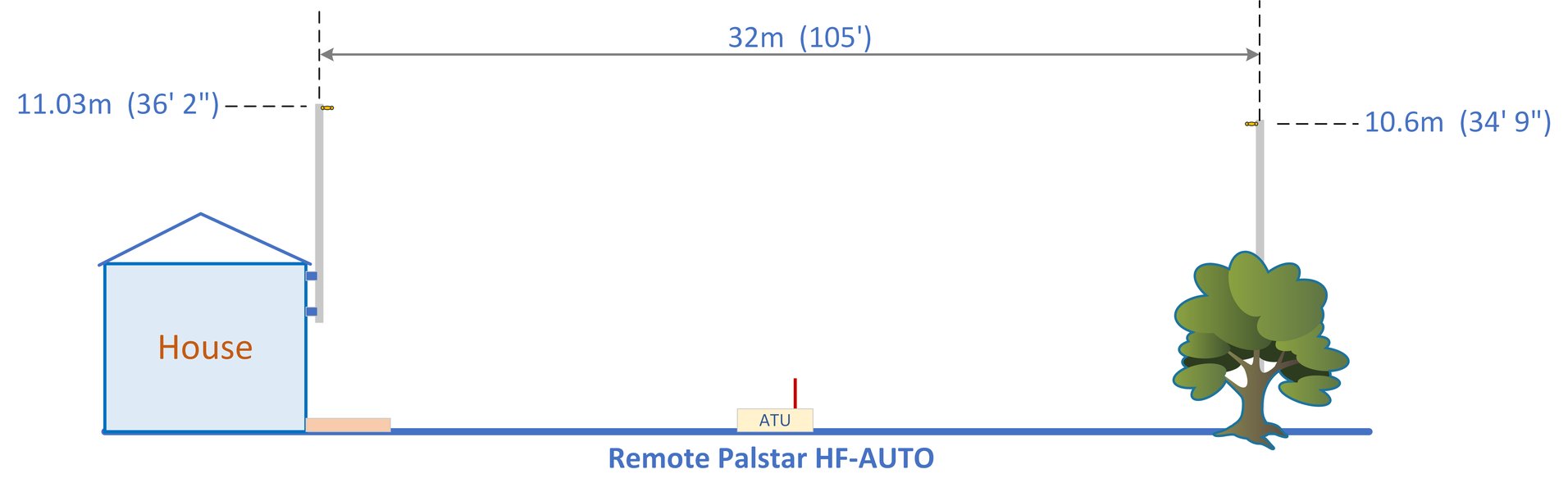
- Space Availability: Although it's a "reduced size" antenna, it still requires some space. Cablehelp suggests a minimum of 40-50 feet of height and about 50 feet of horizontal space. Users with extremely limited space might need to explore even more compact options like magnetic loops.
- Tuner Requirement: While the antenna boasts wide bandwidth, some users may still need an antenna tuner, especially if they wish to operate across the entire 160-meter band or optimize SWR at specific frequencies.
- Radial System: The manufacturer states that ground radials are "rarely needed" with this antenna, though they can improve performance. For a truly optimized vertical component, a radial system is often recommended, but the sloper design minimizes this dependency.
Overall, the Cablehelp 160-meter antennas, particularly their sloper models, appear to be a solid choice for amateur radio operators looking to get on the 160-meter band with practical space constraints. Their long-standing presence, positive user feedback, and emphasis on ruggedness and ease of installation make them a reputable option in the market.
Frequently Asked Questions
What is a 160-meter sloper antenna?
How much space does a Cablehelp 160-meter sloper antenna require?
Do Cablehelp 160-meter antennas require a tuner?
Are Cablehelp antennas durable?
What is "Top Band" in amateur radio?
Conclusion
Based on extensive user feedback and product descriptions, Cablehelp's 160-meter antennas, particularly their sloper designs, are a highly regarded option for amateur radio operators. They effectively address the common challenge of limited space for 160-meter operation by providing a compact yet robust solution. Users consistently praise their performance, ease of installation, and durability. While no shortened antenna can perfectly replicate the efficiency of a full-size counterpart, Cablehelp offers a pragmatic and well-performing compromise, enabling many hams to successfully get on the "Top Band" and enjoy long-distance communications.
Recommended Further Exploration
- Explore the impact of antenna height on 160m DX performance.
- Delve deeper into the differences between vertical and dipole antennas for 160m.
- Learn more about constructing an effective ground radial system for Top Band antennas.
- Understand the considerations for selecting an antenna tuner for the 160-meter band.
References

Last updated May 21, 2025