

Highlights of Calculus Essentials
- Mastering Composite Functions and Roots: Understand how to combine functions and efficiently locate the zeros of polynomial expressions using various algebraic techniques.
- Demystifying Derivatives: Grasp the essence of differentiation, from its foundational definition to practical applications using product, quotient, and logarithmic rules.
- Analyzing Function Behavior: Learn to interpret first and second derivatives to pinpoint intervals of increase/decrease, local extrema, concavity, and inflection points.
This comprehensive guide delves into core calculus problems, providing detailed, step-by-step solutions for each. We will explore composite functions, methods for finding polynomial roots, the definition and rules of differentiation, and the analysis of function behavior through concavity and local extrema. Each section offers multiple approaches to problem-solving, ensuring a thorough understanding of the underlying principles.
Decoding Function Composition and Polynomial Roots
In this section, we tackle the intricacies of combining functions and identifying the crucial points where a polynomial function crosses the x-axis.
Unraveling Composite Functions: (f∘g)(x)
The composition of two functions, denoted as \((f \circ g)(x)\), means applying function \(g\) first, and then applying function \(f\) to the result of \(g(x)\). It can be expressed as \(f(g(x))\).
Problem: Given \(f(x) = \frac{x}{x-2}\) and \(g(x) = \frac{x}{x+2}\), find \((f \circ g)(x)\).
Method 1: Direct Substitution and Simplification
Substitute \(g(x)\) into \(f(x)\):
\[(f \circ g)(x) = f(g(x)) = f\left(\frac{x}{x+2}\right) = \frac{\frac{x}{x+2}}{\frac{x}{x+2} - 2}\]To simplify, first address the denominator:
\[\frac{x}{x+2} - 2 = \frac{x}{x+2} - \frac{2(x+2)}{x+2} = \frac{x - 2x - 4}{x+2} = \frac{-x - 4}{x+2}\]Now, substitute this back into the composite function expression:
\[(f \circ g)(x) = \frac{\frac{x}{x+2}}{\frac{-x - 4}{x+2}} = \frac{x}{x+2} \times \frac{x+2}{-x - 4} = \frac{x}{-x - 4} = -\frac{x}{x+4}\]Method 2: Multiplying by the Common Denominator
Alternatively, to simplify the complex fraction, multiply the numerator and the denominator by \((x+2)\), which is the common denominator of the inner fractions:
\[(f \circ g)(x) = \frac{\frac{x}{x+2}}{\frac{x}{x+2} - 2} \cdot \frac{(x+2)}{(x+2)} = \frac{x}{x - 2(x+2)} = \frac{x}{x - 2x - 4} = \frac{x}{-x - 4} = -\frac{x}{x+4}\]Both methods yield the same simplified result, demonstrating the flexibility in algebraic manipulation.
Locating the Zeros of a Polynomial Function
Finding the zeros of a function means identifying the values of \(x\) for which \(f(x) = 0\).
Problem: Find the zeros for the function \(f(x) = 3x^3 + 12x^2 + 12x\).
Method 1: Factoring by Greatest Common Factor (GCF) and Perfect Square Trinomial
Set \(f(x) = 0\):
\[3x^3 + 12x^2 + 12x = 0\]First, factor out the greatest common factor, which is \(3x\):
\[3x(x^2 + 4x + 4) = 0\]Notice that the quadratic expression inside the parentheses, \(x^2 + 4x + 4\), is a perfect square trinomial, which can be factored as \((x+2)^2\):
\[3x(x+2)^2 = 0\]Now, set each factor equal to zero to find the roots:
- \(3x = 0 \Rightarrow x = 0\)
- \((x+2)^2 = 0 \Rightarrow x+2 = 0 \Rightarrow x = -2\)
Thus, the zeros of the function are \(x = 0\) and \(x = -2\) (with multiplicity 2).
Method 2: Factoring and Quadratic Formula
Start by factoring out \(x\):
\[x(3x^2 + 12x + 12) = 0\]From this, one zero is clearly \(x=0\). For the other zeros, solve the quadratic equation \(3x^2 + 12x + 12 = 0\). First, simplify by dividing by 3:
\[x^2 + 4x + 4 = 0\]This is the same quadratic from Method 1. We can solve it using the quadratic formula, \(x = \frac{-b \pm \sqrt{b^2 - 4ac}}{2a}\), where \(a=1\), \(b=4\), \(c=4\):
\[x = \frac{-4 \pm \sqrt{4^2 - 4(1)(4)}}{2(1)} = \frac{-4 \pm \sqrt{16 - 16}}{2} = \frac{-4 \pm 0}{2} = -2\]The zeros are \(x=0\) and \(x=-2\). This confirms the results from the first method.
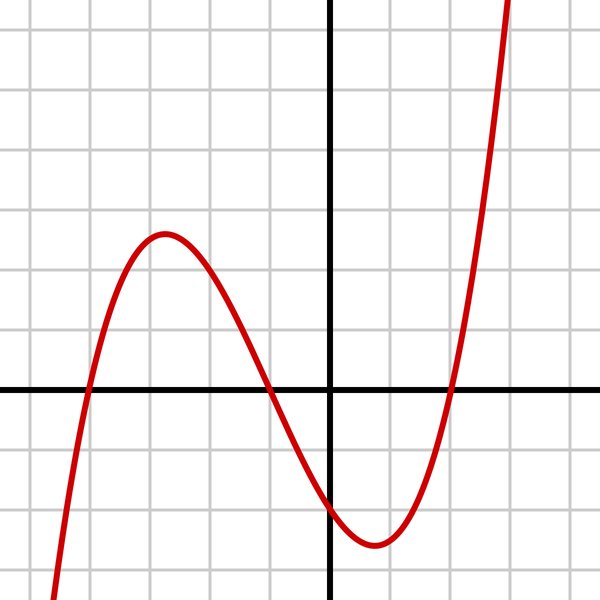
Example of a cubic function graph, illustrating how it can intersect the x-axis at multiple points (zeros).
The Essence of Differentiation: From Definition to Rules
This section explores the concept of the derivative, beginning with its fundamental definition as a limit and progressing to practical differentiation rules for various function types.
Derivative via the Limit Definition
The derivative of a function \(f(x)\) from its definition is given by:
\[f'(x) = \lim_{h \to 0} \frac{f(x+h) - f(x)}{h}\]Problem: Use the definition of the derivative to compute the derivative for the function \(f(x) = \frac{1}{x^2}\).
Method 1: Applying the Limit Definition
First, find \(f(x+h)\):
\[f(x+h) = \frac{1}{(x+h)^2}\]Substitute into the limit definition:
\[f'(x) = \lim_{h \to 0} \frac{\frac{1}{(x+h)^2} - \frac{1}{x^2}}{h}\]Find a common denominator for the terms in the numerator:
\[= \lim_{h \to 0} \frac{\frac{x^2 - (x+h)^2}{x^2(x+h)^2}}{h}\]Expand \((x+h)^2 = x^2 + 2xh + h^2\):
\[= \lim_{h \to 0} \frac{\frac{x^2 - (x^2 + 2xh + h^2)}{x^2(x+h)^2}}{h} = \lim_{h \to 0} \frac{\frac{-2xh - h^2}{x^2(x+h)^2}}{h}\]Multiply by the reciprocal of \(h\) and factor out \(h\) from the numerator:
\[= \lim_{h \to 0} \frac{h(-2x - h)}{h \cdot x^2(x+h)^2} = \lim_{h \to 0} \frac{-2x - h}{x^2(x+h)^2}\]Now, substitute \(h=0\) into the expression:
\[f'(x) = \frac{-2x - 0}{x^2(x+0)^2} = \frac{-2x}{x^4} = -\frac{2}{x^3}\]Method 2: Verification using the Power Rule
Although the problem specifically asks for the definition, we can verify the result using the power rule. Rewrite \(f(x) = \frac{1}{x^2}\) as \(f(x) = x^{-2}\). The power rule states that if \(f(x) = x^n\), then \(f'(x) = nx^{n-1}\).
\[f'(x) = -2x^{-2-1} = -2x^{-3} = -\frac{2}{x^3}\]This confirms the result obtained from the limit definition, showcasing the efficiency of differentiation rules once the fundamental concept is understood.
This video explains how to calculate a derivative using the limit definition, providing valuable context for the problem above.
Applying Differentiation Rules
For more complex functions, direct application of the limit definition becomes cumbersome. This is where differentiation rules like the chain rule, product rule, and quotient rule become invaluable.
Problem 1: Differentiate \(F(x) = \frac{1}{x^3+3x}\)
Method 1: Using the Quotient Rule
The quotient rule for a function \(F(x) = \frac{u(x)}{v(x)}\) is \(F'(x) = \frac{u'(x)v(x) - u(x)v'(x)}{(v(x))^2}\).
Here, let \(u(x) = 1\) and \(v(x) = x^3+3x\).
Then \(u'(x) = 0\) and \(v'(x) = 3x^2+3\).
Method 2: Using the Chain Rule (rewriting the function)
Rewrite \(F(x)\) as \(F(x) = (x^3+3x)^{-1}\). The chain rule states that if \(F(x) = [u(x)]^n\), then \(F'(x) = n[u(x)]^{n-1} \cdot u'(x)\).
Here, \(u(x) = x^3+3x\) and \(n = -1\). So, \(u'(x) = 3x^2+3\).
Both methods yield the same derivative, demonstrating that selecting the appropriate rule can simplify the differentiation process.
Problem 2: Differentiate \(G(x) = (2x^4-x+1)(-x^5+1)\)
Method 1: Using the Product Rule
The product rule for a function \(G(x) = u(x)v(x)\) is \(G'(x) = u'(x)v(x) + u(x)v'(x)\).
Let \(u(x) = 2x^4-x+1\) and \(v(x) = -x^5+1\).
Then \(u'(x) = 8x^3-1\) and \(v'(x) = -5x^4\).
Expand and simplify:
\[G'(x) = (-8x^8 + 8x^3 + x^5 - 1) + (-10x^8 + 5x^5 - 5x^4)\] \[G'(x) = -8x^8 - 10x^8 + x^5 + 5x^5 - 5x^4 + 8x^3 - 1\] \[G'(x) = -18x^8 + 6x^5 - 5x^4 + 8x^3 - 1\]Method 2: Expanding the Product First, then Differentiating
First, expand \(G(x)\):
\[G(x) = (2x^4-x+1)(-x^5+1)\] \[G(x) = -2x^9 + 2x^4 + x^6 - x - x^5 + 1\]Now, differentiate term by term using the power rule:
\[G'(x) = \frac{d}{dx}(-2x^9 + 2x^4 + x^6 - x - x^5 + 1)\] \[G'(x) = -18x^8 + 8x^3 + 6x^5 - 1 - 5x^4\]Rearrange the terms to match the previous result:
\[G'(x) = -18x^8 + 6x^5 - 5x^4 + 8x^3 - 1\]Both methods confirm the derivative. While expanding first might seem longer for this specific problem, it's a valid approach and can be simpler for expressions that are easier to expand.
Analyzing Function Behavior: Increase, Decrease, and Concavity
Understanding the first and second derivatives allows us to determine critical features of a function's graph, such as where it rises or falls, its local peaks and valleys, and its curvature.
Intervals of Increase/Decrease and Local Extrema
To determine intervals of increase or decrease and locate local extrema, we use the first derivative, \(f'(x)\).
Step 1: Find the first derivative and critical points.
\[f'(x) = \frac{d}{dx}(-x^3 + 6x^2 - 9x + 1) = -3x^2 + 12x - 9\]Set \(f'(x) = 0\) to find critical points:
\[-3x^2 + 12x - 9 = 0\]Divide by -3:
\[x^2 - 4x + 3 = 0\]Factor the quadratic equation:
\[(x-1)(x-3) = 0\]The critical points are \(x=1\) and \(x=3\).
Step 2: Use a sign chart for \(f'(x)\) to determine behavior.
We test points in the intervals defined by the critical points: \((-\infty, 1)\), \((1, 3)\), and \((3, \infty)\).
| Interval | Test Value (x) | \(f'(x) = -3(x-1)(x-3)\) | Sign of \(f'(x)\) | Behavior of \(f(x)\) |
|---|---|---|---|---|
| \((-\infty, 1)\) | 0 | \(-3(0-1)(0-3) = -9\) | Negative | Decreasing |
| \((1, 3)\) | 2 | \(-3(2-1)(2-3) = 3\) | Positive | Increasing |
| \((3, \infty)\) | 4 | \(-3(4-1)(4-3) = -9\) | Negative | Decreasing |
Conclusion:
- \(f(x)\) is decreasing on \((-\infty, 1)\) and \((3, \infty)\).
- \(f(x)\) is increasing on \((1, 3)\).
Local Extrema:
- At \(x=1\), \(f'(x)\) changes from negative to positive, indicating a local minimum. \(f(1) = -(1)^3 + 6(1)^2 - 9(1) + 1 = -1 + 6 - 9 + 1 = -3\). Local minimum at \((1, -3)\).
- At \(x=3\), \(f'(x)\) changes from positive to negative, indicating a local maximum. \(f(3) = -(3)^3 + 6(3)^2 - 9(3) + 1 = -27 + 54 - 27 + 1 = 1\). Local maximum at \((3, 1)\).
Concavity and Inflection Points
To determine concavity and find inflection points, we use the second derivative, \(f''(x)\).
Step 1: Find the second derivative and potential inflection points.
\[f''(x) = \frac{d}{dx}(-3x^2 + 12x - 9) = -6x + 12\]Set \(f''(x) = 0\) to find potential inflection points:
\[-6x + 12 = 0 \Rightarrow -6x = -12 \Rightarrow x = 2\]Step 2: Use a sign chart for \(f''(x)\) to determine concavity.
We test points in the intervals defined by the potential inflection point: \((-\infty, 2)\) and \((2, \infty)\).
| Interval | Test Value (x) | \(f''(x) = -6x + 12\) | Sign of \(f''(x)\) | Concavity |
|---|---|---|---|---|
| \((-\infty, 2)\) | 0 | \(-6(0) + 12 = 12\) | Positive | Concave Up |
| \((2, \infty)\) | 3 | \(-6(3) + 12 = -6\) | Negative | Concave Down |
Conclusion:
- The graph of \(f(x)\) is concave up on \((-\infty, 2)\).
- The graph of \(f(x)\) is concave down on \((2, \infty)\).
Inflection Point:
An inflection point occurs where the concavity changes. This happens at \(x=2\).
Calculate \(f(2)\):
\[f(2) = -(2)^3 + 6(2)^2 - 9(2) + 1 = -8 + 24 - 18 + 1 = -1\]The inflection point is at \((2, -1)\).
Tangents and Logarithms: Advanced Differentiation Techniques
This section explores finding tangent lines to implicitly defined curves and using logarithmic differentiation for complex functions, showcasing advanced calculus tools.
Equation of the Tangent Line
To find the equation of a tangent line to a curve at a given point, we need two things: the coordinates of the point and the slope of the tangent line at that point. The slope is found by evaluating the derivative at the given point.
Problem: Find an equation of the tangent line to \(\sqrt{x} + \sqrt{y} = 7\) at the point \(P(9, 16)\).
Method 1: Implicit Differentiation
Since \(y\) is implicitly defined as a function of \(x\), we use implicit differentiation. Differentiate both sides of the equation with respect to \(x\):
\[\frac{d}{dx}(\sqrt{x}) + \frac{d}{dx}(\sqrt{y}) = \frac{d}{dx}(7)\] \[\frac{1}{2\sqrt{x}} + \frac{1}{2\sqrt{y}} \cdot \frac{dy}{dx} = 0\]Now, solve for \(\frac{dy}{dx}\):
\[\frac{1}{2\sqrt{y}} \cdot \frac{dy}{dx} = -\frac{1}{2\sqrt{x}}\] \[\frac{dy}{dx} = -\frac{2\sqrt{y}}{2\sqrt{x}} = -\frac{\sqrt{y}}{\sqrt{x}}\]Evaluate the derivative at the point \(P(9, 16)\) to find the slope \(m\):
\[m = \left.\frac{dy}{dx}\right|_{(9,16)} = -\frac{\sqrt{16}}{\sqrt{9}} = -\frac{4}{3}\]Now, use the point-slope form of a linear equation, \(y - y_1 = m(x - x_1)\), with \((x_1, y_1) = (9, 16)\) and \(m = -\frac{4}{3}\):
\[y - 16 = -\frac{4}{3}(x - 9)\] \[y - 16 = -\frac{4}{3}x + \frac{4}{3} \cdot 9\] \[y - 16 = -\frac{4}{3}x + 12\] \[y = -\frac{4}{3}x + 28\]Method 2: Solving for \(y\) Explicitly (if possible)
In some cases, it's possible to solve for \(y\) explicitly and then differentiate. For this equation:
\[\sqrt{y} = 7 - \sqrt{x}\] \[y = (7 - \sqrt{x})^2\]Now, differentiate \(y\) with respect to \(x\) using the chain rule and power rule:
\[\frac{dy}{dx} = 2(7 - \sqrt{x})^{1} \cdot \frac{d}{dx}(7 - \sqrt{x})\] \[\frac{dy}{dx} = 2(7 - \sqrt{x}) \cdot \left(-\frac{1}{2\sqrt{x}}\right)\] \[\frac{dy}{dx} = -\frac{7 - \sqrt{x}}{\sqrt{x}} = - \frac{7}{\sqrt{x}} + 1\]Evaluate at \(x=9\):
\[m = -\frac{7}{\sqrt{9}} + 1 = -\frac{7}{3} + 1 = -\frac{7}{3} + \frac{3}{3} = -\frac{4}{3}\]The slope is the same. The rest of the process to find the equation of the tangent line is identical to Method 1.
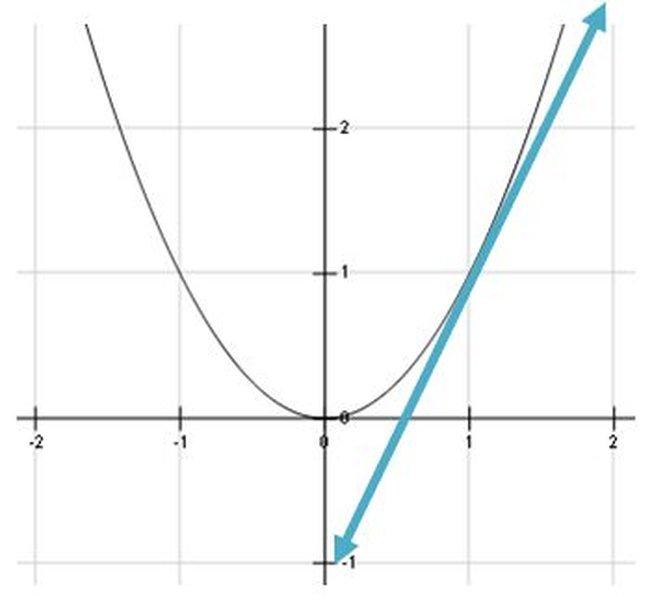
An illustration of a tangent line touching a curve at a single point, representing the instantaneous rate of change.
Logarithmic Differentiation
Logarithmic differentiation is a powerful technique particularly useful for functions involving products, quotients, and powers, especially when the base and exponent are both functions of \(x\).
Problem: Using logarithmic differentiation to find \(f'(x)\) if \(f(x) = \frac{(2x-3)^2}{\sqrt{x+1}(7x+2)^3}\).
Step 1: Take the natural logarithm of both sides.
\[\ln(f(x)) = \ln\left(\frac{(2x-3)^2}{\sqrt{x+1}(7x+2)^3}\right)\]Step 2: Use logarithm properties to expand the right side.
Recall the properties: \(\ln(AB) = \ln A + \ln B\), \(\ln(\frac{A}{B}) = \ln A - \ln B\), and \(\ln(A^n) = n\ln A\).
\[\ln(f(x)) = \ln((2x-3)^2) - \ln(\sqrt{x+1}(7x+2)^3)\] \[\ln(f(x)) = 2\ln(2x-3) - \left[\ln((x+1)^{1/2}) + \ln((7x+2)^3)\right]\] \[\ln(f(x)) = 2\ln(2x-3) - \left[\frac{1}{2}\ln(x+1) + 3\ln(7x+2)\right]\] \[\ln(f(x)) = 2\ln(2x-3) - \frac{1}{2}\ln(x+1) - 3\ln(7x+2)\]Step 3: Differentiate both sides with respect to \(x\).
Remember that \(\frac{d}{dx}(\ln(u)) = \frac{u'}{u}\).
\[\frac{1}{f(x)} f'(x) = 2 \cdot \frac{d}{dx}(\ln(2x-3)) - \frac{1}{2} \cdot \frac{d}{dx}(\ln(x+1)) - 3 \cdot \frac{d}{dx}(\ln(7x+2))\] \[\frac{f'(x)}{f(x)} = 2 \cdot \frac{2}{2x-3} - \frac{1}{2} \cdot \frac{1}{x+1} - 3 \cdot \frac{7}{7x+2}\] \[\frac{f'(x)}{f(x)} = \frac{4}{2x-3} - \frac{1}{2(x+1)} - \frac{21}{7x+2}\]Step 4: Solve for \(f'(x)\).
\[f'(x) = f(x) \left(\frac{4}{2x-3} - \frac{1}{2(x+1)} - \frac{21}{7x+2}\right)\]Substitute the original expression for \(f(x)\) back into the equation:
\[f'(x) = \frac{(2x-3)^2}{\sqrt{x+1}(7x+2)^3} \left(\frac{4}{2x-3} - \frac{1}{2(x+1)} - \frac{21}{7x+2}\right)\]This method significantly simplifies the differentiation process compared to directly applying the quotient and product rules to the original complex function.
This mindmap provides a structured overview of all the calculus concepts and problem-solving methods discussed in this guide. Each node represents a key topic or technique, branching out to the specific methods employed.
Frequently Asked Questions About Calculus Operations
What is the significance of critical points in calculus?
Why is logarithmic differentiation useful?
How can I tell if a function is concave up or concave down?
What does multiplicity of a root mean?
Conclusion
The problems presented in this guide cover fundamental aspects of differential calculus, from understanding function composition and finding polynomial roots to mastering various differentiation techniques and analyzing function behavior. By applying the definition of the derivative, product and quotient rules, chain rule, implicit differentiation, and logarithmic differentiation, one can effectively tackle a wide array of calculus challenges. The analysis of first and second derivatives provides profound insights into a function's increasing/decreasing intervals, local extrema, and concavity, which are essential for graphing and understanding the global properties of functions. Proficiency in these areas forms a strong foundation for further exploration in calculus and its applications in diverse scientific and engineering fields.
Recommended Further Exploration
- How do critical points and inflection points define the shape of a cubic function's graph?
- What are the real-world applications of derivatives beyond mathematical problems?
- Can implicit differentiation be used for higher-order derivatives or more complex equations?
- How do Taylor and Maclaurin series extend the concept of approximating functions with derivatives?