
Unveiling the Integration Challenges in Cambridge Maths 9709 Paper 32 (May/June 2025)
An insight into the expected integration topics and techniques based on syllabus guidelines and expert predictions for the recent examination.
While the precise wording of individual questions from the Cambridge International AS & A Level Mathematics 9709 Paper 32 (Pure Mathematics 3) for the May/June 2025 examination series is not publicly released until a later date by Cambridge International, we can provide a comprehensive overview of the integration topics that were highly anticipated and align with the syllabus and available preparatory materials. This analysis is based on syllabus requirements, trends from past papers, and insights from guess papers and educational resources.
Key Highlights: Integration Focus for 9709 Paper 32
- Core Function Types: Expect questions centering on the integration of exponential, rational (often involving partial fractions), and trigonometric functions, as these form a significant part of the Pure Mathematics 3 syllabus.
- Essential Techniques: Mastery of integration techniques such as integration by substitution and integration by parts is crucial, as problems often require a strategic application of these methods.
- Applications and Definite Integrals: A strong emphasis is typically placed on definite integration, including its application to find areas under curves, areas between curves, and potentially volumes of revolution.
Syllabus Context: Integration in Pure Mathematics 3 (9709/32)
The Cambridge International AS & A Level Mathematics 9709 syllabus for Paper 32 (Pure Mathematics 3) dedicates a significant portion to calculus, with integration being a cornerstone. Section 3.5 of the syllabus specifically outlines the expected knowledge and skills:
3.5 Integration
3.5.1 Integration of Standard Functions
Candidates are expected to be proficient in integrating a variety of functions, including:
- Exponential functions, such as \( \int e^{ax+b} \, dx \)
- Logarithmic functions (resulting from integrating functions like \( \frac{1}{ax+b} \))
- Trigonometric functions, including \( \int \sin(ax+b) \, dx \), \( \int \cos(ax+b) \, dx \), \( \int \sec^2(ax+b) \, dx \)
- Rational functions where decomposition into partial fractions is often a preliminary step. For example, integrating expressions of the form \( \frac{Px+Q}{(ax+b)(cx+d)} \) or \( \frac{Px^2+Qx+R}{(ax+b)(cx^2+d)} \).
Key Integration Techniques
The syllabus emphasizes the application of several key integration techniques:
- Integration by Substitution: Used to simplify integrals by changing the variable of integration. This is often required for composite functions or to transform an integral into a standard form.
- Integration by Parts: Essential for integrating products of functions, using the formula \( \int u \frac{dv}{dx} \, dx = uv - \int v \frac{du}{dx} \, dx \). This is commonly applied to integrals involving products of algebraic functions with exponential, logarithmic, or trigonometric functions.
- Use of Trigonometric Identities: Simplifying trigonometric integrals often requires the use of identities such as \( \sin^2 x = \frac{1-\cos 2x}{2} \), \( \cos^2 x = \frac{1+\cos 2x}{2} \), or product-to-sum formulas before integration.
Definite Integration and Applications
A significant focus is placed on definite integrals and their applications, including:
- Evaluating definite integrals to find exact numerical values.
- Calculating the area of a region bounded by a curve and lines parallel to the axes, or between two curves.
- Potentially, finding volumes of revolution, though this is sometimes more emphasized in further mathematics options.
- Application to problems in geometry and kinematics may also arise, connecting integration to other areas of the syllabus.
Anticipated Integration Question Characteristics for May/June 2025
Based on guess papers, past paper analysis, and user discussions surrounding the May/June 2025 exam period, the integration question(s) in Paper 32 likely tested a combination of the above syllabus points. Resources such as GCEALevelMaths9709.com and PapaCambridge, which provide guess papers and topical past papers, consistently highlight these areas.
Likely Focus Areas
- Complex Rational Functions: Questions often involve integrating rational expressions that first require decomposition into partial fractions. This tests algebraic skill alongside integration.
- Trigonometric Integrals Requiring Identities: Students might encounter integrals like \( \int \sin^2 x \cos x \, dx \) (substitution) or \( \int \sin^2 x \, dx \) (identity).
- Integration by Parts (Possibly Iterated): Problems could involve functions like \( x e^x \), \( x \sin x \), or \( e^x \cos x \), sometimes requiring the technique to be applied more than once or in conjunction with other methods.
- Definite Integrals Involving Limits or Parameters: Finding areas or evaluating definite integrals where the limits might involve parameters or lead to results involving \( \ln \) or \( e \).
- Combined Concepts: Some questions integrate concepts, for example, finding the area under a curve defined by a function that itself requires a specific integration technique like parts or substitution. User discussions sometimes allude to questions (e.g., "Q10. Integration" in some forum discussions for recent sittings) that require a multi-step approach.
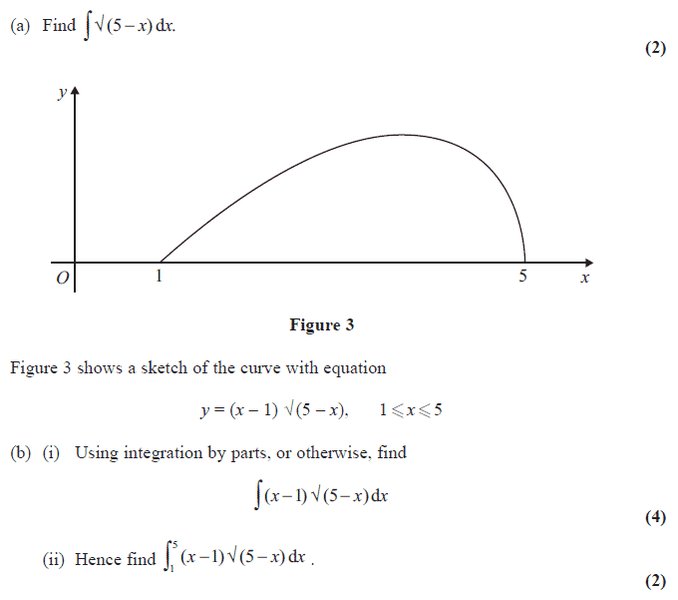
An illustrative example of an A-Level integration question, typically involving finding areas using definite integrals with trigonometric functions.
Visualizing Emphasis of Integration Topics in Paper 32
To provide a conceptual overview of how different integration aspects might be weighted or emphasized in terms of complexity and frequency in Cambridge A-Level Maths Paper 32, the following radar chart offers a visual representation. This is an illustrative interpretation based on general trends and syllabus importance, not specific data from the 2025 exam.
This chart suggests that techniques like Integration by Parts and dealing with Rational Functions via Partial Fractions are often perceived as complex and highly emphasized, alongside the application of definite integrals to solve problems like area calculation.
Mindmap of Integration Concepts for 9709 Paper 32
The following mindmap illustrates the interconnectedness of various integration topics, techniques, and applications relevant to the Pure Mathematics 3 paper. It provides a structured overview of what students are expected to master.
This mindmap visually organizes the breadth of the integration topic, showing how standard function integration, various techniques, and applications all contribute to a comprehensive understanding required for the exam.
Table of Key Integration Aspects for 9709 Paper 32
This table summarizes the primary types of functions, essential techniques, and common applications related to integration in Pure Mathematics 3.
| Category | Specific Examples / Description | Commonly Tested Aspects |
|---|---|---|
| Types of Functions | Exponential (e.g., \( e^{kx} \), \( a^x \)) Rational (e.g., \( \frac{P(x)}{Q(x)} \)) Trigonometric (e.g., \( \sin kx, \cos kx, \sec^2 kx, \tan x \)) Functions involving logarithms (as results or parts of by-parts) |
Recognizing standard forms, applying correct method for each type. |
| Integration Techniques | Substitution (direct or reverse) Integration by Parts (single or multiple applications) Partial Fractions (for rational functions) Use of Trigonometric Identities |
Choosing the appropriate technique, algebraic manipulation, careful execution of the steps. |
| Definite Integrals | Evaluation between limits Integrals involving \( \pi, e, \ln \) |
Correct substitution of limits, handling of constants, exact answers. |
| Applications | Area under a curve Area between two curves Connection to differential equations (finding particular solutions) |
Setting up the correct integral, interpreting the geometric meaning, solving for unknowns. |
Video Insights: Predicted Questions for May/June 2025
For further insights into the types of questions, including integration, that were anticipated for the May/June 2025 examination series for Paper 32, the following video discusses predicted questions. Such resources often analyze past trends and syllabus requirements to forecast potential exam content.
This video discusses predicted questions for the CIE A Level Maths 9709 Paper 32 May/June 2025 exam, which can offer perspective on expected integration topics.
Frequently Asked Questions (FAQ)
What are the core integration techniques for Paper 32?
The primary integration techniques you must be comfortable with for Paper 32 (Pure Mathematics 3) are:
- Integration of standard functions: This includes polynomials, \( \frac{1}{x} \), \( e^{ax} \), \( \sin(ax) \), \( \cos(ax) \), and \( \sec^2(ax) \).
- Integration by substitution: Used to simplify integrals by changing the variable.
- Integration by parts: Essential for integrating products of functions (e.g., \( x e^x \), \( x \ln x \), \( e^x \sin x \)).
- Integration of rational functions using partial fractions: This involves decomposing a rational function into simpler fractions before integrating.
- Using trigonometric identities: To simplify trigonometric integrands, for example, using \( \cos 2A \) identities to integrate \( \sin^2 x \) or \( \cos^2 x \), or product-to-sum formulae.
Where can I find practice questions for 9709 Paper 32 integration?
Excellent sources for practice questions include:
- Official Cambridge International Past Papers: These are the most authentic source. Look for Paper 32 from previous years.
- Topical Past Papers: Websites like PapaCambridge compile past paper questions by topic, allowing you to focus specifically on integration.
- Textbooks endorsed by Cambridge: These usually contain numerous practice exercises and exam-style questions.
- Online resources and revision sites: Platforms like GCEALevelMaths9709.com and ExamSolutions offer worked examples, tutorials, and sometimes guess papers or practice sets.
Are applications of integration, like finding areas, important for this paper?
Yes, absolutely. Applications of definite integration are a key component of Paper 32. You should be prepared for questions that require you to:
- Calculate the area of a region bounded by a curve and the x-axis or y-axis.
- Find the area of a region enclosed between two curves.
- Potentially, calculate volumes of revolution formed by rotating a region about one of the axes (though this is sometimes less frequent than area problems).
These application questions often require you to first correctly set up the definite integral(s) and then evaluate them accurately.
What types of functions are most commonly integrated in Paper 32?
The Cambridge 9709 Paper 32 syllabus emphasizes integration of:
- Exponential functions: Typically of the form \( e^{kx} \) or \( a^{kx} \).
- Rational functions: These often require decomposition into partial fractions before integration. Pay attention to linear factors, repeated linear factors, and irreducible quadratic factors in the denominator.
- Trigonometric functions: Including \( \sin(ax) \), \( \cos(ax) \), \( \sec^2(ax) \), and combinations that might require identities (e.g., \( \sin^2 x \), \( \cos^2 x \), products like \( \sin x \cos x \)).
- Integrals leading to logarithmic functions, such as \( \int \frac{f'(x)}{f(x)} dx = \ln|f(x)| + C \).
Questions frequently combine these, for instance, integrating a product of an algebraic function and an exponential function using integration by parts.
Recommended Further Exploration
- Explore a detailed breakdown of integration by parts examples relevant to Cambridge A-Level Maths 9709.
- Learn effective strategies for approaching partial fraction decomposition specifically for integration problems in Pure Maths 3.
- Discover common mistakes students make in definite integration questions on Cambridge 9709 Paper 32 and how to avoid them.
- Understand how to proficiently use trigonometric identities to simplify and solve complex integrals encountered in A-Level Mathematics.
References
 crackalevel.wordpress.com
Last updated May 6, 2025