
Carbon Nanocrystal-Based Composites: Advancements and Applications
Exploring the forefront of materials science with carbon nanocrystals
Key Takeaways
- Enhanced Mechanical and Thermal Properties: Carbon nanocrystals significantly improve the strength and thermal stability of composite materials.
- Versatile Applications: These composites are pivotal in diverse fields including energy storage, aerospace, and electronics.
- Challenges in Dispersion and Scalability: Uniform distribution of nanocrystals and large-scale production remain critical hurdles.
Introduction to Carbon Nanocrystal-Based Composites
Carbon nanocrystal-based composites represent a pivotal advancement in materials science, amalgamating the exceptional properties of carbon nanocrystals with various matrices to create materials with superior performance characteristics. These composites leverage the unique structural and functional attributes of carbon nanocrystals, such as high mechanical strength, thermal conductivity, and electrical conductivity, to enhance the properties of the host material. The integration of carbon nanocrystals into polymeric, ceramic, or metallic matrices has opened new avenues for innovation across multiple industries.
Types of Carbon Nanocrystal-Based Composites
Carbon Nanotube and Graphene Oxide Composites
These composites incorporate carbon nanotubes (CNTs) and graphene oxide within a matrix, often enhanced with additional nanocrystals such as SmMn2O5. The synergy between CNTs and graphene oxide results in improved catalytic activity, especially for applications like NO oxidation. Carbon nanotubes are particularly effective at lower temperatures, while graphene oxide maintains activity at elevated temperatures, making this combination versatile for various catalytic processes.
Carbon-Coated Cr2O3 Composites
Carbon-coated chromium oxide (Cr2O3) composites are primarily used as anodes in electrochemical applications. These composites are synthesized through hydrothermal reactions followed by annealing, which optimizes the carbon content to enhance stability and performance. The carbon coating provides a conductive layer that improves electron transfer, making these composites suitable for high-performance electrochemical devices.
Cellulose Nanocrystal-Coated Carbon Fiber Composites
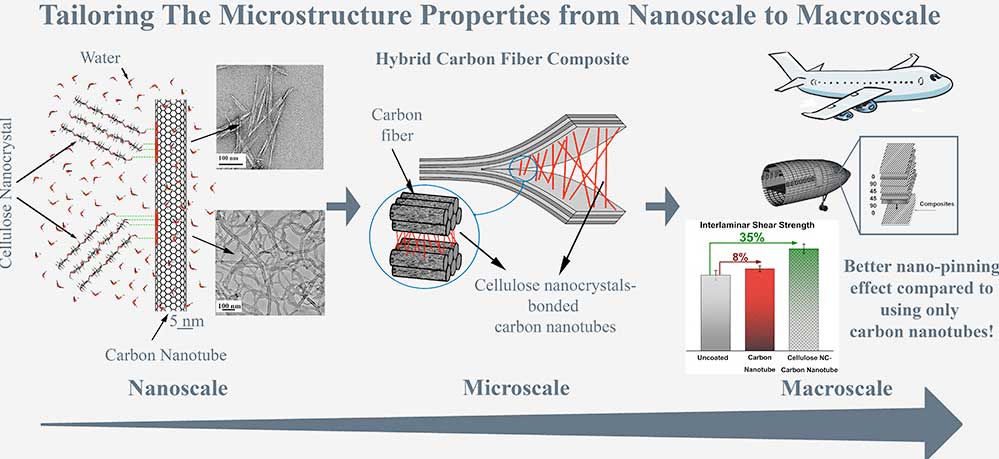
Incorporating cellulose nanocrystals (CNCs) to coat carbon fibers addresses the common issue of uneven dispersion of carbon nanotubes within the composite. CNCs enable a uniform coating and pinning of carbon nanotubes onto carbon fibers, thereby significantly enhancing the tensile strength and overall mechanical performance of the composite. This hybrid approach not only improves the structural integrity but also contributes to the versatility of the material in various structural applications.
Properties of Carbon Nanocrystal-Based Composites
Mechanical Strength
The inclusion of carbon nanocrystals, such as CNTs and graphene oxide, substantially enhances the mechanical properties of composites. These nanocrystals act as reinforcing agents that increase the flexural and shear strength of the material. Additionally, the uniform distribution facilitated by CNCs ensures that the load is evenly transferred across the composite, thereby improving overall durability and resistance to mechanical stress.
Thermal Stability and Conductivity
Carbon nanocrystals possess high thermal conductivity, which imparts excellent thermal stability to the composites. This property is crucial for applications that involve high-temperature environments, as it allows the material to dissipate heat efficiently. The integration of carbon-coated Cr2O3, for instance, not only improves thermal stability but also enhances the composite’s ability to withstand thermal cycling without degradation.
Electrical Conductivity
One of the standout properties of carbon nanocrystal-based composites is their enhanced electrical conductivity. The conductive nature of CNTs and graphene oxide facilitates efficient electron transfer within the composite, making these materials ideal for use in electronic and optoelectronic devices. This property is particularly beneficial for applications such as high-performance sensors, conductive polymers, and energy storage systems.
Optical and Electronic Properties
Beyond mechanical and thermal enhancements, carbon nanocrystals contribute unique optical and electronic properties to composites. For instance, graphene quantum dots can impart photonic functionalities, allowing the composite to be used in advanced optoelectronic applications. The crystalline structure of these nanocrystals enables specific interactions with light and electrons, broadening the scope of potential applications.
Manufacturing Techniques
Hydrothermal Reaction and Annealing
This method is primarily used for creating carbon-coated Cr2O3 composites. The process involves the reaction of ammonium chromate with sucrose under hydrothermal conditions, followed by carbonization through annealing. This technique allows precise control over the carbon content, optimizing the composite’s stability and electrochemical performance.
Hand-Paste Method
Employed in the preparation of hybrid cellulose nanocrystal-bonded carbon nanotubes/carbon fiber polymer composites, the hand-paste method involves manually mixing the components to ensure uniform distribution. This technique is particularly useful for tensile testing and evaluating the performance of the composite, allowing for adjustments to be made based on mechanical feedback.
Solution Blending and Melt Mixing
These techniques are fundamental in integrating carbon nanocrystals into polymeric matrices. Solution blending involves dissolving both the matrix and the nanocrystals in a solvent, followed by mixing and solvent evaporation. Melt mixing, on the other hand, involves physically mixing the nanocrystals into the molten polymer. Both methods aim to achieve a homogeneous dispersion of nanocrystals to maximize the composite’s properties.
Chemical Vapor Deposition and Laser Ablation
For the synthesis of high-purity carbon nanocrystals, methods like chemical vapor deposition (CVD) and laser ablation are employed. CVD involves decomposing hydrocarbon gases at high temperatures to deposit carbon atoms onto a substrate, forming nanocrystals with controlled size and shape. Laser ablation uses high-energy laser beams to vaporize a carbon source, allowing precise formation of nanocrystalline structures.
Applications of Carbon Nanocrystal-Based Composites
Catalysis
Carbon nanocrystal-based composites play a significant role in catalysis, particularly in the oxidation of nitrogen oxides (NOx). The combination of CNTs and graphene oxide with SmMn2O5 nanocrystals enhances catalytic activity, making these composites effective in low and high-temperature environments. This application is crucial for environmental remediation and industrial processes where efficient catalysis is required.
Energy Storage
In the realm of energy storage, these composites are instrumental in developing advanced battery technologies. Carbon-coated Cr2O3 composites are used as anodes in lithium-ion batteries, offering improved performance and stability. The high surface area and excellent electrochemical properties of carbon nanocrystals contribute to higher energy densities and longer battery lifespans.
Structural Materials
The aerospace, automotive, marine, and defense industries benefit immensely from the use of carbon nanocrystal-based composites. These materials provide lightweight yet strong alternatives to traditional composites, enabling the design of structures that are both robust and efficient. The incorporation of CNCs ensures uniform dispersion of nanocrystals, enhancing the mechanical properties without adding significant weight.
Electronic and Optoelectronic Devices
The enhanced electrical conductivity of these composites makes them suitable for high-performance electronic applications. They are used in the fabrication of sensors, conductive polymers, and optoelectronic devices where efficient electron transfer and thermal management are essential. The ability to integrate optical functionalities through carbon quantum dots further broadens their application scope.
Biomedical Applications
Carbon nanocrystal-based composites, particularly those incorporating nanodiamonds, are explored for biomedical uses such as drug delivery systems, bioimaging, and implants. Their biocompatibility and chemical inertness make them ideal for medical applications where material interactions with biological systems must be carefully controlled.
Challenges and Future Directions
Uniform Dispersion of Nanocrystals
Achieving a consistent and uniform distribution of carbon nanocrystals within the host matrix remains a primary challenge. Agglomeration of nanocrystals can lead to inconsistent properties and reduced performance. The use of cellulose nanocrystals has shown promise in facilitating uniform dispersion, but further research is needed to optimize these methods for large-scale production.
Scalability of Manufacturing Processes
While laboratory-scale synthesis and fabrication techniques have demonstrated the potential of carbon nanocrystal-based composites, scaling these processes to industrial levels presents significant challenges. Developing cost-effective and scalable manufacturing methods is crucial for the widespread adoption of these advanced materials in commercial applications.
Interface Engineering
Optimizing the interfacial interactions between carbon nanocrystals and the matrix is essential for maximizing the composite’s performance. Surface functionalization and coating of nanocrystals enhance bonding and load transfer, but achieving the right balance without compromising other material properties requires ongoing research and development.
Long-Term Stability and Environmental Impact
Ensuring the long-term stability of carbon nanocrystal-based composites is vital, particularly for applications in harsh environments. Additionally, assessing the environmental impact and potential health risks associated with nanomaterials is necessary to ensure safe and sustainable use. Research efforts are focused on developing composites that maintain their properties over time while minimizing any adverse effects on the environment and human health.
Enhanced Properties in Composites
Mechanical Enhancements
The integration of carbon nanocrystals such as carbon nanotubes and graphene oxide leads to significant improvements in mechanical strength, including increased flexural and shear strength. Cellulose nanocrystals aid in the even distribution of these nanocrystals, ensuring that the mechanical load is adequately distributed across the composite, thereby preventing weak points and enhancing overall durability.
Thermal and Electrical Properties
Carbon nanocrystals inherently possess high thermal conductivity, which when integrated into composites, facilitates efficient heat dissipation. This property is particularly beneficial for applications requiring thermal management, such as electronic devices. Additionally, the electrical conductivity is enhanced, making these composites suitable for use in conductive applications and energy storage systems where efficient electron flow is critical.
Optical Properties
The unique optical properties of certain carbon nanocrystals, such as graphene quantum dots, enable composites to be used in optoelectronic applications. These composites can interact with light in controlled ways, making them suitable for use in sensors, display technologies, and other photonic devices.
Applications in Detail
Energy Storage Systems
Advanced battery technologies, particularly lithium-ion batteries, have benefited from the incorporation of carbon nanocrystal-based composites. Carbon-coated Cr2O3 anodes exhibit enhanced charge-discharge cycles, higher energy densities, and improved longevity compared to traditional anode materials. This advancement is crucial for electric vehicles and portable electronic devices that demand high-performance energy storage solutions.
Aerospace and Automotive Industries
The aerospace and automotive sectors require materials that are both lightweight and exceptionally strong. Carbon nanocrystal-based composites meet these requirements, offering significant reductions in weight without compromising structural integrity. This results in improved fuel efficiency, increased payload capacities, and enhanced overall performance of vehicles and aircraft.
Environmental Remediation
Composites with enhanced catalytic properties are utilized in environmental remediation efforts, particularly in the oxidation of harmful pollutants such as nitrogen oxides. The high catalytic activity of carbon nanocrystal-based composites ensures efficient pollutant degradation, contributing to cleaner air and compliance with environmental regulations.
Biomedical Engineering
In biomedical engineering, the biocompatibility and mechanical robustness of carbon nanocrystal-based composites make them suitable for applications like prosthetics, implants, and drug delivery systems. Their ability to integrate seamlessly with biological tissues and provide mechanical support while minimizing adverse reactions is highly valuable in medical applications.
Manufacturing Challenges and Innovations
Achieving Uniform Dispersion
Uniform dispersion of carbon nanocrystals within the matrix is critical for ensuring consistent properties throughout the composite. Techniques such as surface functionalization and the use of assisting nanomaterials like cellulose nanocrystals have shown efficacy in preventing agglomeration and promoting even distribution. Innovations in manufacturing techniques continue to evolve, aiming to improve dispersion methods for better composite performance.
Cost-Effective and Scalable Production
The high cost of synthesizing carbon nanocrystals and fabricating composites on a large scale remains a barrier to widespread adoption. Research is focused on developing more economical synthesis routes and scalable fabrication methods that maintain the quality and properties of the nanocrystals while reducing production costs. Advances in automation and process optimization are key areas of development.
Enhanced Interface Engineering
Optimizing the interface between carbon nanocrystals and the host matrix is essential for maximizing the benefits of the composite. Techniques such as surface functionalization and the use of coupling agents enhance the interfacial bonding, ensuring efficient stress transfer and improved mechanical properties. Ongoing research aims to fine-tune these interfaces to further enhance composite performance.
Future Directions
Advanced Functionalization Techniques
Future research is likely to explore more sophisticated functionalization techniques to further enhance the compatibility and bonding between carbon nanocrystals and various matrices. These advancements will enable the design of composites with tailored properties for specific applications, expanding the utility of carbon nanocrystal-based materials.
Integration with Renewable Technologies
There is growing interest in integrating carbon nanocrystal-based composites with renewable energy technologies. These materials can play a crucial role in the development of more efficient solar panels, wind turbine components, and energy storage systems, contributing to the advancement of sustainable energy solutions.
Biodegradable and Environmentally Friendly Composites
As environmental concerns become increasingly prominent, the development of biodegradable and environmentally friendly composites is a key focus. Carbon nanocrystals derived from renewable sources, such as cellulose nanocrystals from recycled wood pulp, offer a sustainable approach to composite manufacturing, reducing the environmental footprint of these advanced materials.
Conclusion
Carbon nanocrystal-based composites stand at the forefront of materials science, offering a unique combination of enhanced mechanical, thermal, and electrical properties. Their versatile applications across diverse industries—from energy storage and aerospace to biomedical engineering and environmental remediation—demonstrate their significant potential. However, challenges such as achieving uniform dispersion, scaling manufacturing processes, and optimizing interfacial interactions must be addressed to fully realize their capabilities. Ongoing research and innovation are paving the way for more efficient, cost-effective, and sustainable composites, heralding a new era of advanced material applications.
References
| Composite Type | Carbon Nanocrystals Used | Main Properties Enhanced | Key Applications |
|---|---|---|---|
| Carbon Nanotube and Graphene Oxide | Carbon Nanotubes, Graphene Oxide | Mechanical Strength, Catalytic Activity | Catalysis, Electronics |
| Carbon-Coated Cr2O3 | Carbon-Coated Chromium Oxide | Electrical Conductivity, Stability | Energy Storage, Electrochemical Devices |
| Cellulose Nanocrystal-Coated Carbon Fiber | Cellulose Nanocrystals, Carbon Nanotubes | Tensile Strength, Uniform Dispersion | Structural Materials, Aerospace |
| Hybrid Composites | Carbon Nanotubes, Cellulose Nanocrystals | Mechanical Robustness, Sustainability | Aerospace, Automotive, Marine |
Last updated February 15, 2025