
Unlocking the Power of Catalysis: Transforming Reactions Across Industries
Discover how catalysts drive efficiency and innovation in chemical processes
Key Insights and Takeaways
- Enhanced Efficiency in Reactions: Catalysts lower activation energy, speeding up reactions.
- Diverse Industrial Applications: From environmental cleanup to pharmaceutical synthesis, catalysis is ubiquitous.
- Sustainability and Economic Impact: Better reaction conditions lead to both environmental and cost benefits.
Overview of Catalysis and Its Impact
Catalysis is a process of increasing the rate of a chemical reaction through the addition of a catalyst—a substance that is not consumed during the reaction. By providing an alternative reaction pathway and significantly lowering the activation energy necessary to drive the reaction, catalysts help accomplish reactions more efficiently and selectively. This transformative process is utilized heavily across many domains ranging from petrochemical refining, environmental remediation, pharmaceutical synthesis, to food processing.
The applications of catalysis are vast and varied. In the petrochemical industry, catalysts are essential for processes like hydrocracking and reforming, transforming heavy crude oils into valuable fuels such as gasoline and diesel. In environmental applications, catalysts minimize harmful emissions by converting pollutants into less dangerous substances; a notable example being the catalytic converters in automobiles. In pharmaceuticals, catalysts yield highly selective reactions that allow for the creation of complex chiral molecules, which are vital for drug synthesis.
Additionally, catalysis plays a significant role in sustainable energy production. Processes like water splitting for hydrogen generation and biomass conversion significantly rely on catalysts to produce renewable fuels efficiently. Catalysts are also applied in food processing, where enzymes, as natural biological catalysts, enhance processes such as fermentation, improving product yield and quality.
Applications of Catalysis with Detailed Reaction Examples
1. Environmental Applications
Automotive Catalytic Converters
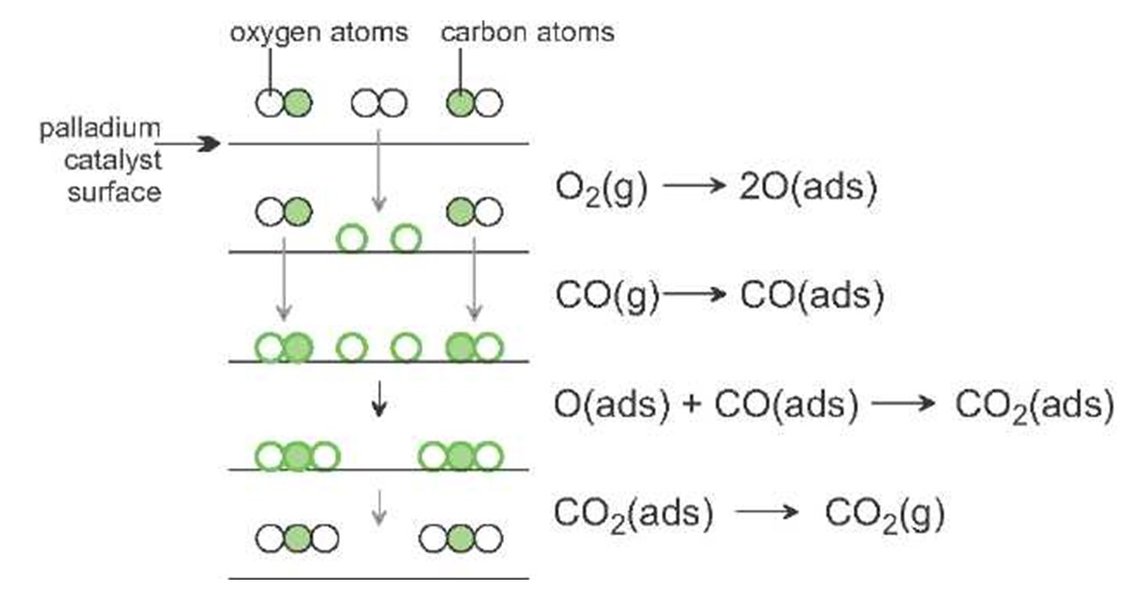
Automotive catalytic converters use precious metals like platinum, palladium, and rhodium to convert harmful exhaust gases into less harmful emissions. For instance, a simplified conversion reaction is:
\( 2 \text{CO} + 2 \text{NO} \rightarrow 2 \text{CO}_2 + \text{N}_2 \)
This process is critical for reducing pollutants such as carbon monoxide and nitrogen oxides from car exhaust, thereby contributing to better air quality. Environmental catalysis also extends into wastewater treatment, where catalysts help break down complex organic molecules.
2. Petrochemical Industry
Cracking, Reforming, and Hydrocracking
In the petroleum refining process, catalysis is employed to break down heavy hydrocarbons into lighter, more useful fractions. Zeolites and platinum-based catalysts are often used in these processes for their high selectivity and stability. For example:
\( \text{C}_{12}\text{H}_{26} \xrightarrow{\text{zeolite catalyst}} \text{C}_2\text{H}_4 + \text{C}_6\text{H}_{14} + \text{C}_4\text{H}_{10} \)
This reaction describes a catalytic cracking process that converts larger molecules into smaller, commercially viable hydrocarbons used as gasoline, diesel fuels, and other chemical feedstocks.
3. Pharmaceutical Synthesis
Enantioselective Hydrogenation
In the pharmaceutical industry, catalysts facilitate the synthesis of complex active pharmaceutical ingredients (APIs) with precise stereo- and regio-selectivity. An example involves the asymmetric hydrogenation of α-keto acids to produce chiral alcohols:
\( \text{RCOCH}_2\text{COOH} + \text{H}_2 \xrightarrow{\text{transition metal catalyst}} \text{RCH(OH)COOH} \)
This reaction, which uses catalysts like rhodium or palladium complexes, is fundamental for manufacturing drugs where chirality affects the efficacy and safety of the final product.
4. Food Industry and Biotechnology
Enzymatic Catalysis in Food Processing
Enzymes act as natural catalysts in various food processes. For example, the isomerization of glucose to fructose by glucose isomerase is crucial in the production of high-fructose corn syrup:
\( \text{C}_6\text{H}_{12}\text{O}_6 \xrightarrow{\text{glucose isomerase}} \text{C}_6\text{H}_{12}\text{O}_6 \text{ (fructose)} \)
Additionally, catalysis is instrumental in fermentation processes that produce bread, beer, cheese, and other fermented foods, ensuring consistent product quality and improving production efficiency.
5. Sustainable Energy and Chemical Synthesis
Hydrogen Production and Ammonia Synthesis
In sustainable energy applications, catalysts facilitate reactions like water splitting, which is crucial for hydrogen production:
\( 2 \text{H}_2\text{O} \xrightarrow{\text{catalyst}} 2 \text{H}_2 + \text{O}_2 \)
Another key application is the Haber-Bosch process in ammonia synthesis, critical for fertilizer production:
\( \text{N}_2 + 3 \text{H}_2 \xrightarrow{\text{Fe catalyst}} 2 \text{NH}_3 \)
These sustainable processes leverage the catalytic conversion of abundant compounds into valuable resources, contributing to renewable energy solutions and modern agriculture.
Integrating Catalysis Reactions: Visual Representations
Mindmap Overview
The following diagram represents a simplified mindmap highlighting major applications of catalysis and the interconnected nature of these pathways.
This mindmap enables a clear visualization of how catalysis interlinks a variety of industries and technical processes.
Radar Chart Analysis
The radar chart below reflects opinionated analyses on various factors such as Efficiency, Selectivity, Sustainability, Economic Impact, and Versatility across different catalytic applications. Each dataset reflects a category: Environmental, Petrochemical, and Pharmaceutical.
Catalysis Reaction Processes: A Comparative Table
The table below compares key industries where catalysis is applied, including the type of catalyst used, typical reactions, and primary benefits observed:
| Industry | Catalyst Type | Example Reaction | Benefits |
|---|---|---|---|
| Environmental | Platinum, Palladium, Rhodium | 2CO + 2NO → 2CO₂ + N₂ | Pollution reduction, cleaner air |
| Petrochemical | Zeolites, Platinum | C₁₂H₂₆ → C₂H₄ + C₆H₁₄ + C₄H₁₀ | Efficient fuel production, improved yield |
| Pharmaceutical | Rhodium, Palladium complexes | RCOCH₂COOH + H₂ → RCH(OH)COOH | High selectivity, chiral synthesis |
| Food/Biotech | Enzymes | C₆H₁₂O₆ (Glucose isomerization) | Improved food quality, efficient processing |
| Sustainable Energy | Platinum, Iron | 2H₂O → 2H₂ + O₂ N₂ + 3H₂ → 2NH₃ |
Renewable energy production, environmental benefits |
Expanding Knowledge with FAQs
What is the fundamental role of catalysts in chemical reactions?
How do catalysts impact industrial efficiency and economic benefits?
What are some real-life examples of catalytic applications?
How does catalysis contribute to sustainable energy solutions?
References
- Catalysis - Britannica
- Catalysis Explainer - PNNL
- Real Life Applications of Catalyst - GeeksforGeeks
- Heterogeneous Catalysis in Industry - Cademix
- Catalysis - Wikipedia
Recommended Queries for Deeper Insights
Last updated March 30, 2025