
Cell Organization
An in-depth exploration of cellular structures and their functions
Key Takeaways
- Fundamental Unit of Life: Cells are the basic structural and functional units of all living organisms.
- Prokaryotic vs. Eukaryotic: Cells are categorized into prokaryotic and eukaryotic, each with distinct structural features.
- Specialized Organelles: Various organelles within a cell perform specific functions essential for the cell's survival and operation.
Introduction to Cell Organization
Cell organization refers to the structured arrangement of various components within a cell, enabling it to perform essential life functions. As the fundamental units of life, cells exhibit remarkable diversity in structure and function, adapting to the specific needs of different organisms.
Types of Cells
Prokaryotic Cells
Prokaryotic cells are characterized by their simplicity and lack of a defined nucleus. They are generally smaller in size and lack membrane-bound organelles. Examples include bacteria and archaea. Key features of prokaryotic cells include:
- Nucleoid Region: Contains the cell's genetic material in a circular DNA molecule, not enclosed by a membrane.
- Cell Wall: Provides structural support and protection. Composed of peptidoglycan in bacteria.
- Plasma Membrane: Regulates the movement of substances in and out of the cell.
- Ribosomes: Sites of protein synthesis, smaller than those found in eukaryotic cells.
- Flagella/Pili: Structures that aid in movement and attachment to surfaces.
Eukaryotic Cells
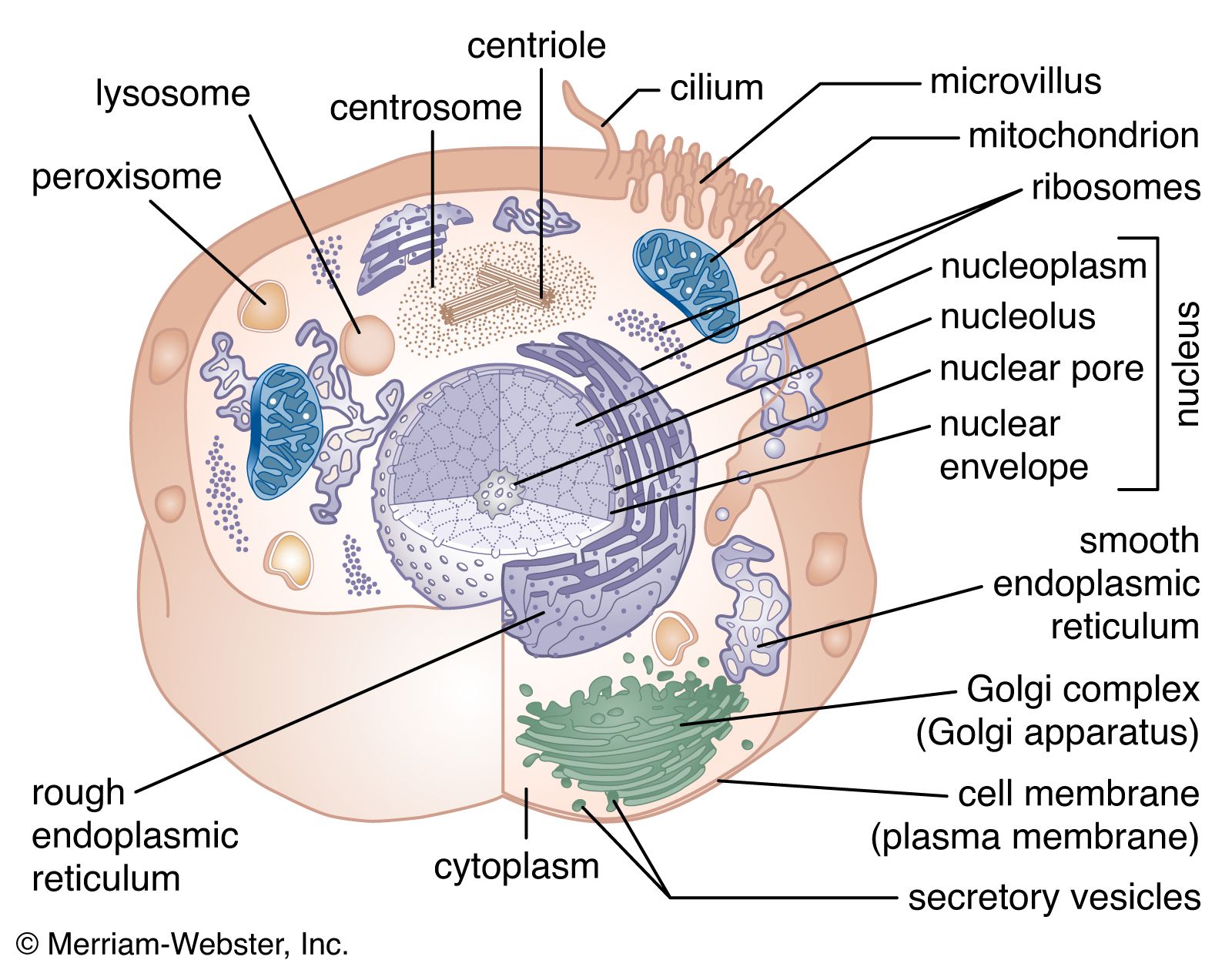
Eukaryotic cells are more complex and larger than prokaryotic cells. They possess a defined nucleus and various membrane-bound organelles, allowing for specialized functions. Eukaryotic cells are found in plants, animals, fungi, and protists.
- Nucleus: Enclosed by a nuclear envelope, it houses the cell's DNA and directs cellular activities.
- Mitochondria: Known as the "powerhouses" of the cell, they generate ATP through cellular respiration.
- Endoplasmic Reticulum (ER):
- Rough ER: Studded with ribosomes, involved in protein synthesis and transport.
- Smooth ER: Lacks ribosomes, involved in lipid synthesis and detoxification processes.
- Golgi Apparatus: Modifies, sorts, and packages proteins and lipids for secretion or internal use.
- Lysosomes: Contain digestive enzymes to break down waste materials and cellular debris.
- Peroxisomes: Break down fatty acids and detoxify harmful substances.
- Cytoskeleton: A network of protein filaments that maintains cell shape, enables movement, and facilitates cell division.
- Vacuoles:
- Plant Cells: Large central vacuole for storing water, nutrients, and waste products.
- Animal Cells: Smaller vacuoles for storage and transport functions.
- Chloroplasts: Found in plant cells and some protists, responsible for photosynthesis.
- Cell Wall: Provides structural support and protection, made of cellulose in plants and chitin in fungi.
Cellular Components and Their Functions
Cell Membrane
The cell membrane, or plasma membrane, is a selectively permeable barrier that surrounds the cell, regulating the entry and exit of substances. It is primarily composed of a phospholipid bilayer embedded with proteins, cholesterol, and carbohydrates. The fluid mosaic model describes its dynamic structure, allowing for flexibility and the movement of molecules within the membrane.
Cytoplasm
Cytoplasm is the gel-like substance within the cell membrane that holds all the organelles in place. It is composed of cytosol, a semi-fluid matrix that facilitates the movement of proteins and organelles within the cell. Cytoplasm is the site of many metabolic reactions, including glycolysis and other enzymatic processes essential for cell survival.
Nucleus
The nucleus serves as the control center of eukaryotic cells, containing the cell's genetic material in the form of DNA. It is enveloped by a double membrane called the nuclear envelope, which contains nuclear pores for the selective exchange of materials between the nucleus and cytoplasm. The nucleus is responsible for regulating gene expression and facilitating DNA replication during cell division.
Mitochondria
Mitochondria are double-membraned organelles known as the "powerhouses" of the cell due to their role in producing ATP through cellular respiration. They have their own DNA and ribosomes, indicating their evolutionary origin as symbiotic bacteria. The inner membrane is folded into cristae, increasing the surface area for energy production.
Endoplasmic Reticulum (ER)
The endoplasmic reticulum is an extensive network of membranes involved in protein and lipid synthesis. It exists in two forms:
- Rough ER: Studded with ribosomes, it synthesizes and transports proteins destined for secretion or membrane insertion.
- Smooth ER: Lacks ribosomes and is involved in lipid synthesis, detoxification, and calcium storage.
Golgi Apparatus
The Golgi apparatus modifies, sorts, and packages proteins and lipids received from the ER. It is organized into flattened membrane sacs called cisternae. The Golgi plays a critical role in directing these molecules to their appropriate destinations, whether inside or outside the cell.
Lysosomes and Peroxisomes
Lysosomes contain hydrolytic enzymes that break down waste materials and cellular debris, recycling macromolecules for reuse. Peroxisomes are involved in the catabolism of fatty acids and the detoxification of harmful substances like hydrogen peroxide, converting them into less reactive molecules.
Ribosomes
Ribosomes are the sites of protein synthesis, translating messenger RNA into amino acid sequences. They can be found free in the cytoplasm or attached to the rough ER, depending on whether the synthesized proteins are destined for secretion or membrane localization.
Cytoskeleton
The cytoskeleton is a dynamic network of protein filaments that provide structural support, maintain cell shape, and facilitate cell movement. It consists of three main types of filaments:
- Microfilaments: Thin fibers made of actin, involved in muscle contraction and cell movement.
- Intermediate Filaments: Provide tensile strength and help maintain cell integrity.
- Microtubules: Hollow tubes made of tubulin, essential for intracellular transport and cell division.
Vacuoles
Vacuoles are membrane-bound storage compartments. In plant cells, a large central vacuole maintains turgor pressure, stores nutrients, and degrades waste products. In animal cells, vacuoles are smaller and serve various functions, including storage of ions, metabolites, and waste products.
Chloroplasts
Chloroplasts are specialized organelles found in plant cells and some protists, responsible for photosynthesis. They contain chlorophyll, which captures light energy to convert carbon dioxide and water into glucose and oxygen. Chloroplasts have their own DNA and ribosomes, supporting their endosymbiotic origin.
Cell Wall
The cell wall is a rigid outer layer found in plant cells, fungi, bacteria, and some protists. It provides structural support, protection, and determines cell shape. In plants, the cell wall is primarily composed of cellulose, while in fungi, it is made of chitin.
Levels of Cellular Organization
Cells exhibit hierarchical organization, from individual cells to complex multicellular organisms. Understanding these levels highlights the intricate relationships and dependencies that sustain life.
1. Individual Cells
The most basic level, where a single cell functions independently or as part of a colony. Each cell performs essential life processes, such as metabolism, growth, and reproduction.
2. Tissues
Tissues are groups of similar cells organized to perform specific functions. There are four primary types of tissues in animals:
- Epithelial Tissue: Covers body surfaces and lines cavities.
- Connective Tissue: Supports and binds other tissues; includes bone, blood, and adipose tissue.
- Muscle Tissue: Facilitates movement through contraction.
- Nervous Tissue: Transmits electrical signals for communication and control.
3. Organs
Organs are structures composed of different tissues working together to perform specific activities. Examples include the heart, lungs, and kidneys in animals, and leaves and roots in plants.
4. Organ Systems
Organ systems consist of multiple organs that collaborate to carry out complex functions necessary for the organism's survival. Examples include the digestive system, respiratory system, and nervous system.
5. Organisms
The highest level of organization, where all organ systems integrate to form a complete living being. Organisms can be unicellular, like bacteria, or multicellular, like humans.
Importance of Cell Organization
Cellular organization is fundamental to life, enabling efficient functioning and adaptability. Key reasons for its importance include:
1. Compartmentalization
Compartmentalization allows cells to separate different biochemical processes into specialized organelles. This separation enhances efficiency by providing optimal environments for specific reactions and prevents interference between incompatible processes.
2. Specialization and Division of Labor
Different organelles and structures within a cell perform unique functions, allowing for specialization. This division of labor ensures that critical processes such as energy production, protein synthesis, and waste management are carried out effectively and concurrently.
3. Structural Integrity and Support
The cytoskeleton and cell wall provide structural integrity, maintaining cell shape and protecting against mechanical stress. This support is essential for cell stability and the ability to withstand external forces.
4. Communication and Coordination
Cells communicate internally through signaling pathways and externally through interactions with other cells and the environment. This communication is vital for coordinating cellular activities, responding to environmental changes, and maintaining homeostasis.
5. Adaptability and Survival
Organized cellular structures enable cells to adapt to varying conditions, whether through changes in gene expression, metabolic pathways, or structural rearrangements. This adaptability is crucial for survival in diverse and changing environments.
Comparative Analysis of Prokaryotic and Eukaryotic Cells
| Feature | Prokaryotic Cells | Eukaryotic Cells |
|---|---|---|
| Size | Generally smaller (1-10 µm) | Larger (10-100 µm) |
| Nucleus | Absent; DNA located in nucleoid region | Present; DNA enclosed within nuclear envelope |
| Organelles | Lack membrane-bound organelles | Contain numerous membrane-bound organelles |
| Cell Wall | Often present, composed of peptidoglycan (bacteria) | Present in plants and fungi; composed of cellulose or chitin |
| Ribosomes | 70S ribosomes | 80S ribosomes in cytoplasm and rough ER |
| Reproduction | Asexual; binary fission | Asexual and sexual reproduction; mitosis and meiosis |
| Genetic Material | Single circular DNA molecule | Multiple linear chromosomes |
| Examples | Bacteria, Archaea | Plants, Animals, Fungi, Protists |
Advanced Cellular Processes
Cell Differentiation
Cell differentiation is the process by which unspecialized cells become specialized in structure and function. It is essential for the development of various tissues and organ systems in multicellular organisms. Differentiated cells perform specific roles, such as muscle contraction, nerve impulse transmission, and immune responses.
Cell Communication
Cells communicate through chemical signals to coordinate activities and maintain homeostasis. This communication can occur through direct contact via gap junctions or through the release of signaling molecules like hormones and neurotransmitters. Effective cell communication ensures proper functioning of tissues and organs.
Cellular Metabolism
Cellular metabolism encompasses all biochemical reactions occurring within a cell, including catabolic pathways that break down molecules to generate energy and anabolic pathways that synthesize complex molecules necessary for growth and repair. Metabolic pathways are tightly regulated to meet the cell's energy and biosynthetic needs.
Cellular Respiration and Photosynthesis
In eukaryotic cells, mitochondria are the sites of cellular respiration, where glucose is broken down to produce ATP, the cell's primary energy currency. Plant cells contain chloroplasts, where photosynthesis occurs, converting light energy into chemical energy stored in glucose. These processes are fundamental for energy flow within cells and ecosystems.
Genetic Regulation and Expression
Gene expression is regulated at multiple levels, from transcriptional control within the nucleus to post-translational modifications of proteins. Regulatory proteins and non-coding RNAs play crucial roles in turning genes on or off in response to internal and external signals, ensuring that proteins are synthesized as needed for cellular functions.
Cell Division
Cell division is the process by which a cell replicates its contents and divides into two daughter cells. In eukaryotes, this involves mitosis for growth and repair, and meiosis for producing gametes in sexual reproduction. Proper regulation of cell division is vital for maintaining genomic integrity and organismal development.
Specialized Cellular Structures in Plant Cells
Chloroplasts
Chloroplasts are unique to plant cells and some protists, functioning as the sites of photosynthesis. They contain chlorophyll, which absorbs light energy to convert carbon dioxide and water into glucose and oxygen. The structure of chloroplasts includes thylakoid membranes organized into stacks called grana, where the light-dependent reactions of photosynthesis occur.
Cell Wall
The cell wall provides rigidity and protection to plant cells, enabling them to maintain their shape and resist osmotic pressure. Composed primarily of cellulose, hemicellulose, and lignin, the cell wall also plays a role in cell-to-cell communication and growth. In addition to structural support, the cell wall acts as a barrier against pathogens.
Central Vacuole
The central vacuole in plant cells serves multiple functions, including storing water, nutrients, and waste products. It also contributes to maintaining turgor pressure, which is essential for plant rigidity and growth. The acidic environment within the vacuole aids in the breakdown of macromolecules and cellular debris.
Cellular Transport Mechanisms
Passive Transport
Passive transport refers to the movement of substances across the cell membrane without the expenditure of energy. This includes simple diffusion, facilitated diffusion through transport proteins, and osmosis, the diffusion of water molecules.
Simple Diffusion
Molecules move from an area of higher concentration to an area of lower concentration until equilibrium is reached.
Facilitated Diffusion
Uses transport proteins to help move substances across the membrane, typically for molecules that cannot easily diffuse through the lipid bilayer.
Osmosis
Specifically refers to the movement of water molecules through a selectively permeable membrane from a region of lower solute concentration to higher solute concentration.
Active Transport
Active transport involves the movement of molecules against their concentration gradient, requiring energy in the form of ATP. This process is essential for maintaining concentration gradients of ions and other important substances within the cell.
Primary Active Transport
Directly uses ATP to transport molecules, such as the sodium-potassium pump which maintains cell potential by moving Na⁺ out and K⁺ into the cell.
Secondary Active Transport
Utilizes the energy from the electrochemical gradient created by primary active transport to move other substances, such as glucose transport in the intestines.
Vesicular Transport
Vesicular transport involves the movement of large molecules or particles into (endocytosis) or out of (exocytosis) the cell via vesicles. This process allows cells to uptake nutrients, release waste, and communicate with their environment.
Endocytosis
The process by which cells internalize substances by engulfing them in a vesicle. Types include phagocytosis (ingestion of large particles) and pinocytosis (ingestion of fluids).
Exocytosis
The process of expelling materials from the cell by fusing vesicles with the plasma membrane, releasing their contents outside the cell.
Cellular Communication and Signaling
Cellular communication is critical for coordinating activities within multicellular organisms. Cells use various signaling mechanisms to convey information and respond to their environment.
Types of Cell Signaling
Autocrine Signaling
Cells respond to signals they produce themselves, often seen in immune responses and cancer cell proliferation.
Paracrine Signaling
Signals are released by one cell and affect nearby target cells, playing roles in tissue development and wound healing.
Endocrine Signaling
Hormones are released into the bloodstream and travel to distant target cells, regulating processes like growth, metabolism, and reproduction.
Juxtacrine Signaling
Direct contact between neighboring cells facilitates signaling, important in processes like embryonic development and tissue repair.
Signal Transduction Pathways
Signal transduction involves the conversion of an external signal into a functional change within the cell. Key steps include:
-
Reception: Binding of a signaling molecule to a receptor on the cell surface or inside the cell.
-
Transduction: Activation of a series of intracellular signaling molecules, often involving phosphorylation cascades.
-
Response: Cellular actions such as gene expression, enzyme activity, or changes in cell behavior.
Genetic Regulation and Expression
Genetic regulation ensures that genes are expressed at the right time and place, allowing cells to respond to internal and external cues. This regulation occurs at multiple levels:
Transcriptional Control
Regulation of gene expression at the DNA level, involving transcription factors that enhance or repress the transcription of specific genes into mRNA.
Post-Transcriptional Control
Processes that occur after transcription, such as mRNA splicing, editing, and transport, which determine the stability and translation efficiency of mRNA molecules.
Translational Control
Regulation of protein synthesis by controlling the initiation, elongation, and termination phases of translation, influencing the amount and activity of proteins produced.
Post-Translational Modifications
Chemical modifications of proteins after translation, such as phosphorylation, glycosylation, and ubiquitination, which affect protein function, localization, and interactions.
Conclusion
Cell organization is a cornerstone of biological systems, defining the structure and function of cells which, in turn, build the complex tissues and organs of living organisms. The intricate arrangement of cellular components allows for efficient metabolic processes, communication, and adaptation, ensuring the survival and prosperity of cells. Understanding cell organization not only provides insights into fundamental life processes but also underpins advancements in medicine, biotechnology, and numerous scientific disciplines. As research continues to unveil the complexities of cellular structures and their interactions, our comprehension of life at the molecular level deepens, paving the way for innovative solutions to biological challenges.
References
Last updated February 12, 2025