
Unlock English Confidence: Your Personalized Lesson Plan for Navigating Life in the US
A CELTA-style plan for A1 ESL students focusing on first impressions, plans, and travel talk.
Moving to a new country is a huge adventure! This lesson plan is designed specifically for an A1-level ESL student who has recently arrived in the US. It follows the CELTA methodology, focusing on building conversational confidence through relevant topics like first impressions, daily life, travel experiences, and future plans, while gently incorporating essential grammar (Present Simple questions) and vocabulary.
Lesson Highlights
- Personalized Conversation: Activities directly relate to the student's recent move and experiences in the US.
- Structured Skill Building: Integrates speaking, listening, vocabulary (travel, daily life), and grammar (Present Simple questions) in a clear, progressive manner.
- Engaging & Supportive: Uses visuals, interactive exercises, and a positive approach to make learning enjoyable and build confidence for an A1 learner.
CELTA Lesson Plan: First Steps in the USA
Lesson Details
- Level: A1 (Beginner)
- Student Profile: Adult, recently moved to the US with husband (O1 visa holder).
- Time: 50-60 minutes (flexible for online format)
- Main Skills Focus: Speaking (Conversational Fluency), Listening Comprehension
- Subsidiary Skills Focus: Grammar (Present Simple Questions), Vocabulary (Travel, Daily Life, Impressions)
- Materials: Digital whiteboard/shared screen, prepared digital handout/worksheet (Vocabulary & Grammar), images/flashcards (digital), potentially a short video clip.
Lesson Objectives
By the end of this lesson, the student will be better able to:
- Share simple first impressions of the US using basic vocabulary.
- Ask and answer basic Present Simple questions about daily routines, experiences, and plans (e.g., "Do you like...?", "Where do you go...?").
- Recognize and use 8-10 new vocabulary words related to travel, moving, and daily life.
- Engage in short conversational exchanges about her recent move, current situation, and future intentions.
- Feel more confident speaking English in a supportive environment.
Anticipated Problems & Solutions
| Anticipated Problem | Solution |
|---|---|
| Student may feel shy or lack confidence due to A1 level and new environment. | Start with simple, personalized questions. Use visuals extensively. Offer consistent positive reinforcement and encouragement. Model language clearly. Maintain a warm, patient demeanor. |
| Limited vocabulary hinders expression. | Pre-teach essential vocabulary with visuals and context. Encourage use of gestures or drawing. Allow use of translation tools for specific words if necessary, but encourage English first. |
| Difficulty forming Present Simple questions correctly (e.g., auxiliary verb 'do/does', word order). | Provide clear models and structures. Use Concept Checking Questions (CCQs). Practice with controlled exercises (gap-fills, matching) before freer practice. Use gentle, delayed error correction, focusing on the target structure. |
| Potential technical issues in the online environment (connection, audio/video). | Have backup activities ready (e.g., chat-based tasks, shared document exercises). Test technology beforehand. Be prepared to simplify activities if needed. |
Lesson Procedure
Stage 1: Lead-in & Warmer (5-7 minutes)
Aim:
To create a relaxed atmosphere, activate the student's existing knowledge, introduce the lesson topic, and personalize the context.
Procedure:
- Warm Greeting: Greet the student warmly. Ask simple, friendly questions: "How are you today?", "How was your morning/afternoon?".
- Introduce Topic: "Today, we will talk about your new life here in the US! Moving to a new country is very exciting." Show an image of people arriving in a new place (like the historical Ellis Island photos, explaining briefly they show people arriving long ago).
- Personal Connection: "You recently arrived in the US. What was your very first impression? One word? Happy? Tired? Excited?" Elicit simple adjectives.
- Context Setting Question: Ask a simple Present Simple question related to her situation: "Where do you live now?" or "Do you live in a big city?". Model the answer if needed ("I live in...").
 Immigrants arriving in the US historically.
Teacher Notes:
- Maintain eye contact (via camera) and use positive body language.
- Keep language simple and speak clearly.
- Listen actively to the student's responses, noting any emerging language needs or interests.
- Focus on building rapport and making the student feel comfortable.
Stage 2: Vocabulary Introduction & Practice (10-12 minutes)
Aim:
To introduce and practice key vocabulary related to travel, impressions, and daily life needed for the conversational tasks.
Procedure:
- Presentation: Introduce 6-8 key vocabulary items using visuals (digital flashcards or images on screen) and simple definitions/context. Example words: airport, travel, visa, husband, plan, explore, neighborhood, culture shock.
- "Airport: You go here for planes." (Show picture)
- "Visa: Special paper to live/work here. Your husband has an O1 visa."
- "Explore: To look around a new place." (Mime looking around)
- "Culture shock: Feeling surprised by different customs."
- Pronunciation Practice: Model pronunciation clearly. Have the student repeat each word. Drill if necessary, focusing on stress (e.g., air-PORT, ex-PLORE).
- Meaning Check: Use simple checks (e.g., "Show me the picture for 'airport'.", "Is 'visa' for holiday or living?").
- Controlled Practice (Matching): Provide a simple digital matching activity (words to pictures or simple definitions). Guide the student through it verbally.
- Personalization: Ask simple questions using the new words: "Did you go to the airport?", "Do you want to explore your neighborhood?".
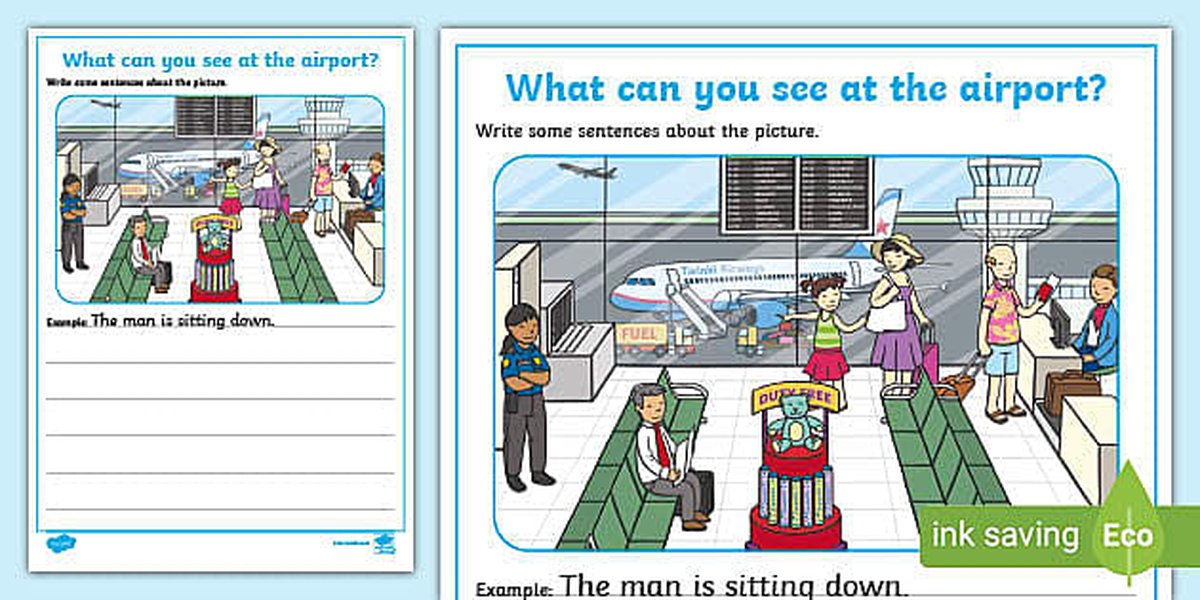 Vocabulary context: A busy airport scene.
Teacher Notes:
- Keep the pace appropriate for A1. Don't overload with too many words.
- Use gestures, mime, and context to clarify meaning.
- Praise correct pronunciation and understanding.
- Relate words directly to her experience (visa, husband, travel).
Stage 3: Grammar Focus: Present Simple Questions (15 minutes)
Aim:
To introduce/clarify the structure of basic Present Simple questions (Yes/No and Wh-) and provide controlled practice.
Procedure:
- Presentation (Guided Discovery):
- Write a simple statement on the board: "You live in [City]."
- Ask: "How do I make this a question?" Elicit or provide: "Do you live in [City]?" Highlight the use of 'Do'.
- Write another statement: "Your husband works." Ask: "Question?" Elicit or provide: "Does your husband work?" Highlight 'Does' for he/she/it.
- Introduce Wh- questions: "Where do you live?", "What does he do?". Highlight the structure: Wh-word + do/does + subject + verb?
- Use CCQs: "For 'you', we use 'Do' or 'Does'? (Do)", "For 'husband' (he), we use 'Do' or 'Does'? (Does)".
- Controlled Practice 1 (Gap Fill): Provide a digital worksheet with 4-5 sentences where the student fills in 'Do' or 'Does'.
- Example: ____ you like American food? (Do)
- Example: ____ your husband travel for work? (Does)
- Controlled Practice 2 (Question Formation): Provide simple answers and ask the student to form the question.
- Answer: "Yes, I live near a park." -> Question: "Do you live near a park?"
- Answer: "He works in an office." -> Question: "Where does he work?"
Teacher Notes:
- Keep explanations very simple and visual. Use colors on the digital board to highlight 'Do'/'Does' and word order.
- Focus on the most common forms for A1 (Do you...?, Does he/she...?, Where do...?, What do...?).
- Provide immediate, gentle correction during practice. Re-model the correct form.
- Use personalized examples relevant to the student.
Stage 4: Conversational Practice (Production) (15-20 minutes)
Aim:
To allow the student to use the target grammar and vocabulary more freely in a conversational context related to the lesson themes.
Procedure:
- Guided Conversation Prompts: Use a list of simple questions (shared on screen) related to the themes. Ask the student, and encourage her to ask you too.
- First Impressions: "Do you like your new city?", "Is the food different?", "What is surprising?"
- Immediate Plans/Daily Life: "What do you do every day?", "Do you go shopping?", "Do you meet people?"
- Past Travel/Experiences: "How did you travel here? (Plane?)", "Where did you go first?", "Did you feel jet lag?" (Introduce 'jet lag' if relevant).
- Future Plans: "Do you plan to travel in the US?", "Where do you want to go?", "Do you want to learn something new here?"
- Role-Play (Optional): A very simple role-play, e.g., Student A asks Student B (teacher) about their daily routine using Present Simple questions. Swap roles.
- Freer Discussion: Encourage the student to talk more openly about one topic, e.g., "Tell me about your neighborhood. Do you like it? What do you see there?". Use the new vocabulary and questions naturally.
- Visual Aid (Map): Briefly show a map of the US. "Where is your city? Where do you want to explore?".
Teacher Notes:
- Act as a conversational partner, not just an interviewer. Respond to her answers and share brief, simple information about yourself if she asks.
- Encourage use of the target grammar and vocabulary, but prioritize communication and fluency over perfect accuracy at this stage.
- Provide scaffolding and support as needed (e.g., rephrasing questions, offering word choices).
- Listen for examples of good language use to praise later, and note persistent errors for feedback.
- Keep the conversation moving and engaging.
Lesson Topic Overview Mindmap
This mindmap provides a visual overview of the key conversational areas covered in the lesson, helping to structure the discussion points.
(airport, visa, explore, husband,
plan, neighborhood, travel...)"] id5b["Grammar
(Present Simple Questions:
Do you...? Does he...?
Where do...? What do...?)"]
Student Skill Focus Radar Chart
This chart visualizes the intended focus areas of the lesson, balancing different aspects of language learning for an A1 student. It helps conceptualize the balance between structured input and conversational output.
Stage 5: Feedback & Wrap-up (5 minutes)
Aim:
To provide constructive feedback, consolidate learning, and end the lesson positively.
Procedure:
- Positive Feedback: Start with praise for effort and specific achievements. "You did a great job talking about your plans!" or "Your questions using 'Do you...' were very good!".
- Gentle Correction: Address 1-2 common errors noted during the production stage, focusing on the target language. Write the correct form on the screen. "Remember, for 'he', we say 'Does he work?' not 'Do he work?'". Keep it brief and focused.
- Review Key Learning: Briefly recap the main topic or a few key vocabulary words. "So today we talked about first impressions and using 'Do you...?' questions."
- Homework Assignment (Optional): Assign a simple, relevant task. "For homework, maybe write 3 sentences about your plans for tomorrow?" OR "Try to ask your husband one question using 'Do...' or 'Does...' today." Keep it light and confidence-building.
- Closing: End on an encouraging note. "Great work today! Do you have any questions for me? I look forward to our next lesson!"
Teacher Notes:
- Prioritize positive reinforcement, especially for an A1 student in a new situation.
- Focus correction on errors that impede communication or relate directly to the lesson aims. Avoid overwhelming the student.
- Ensure the homework task is clear, achievable, and reinforces the lesson content.
- Finish on time and confirm the next lesson schedule if appropriate.
Helpful Video Resource
Watching examples of basic English conversations can be very helpful for A1 learners. This video demonstrates simple interactions and question/answer patterns, similar to those practiced in the lesson. Observing pronunciation and flow in a natural context can boost listening skills and confidence.
This video shows a demonstration lesson for A1 beginners, highlighting techniques like using visuals, simple language, and repetition, which are key for this level.
Frequently Asked Questions (FAQ)
How much should I correct the student's grammar mistakes?
For A1 learners, especially in a conversational lesson, focus on gentle correction of errors that significantly impede understanding or relate directly to the lesson's grammar target (Present Simple questions). Prioritize fluency and confidence-building over perfect accuracy. During freer practice, make notes of errors and address 1-2 key ones during the feedback stage, modeling the correct form positively.
What if the student doesn't know the vocabulary needed?
Be prepared! Pre-teach essential vocabulary with visuals and context. During conversation, if a word is missing, try to elicit it with simple descriptions or mime. If necessary, provide the word directly. You can also encourage the student to use simple language they already know to describe the idea, or allow judicious use of a translation tool for a specific key word if communication breaks down, then immediately practice the English word.
How can I make the online lesson more interactive?
Use the features of your online platform: share your screen for visuals and exercises, use digital whiteboard tools for collaborative writing or drawing, incorporate simple online matching games for vocabulary, use chat for quick responses or spelling practice. Vary activities (listening, speaking, matching, gap-fill), use gestures and facial expressions, maintain eye contact, and frequently ask concept-checking or personalized questions.
How long should each stage of the lesson take?
The timings provided (e.g., Lead-in 5-7 mins, Vocab 10-12 mins, Grammar 15 mins, Conversation 15-20 mins, Feedback 5 mins) are approximate guidelines. Be flexible based on the student's engagement and needs. If the student needs more time on grammar practice, adjust accordingly. If they are actively engaged in conversation, allow that stage to run slightly longer. The key is to achieve the lesson objectives within the overall time frame.
References
- ESL Lesson Plans: First Impression - Amerilingua
-
Beginner A1 Lesson Plans - TeachingEnglish | British Council
- Present Simple Questions Worksheets - ISL Collective
- First Impressions - ESL Conversation Questions
- Introduction and First Impression Materials - ESL Friend
- CELTA Pass A Examples (Lesson Plan Structure) - Slev Life
- Present Simple - All Things Grammar
Recommended Further Exploration
 fivethingselt.wordpress.com
Last updated April 17, 2025