
ChargePaws Unveiled: Building the Ultimate Subscription-Free GPS Cat Tracker
A deep dive into the design, components, and development plan for an affordable, lightweight feline locator.
This document outlines the concept and development plan for ChargePaws, a bespoke GPS tracking device designed with feline comfort and owner peace of mind at its core. Focusing on affordability, long battery life, and freedom from subscription fees, ChargePaws aims to be a practical solution for monitoring your cat's adventures.
Highlights of the ChargePaws Concept
- Subscription-Free Tracking: Utilizes the Helium LoRaWAN network, eliminating costly monthly fees often associated with pet GPS trackers.
- Ultra-Lightweight Design: Targets a maximum weight of 15 grams, ensuring comfort and minimal interference for cats of various sizes.
- Cost-Effective DIY Build: Aims for a total parts cost under $50, making reliable pet tracking accessible to more owners and hobbyists.
Product Details
Defining the ChargePaws Tracker
ChargePaws is envisioned as a compact, efficient, and user-friendly GPS tracker specifically engineered for cats. Its primary characteristics revolve around addressing common pain points found in commercial pet trackers:
- Weight & Size: The paramount goal is a total weight of 15 grams or less, housed within a small, unobtrusive 3D-printed case designed for comfortable wear on a cat's collar.
- Battery & Charging: Powered by a 300mAh Lithium Polymer (LiPo) battery, it targets a 7-day operational life on a single charge. Recharging is handled manually via a standard USB-C port, utilizing a TP4056 charging module for simplicity and universal compatibility.
- Connectivity & Cost: It leverages the Helium LoRaWAN network for data transmission. This decentralized, low-power, wide-area network technology enables subscription-free operation, drastically reducing the long-term cost of ownership. The target budget for all electronic components and the case is under $50.
- Core Technology: At its heart is the RAK3172 module, which integrates both GPS (for location acquisition) and LoRaWAN (for communication) functionalities into a single, power-efficient chip.
- Reliability: Incorporates GPS caching mechanisms to mitigate potential location data loss due to temporary signal drops, common in urban environments or areas with dense foliage.
Target User Profile
Who is ChargePaws For?
The ideal ChargePaws user is a cat owner who:
- Seeks a reliable method to monitor their cat's location, particularly if the cat spends time outdoors.
- Prefers a solution without recurring monthly or annual subscription fees.
- Values a lightweight and comfortable device (≤15g) suitable for feline companions.
- Is comfortable with manually recharging the device approximately once a week via USB-C.
- May be a tech enthusiast, hobbyist, or DIYer interested in building or using a custom tracking solution.
- Is budget-conscious and looking for an affordable alternative to expensive commercial trackers.
- Resides in an area with adequate Helium LoRaWAN network coverage.
This includes urban and suburban pet parents, individuals involved in pet rescue, or anyone needing to track cats in environments where traditional cellular-based trackers might be overkill or too costly.
Functionality Overview
How ChargePaws Works
ChargePaws is designed to deliver essential tracking capabilities efficiently:
- GPS Location Tracking: Uses the RAK3172 module's integrated GPS receiver to determine the cat's geographical coordinates.
- LoRaWAN Data Transmission: Periodically transmits location data (and potentially battery status) over the Helium LoRaWAN network. This low-power communication method is ideal for long battery life and avoids cellular data costs.
- Subscription-Free Operation: By utilizing Helium (or potentially other LoRaWAN networks like The Things Network), the device bypasses the need for cellular plans and associated fees.
- Manual USB-C Recharging: The 300mAh LiPo battery is recharged using a common USB-C cable connected to the onboard TP4056 charging circuit.
- GPS Caching: Implements a software-based caching system. If the device temporarily loses LoRaWAN connectivity (e.g., inside a building), it stores recent GPS fixes locally and transmits them once the connection is re-established. This enhances tracking continuity.
- Configuration: The RAK3172 module can be configured (e.g., setting network keys, transmission intervals) using AT commands via a UART interface, typically managed by the firmware developed using the Arduino IDE.
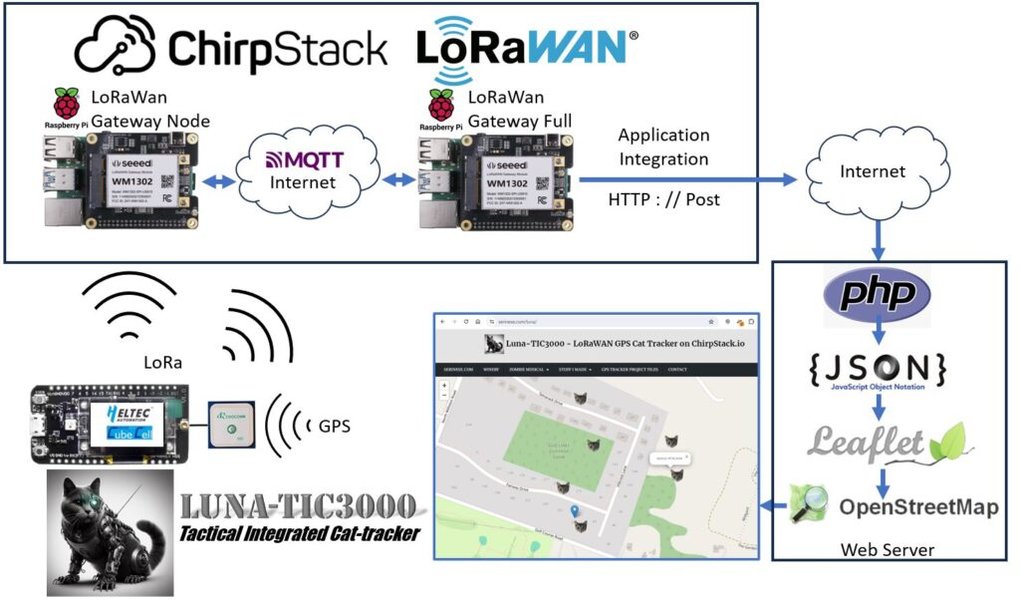
Conceptual diagram illustrating how GPS data is transmitted via LoRaWAN for pet tracking.
Materials & Components
The Building Blocks of ChargePaws
The selection of materials focuses on achieving the project's goals of low weight, low cost, and reliable functionality. The primary components include:
| Component | Description | Function | Estimated Cost | Relevance |
|---|---|---|---|---|
| RAK3172 Module | Integrated GPS & LoRaWAN SiP (System-in-Package) based on STM32WLE5CCU6. | Core processing, location acquisition, and network communication. | $10 - $15 | Combines essential functions in one small, low-power module. |
| 300mAh LiPo Battery | Single-cell Lithium Polymer rechargeable battery. | Provides power for up to 7 days of operation. | ~$5 | Balances capacity and weight for extended use. |
| TP4056 Module | Lithium battery charging IC with USB-C interface. | Manages safe and efficient recharging via USB-C. | ~$2 | Standard, reliable, and cost-effective charging solution. |
| 3D-Printed Case | Custom enclosure designed in CAD software (e.g., Fusion 360). | Houses and protects electronics, provides collar attachment, ensures lightweight design. | $5 - $10 (Filament cost) | Allows for optimized size, weight, and ergonomics. Material likely PLA or PETG for durability and low weight. |
| Miscellaneous | Wiring, connectors, possibly a small PCB, fasteners. | Interconnecting components and final assembly. | ~$3 - $5 | Essential for integrating the system. |
| Total Estimated Cost | ~$25 - $37 | Well within the target budget of <$50. |
This component list ensures the project remains affordable while utilizing capable hardware suitable for the demanding size and power constraints of a cat tracker.

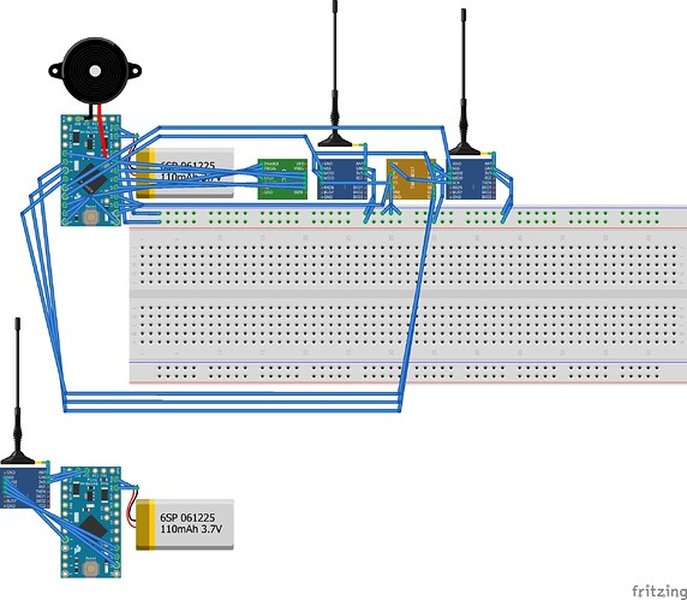
Example of components used in a similar DIY LoRa-based GPS tracker project.
Development Roadmap: Plan of Action
From Concept to Working Prototype
The creation of ChargePaws follows a structured development process:
-
Phase 1: Research & Component Verification
- Review RAK3172 documentation (datasheets, AT command manuals, quick start guides).
- Confirm compatibility of the TP4056 charger with the chosen 300mAh LiPo battery.
- Investigate Helium LoRaWAN network setup (device registration, data handling).
-
Phase 2: Breadboard Prototyping & Basic Functionality
- Assemble the core circuit (RAK3172, battery, charger) on a breadboard.
- Use the Arduino IDE and a suitable development board or UART adapter to communicate with the RAK3172.
- Test basic AT commands to verify module response.
- Implement minimal firmware to acquire GPS coordinates and attempt LoRaWAN connection (e.g., OTAA activation).
- Verify battery charging via the TP4056 module.
-
Phase 3: Firmware Development & Feature Implementation
- Develop robust Arduino code to manage GPS data acquisition, power modes, LoRaWAN transmission scheduling, and battery monitoring.
- Implement the GPS caching logic to store data when the network is unavailable and transmit later.
- Configure the device for the Helium network.
- Optimize code for low power consumption to achieve the 7-day battery life target.
-
Phase 4: Hardware Miniaturization & Case Design
- Design a compact Printed Circuit Board (PCB) or use perfboard to solder components, minimizing size and weight.
- Model the enclosure using 3D CAD software (Fusion 360), focusing on:
- Minimal dimensions and weight (target ≤15g total).
- Secure mounting for all components.
- Access to the USB-C port.
- Ergonomic shape for cat comfort.
- Durable and potentially water-resistant design.
- Integrated collar attachment mechanism.
- 3D print prototype cases using lightweight filament (PLA, PETG). Iterate design based on fit and component placement.
-
Phase 5: Integration, Testing & Refinement
- Assemble the finalized components into the 3D-printed case.
- Conduct extensive testing:
- GPS accuracy and time-to-first-fix (TTFF) in various environments.
- LoRaWAN signal strength and transmission reliability on the Helium network.
- Battery endurance tests under realistic usage patterns.
- GPS caching functionality during simulated signal loss.
- Durability and wearability testing (potentially using a plush toy first).
- Refine firmware and case design based on testing results. Address any remaining challenges identified (e.g., optimizing antenna placement).
ChargePaws Feature Prioritization
Balancing Key Design Goals
The development of ChargePaws involves balancing several crucial factors. This chart visualizes the target priorities for ChargePaws compared to a hypothetical 'Ideal' tracker and a 'Typical Commercial' GPS tracker often reliant on subscriptions and cellular tech.
This visualization highlights ChargePaws' focus on weight, cost, and subscription freedom, potentially trading off instantaneous real-time updates (characteristic of cellular trackers) for significantly longer battery life and lower operating costs provided by LoRaWAN.
Conceptual Design
Visualizing the ChargePaws Device
3D Model Description (Conceptual)
While a specific 3D model file isn't provided, the design conceived using Fusion 360 would prioritize:
- Form Factor: A small, streamlined rectangular or slightly curved shape (estimated dimensions around 40mm x 20mm x 10-12mm) to minimize bulk on a cat's collar.
- Ergonomics: Rounded edges and smooth surfaces to prevent snagging and ensure comfort against the cat's fur and skin.
- Component Layout: Internal structure designed to securely hold the RAK3172 module, 300mAh LiPo battery, and TP4056 charging board, ensuring optimal weight distribution and antenna placement.
- Accessibility: A precisely located cutout for the USB-C charging port.
- Attachment: Integrated loops or a clip mechanism designed to securely fasten the device to standard cat collars.
- Material: Lightweight yet durable 3D printing filament like PETG or PLA, potentially with considerations for water resistance (e.g., tight seams, internal seals).
Example of a prototype DIY tracker attached to a collar, illustrating potential form factor.
Sketches: Outside & Inside (Conceptual)
Based on the project description and typical DIY tracker designs, here's a conceptual sketch description:
- Outside Parts (Solid External Case):
- A sketch would show a small, compact enclosure.
- One side features the USB-C port opening.
- The top surface might be smooth, possibly with a subtle indicator LED visible through the plastic (if implemented).
- The underside or sides incorporate the collar attachment points (e.g., two parallel slots for a strap to pass through).
- The overall aesthetic is minimal and functional.
- Inside Parts (Internal Components / "Organs"):
- An internal sketch or exploded view would depict the RAK3172 module positioned centrally, likely on a small custom PCB or perfboard.
- The flat 300mAh LiPo battery sits adjacent or underneath the module, connected via short wires.
- The TP4056 charging module is positioned near the edge, aligning its USB-C port with the case opening.
- Wiring is shown routed neatly to connect the battery, charger, and RAK module.
- Minimal empty space is utilized to keep the overall volume small.
Project Structure Mindmap
Visualizing the ChargePaws Ecosystem
This mindmap provides a visual overview of the key elements constituting the ChargePaws project, from its core goals to the technical components and development challenges.
(RAK3172)"] T3["Helium Network"] T4["LiPo Battery Power"] T5["USB-C Charging (TP4056)"] T6["GPS Caching"] Components["Hardware Components"] C1["RAK3172 Module"] C2["300mAh LiPo Battery"] C3["TP4056 Charger"] C4["3D Printed Case"] C5["Antenna (Internal/External)"] C6["Wiring & Connectors"] Process["Development Process"] P1["Research & Planning"] P2["Breadboard Prototyping"] P3["Firmware Dev (Arduino IDE)"] P4["Case Design (Fusion 360)"] P5["PCB/Assembly Miniaturization"] P6["Testing & Iteration"] Challenges["Identified Challenges"] CH1["Size & Weight Reduction"] CH2["Power Optimization"] CH3["Signal Reliability (GPS/LoRaWAN)"] CH4["GPS Caching Implementation"] CH5["Helium Network Coverage"] CH6["Durability & Water Resistance"]
Understanding these interconnected elements is crucial for the successful development and deployment of the ChargePaws tracker.
DIY LoRa Cat Tracker Insights
Learning from Similar Projects
Building a LoRa-based pet tracker is a popular DIY project. This video demonstrates a similar concept, tracking a cat using LoRa technology and visualizing the location on Google Maps. While specific components might differ from ChargePaws (e.g., different LoRa module or GPS unit), the core principles of acquiring GPS data and transmitting it via LoRaWAN are highly relevant. It showcases the feasibility of using LoRa for pet tracking applications, especially in achieving long range without cellular fees, aligning perfectly with the ChargePaws philosophy.
Insights from such projects can inform antenna placement strategies, power consumption optimization techniques, and potential software libraries or platforms for data visualization compatible with the ChargePaws project.
Frequently Asked Questions (FAQ)
▶ How does Helium LoRaWAN enable subscription-free tracking?
Helium is a decentralized wireless network powered by individuals who operate LoRaWAN hotspots. Devices like ChargePaws use this network to send small packets of data (like GPS coordinates) over long distances using very little power. Data transmission on the Helium network is paid for using Data Credits (DCs), which have a fixed cost in USD. A small, one-time purchase of DCs can often cover years of data usage for a low-traffic device like a pet tracker, effectively making it "subscription-free" compared to traditional monthly cellular plans.
▶ Is 15 grams truly lightweight enough for a cat?
Veterinary and pet product experts often recommend that collar attachments should not exceed 1-2% of a cat's body weight. For an average cat weighing 4-5 kg (approx. 9-11 lbs), 15 grams is well below this threshold (around 0.3%). Many commercial cat trackers weigh between 20-40 grams. Therefore, a target weight of ≤15 grams is considered very lightweight and should be comfortable for most adult cats, provided the tracker's shape and size are also ergonomic.
▶ What are the main challenges with GPS caching?
GPS caching involves storing location data when network connectivity is lost and sending it later. The main challenges include:
- Memory Limitation: The microcontroller (like the one in RAK3172) has limited memory to store cached points. This requires careful management of how many points are stored and for how long.
- Data Management: Ensuring data is transmitted in the correct order once connectivity is restored, and handling potential data overflows if connectivity is lost for extended periods.
- Power Consumption: Writing to memory (like EEPROM or flash) consumes power, which needs to be balanced against the goal of long battery life.
- Real-time Gap: While caching ensures data isn't lost, it means there will be a delay in seeing the cat's location during periods of no connectivity.
▶ Can the RAK3172 handle both GPS and LoRaWAN effectively?
Yes, the RAK3172 module integrates a Semtech SX1262 LoRa transceiver and an STMicroelectronics STM32WLE5CC microcontroller which itself includes LoRa capabilities. While the base RAK3172 focuses on LoRaWAN, it's often paired or controlled by another microcontroller that handles GPS data acquisition from a separate GPS module. However, some project variants might use the STM32WLE5's processing power to manage both tasks, potentially using specific firmware or libraries. The key challenge lies in managing the power consumption and processing load of running both GPS acquisition (which can be power-hungry) and LoRaWAN transmissions efficiently within the firmware.
Correction Note: The initial prompt mentioned RAK3172 handling both GPS/LoRa. While RAK3172 is primarily LoRaWAN based on STM32WLE5, achieving GPS often requires pairing it with an external GPS module or using a different integrated module like the RAK11200 (ESP32-based) which can manage both. If using *only* RAK3172, GPS functionality would depend on external components controlled by it, or a different module might be implied. This FAQ clarifies the typical usage.References
Sources & Further Reading
- Lora Based Gps Tracker Using RAK3172 - Instructables
- RAK3172 WisDuo LoRaWAN Module Quick Start Guide - RAKwireless Documentation Center
- 11 Best GPS Pet Tracking Collars Without Monthly Subscription Fees - HubPages
- The 9 Best Cat GPS Trackers of 2024, Tested and Reviewed - The Spruce Pets
- Schematic RAK3172 - RAKwireless Forum
- GPS tracker for pets without subscription: Does it exist? - Weenect
- The 5 Best Cat GPS Trackers for Peace of Mind in 2024 - TechnoMeow
Recommended Exploration
Discover Related Topics

Last updated April 23, 2025