
Crafting the Perfect Attendance Sheet: A Childminder's Essential Tool
Unlock the secrets to efficient, compliant, and stress-free attendance tracking for your childminding service.
A well-designed attendance sheet is more than just a list of names; it's a cornerstone of a professional and safe childminding environment. It serves as a vital record for safety, billing accuracy, regulatory compliance, and clear communication with parents. This guide will walk you through creating a comprehensive attendance sheet tailored to your specific needs.
Highlights of Effective Attendance Tracking
- Clarity and Simplicity: An attendance sheet must be easy to understand and quick to fill out for both childminders and parents. Prioritize legible fonts and a logical layout.
- Comprehensive Information: Capture all essential details, including the child's name, arrival/departure times, and parent/guardian signatures, to ensure accountability and meet regulatory standards.
- Adaptability: Choose a format (daily, weekly, monthly, or digital) that best suits your operational flow and the number of children in your care, ensuring it can evolve with your needs.
Why is an Attendance Sheet Crucial for Childminding?
Attendance sheets are indispensable for several key reasons in a childminding setting:
- Safety and Emergency Preparedness: Knowing exactly who is on the premises at any given time is paramount for safety, especially during emergency situations or evacuations. Accurate roll calls depend on these records.
- Billing and Financial Accuracy: For childminders who charge by the hour or day, precise attendance records are essential for transparent and accurate invoicing, preventing disputes and ensuring fair compensation.
- Regulatory Compliance: Local authorities and governing bodies often mandate detailed attendance logs as part of licensing requirements. Proper records demonstrate adherence to these regulations.
- Parent Communication and Peace of Mind: Formal check-in and check-out procedures, documented on an attendance sheet, provide parents with assurance about their child's safety and whereabouts. It can also be a place for brief handover notes.
- Operational Efficiency: Streamlined attendance tracking saves time for both staff and parents, making drop-offs and pick-ups smoother and more organized.
- Staff-to-Child Ratio Management: Some settings require tracking staff-to-child ratios, and attendance sheets can aid in monitoring this for compliance.
Core Components: The Must-Haves for Your Attendance Sheet
Every effective attendance sheet should include several non-negotiable pieces of information to ensure it is functional and compliant.
Header Information
The top of your sheet should clearly identify your service and the period the sheet covers.
- Childminding Service Name/Logo: For professional identification.
- Date(s): Clearly state the specific date (for daily sheets) or the week/month and year (for weekly/monthly sheets).
- Childminder/Staff Name (Optional): Useful if multiple staff members are involved.
Child-Specific Details
Accurate identification of each child is fundamental.
- Child's Full Name: A dedicated space for each child's name.
- Date of Birth (Optional but Recommended): Useful for identification and age-specific activities or requirements.
- Room/Group (if applicable): Important if your setting is divided into different groups.
Daily Attendance Tracking
This is the heart of the attendance sheet, recording the child's presence.
- Date Column (for weekly/monthly sheets): Clearly lists each day.
- Time In: The exact time the child arrives.
- Time Out: The exact time the child departs.
Verification: Signatures are Key
Signatures provide crucial verification and accountability.
- Parent/Authorized Guardian Signature (Time In): Confirms who dropped off the child and when.
- Parent/Authorized Guardian Signature (Time Out): Confirms who picked up the child and when, enhancing safety protocols.
Enhancing Your Sheet: Additional Useful Information
Beyond the basics, several other fields can add significant value to your attendance sheet, improving communication and record-keeping.
Notes and Observations
A space for brief, relevant comments can be invaluable.
- Examples: Notes from parents at drop-off (e.g., "Slightly tired today"), observations by the childminder (e.g., "Enjoyed painting"), reminders about pick-up arrangements (e.g., "Grandma picking up"), or medication administered (if policy allows notes here, though a separate medication log is often better).
Absence Tracking
Noting absences and reasons helps with planning and record analysis.
- Columns or codes for "Absent," "Sick," "Vacation." This information can be useful for understanding attendance patterns.
Meal Records (Optional)
If you provide meals, tracking what was eaten can be helpful for parents.
- A simple checkbox or short note section for breakfast, lunch, and snacks.
Emergency Contact Quick Reference (Optional)
While full emergency details are kept elsewhere, a primary contact initial or "EC on file" note can be useful on daily sheets, though this is often better placed in a more secure, readily accessible emergency file.
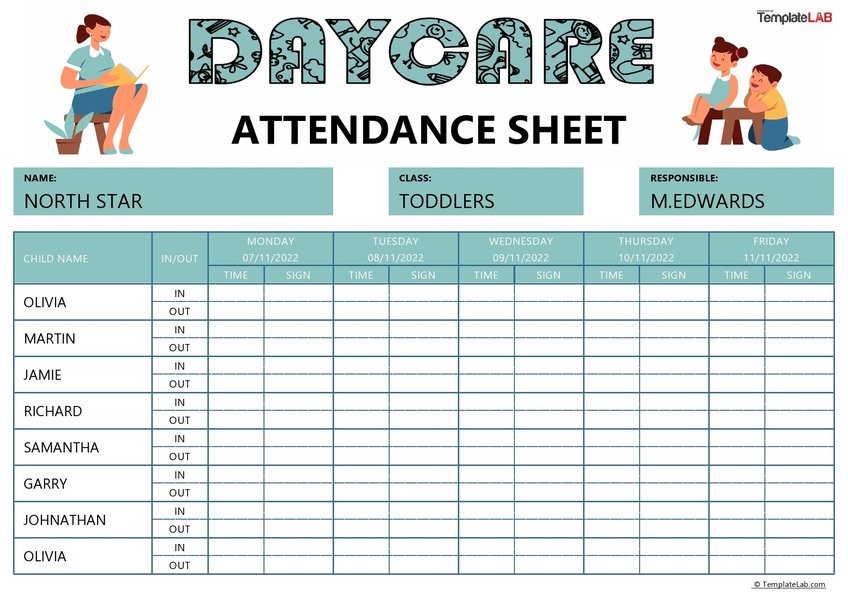
An example of a structured daily attendance sheet.
Choosing the Right Format and Layout
The best format depends on your specific operational style, the number of children you care for, and your record-keeping preferences. Each has its pros and cons.
Daily Attendance Sheets
- Description: One sheet per day, listing all children attending on that specific day.
- Pros: Easy to see who is present at a glance; less paper for staff to handle daily if printed on demand. Focuses on the current day's details.
- Cons: Requires a new sheet each day; can accumulate more paper over time if printing all.
Weekly Attendance Sheets
- Description: Covers a full week, typically with children's names down one side and days of the week across the top.
- Pros: Good overview for the week; convenient for settings with consistent weekly schedules; less paper to manage than daily sheets if one child has one sheet per week.
- Cons: Can become cluttered if many details per day are needed; may not suit highly flexible or drop-in schedules as easily.
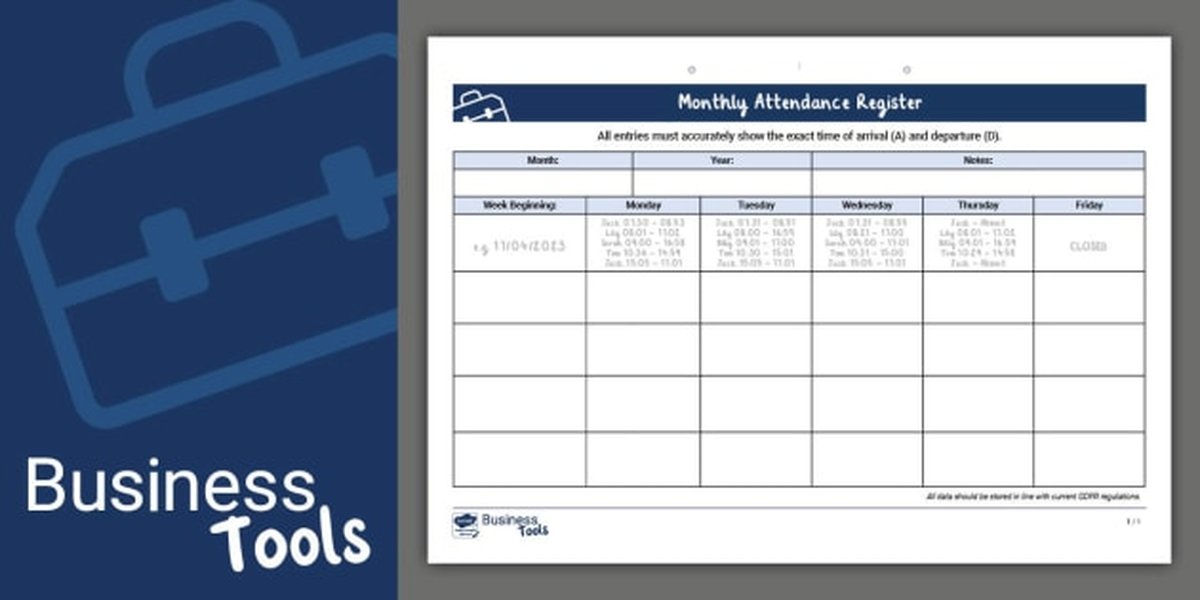
An example of a monthly attendance register, offering a broader view.
Monthly Attendance Sheets
- Description: Tracks attendance for an entire month on a single sheet (or a pair of sheets) per child or for the group.
- Pros: Comprehensive long-term overview; useful for billing cycles and compliance reporting.
- Cons: Can be very large and cumbersome to handle if for the whole group on one page; individual child details might be harder to see quickly.
Child-Specific Attendance Sheets
- Description: A separate sheet for each child, tracking their attendance over a defined period (e.g., weekly or monthly).
- Pros: Excellent for individual tracking, especially for billing based on varied hours; keeps all one child's data together.
- Cons: More sheets to manage and file overall; harder to get an immediate group attendance count.
Digital vs. Printable: Making the Choice
Both digital and printable formats have their merits:
- Printable Sheets:
- Pros: Low-tech, accessible, no reliance on devices or internet. Many free templates are available for download. Easy for physical signatures.
- Cons: Requires manual filing and storage; can be prone to damage or loss; data aggregation for billing can be time-consuming.
- Digital Solutions (Apps or Spreadsheets):
- Pros: Real-time updates, automatic calculations for billing, easy storage and retrieval, often includes parent communication features, digital signatures possible. Environmentally friendly.
- Cons: May involve subscription costs; requires devices and internet access; potential learning curve for staff and parents.
Visualizing Key Elements
A mindmap can help visualize the interconnected components of an effective childminder attendance sheet. This diagram illustrates the core information, beneficial additions, various format options, and key considerations to keep in mind during the design process.
Attendance Sheet"] id1["Core Information"] id1a["Child's Full Name"] id1b["Date / Period Covered"] id1c["Time In & Parent Signature"] id1d["Time Out & Parent Signature"] id1e["Childminding Service Name"] id2["Beneficial Additions"] id2a["Notes/Observations"] id2b["Reason for Absence"] id2c["Meal Tracking (Optional)"] id2d["Child's Date of Birth"] id2e["Allergies/Special Notes
(Brief reminder)"] id3["Format Options"] id3a["Daily Sheets"] id3b["Weekly Sheets"] id3c["Monthly Sheets"] id3d["Child-Specific Sheets"] id3e["Digital Solutions (Apps/Software)"] id3f["Printable (Paper-based)"] id4["Key Design Considerations"] id4a["Clarity & Readability"] id4b["Regulatory Compliance"] id4c["Safety & Accountability"] id4d["Ease of Use (for Staff & Parents)"] id4e["Secure Storage & Accessibility"]
Sample Attendance Sheet Layout (Daily Format)
Here is an example of a basic daily attendance sheet structure. This can be adapted into a weekly or monthly format by adding more date columns or creating a grid.
|
Your Childminding Service Name Daily Attendance Record - Date: |
|||||||
|---|---|---|---|---|---|---|---|
| Child's Full Name | Date of Birth | Arrival Time | Drop-off Parent/Guardian Signature | Departure Time | Pick-up Parent/Guardian Signature | Absence (Reason if known) | Notes/Comments |
This table can be expanded with more rows for additional children.
Comparative Effectiveness of Attendance Sheet Features
Different attendance sheet formats and systems vary in their effectiveness across key operational aspects. The radar chart below offers a visual comparison based on common childminding priorities. This is an opinionated analysis to illustrate general trends rather than hard data.
This chart suggests that while paper methods are viable, digital systems often offer enhanced capabilities across multiple areas, particularly in accuracy, compliance ease, and efficiency.
Practical Design and Usage Tips
To maximize the effectiveness of your attendance sheet, consider these practical tips:
- Clarity and Readability: Use clear, legible fonts (e.g., Arial, Calibri) and adequate spacing. Consider using alternating row colors (zebra striping) on printed sheets for easier reading.
- Regulatory Compliance: Familiarize yourself with local childcare regulations regarding attendance records. Ensure your sheet captures all mandated information.
- Storage and Accessibility: Keep completed attendance sheets organized and secure, yet accessible for staff and potential inspections. Establish a clear retention policy (e.g., keep records for a specific number of years as per local guidelines).
- Daily Updates: Make it a strict routine to fill out the sheet accurately as children arrive and depart. Don't leave it until the end of the day.
- Authorized Pick-up: Clearly note who is authorized to pick up each child and always verify identity if unsure. The signature section is critical here.
- Review and Updates: Periodically review your attendance sheet design to ensure it still meets your needs. If you switch to a digital system, ensure all staff are trained.
Guidance on Filling Attendance Records
Properly filling out an attendance record is crucial for its validity and usefulness. The following video provides general instructions and insights applicable to child care settings, emphasizing accuracy and completeness.
This video explains how to properly fill out an attendance record, highlighting key areas for parents and providers.
Key takeaways from such guidance often include ensuring legible handwriting, using correct dates and times, obtaining necessary signatures promptly, and noting any deviations or special circumstances accurately.
Frequently Asked Questions (FAQ)
What is the most important information to include on a childminding attendance sheet?
How long should I keep childminding attendance records?
What should I do if a parent forgets to sign the attendance sheet?
Are digital attendance sheets better than paper ones?
Conclusion
Designing an effective attendance sheet is a fundamental aspect of running a professional, safe, and compliant childminding service. By incorporating essential information, choosing a suitable format, and adhering to best practices for design and usage, you can create a tool that not only meets regulatory requirements but also enhances communication, streamlines operations, and provides peace of mind for both you and the families you serve. Whether you opt for a traditional paper system or a modern digital solution, consistency and accuracy are paramount.
Recommended Further Exploration
- How can I integrate digital attendance tracking into my childminding business?
- What are the specific regulatory requirements for childminding attendance records in my region?
- Tips for improving communication with parents using attendance sheet notes.
- Examples of childminding policies related to late pick-ups and absences documented on attendance sheets.
