
Unlocking the Secrets: How Your Body Uses Chlorine Without Making It
Discover the essential chlorine compounds your body creates and where the crucial ingredient actually comes from.
Highlights: The Chlorine Connection
- Essential Ion, Not Toxic Gas: Your body utilizes chlorine in the form of chloride ions (Cl⁻), an essential electrolyte, not the toxic elemental chlorine gas (Cl₂).
- Dietary Dependence: All chloride the body uses originates from external sources, primarily dietary salt (sodium chloride, NaCl) and certain vegetables.
- Vital Compounds Produced: Key chlorine-containing compounds, like hydrochloric acid (HCl) for digestion and hypochlorous acid (HOCl) for immunity, are synthesized internally using dietary chloride.
Chlorine vs. Chloride: Understanding the Difference
When discussing "chlorine" in the context of the human body, it's crucial to distinguish between elemental chlorine (Cl₂) and chloride ions (Cl⁻). Elemental chlorine is a greenish-yellow gas, highly reactive and toxic if inhaled. The human body does not produce or utilize chlorine in this gaseous form.
Instead, the body relies heavily on chloride (Cl⁻), the negatively charged ion formed when chlorine gains an electron. Chloride is an essential mineral and one of the most important electrolytes in your body fluids. It's obtained entirely from external sources and plays indispensable roles in maintaining health.
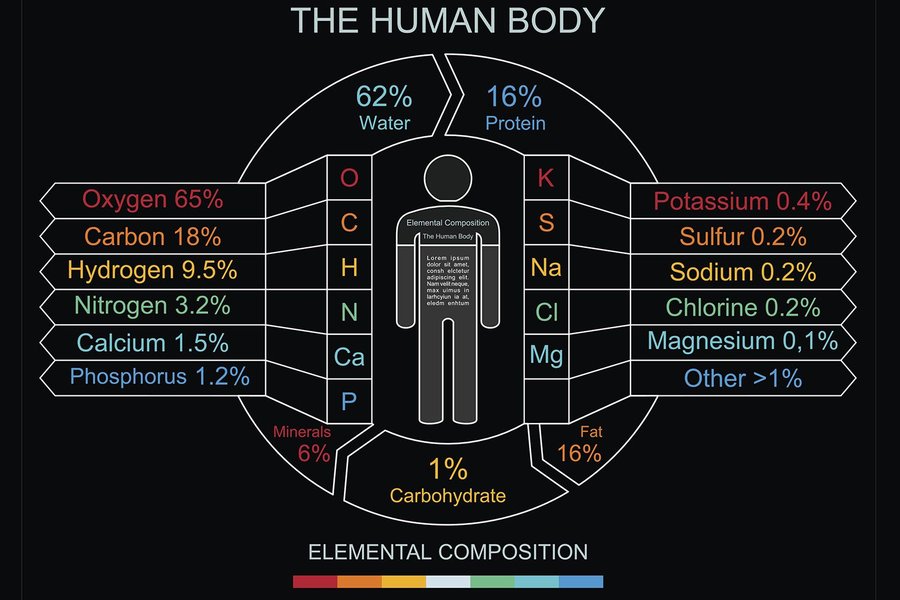
The human body is composed of various elements, with chlorine (as chloride) being an essential minor component.
Where Does the Body's Chloride Come From?
The Primary Source: Your Diet
The human body cannot synthesize chloride ions. Therefore, 100% of the chloride required for physiological processes must be obtained from the diet. The most significant source is sodium chloride (NaCl), commonly known as table salt or sea salt.
When you consume salt, it dissolves in the fluids of your digestive system and dissociates into sodium ions (Na⁺) and chloride ions (Cl⁻):
\[ \text{NaCl (solid)} \xrightarrow{\text{Water}} \text{Na}^+ \text{(aq)} + \text{Cl}^- \text{(aq)} \]These chloride ions are then readily absorbed, primarily in the intestines, and enter the bloodstream to be distributed throughout the body.
Other Dietary Sources
Besides added salt, chloride is naturally present in various foods, although typically in smaller amounts compared to processed foods with added salt. Good natural sources include:
- Vegetables: Tomatoes, lettuce, celery, olives, seaweed
- Rye
- Meats
- Milk
- Eggs
Drinking water, especially if municipally treated, can also contribute minor amounts of chloride, although dietary intake remains the main contributor.
Absorption and Storage
Once absorbed, chloride ions become a major component of the extracellular fluid, including blood plasma and the fluid surrounding cells. The body maintains a specific balance of chloride. While some chloride is stored temporarily in the skin, subcutaneous tissues, and skeleton, the body doesn't maintain large reserves. Excess chloride is typically excreted via the kidneys in urine, and some is lost through sweat.
Chlorine Compounds Synthesized by the Body
While the body doesn't make elemental chlorine, it ingeniously uses the chloride ions obtained from the diet to synthesize vital chlorine-containing compounds.
Hydrochloric Acid (HCl): The Stomach's Digestive Powerhouse
One of the most well-known chlorine compounds produced by the body is hydrochloric acid (HCl), a key component of gastric juice in the stomach. Specialized cells in the stomach lining, called parietal cells, actively transport hydrogen ions (H⁺) and chloride ions (Cl⁻) into the stomach cavity.
The chloride ions used in this process are drawn from the blood plasma, originating from dietary intake (primarily from sources like potassium chloride and sodium chloride). Inside the stomach, these ions combine to form HCl:
\[ \text{H}^+ + \text{Cl}^- \rightarrow \text{HCl} \]Hydrochloric acid serves several critical functions:
- Protein Digestion: It helps unravel dietary proteins, making them easier for enzymes to break down.
- Enzyme Activation: It converts pepsinogen (an inactive enzyme precursor) into pepsin (the active protein-digesting enzyme).
- Sterilization: The highly acidic environment (pH 1.5-3.5) kills most harmful bacteria and pathogens ingested with food, protecting against infections.
This video provides a visual explanation of how parietal cells in the stomach produce hydrochloric acid.
Hypochlorous Acid (HOCl): The Immune System's Disinfectant
Perhaps less known is the body's production of hypochlorous acid (HOCl), the very same active ingredient found in household bleach, but produced naturally by immune cells. Certain white blood cells, particularly neutrophils, utilize HOCl as a potent weapon against invading pathogens like bacteria and fungi.
During an immune response, neutrophils engulf pathogens. Inside the neutrophil, an enzyme called myeloperoxidase uses hydrogen peroxide (H₂O₂) and chloride ions (Cl⁻) – again, ultimately derived from the diet – to generate hypochlorous acid:
\[ \text{H}_2\text{O}_2 + \text{Cl}^- + \text{H}^+ \xrightarrow{\text{Myeloperoxidase}} \text{HOCl} + \text{H}_2\text{O} \]HOCl is a powerful oxidizing agent that rapidly destroys pathogens by damaging their cell walls and essential proteins. This internal production of a disinfectant highlights the sophisticated ways the body uses available chemical building blocks for defense.
Other Essential Roles of Chloride Ions
Beyond being a precursor for HCl and HOCl, chloride ions are fundamental electrolytes with widespread physiological importance:
Maintaining Fluid Balance and Osmotic Pressure
Chloride is the most abundant negatively charged ion in the extracellular fluid. Working closely with sodium (Na⁺), it plays a vital role in regulating the amount of fluid inside and outside cells and maintaining the overall osmotic pressure of body fluids. This balance is crucial for cell function and blood pressure regulation.
Nerve and Muscle Function
The movement of chloride ions across cell membranes contributes to the electrical potential difference necessary for nerve impulse transmission and muscle contraction. Specific chloride channels regulate this flow, ensuring proper neurological and muscular activity.
Acid-Base Balance
Chloride ions are involved in maintaining the body's delicate acid-base (pH) balance. One key mechanism is the "chloride shift" in red blood cells, where chloride ions are exchanged for bicarbonate ions (HCO₃⁻). This process facilitates the transport of carbon dioxide (a metabolic waste product) from tissues to the lungs for exhalation, helping to regulate blood pH.
Chlorine vs. Chloride: A Vital Distinction
It's worth reiterating the difference. While the body skillfully uses chloride ions (Cl⁻) obtained from the diet, exposure to elemental chlorine gas (Cl₂) is harmful. Inhaling chlorine gas causes it to react with moisture in the eyes, throat, and lungs, forming hydrochloric acid (HCl) and hypochlorous acid (HOCl) directly on these sensitive tissues. This causes irritation, chemical burns, coughing, breathing difficulties, and potentially severe lung damage. This external hazard is entirely different from the controlled, internal production and use of specific chlorine compounds from dietary chloride.
Key Chlorine-Related Components in the Body
The following table summarizes the main forms and compounds related to chlorine within the human body:
| Component | Form/Compound | Source/Location | Key Function |
|---|---|---|---|
| Chloride Ion | Cl⁻ | Diet (NaCl, etc.); Extracellular fluid, Blood plasma | Electrolyte balance, Fluid volume, Osmotic pressure, Nerve/Muscle function, Acid-base balance, Precursor for HCl/HOCl |
| Hydrochloric Acid | HCl | Produced by Parietal Cells in the Stomach | Food digestion (protein breakdown), Enzyme activation (pepsin), Sterilization of ingested food |
| Hypochlorous Acid | HOCl | Produced by Immune Cells (e.g., Neutrophils) | Antimicrobial defense (killing bacteria, fungi) |
Visualizing Chlorine's Journey in the Body
This mindmap illustrates the origin, forms, and functions of chlorine (as chloride) within the human body:
Relative Importance of Chloride Functions
While all functions of chloride are vital, their perceived impact or scale might differ. This radar chart offers a conceptual visualization of the relative importance of different roles chloride plays in maintaining human health, based on physiological significance.
This chart highlights the profound impact of chloride on fundamental processes like fluid balance and digestion, while also acknowledging its crucial roles in immunity, nerve/muscle activity, and pH regulation.
Frequently Asked Questions (FAQ)
Is the chloride the body uses the same as chlorine in swimming pools?
Not exactly. The essential nutrient your body uses is the chloride ion (Cl⁻), usually obtained from salt (NaCl). Swimming pools are typically disinfected using substances that release elemental chlorine (Cl₂) or hypochlorous acid (HOCl), like sodium hypochlorite (bleach) or calcium hypochlorite. While your immune system produces small amounts of HOCl internally for defense, the high concentrations in pools can irritate skin, eyes, and airways. The Cl⁻ ion itself is vital, whereas pool "chlorine" refers to disinfecting chemicals.
What happens if I don't get enough chloride?
Chloride deficiency (hypochloremia) is rare with a normal diet due to the prevalence of salt. However, it can occur due to severe vomiting, diarrhea, excessive sweating (without adequate electrolyte replacement), certain kidney diseases, or specific medications (like diuretics). Symptoms can include dehydration, weakness, fatigue, difficulty breathing, and potentially disturbances in acid-base balance (metabolic alkalosis).
Can I have too much chloride?
Yes, excessive chloride intake (hyperchloremia), usually from consuming very large amounts of salt or saline solutions, or due to dehydration or certain medical conditions (like kidney failure), can be harmful. High chloride levels can disrupt the acid-base balance (leading to metabolic acidosis), potentially affect blood pressure (often linked with high sodium intake), and strain the kidneys as they work to excrete the excess.
How much chlorine (as chloride) is in the average human body?
The average adult human body contains approximately 95 grams (about 3.5 ounces) of chlorine, primarily in the form of chloride ions (Cl⁻), distributed throughout body fluids and tissues.
Recommended Reading
- What are the main electrolytes in the human body and their functions?
- How does the stomach produce acid without digesting itself?
- What is the role of neutrophils in the immune system?
- What are the health effects of a high salt diet?
References
Last updated May 5, 2025