

Essential Insights into Citation Styles
- Discipline-Specific Design: Citation styles are not arbitrary; they are meticulously crafted to serve the specific needs and conventions of different academic disciplines, emphasizing particular elements of sources relevant to that field.
- Consistency is Key: Regardless of the style chosen, the most crucial aspect of academic referencing is consistent application throughout a document to ensure clarity, prevent plagiarism, and allow readers to easily locate sources.
- Varied In-text Approaches: Citation styles employ distinct methods for in-text attribution, ranging from author-date (APA, Chicago Author-Date, Harvard) to author-page (MLA) and numerical systems (IEEE, Vancouver, Chicago Notes-Bibliography).
In the academic world, proper attribution of sources is paramount. Citation styles provide standardized frameworks for documenting the information and ideas borrowed from others. These frameworks ensure intellectual honesty, allow readers to verify claims, and facilitate the discovery of original research. While the core purpose of all citation styles is the same, their methodologies, disciplinary preferences, and specific formatting rules vary significantly. Understanding these differences is crucial for any student, researcher, or writer aiming for academic rigor.
The choice of citation style is rarely left to personal preference; it is typically dictated by the academic discipline, the specific journal or publisher, or the instructor's guidelines. Each style prioritizes certain elements of a source based on what is considered most important within its respective field. For instance, disciplines that rely heavily on recent research (like the social sciences) tend to emphasize publication dates, while fields focused on textual analysis (like the humanities) might prioritize page numbers to pinpoint exact locations of quoted material.
The Core Purpose of Citation Styles
At their heart, citation styles standardize the process of acknowledging sources. This standardization serves several critical functions:
Ensuring Academic Integrity
The primary role of citation styles is to prevent plagiarism. By clearly attributing ideas, words, and data to their original creators, writers demonstrate intellectual honesty and respect for others' work. This practice upholds the ethical standards of academic discourse.
Facilitating Source Retrieval
A well-formatted citation provides all the necessary information for a reader to locate the original source. This is vital for scholars who wish to delve deeper into a topic, verify information, or build upon existing research. Standardized formats make this process efficient and straightforward.
Maintaining Consistency and Clarity
Consistent formatting throughout a document enhances readability and professionalism. It ensures that all source information is presented uniformly, reducing confusion and allowing readers to quickly grasp the relevant details of each reference.
Reflecting Disciplinary Conventions
Different academic fields have evolved their own traditions and priorities regarding how information is presented. Citation styles often reflect these disciplinary conventions, emphasizing aspects of sources that are most pertinent to the field's research methodologies and communication practices.
Major Citation Styles and Their Distinguishing Features
While numerous citation styles exist, a few are predominantly used across academic disciplines. Understanding their unique characteristics is key to selecting and applying the correct one.
APA (American Psychological Association) Style
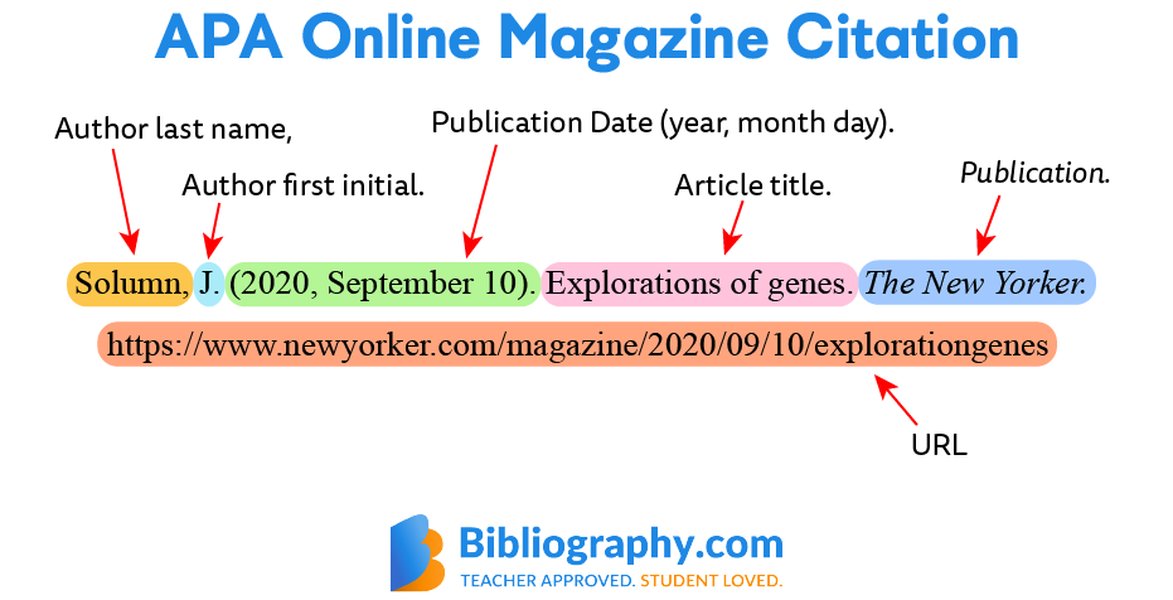
An example breakdown of an APA online magazine citation.
Primarily used in the social sciences (psychology, sociology, education), nursing, and some natural sciences, APA style (currently in its 7th edition) places a strong emphasis on the date of publication. This reflects the importance of recent research in these rapidly evolving fields.
In-Text Citations (Author-Date System)
APA uses parenthetical in-text citations that include the author's last name and the year of publication, for example: (Smith, 2023). For direct quotes, a page number or paragraph number is also included (Smith, 2023, p. 45).
Reference List
A "References" list appears at the end of the document, providing full bibliographic details for all cited sources. Entries are alphabetized by the author's last name. Titles of sources are generally in sentence case (only the first word and proper nouns are capitalized), while journal titles are italicized and in title case. DOIs (Digital Object Identifiers) and URLs are crucial for online sources.
MLA (Modern Language Association) Style

A visual guide to citing a book using MLA format.
MLA style (currently in its 9th edition) is the standard for the humanities, particularly in literature, language arts, and cultural studies. It emphasizes the author and page numbers, which are essential for pinpointing specific passages in textual analysis.
In-Text Citations (Author-Page System)
In-text citations typically include the author's last name and the page number(s) where the information was found, for example: (Smith 45). No comma separates the author and page number.
Works Cited List
At the end of the document, a "Works Cited" page lists all sources referenced in the text. MLA employs a "container" system, which is highly flexible for citing complex sources that might be part of larger works (e.g., an essay in an anthology, an article in a journal). Dates are generally less emphasized than in APA unless specifically relevant.
Chicago/Turabian Style
Chicago style, often adapted for student papers as Turabian style, is widely used in history, business, and the fine arts. It is unique in offering two distinct citation systems, providing flexibility depending on the nature of the research and the preferences of the discipline.
Notes and Bibliography System
This system uses numbered footnotes or endnotes for citations, with a comprehensive "Bibliography" at the end. Footnotes allow for extensive commentary or additional details that might disrupt the flow of the main text, making it popular in history and other fields requiring detailed source analysis.
Author-Date System
Similar to APA, this system uses author-date parenthetical citations within the text, followed by a "References" list. It is often preferred in the social sciences, natural sciences, and some humanities fields when a simpler in-text citation method is desired.
Other Specialized Citation Styles
- IEEE (Institute of Electrical and Electronics Engineers): Predominantly used in engineering, computer science, and other technical fields. It employs a numerical citation system where sources are numbered in the order they appear in the text, and these numbers correspond to an ordered list of references.
- Vancouver: Common in medicine and biomedical sciences, this style also uses a numerical system, often with in-text numbers referring to a list of references at the end. It emphasizes conciseness and ease of cross-referencing in scientific publications.
- Harvard: Widely adopted in the UK, Australia, and many European universities across various disciplines. It generally follows an author-date system similar to APA and Chicago's Author-Date system, with a reference list at the end.
The Interplay of Citation Components and Disciplinary Focus
The specific information included in a citation, and its order and formatting, are not arbitrary. They are carefully designed to prioritize what is most relevant to a particular academic field.
This mindmap visually outlines how citation styles control the standardization of information, how different disciplines prioritize specific data elements, and the variations in how full references are presented versus in-text notes. It highlights the structured approach each style takes to meet academic needs.
Consider the contrast between APA and MLA: APA's focus on the publication date is crucial for fields where theories and findings evolve rapidly. In contrast, MLA's emphasis on page numbers directly supports close textual analysis, a hallmark of literary studies. Chicago offers a versatile solution, allowing historians to provide detailed contextual notes without interrupting the narrative flow, while its Author-Date system caters to those needing a more concise approach.
The table below summarizes the key differentiators among the most common citation styles:
| Citation Style | Primary Disciplines | In-Text Citation Format | End-of-Document List | Key Emphasis |
|---|---|---|---|---|
| APA | Social Sciences, Education, some Sciences | (Author, Year) or (Author, Year, p. #) | References | Publication date, scientific rigor, DOIs |
| MLA | Humanities, Literature, Language Arts | (Author Page #) | Works Cited | Author, page numbers, textual analysis |
| Chicago/Turabian (Notes & Bibliography) | History, Arts, some Humanities | Numbered footnotes/endnotes | Bibliography | Detailed notes, historical context, extensive sources |
| Chicago/Turabian (Author-Date) | Social Sciences, Natural Sciences, some Humanities | (Author Year) | References | Conciseness, similar to APA for specific disciplines |
| IEEE | Engineering, Computer Science, Technical fields | [#] or [Author, Year] | References (numerical order) | Numerical system, technical conciseness |
| Vancouver | Medicine, Biomedical Sciences | Numbered superscripts or parentheses | References (numerical order) | Concise referencing in scientific publications |
| Harvard | UK, Australia, European universities (various) | (Author, Year) | Reference List | Author-date system, widespread adaptability |
Navigating the Nuances: What to Consider When Citing
Choosing and implementing a citation style requires attention to detail and an understanding of its specific guidelines. Even within a chosen style, there can be variations for different types of sources (e.g., books, journal articles, websites, interviews).
Consulting Official Style Guides
For definitive rules and examples, always refer to the official manuals published by the respective organizations (e.g., the Publication Manual of the American Psychological Association, the MLA Handbook, or The Chicago Manual of Style). Many universities also provide detailed library guides that summarize these styles.
Checking Assignment or Publisher Guidelines
The most important rule is to always follow the specific instructions provided by your instructor, department, or the target publication. These guidelines supersede general rules and ensure your work meets their exact requirements.
The Importance of Consistency
Once a style is chosen, consistent application of its rules throughout your entire document is paramount. Inconsistencies can detract from the credibility of your work and make it difficult for readers to follow your sources.
Why So Many Styles? The Disciplinary Rationale
The existence of multiple citation styles is a direct reflection of the diverse needs of different academic communities. Each style has evolved to best serve its primary users:
This video provides an excellent overview of the key differences between MLA, APA, and CMS styles, offering a foundational understanding of why distinct citation systems are necessary across academic disciplines.
The provided video, "Citation: Understanding the Differences Between MLA, APA, and CMS styles," is highly relevant as it directly addresses the user's query by explaining the fundamental distinctions among these three prevalent citation systems. It sheds light on why different styles exist, often emphasizing specific elements of a source that are most pertinent to a particular field of study. For instance, it likely covers how APA's focus on publication dates suits the fast-evolving social sciences, while MLA's emphasis on page numbers aids detailed textual analysis in the humanities. The video also probably touches upon Chicago's versatility, offering both note-based and author-date systems for varied research needs.
The Social Sciences' Need for Currency
In fields like psychology and sociology, research builds rapidly on prior work. The recency of a study is often a critical factor in its relevance. APA's author-date system effectively highlights the publication date, allowing readers to quickly assess the timeliness of cited research.
The Humanities' Focus on Textual Detail
Literary analysis, philosophy, and language studies often involve close readings and interpretations of specific texts. MLA's author-page system enables precise referencing to particular passages, which is crucial for supporting arguments with direct evidence from primary or secondary sources.
History's Demand for Context and Depth
Historical research frequently relies on a vast array of primary and secondary sources, sometimes with complex publication histories. Chicago's Notes-Bibliography system allows historians to provide rich contextual details, acknowledge multiple interpretations, and offer extensive discussions within footnotes or endnotes without interrupting the narrative flow of their arguments.
STEM Fields' Pursuit of Conciseness and Reproducibility
In scientific and technical disciplines, conciseness is often valued for rapid communication of findings. Numerical styles like IEEE and Vancouver allow for brief in-text citations that refer to a detailed reference list, streamlining the reading process while ensuring that sources can be easily located for verification and reproducibility of experiments or methods.
FAQ
What is the main purpose of using citation styles?
Which citation style should I use for my paper?
Can I mix different citation styles in one document?
What is the difference between a "References" list and a "Works Cited" list?
Are there tools available to help with citation formatting?
Conclusion
Citation styles are more than just arbitrary rules; they are meticulously developed systems that uphold the integrity of academic discourse and facilitate scholarly communication. Each style, from APA's emphasis on publication dates in the social sciences to MLA's focus on textual location in the humanities and Chicago's versatile systems for history and arts, is tailored to the specific needs and conventions of its respective discipline. Mastering the appropriate citation style demonstrates not only academic skill but also a fundamental respect for intellectual property and the collaborative nature of knowledge creation. The key is to understand the underlying principles of each style, always consult specific guidelines, and apply the chosen method with unwavering consistency to produce credible and professional academic work.
Recommended Further Reading
- Detailed comparison of APA vs MLA vs Chicago citation styles
- How to choose the correct citation style for my academic field
- Best practices for consistent citation formatting in academic papers
- Overview of numerical citation styles like IEEE and Vancouver