
Citing Bob Brookmeyer's Biography in Chicago 17th Edition
A Comprehensive Guide to Citing Online Sources in Chicago Style
To cite the provided URL regarding Bob Brookmeyer's biography from his official website (https://www.bobbrookmeyer.com/about) using the Chicago Manual of Style, 17th edition, you would typically use the notes and bibliography system, which is common in the humanities. This system involves using numbered footnotes or endnotes for citations within the text and a corresponding entry in a bibliography at the end of the work. The Chicago style emphasizes providing clear and consistent information for readers to easily locate the source.
Bob Brookmeyer was a highly influential figure in jazz, recognized for his mastery of the valve trombone, his innovative compositions and arrangements, and his significant contributions as an educator. His biography on his official website provides key details about his life and career, making it a valuable source for research. Understanding how to properly cite this online resource in Chicago style is crucial for academic integrity and giving due credit.
Key Highlights for Citing Online Sources in Chicago 17th Edition
- Notes and Bibliography System: This is the preferred system for many in the humanities, using numbered footnotes or endnotes and a bibliography.
- Essential Information: A citation for an online source should include the author (if available), title of the page, title of the website, publication or last updated date (if available), and the URL.
- Consistency is Key: Whichever citation method you choose (full note, short note, or author-date), maintain consistency throughout your work.
Understanding Chicago Style Citation Methods
The Chicago Manual of Style offers two primary citation systems: the notes and bibliography system and the author-date system. The notes and bibliography system is widely used in the humanities, such as history, literature, and the arts. It allows for detailed citations in footnotes or endnotes, which can include supplementary information if needed. The author-date system, more common in the social sciences and sciences, uses parenthetical citations within the text that refer to a reference list. For citing a biography from an official website like the one for Bob Brookmeyer, the notes and bibliography system is generally more appropriate.
Notes and Bibliography System Explained
In the notes and bibliography system, the first time you cite a source, you provide a full note. Subsequent citations of the same source can use a shortened note. A bibliography entry provides complete details about the source.
First Full Note
A full note for a webpage includes the author (if identifiable), the title of the specific page in quotation marks, the title of the website in italics, the publication date or last modified date (if available), and the URL. Since the "About" page on Bob Brookmeyer's website doesn't explicitly list a specific author for that page, you would typically omit the author's name in the note.
The structure for a footnote or endnote is as follows:
1. "Title of Webpage," Title of Website, Last modified Date (if available), URL.
Applying this to the Bob Brookmeyer biography page:
1. "About," Bob Brookmeyer, https://www.bobbrookmeyer.com/about.
If a last modified date were available on the page, you would include it after the website title. For example:
1. "About," Bob Brookmeyer, Last modified [Date], https://www.bobbrookmeyer.com/about.
Shortened Note
For subsequent citations of the same source after the first full note, a shortened note is used. A shortened note typically includes the author's last name (if available) and a shortened title of the work. If there is no author, you would use a shortened version of the title.
The structure for a shortened note for a webpage without a named author is:
2. Shortened Title of Webpage.
Applying this to the Bob Brookmeyer biography page:
2. "About," Bob Brookmeyer.
Note that for online sources without a specific author, you might include the website name in the shortened note for clarity, especially if you are citing multiple pages from different websites. The Chicago Manual of Style prefers shortened notes over the use of "ibid." in the 17th edition, although "ibid." is still acceptable.
Bibliography Entry
The bibliography entry provides the complete information for the source and is listed alphabetically by author's last name (or by title if no author is available) in the bibliography section at the end of your paper. For a webpage without a specific author, the entry begins with the title of the page.
The structure for a bibliography entry for a webpage without a named author is:
"Title of Webpage." Title of Website. Last modified Date (if available). URL.
Applying this to the Bob Brookmeyer biography page:
"About." Bob Brookmeyer. https://www.bobbrookmeyer.com/about.
Again, if a last modified date were present on the page, you would include it before the URL.
Author-Date System Explained
While less common for this type of source in the humanities, the author-date system uses in-text parenthetical citations. The in-text citation includes the author's last name and the year of publication. For online sources without a clear publication date, a date of access can be used, or the citation may include the year the website was last updated.
The structure for an in-text citation in the author-date system is:
(Author Last Name Year)
Since there is no specific author for the "About" page, you might cite it by the website title or a shortened title and the year of access or latest update if known. However, for a formal academic paper using Chicago style in the humanities, the notes and bibliography system is generally preferred for this type of source.
The corresponding entry in the reference list (equivalent to the bibliography in the notes and bibliography system) for the author-date system would follow a similar format to the bibliography entry but with the date placed directly after the author or title.
Title of Website. "Title of Webpage." Last modified Date (if available). URL.
Applying this to the Bob Brookmeyer biography page (assuming no specific author and no clear publication/update date, using access date if necessary):
Bob Brookmeyer. "About." Accessed April 24, 2025. https://www.bobbrookmeyer.com/about.
It is important to consult your instructor or publisher regarding which Chicago style system is required for your specific work.
Bob Brookmeyer's Illustrious Career
Bob Brookmeyer (1929-2011) was a towering figure in the jazz world, known for his exceptional talent as a valve trombonist, pianist, composer, and arranger. Born in Kansas City, Missouri, he was exposed to jazz at a young age, citing a performance by the Count Basie Orchestra as a formative experience. He began his musical journey on the clarinet before switching to the trombone and teaching himself piano. His early studies at the Kansas City Conservatory laid the foundation for his later contributions to jazz.
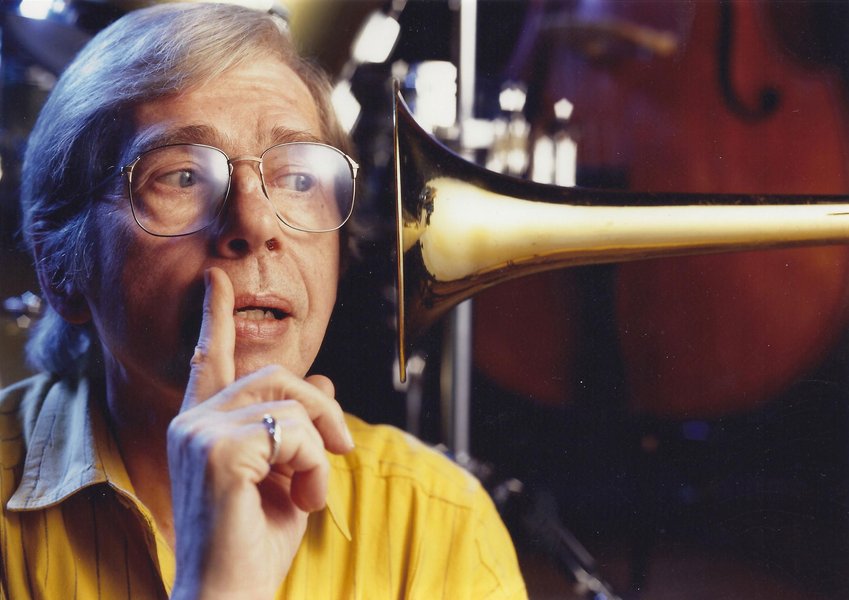
Bob Brookmeyer, a master of the valve trombone.
Brookmeyer gained significant recognition in the 1950s as a member of Gerry Mulligan's quartet. His work with Mulligan, particularly from 1954 to 1957, brought him widespread attention. He was one of the few jazz professionals to primarily play the valve trombone, giving him a distinctive sound. His career also included collaborations with notable artists such as Jimmy Giuffre and Stan Getz.
Beyond his performance career, Brookmeyer was a prolific composer and arranger. His writing was influenced by modern classical music, and he was known for his advanced and innovative approaches to arranging for both small and large ensembles. He was a founding member and lead trombonist for the Thad Jones/Mel Lewis Jazz Orchestra, contributing significantly to their repertoire as an arranger.
Brookmeyer's impact extended to jazz education. He held faculty positions at prestigious institutions like the Manhattan School of Music and the New England Conservatory, where he also chaired the jazz composition department. He was a mentor to many aspiring jazz musicians and composers, sharing his insights and compositional methods. His dedication to education helped shape the next generation of jazz artists.
The late Bob Brookmeyer and The Vanguard Jazz Orchestra performing live.
This performance clip featuring Bob Brookmeyer and The Vanguard Jazz Orchestra provides a dynamic example of his work as both a performer and arranger in a large ensemble setting. The Vanguard Jazz Orchestra has a rich history intertwined with Brookmeyer's career, particularly through his association with the Thad Jones/Mel Lewis Jazz Orchestra, which later evolved into the Vanguard Jazz Orchestra. The video showcases the power and complexity of big band jazz and Brookmeyer's role in shaping its sound. His arrangements for this ensemble were often challenging and pushed the boundaries of traditional big band writing, highlighting his innovative approach to composition. Watching this performance offers a glimpse into the energy and artistry that characterized Brookmeyer's live performances and his ability to lead and shape a large jazz ensemble.
Key Milestones in Bob Brookmeyer's Career
Bob Brookmeyer's career spanned several decades and included numerous significant achievements and collaborations. Here is a summary of some key milestones:
| Period | Key Activities and Collaborations | Notable Achievements |
|---|---|---|
| Early Years (Kansas City and Chicago) | Studied piano and composition at Kansas City Conservatory, played with dance bands, moved to Chicago and played at the Aragon Ballroom. | Awarded Carl Busch Award for Choral Composition (1949). |
| New York Scene (1950s-1960s) | Worked as freelance pianist and trombonist, played with swing and bebop bands, joined Gerry Mulligan's quartet and sextet, formed quintet with Clark Terry, became founding member and lead trombonist/arranger for Thad Jones/Mel Lewis Jazz Orchestra. | Downbeat Magazine “New Star Award” for trombone (1953), numerous Grammy nominations, collaboration with Bill Evans on a two-piano recording. |
| West Coast and Return to New York (1968-1980s) | Worked as session musician and staff arranger in Los Angeles, returned to New York, formed own quartet, became musical director of Mel Lewis's reorganized Jazz Orchestra. | Grammy nomination for Arranging and Best Album (Bob Brookmeyer: Composer, Arranger Live at the Village Vanguard), NEA grant for Jazz Composition. |
| Education and International Recognition (1980s-2000s) | Taught at Manhattan School of Music and New England Conservatory, directed BMI Composer’s Workshop, organized World School for New Jazz in Rotterdam, appointed musical director of Schleswig-Holstein Musik Festival Big Band, formed NewArt Orchestra. | Internationally recognized composer and arranger, received commissions from various orchestras and ensembles, awarded honorary doctorates, named NEA Jazz Master (2006). |
| Later Years | Continued composing, performing, and teaching, released final recording "Standards" shortly before his death. | Continued influence on jazz composition and education. |
This table provides a snapshot of the breadth and depth of Bob Brookmeyer's involvement in the jazz world, highlighting his multifaceted career as a performer, composer, arranger, and educator. His versatility and continuous evolution as an artist left an indelible mark on the history of jazz.
Bob Brookmeyer's Influence and Legacy
Bob Brookmeyer's influence on jazz extends far beyond his performances. His innovative compositional methods and his dedication to teaching have had a lasting impact on generations of musicians. He is considered one of the most significant jazz composers and arrangers of the 20th century, contributing significantly to the development of both big band jazz and orchestral jazz.
His arrangements were known for their complexity, harmonic richness, and inventive use of form. He pushed the boundaries of what was possible with jazz ensembles, inspiring other composers to explore new avenues. Through his teaching, he mentored many prominent jazz artists and educators, passing on his knowledge and philosophy of music. His legacy lives on through his extensive discography, his published scores, and the work of his many students.
FAQ
What instrument was Bob Brookmeyer best known for playing?
Bob Brookmeyer was best known for playing the valve trombone. He was one of the few prominent jazz musicians to specialize in this instrument.
What were some of the notable groups Bob Brookmeyer was a part of?
Some of the notable groups Bob Brookmeyer was a part of include the Gerry Mulligan Quartet and Concert Jazz Band, the Jimmy Giuffre 3, and the Thad Jones/Mel Lewis Jazz Orchestra (later the Vanguard Jazz Orchestra).
In what other areas did Bob Brookmeyer contribute to jazz?
In addition to being a performer, Bob Brookmeyer was a highly respected composer, arranger, and educator. He wrote numerous compositions and arrangements for various ensembles and taught at several prestigious music institutions.
Did Bob Brookmeyer receive any significant awards or honors?
Yes, Bob Brookmeyer received multiple Grammy Award nominations, grants from the National Endowment for the Arts, honorary doctorates, and was named an NEA Jazz Master in 2006.
References
 londonjazzcollector.wordpress.com
Last updated April 24, 2025