

Key Insights into Clause Patterns
- Fundamental Units: Clause patterns are the core grammatical arrangements of elements like subjects, verbs, and objects, forming the basic structures of sentences in any language.
- Diverse Structures: While English largely follows a Subject-Verb-Object (SVO) pattern, Arabic primarily utilizes Verb-Subject-Object (VSO) or nominal (subject-predicate) structures, and Kurdish commonly employs Subject-Object-Verb (SOV).
- Beyond Simple Order: These patterns extend beyond basic word order to include various complements and adverbials, creating a rich tapestry of expression across different linguistic families.
Understanding clause patterns is fundamental to comprehending how languages construct meaning. These patterns are essentially the grammatical blueprints that dictate how words and phrases are arranged to form coherent clauses and, subsequently, complete sentences. A clause, at its most basic, contains a subject (the doer of an action or the entity being described) and a predicate (typically including a verb, which expresses the action or state). The way these elements are ordered and complemented varies significantly across different languages, reflecting their unique syntactical rules and expressive capabilities.
This exploration delves into the distinct clause patterns found in English, Arabic, and Kurdish, highlighting both their commonalities and their fascinating differences. English, as an Indo-European language, often adheres to a Subject-Verb-Object (SVO) structure. Arabic, a Semitic language, frequently exhibits Verb-Subject-Object (VSO) patterns in its verbal sentences and distinct nominal structures. Kurdish, an Indo-Iranian language, commonly employs a Subject-Object-Verb (SOV) order.
The Essence of Clause Patterns: Building Blocks of Meaning
Clause patterns are foundational to linguistics, offering a framework for analyzing how languages organize information. They move beyond mere vocabulary to reveal the underlying architecture of communication. By identifying these patterns, we can better understand how speakers and writers construct precise meanings and how these constructions differ across diverse linguistic traditions.
Defining the Core Elements
At the heart of every clause pattern are a few key grammatical elements:
Subject (S)
The subject is the noun or pronoun that performs the action of the verb or is described by the predicate. It is the central figure or topic of the clause.
Verb (V)
The verb expresses an action, an occurrence, or a state of being. It is the dynamic core of the clause, determining what the subject does or what is done to the subject.
Object (O)
An object is a noun or pronoun that receives the action of a transitive verb. There can be direct objects (DO) and indirect objects (IO).
Complement (C)
A complement provides more information about the subject (subject complement) or the object (object complement), often following a linking verb or a verb that takes an object complement.
Adverbial (A)
An adverbial modifies a verb, an adjective, or another adverb, providing information about manner, place, time, frequency, or degree.
English Clause Patterns: A Detailed Look
English syntax is characterized by its relatively fixed word order, primarily SVO, which contributes to its clarity. The most common clause patterns in English form the backbone of both simple and complex sentences.
1. Subject + Verb (SV)
This is the simplest pattern, used with intransitive verbs that do not take an object.
- Example: She runs. (S: She; V: runs)
- Example: Birds fly. (S: Birds; V: fly)
2. Subject + Verb + Object (SVO)
The most common pattern, involving a transitive verb and a direct object.
- Example: She reads a book. (S: She; V: reads; O: a book)
- Example: He ate the apple. (S: He; V: ate; O: the apple)
3. Subject + Verb (Linking) + Complement (SVC)
Used with linking verbs (like "be," "seem," "become") that connect the subject to a subject complement (noun, adjective, or pronoun).
- Example: Abdul is happy. (S: Abdul; V: is; C: happy)
- Example: He is a doctor. (S: He; V: is; C: a doctor)
4. Subject + Verb + Indirect Object + Direct Object (SVOO)
This pattern involves ditransitive verbs where the action is performed on an indirect object, then transferred to a direct object.
- Example: She made me a pie. (S: She; V: made; IO: me; DO: a pie)
- Example: I gave her a gift. (S: I; V: gave; IO: her; DO: a gift)
5. Subject + Verb + Object + Object Complement (SVOC)
Here, the object is followed by a complement that describes or renames the object.
- Example: They made him happy. (S: They; V: made; O: him; OC: happy)
- Example: We elected him president. (S: We; V: elected; O: him; OC: president)
6. Subject + Verb + Adverbial (SVA)
Similar to SV, but with an added adverbial element describing the verb.
- Example: She sat there. (S: She; V: sat; A: there)
- Example: They arrived home. (S: They; V: arrived; A: home)
7. Subject + Verb + Object + Adverbial (SVOA)
This pattern combines a transitive verb and object with an adverbial phrase.
- Example: She put the book on the table. (S: She; V: put; O: the book; A: on the table)
These patterns provide the structural versatility needed for complex expressions in English.
Arabic Clause Patterns: Verbal and Nominal Constructions
Arabic syntax presents a different approach, prominently featuring two main types of sentences: verbal and nominal. The flexibility in Arabic often allows for omitted elements, particularly the verb "to be" in the present tense.
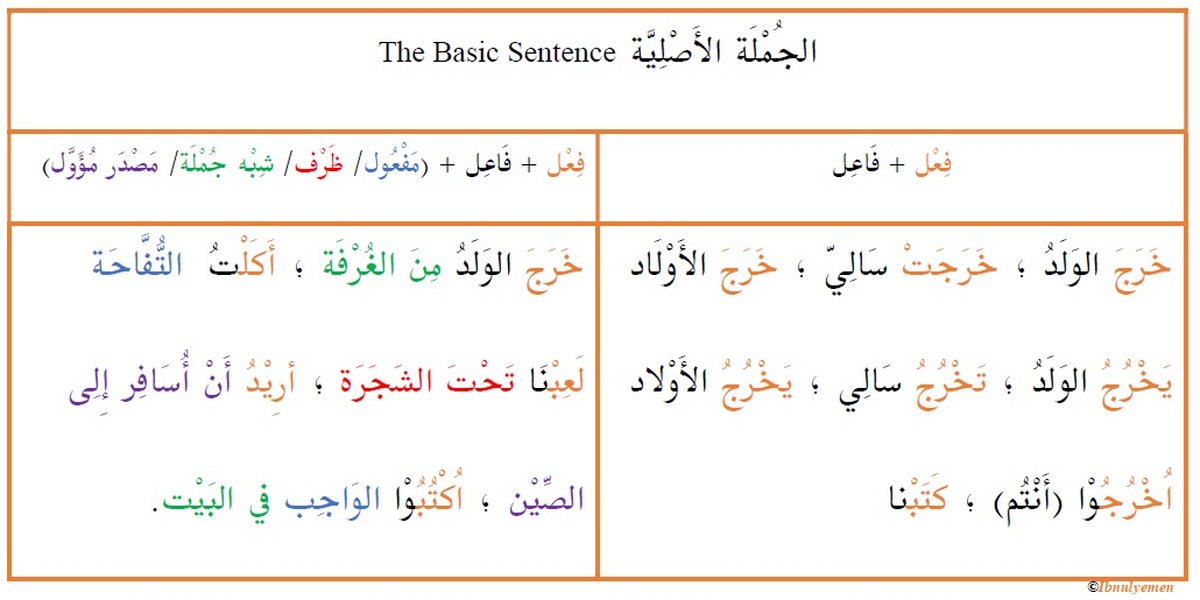
An illustration depicting the basic sentence structure in Arabic.
Verbal Sentences (Jumla Fiʿliyya)
Verbal sentences typically begin with a verb, followed by the subject and object (VSO).
- Example: كتبَ الطالبُ الواجبَ (*kataba al-ṭālibu al-wājiba*)
"The student wrote the homework." (V: wrote; S: the student; O: the homework) - Example: درستْ طالبةٌ الكتابَ (*Darasat talibatun al-kitab*)
"A student studied the book." (V: studied; S: a student; O: the book)
Nominal Sentences (Jumla Ismiyyah)
Nominal sentences usually start with a noun (the subject) followed by a predicate. The verb "to be" is often implied in the present tense.
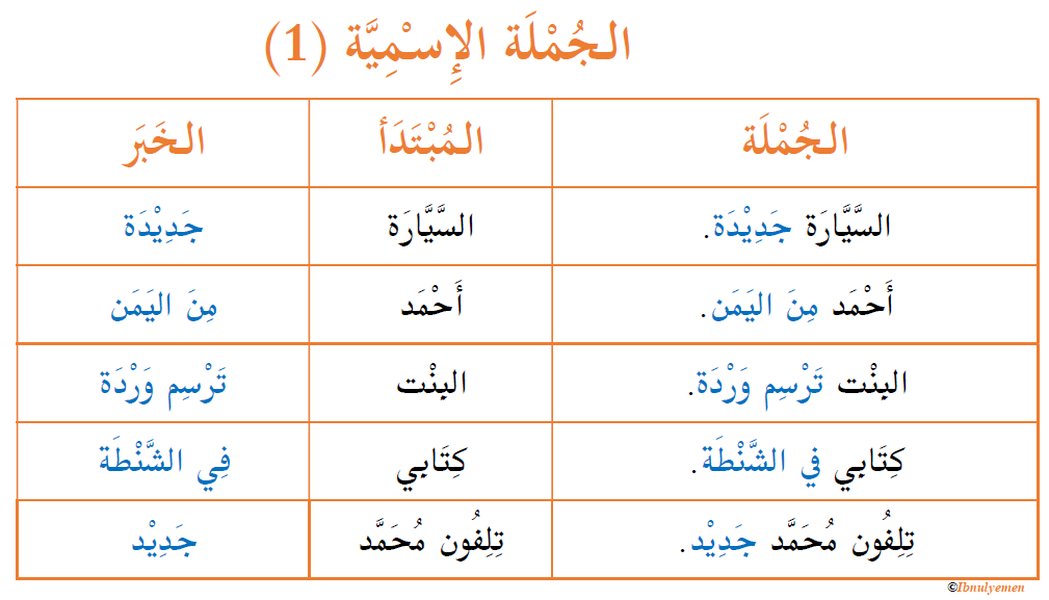
A visual representation of the nominal sentence structure in Arabic.
- Example: البنتُ ذكيةٌ (*al-bintu dhakiyyah*)
"The girl is smart." (S: The girl; P: smart - 'is' implied) - Example: الطقسُ جميلٌ (*al-ṭaqsu jamīlun*)
"The weather is beautiful." (S: The weather; P: beautiful - 'is' implied) - Example: الولدُ كبيرٌ (*Al-waladu kabirun*)
"The boy is big." (S: The boy; P: big - 'is' implied)
This distinction between verbal and nominal sentences is a key characteristic of Arabic grammar, influencing how meaning is conveyed without always requiring an explicit verb in present-tense descriptive clauses.
Kurdish Clause Patterns: Predominantly SOV
Kurdish, particularly the Kurmanji and Sorani dialects, generally follows a Subject-Object-Verb (SOV) word order in verbal clauses, a feature common among Indo-Iranian languages.
Subject + Object + Verb (SOV)
This is the most typical pattern for verbal sentences in Kurdish.
- Example (Kurmanji): Min kitêba xwend.
"I read the book." (S: I; O: the book; V: read) - Example (Sorani): Ew pirtûkê dixwîne.
"She reads a book." (S: She; O: a book; V: reads)
Kurdish also features some flexibility, especially in spoken language, but the SOV order remains a strong underlying principle.
Nominal Structures
Similar to Arabic, Kurdish can also form nominal sentences where a subject is followed by a predicate, often implying the copula "to be" in the present tense.
- Example: Ew bextewar e.
"He is happy." (S: He; P: happy - 'is' implied) - Example: Pişik spi.
"The cat is white." (S: The cat; P: white - 'is' implied)
Summary Table of Clause Pattern Differences
To further illustrate the distinctions, the following table provides a consolidated overview of primary clause patterns and general characteristics for each language:
| Language | Primary Clause Pattern (Verbal) | Nominal/Equational Structure | Word Order Flexibility | Key Characteristics |
|---|---|---|---|---|
| English | Subject + Verb + Object (SVO) | Subject + Linking Verb + Complement (SVC) - explicit verb "to be" | Relatively fixed | Strong SVO preference, explicit subject required, rich use of prepositions. |
| Arabic | Verb + Subject + Object (VSO) | Subject + Predicate (verb "to be" often implied in present tense) | More flexible with VSO and nominal options | Distinction between verbal and nominal sentences, inflections for gender/number. |
| Kurdish | Subject + Object + Verb (SOV) | Subject + Predicate (verb "to be" often implied in present tense) | Moderate flexibility, influenced by case marking | Predominantly SOV, postpositions, ergative alignment in past tenses in some dialects. |
Video Deep Dive: Understanding Simple Clause Patterns
For those seeking a more visual and auditory explanation of these fundamental concepts, the video below from The Language Library provides an excellent introduction to simple clause patterns. It offers clear explanations and examples that can further solidify your understanding of how sentences are constructed.
This video explains the fundamental building blocks of sentences and how clause patterns function.
The video "What Are Simple Clause Patterns?" breaks down the essential components of clauses, illustrating how subjects, verbs, and other elements combine. It's particularly useful for grasping the foundational principles before diving into the nuances of specific languages like Arabic and Kurdish, which, while different from English, still operate on the same core ideas of subject and predicate.
FAQ
What is a clause?
Why are clause patterns important?
What is the main difference between English, Arabic, and Kurdish clause patterns?
Can a language have more than one clause pattern?
Conclusion
Clause patterns are the syntactic backbone of any language, providing the structured arrangements that allow for coherent communication. While English, Arabic, and Kurdish each adhere to distinct primary patterns—SVO, VSO/Nominal, and SOV, respectively—their underlying purpose is the same: to clearly convey who is doing what, to whom, or what state something is in. Understanding these differences enriches our appreciation for linguistic diversity and provides a critical framework for both language learners and linguists alike. The interplay of subjects, verbs, objects, complements, and adverbials forms a universal grammar that manifests in fascinatingly varied ways across the globe.
Recommended Further Exploration
- How do grammatical cases affect clause patterns in different languages?
- The role of verb conjugation in shaping sentence structure across languages
- Comparative linguistics of Indo-European and Semitic language families
- Syntax of complex sentences in English, Arabic, and Kurdish