
Unveiling the Differences: Why SirsiDynix CloudSource+ Isn't a Simple Swap for EBSCO EDS
Exploring the distinct roles, strengths, and design philosophies of two major library discovery solutions.
In the realm of library technology, discovery services are pivotal in connecting users with a vast universe of information. SirsiDynix CloudSource+ and EBSCO Discovery Service (EDS) are prominent players in this field. However, they are designed with different core philosophies and strengths, meaning CloudSource+ cannot simply replace EDS without significant considerations. Understanding these distinctions is crucial for libraries evaluating their discovery needs.
Key Distinctions at a Glance
- Core Focus: CloudSource+ strongly emphasizes Open Access (OA) and Open Educational Resources (OER), prioritizing these freely available materials. EDS aims to provide a comprehensive, single-search experience across a library's entire collection, including subscribed databases, physical holdings, and OA content.
- Content Scope & Indexing: EDS boasts a long-established, extensive index covering a vast array of commercial and subscription-based databases alongside OA resources. CloudSource+ is rapidly expanding its index, particularly in OA and through partnerships, but its traditional strength lies in aggregating and managing electronic titles, with a primary focus on open content.
- Discovery Experience: EDS is renowned for its mature, highly customizable user interface and sophisticated relevance ranking, built upon years of user research. CloudSource+ offers discovery features and often integrates with existing discovery layers like SirsiDynix’s Enterprise, focusing more on the backend knowledge base and content aggregation.
Delving Deeper: Core Functionalities and Design Philosophies
The fundamental reasons why CloudSource+ cannot be a straightforward replacement for EDS lie in their differing objectives and designs.
SirsiDynix CloudSource+: Championing Open Access
CloudSource+, an evolution of the CloudSource platform, is engineered to highlight and provide direct access to OA and OER materials. Its design philosophy centers on making these freely available resources the first point of discovery, rather than a secondary option. Key characteristics include:
- Emphasis on OA/OER: CloudSource+ aggregates a comprehensive knowledge base of electronic titles, with a strong push towards OA articles, eBooks, eTextbooks, and OER. CloudSource OA, a component of CloudSource+, provides access to a vast number of global open access materials.
- Content Aggregation: It manages electronic titles and packages from various providers and allows for the incorporation of custom coverage.
- Integration for Fulfillment: For resources not available via OA or subscriptions, CloudSource+ integrates with interlibrary loan (ILL) systems and services like Copyright Clearance Center's "Get It Now" for on-demand article fulfillment.
- Management Tools: It includes reporting tools for title list comparisons, metadata enrichment, collection management utilities, and usage statistics.
SirsiDynix positions CloudSource+ as a solution that offers libraries flexibility in collection management and potential cost savings by leveraging the growing body of open access content.
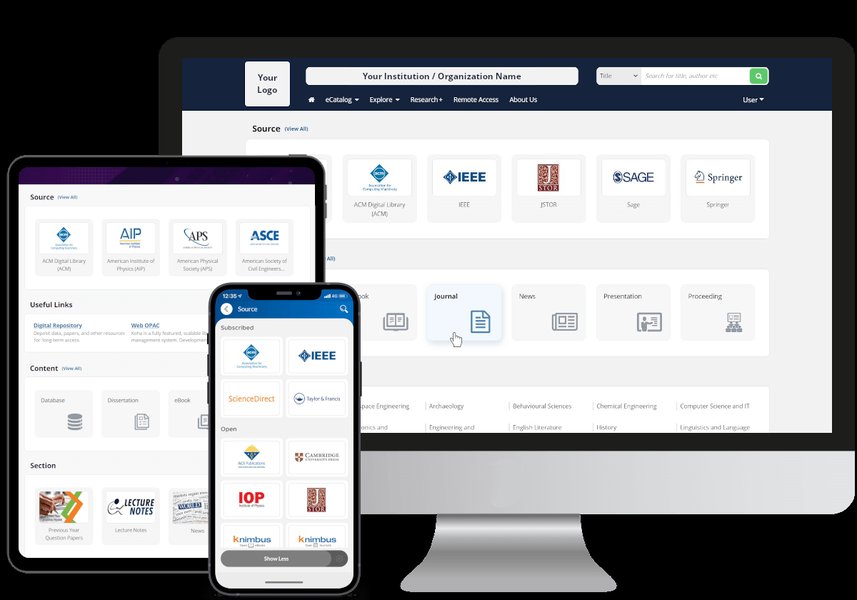
A modern digital library interface, illustrating the type of user experience discovery services aim to provide.
EBSCO Discovery Service (EDS): The Comprehensive Search Gateway
EDS is designed to be a central search hub for a library's entire collection. Its primary goal is to offer users a single search box to explore internal resources (like the library catalog) and external resources (content from numerous database vendors). Core features of EDS include:
- Unified Search Experience: EDS provides a single interface to search across diverse content types, including subscription databases, the library’s physical catalog, institutional repositories, and open access materials.
- Extensive Indexing: It features a large, centrally managed index with content from a multitude of publishers and aggregators, including superior subject indexing and full-text searching capabilities.
- User-Centric Design: The EDS interface is developed based on extensive user research, offering features like relevance ranking, faceting, saved searches, personalization through "MyEBSCO" accounts, and citation management integration.
- Broad Integration: EDS is built to be vendor-neutral and interoperable, integrating with various Integrated Library Systems (ILS), link resolvers (like Full-Text Finder), authentication systems (proxy, SSO), and other library services.
EBSCO emphasizes EDS's ability to bring together a comprehensive collection of content into a customizable discovery layer, enhancing the research experience for users.
Content Coverage: Breadth vs. Specialized Depth
A significant differentiator is the scope and nature of the content each service prioritizes and indexes.
EDS: A Universe of Subscribed and Open Content
EDS has a long-standing advantage in the breadth of its indexed content, especially concerning commercial and proprietary databases. Libraries heavily invested in specific subscription databases often find EDS's coverage indispensable. While EDS also indexes open access titles and links to trusted OA repositories, its primary strength lies in its comprehensive aggregation of diverse, high-value subscribed resources alongside open content.
CloudSource+: Excelling in Open Access Aggregation
CloudSource+ is rapidly expanding its index, notably through partnerships like the one with Gale, which added over a billion records. However, its core design prioritizes the discovery of open access materials. While it can integrate with and manage access to subscribed content, its foundational strength is in providing deep and direct access to the growing body of OA and OER. This focus can be highly beneficial for libraries aiming to maximize the use of free resources and potentially reduce subscription costs for high-OA/low-use databases.
Feature Comparison: CloudSource+ vs. EDS
To better illustrate the distinct characteristics and strengths of SirsiDynix CloudSource+ and EBSCO Discovery Service (EDS), the following radar chart provides a visual comparison across several key dimensions. This chart reflects general tendencies and core design philosophies rather than absolute measures, as specific implementations and library needs can vary.
The chart visualizes how CloudSource+ typically excels in Open Access Focus and potential Cost-Effectiveness (due to its OA emphasis), while EDS generally scores higher in areas like Commercial Database Coverage, User Interface Sophistication, and comprehensiveness in discovering Physical Collections (when integrated with an ILS). Both platforms offer robust Link Resolution and Metadata Management, though their approaches and underlying knowledge bases differ. ILS Integration capability varies, with CloudSource+ seamlessly integrating with SirsiDynix ILS and EDS offering broader vendor-neutral integration options.
Integration, User Experience, and Established Workflows
User Interface and Experience (UI/UX)
EDS has a mature and highly developed user interface, refined over years with extensive user feedback. It offers a rich set of features for personalization, filtering, and exploring results. Libraries can customize the EDS interface to match their branding and user needs.
CloudSource+ provides discovery functionalities, and users can search its index through SirsiDynix’s Enterprise Discovery platform, which allows for simultaneous searching of physical and electronic collections. The experience is thus often tied to the specific SirsiDynix discovery interface being used.
Integration with Library Systems
Libraries operate within complex technological ecosystems. EDS is designed for broad interoperability with various ILS, authentication systems, and other third-party library tools. This vendor neutrality is a key aspect of its appeal.
CloudSource+ integrates seamlessly with SirsiDynix's own ILS and other services like ILL and Get It Now. While it can work with other systems, replacing a deeply embedded EDS instance would require careful planning to ensure all necessary integrations are replicated or reconfigured, which can be a substantial undertaking.
Established Infrastructure and Workflows
Many libraries have invested considerable time and resources in configuring, customizing, and maintaining their EDS implementations. Staff and patrons are often trained and familiar with its functionalities. Switching to a new platform like CloudSource+ would necessitate significant effort in data migration, system configuration, retraining, and overall change management. This "switching cost" is a major factor.
Mindmap: Navigating Library Discovery Systems
This mindmap illustrates the core characteristics and relationships between SirsiDynix CloudSource+ and EBSCO Discovery Service (EDS) within the broader context of library discovery. It highlights their primary focuses, content strengths, and how they interact with the library ecosystem.
growing subscribed content"] id1_3["Knowledge Base Management"] id1_4["Integration: Seamless with SirsiDynix ILS,
ILL, Get It Now"] id1_5["User Experience: Often via Enterprise Discovery"] id1_6["Goal: Cost-effectiveness,
maximize free resources"] id2["EBSCO Discovery Service (EDS)"] id2_1["Core Focus: Comprehensive Single Search"] id2_2["Content: Extensive commercial databases,
physical collections, OA"] id2_3["Central Indexing Platform"] id2_4["Integration: Vendor-neutral,
broad ILS & 3rd party support"] id2_5["User Experience: Mature, customizable UI,
advanced search features"] id2_6["Goal: Unified access to all library holdings"] id3["Key Differentiators"] id3_1["Content Prioritization (OA vs. Comprehensive)"] id3_2["Index Breadth (Commercial vs. OA-centric)"] id3_3["Primary Design (Aggregator vs. Discovery Layer)"] id3_4["UI/UX Maturity and Customization"] id4["Considerations for Libraries"] id4_1["Collection Strategy & Budget"] id4_2["User Needs & Expectations"] id4_3["Existing Tech Infrastructure"] id4_4["Integration Requirements"]
The mindmap shows that while both services aim to improve resource discovery, their approaches, primary content strengths, and integration philosophies differ significantly, leading to distinct roles in a library's technology stack.
Comparative Overview: CloudSource+ vs. EDS
The following table provides a side-by-side comparison of key features and characteristics of SirsiDynix CloudSource+ and EBSCO Discovery Service (EDS), summarizing their main differences and strengths.
| Feature | SirsiDynix CloudSource+ | EBSCO Discovery Service (EDS) |
|---|---|---|
| Primary Focus | Open Access (OA) and Open Educational Resources (OER) prioritization; content aggregation. | Comprehensive, single search across all library resources (subscribed, OA, physical). |
| Content Strength | Extensive OA/OER aggregation, growing index of subscribed e-titles. | Vast index of commercial databases, journals, eBooks, alongside OA and catalog data. |
| Indexing Approach | Knowledge base of electronic titles, with strong emphasis on linking to OA. | Large central index covering diverse content types with sophisticated relevance ranking. |
| User Interface (UI) | Discovery via SirsiDynix Enterprise or other integrated platforms; focus on backend management. | Mature, highly customizable, feature-rich standalone discovery interface. |
| Integration | Deep integration with SirsiDynix ILS, ILL, Get It Now. | Vendor-neutral, designed for broad interoperability with various ILSs, authentication systems, and library tools. |
| Physical Collection Discovery | Primarily through integration with SirsiDynix Enterprise which searches the ILS. | Directly integrates with and indexes library catalogs (ILS) for physical items. |
| Full-Text Linking | Direct linking, prioritizing OA; integrates with ILL and document delivery. | Robust link resolution (e.g., Full-Text Finder) to subscribed and OA full text. |
| Customization | Customizable knowledge base and content packages. | Highly customizable user interface, search profiles, and branding. |
| Typical Use Case | Enhancing access to OA/OER, managing e-resource lifecycle, potentially reducing subscription costs. | Providing a primary, comprehensive discovery layer for all library users and resources. |
Complementary Roles and Industry Trends
It's important to note that these systems are not always mutually exclusive. In fact, SirsiDynix and EBSCO have existing partnerships. For instance, SirsiDynix Enterprise can integrate with EDS, leveraging EBSCO's discovery capabilities while CloudSource+ might manage the knowledge base for certain electronic resources, especially OA content. This suggests a complementary relationship rather than a purely competitive one where one must entirely replace the other.
The decision for a library to choose one over the other, or how to use them in conjunction, depends heavily on specific institutional goals, collection development strategies, budget constraints, existing technology infrastructure, and the primary needs of its user community. A library heavily focused on maximizing open access usage and streamlining e-resource management might find CloudSource+ highly attractive, while an institution needing a powerful, all-encompassing search across vast subscribed collections might lean heavily on EDS.
Ultimately, replacing a well-established and deeply integrated system like EDS with CloudSource+ would involve a thorough evaluation of feature parity, content coverage for essential subscribed resources, integration capabilities with the existing library ecosystem, and the significant effort required for migration and change management. While CloudSource+ offers compelling advantages, particularly in the realm of open access, its current design and scope mean it doesn't serve as a direct, one-to-one replacement for the comprehensive discovery role that EDS fulfills for many libraries.
Frequently Asked Questions (FAQ)
What is the main advantage of CloudSource+'s focus on Open Access?
The primary advantage is enhanced visibility and accessibility of freely available scholarly resources. This can lead to potential cost savings for libraries by reducing reliance on expensive subscriptions, especially for content that has high open access availability. It also supports the global movement towards open science and equitable access to information.
Can EDS effectively search a library's physical collection?
Yes, EDS is designed to integrate with a library's Integrated Library System (ILS) or catalog. This allows it to include records for physical items like books, journals, and media within its search results, providing a truly comprehensive discovery experience that spans both digital and physical holdings.
Why is integration with existing library systems so important for discovery services?
Libraries use a variety of systems (ILS, authentication, link resolvers, ILL, etc.). A discovery service must seamlessly integrate with these systems to provide accurate availability information, access to full text, user authentication, and a cohesive user experience. Poor integration can lead to broken links, access issues, and user frustration.
Do CloudSource+ and EDS compete directly, or can they work together?
While they are distinct products that might be considered alternatives in some respects, they can also be complementary. SirsiDynix and EBSCO have partnerships where their systems integrate. For example, a library might use EDS as its primary discovery interface while leveraging CloudSource+ for its OA content aggregation and e-resource management capabilities, particularly if they use a SirsiDynix ILS.
Recommended Further Exploration
- How do library discovery services handle metadata from different providers?
- What are the key factors libraries consider when choosing a discovery service?
- Explore the impact of Open Access initiatives on library collection development strategies.
- Compare the user experience design philosophies of major library discovery platforms.
References

Last updated May 6, 2025