
Unveiling the Indexing Frontiers: CloudSource+ vs. EBSCO EDS for Closed Content
A deep dive into how these discovery services handle proprietary and subscription-based resources for libraries.
When libraries evaluate discovery services, a critical factor is their ability to comprehensively index a wide array of content, especially "closed content" – resources that require subscriptions or specific access controls, such as proprietary databases, licensed journals, and eBooks. Both SirsiDynix CloudSource+ and EBSCO Discovery Service (EDS) are powerful platforms designed to provide unified access to diverse library collections. However, their approaches, partnerships, and underlying architectures can lead to differences in what specific closed content resources they can readily index or integrate.
Key Insights: Indexing Closed Content
- Partnerships & Proprietary Content: EBSCO EDS often has an advantage in indexing certain niche or proprietary databases due to its extensive network of "Partner Databases" and direct licensing agreements that might not be as readily available or deeply indexed by CloudSource+.
- Customization & Control: EDS, through EBSCOadmin, generally offers more granular control for administrators to add, customize, and prioritize specific subscribed closed content, potentially leading to a more tailored and comprehensive indexing of a library's unique collection.
- Focus and Scope: While CloudSource+ boasts a massive index of closed-access scholarly metadata from major publishers, its core strengths and ongoing development have heavily emphasized broad academic content and Open Access integration. Specific, specialized closed content outside this core might require more bespoke solutions compared to EDS's established pathways for diverse third-party content.
SirsiDynix CloudSource+: Expanding Access to Closed Content
SirsiDynix CloudSource+ aims to provide a comprehensive discovery experience by aggregating a vast amount of metadata. It unites nearly one billion closed-access records, primarily from major academic journal publishers, with an ever-expanding index of global open access (OA) and open educational resources (OER). New records are frequently added, and enhanced metadata supports a robust discovery experience.
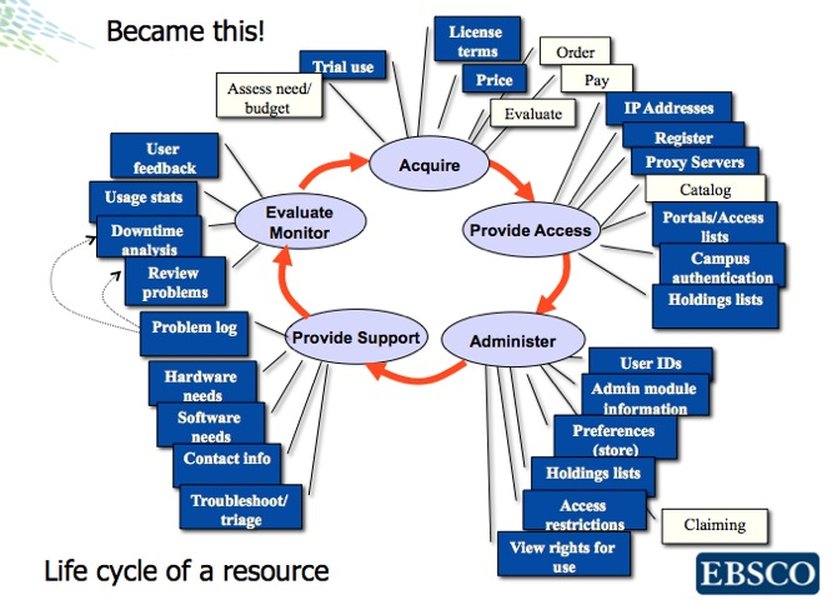
The complexities of electronic content distribution underscore the importance of robust indexing capabilities in discovery services.
Key Features of CloudSource+ Indexing:
- Broad Publisher Coverage: Incorporates metadata from virtually every major academic journal publisher.
- Significant Partnerships: A strategic partnership with Gale (part of Cengage Group) added over one billion records, including full-text journal articles, newspapers, archives, and eBooks from Gale's online databases.
- Integrated Fulfillment: Offers patron-driven acquisition and full-text article fulfillment options, such as CCC's Get It Now, for immediate access to paywalled articles.
- Knowledge Base: Includes a comprehensive knowledge base of electronic titles and packages from numerous providers, covering approximately 2,500 databases and over 100,000 journals.
- Local Content Integration: Allows for the addition of local collections like institutional repositories and digital assets, though sometimes requiring consulting services.
- Ongoing Expansion: While its current strength is scholarly resources, CloudSource+ is actively adding other types like newspapers, trade journals, and popular magazines.
Despite its broad scope, CloudSource+'s approach to closed content often relies on aggregating metadata feeds and leveraging existing library system subscriptions and fulfillment engines. While it aims for comprehensive coverage, the ease of integrating highly specialized or niche closed-access databases might vary compared to platforms with longstanding, direct integration pathways for such content.
EBSCO Discovery Service (EDS): A Customizable Gateway to Closed Resources
EBSCO Discovery Service (EDS) is renowned for its vendor-neutral, customizable single-search experience. It aggregates content from top subject indexes, extensive full-text resources, and a library's entire collection, including numerous proprietary and subscription-based databases.
Key Features of EDS Indexing:
- Extensive Partner Network: EBSCO maintains agreements with a wide array of commercial publishers, aggregators, and academic databases. The "EDS Partner Databases" program incorporates numerous third-party databases, providing access to exclusive closed content.
- Proprietary Indexes: Includes rich indexing from EBSCO’s own curated databases and high-end subject-specific indexes.
- Granular Customization: EBSCOadmin allows institutions to meticulously manage the content within their EDS profile. This includes adding new EDS Partner databases, EBSCO subscriptions, and even integrating content from other vendors like ProQuest through established best practices.
- Full-Text Depth: Often provides deeper indexing and full-text searching capabilities for subscribed databases due to direct licensing agreements.
- Vendor Neutrality: Designed to be fully interoperable with other library services, facilitating comprehensive discovery.
EDS's strength lies in its ability to integrate a diverse range of closed content, including specialized proprietary databases in fields such as business, health, education, and social sciences, which might not be standard in other platforms without specific, direct agreements. The administrative tools offer significant flexibility in tailoring the discovery experience to a library's specific holdings.
Comparative Analysis: Identifying Potential Indexing Gaps for CloudSource+
While both platforms strive for comprehensive indexing of closed content, differences in their partnership ecosystems, technological approaches, and customization capabilities can lead to situations where EDS might index specific closed content resources that are not as readily or deeply indexed by CloudSource+. It's crucial to understand that "cannot index" is a strong term; often, it's a matter of native integration versus requiring custom solutions or being outside the platform's primary aggregation strategy.
Specific Areas Where EDS May Offer More Comprehensive Indexing:
Exclusive EBSCO Partner Databases & Third-Party Aggregations
EBSCO’s long-standing "Partner Database" program means it has established integrations with numerous specialized third-party databases. These partnerships often provide exclusive or more deeply indexed content that might not be part of CloudSource+'s primary indexing targets, which focuses more on broad publisher metadata feeds. Libraries subscribing to these niche databases (e.g., specific legal, medical, or engineering databases) may find them more seamlessly discoverable via EDS.
Highly Curated Proprietary Content & Specialized Indexes
EBSCO curates and owns several proprietary content bundles and specialized scholarly indexes (e.g., in humanities, social sciences, business). This content is naturally deeply integrated into EDS. While CloudSource+ indexes broadly, it may not achieve the same level of indexing granularity or offer the same suite of curated proprietary content that is native to the EBSCO ecosystem without separate agreements or integrations.
Content Licensing and Ingestion Differences
EDS often benefits from EBSCO’s extensive direct publisher licensing agreements. These agreements can allow for deeper levels of indexing, including full-text indexing for many resources, beyond just metadata. CloudSource+'s reliance on publisher metadata feeds and services like "Get It Now" for fulfillment, while effective for broad discovery, may not always provide the same depth of direct indexing for the full text of all closed content resources compared to EDS's direct ingestion models for certain databases.
Integration of Specific Non-EBSCO Aggregator Content
EBSCO has established methodologies and best practices for integrating content from other major aggregators. For example, there are documented procedures for incorporating ProQuest products into EDS, allowing libraries to activate ProQuest aggregation collections and enable full-text sources. While CloudSource+ can integrate various content, the out-of-the-box ease and depth of integration for large, specific third-party aggregator platforms might be more developed within EDS due to its historical position as a central discovery hub.
Customization and Content Control via EBSCOadmin
EBSCOadmin provides powerful tools for librarians to fine-tune which closed content and partner databases are included and prioritized in their discovery service. This level of granular control can result in a more comprehensive and tailored indexing of a library's specific closed content subscriptions. CloudSource+ offers administrative functionality, but the extent of granular control over diverse, non-standard third-party closed content sources might differ.
Illustrative Comparison of Indexing Focus
The following chart offers a generalized comparison of the typical strengths of CloudSource+ and EDS across different aspects of content indexing. The values are illustrative and represent general tendencies rather than absolute measures, as specific library configurations and subscriptions heavily influence actual coverage.
This chart visualizes that while CloudSource+ excels in aggregating broad academic publisher metadata and open access content, EDS generally offers stronger capabilities in integrating niche proprietary databases, specific third-party aggregator content, and provides more granular administrative control over diverse sources.
Factors Influencing Closed Content Indexing Capabilities
The ability of a discovery service to index specific closed content is not static; it's influenced by a dynamic interplay of several factors. The mindmap below illustrates the key elements that determine the breadth and depth of closed content coverage for platforms like SirsiDynix CloudSource+ and EBSCO EDS.
(e.g., CloudSource+)"] id1b["Direct Content Ingestion
& Partner Integrations (e.g., EDS)"] id2["Vendor Partnerships"] id2a["Publisher Agreements
(Breadth vs. Depth)"] id2b["Third-Party Database
Integrations (e.g., EDS Partner Program)"] id2c["Aggregator Relationships
(e.g., ProQuest, Gale)"] id3["Licensing & Entitlements"] id3a["Library Subscriptions"] id3b["Content Provider Restrictions"] id3c["Proprietary Content Exclusivity"] id4["Technical Capabilities"] id4a["Indexing Depth
(Metadata, Full-Text)"] id4b["Knowledge Base Scope"] id4c["API Integrations"] id5["Customization & Administration"] id5a["Admin Tools for Content Management
(e.g., EBSCOadmin)"] id5b["Ability to Add Custom Sources"] id5c["Prioritization of Content"] id6["Platform Focus"] id6a["Emphasis on Scholarly vs.
Other Content Types"] id6b["Open Access Strategy"]
Understanding these interconnected factors helps explain why one discovery service might offer more comprehensive access to certain types of closed content than another. For instance, strong vendor partnerships and robust administrative tools for customization (often highlighted for EDS) can lead to better coverage of niche or highly specialized subscribed resources.
Summary Table: CloudSource+ vs. EDS on Closed Content Indexing
The following table provides a summarized comparison of potential differences in indexing specific types of closed content between SirsiDynix CloudSource+ and EBSCO Discovery Service. It's important to reiterate that actual capabilities can vary based on individual library subscriptions and configurations.
| Feature / Content Type | SirsiDynix CloudSource+ | EBSCO Discovery Service (EDS) |
|---|---|---|
| Primary Indexing Strength | Broad metadata from major academic publishers; extensive Open Access content. | Comprehensive indexing of subscribed databases, partner content, and proprietary EBSCO resources. |
| Niche/Proprietary Databases | Coverage depends on direct publisher feeds and partnerships; may require custom integration for some. | Strong coverage through EDS Partner Program and direct licensing; often more readily integrated. |
| Specialized Subject Indexes | Focus on broad academic journal metadata; specific deep subject indexing varies. | Often includes deep indexing from EBSCO-owned and partner subject-specific indexes. |
| Integration of Non-EBSCO Aggregator Content (e.g., ProQuest) | Possible, but integration pathways might be less standardized or require more configuration. | Established best practices and tools (e.g., via EBSCOadmin) for integrating content from major third-party aggregators. |
| Full-Text Indexing Depth | Primarily metadata-driven discovery with fulfillment options (e.g., Get It Now); full-text indexing depth varies by source. | Often provides deeper full-text indexing for many subscribed resources due to direct content ingestion and licensing. |
| Administrative Customization for Closed Content | Offers administrative tools; focus often on managing core index and OA resources. | EBSCOadmin provides extensive, granular control over adding, prioritizing, and managing a wide variety of closed content sources. |
| Reliance on | Publisher metadata feeds, knowledge base, link resolvers, and fulfillment services. | Direct content agreements, partner database integrations, and sophisticated indexing technology. |
In essence, while CloudSource+ provides excellent breadth for mainstream academic closed content and open resources, EDS often provides greater depth and flexibility for integrating a wider, more eclectic range of specialized, proprietary, and third-party subscribed closed content databases due to its historical focus, extensive partnerships, and robust administrative controls.
Frequently Asked Questions (FAQ)
Does "cannot index" mean CloudSource+ will never be able to index certain closed content?
Not necessarily. "Cannot index" in this context often refers to resources not being *readily* or *natively* indexed without significant custom effort, new partnerships, or changes in platform strategy. Both platforms are continuously evolving. CloudSource+ is expanding its content coverage. However, EDS currently has more established mechanisms and partnerships for certain types of niche or proprietary closed content due to its longstanding focus as a comprehensive discovery aggregator and its extensive partner network.
If my library subscribes to a specific ProQuest database, will CloudSource+ or EDS provide better access?
EBSCO Discovery Service generally has well-documented procedures and integrations for incorporating ProQuest products (and other third-party aggregators) effectively through EBSCOadmin. This often leads to more seamless and comprehensive discovery of such resources within EDS. While CloudSource+ can integrate various content types, the ease and depth of integration for specific large aggregator platforms like ProQuest might be more straightforward with EDS, which has historically focused on being a central point of access for diverse library subscriptions.
Is one platform definitively "better" for closed content?
There isn't a single "better" platform for all scenarios. The optimal choice depends on a library's specific collection profile, priorities, and technical resources. CloudSource+ excels in providing broad access to scholarly metadata from major publishers and an extensive range of open access content. EDS often provides more robust options for integrating and customizing access to a wider variety of specialized, proprietary, and third-party subscribed closed databases. Libraries should evaluate based on their unique subscribed resources and discovery needs.
How important are administrative tools like EBSCOadmin in this comparison?
Administrative tools are very important. EBSCOadmin, for example, allows librarians to finely tune their EDS profile by adding specific partner databases, managing subscriptions, and customizing how content appears. This level of control is crucial for ensuring that all of a library's subscribed closed content is discoverable and prioritized appropriately. While CloudSource+ also has administrative features, the granularity of control over a diverse range of third-party closed content sources is a recognized strength of EDS.
Recommended Further Exploration
- How do EBSCO Partner Databases enhance EDS closed content coverage?
- What are the specific mechanisms CloudSource+ uses for integrating third-party closed access content?
- Compare the depth of full-text indexing between CloudSource+ and EDS for major journal packages.
- What role does a library's institutional repository play in discovery services like CloudSource+ and EDS?
References
Last updated May 6, 2025