
Revolutionizing Diagnostics: The Fusion of Colorimetric LAMP and Microfluidics for Rapid Point-of-Care Testing
Unlocking accessible, swift, and precise detection by integrating cutting-edge molecular assays with miniaturized lab-on-a-chip technology.
Key Insights: The Future of On-Site Detection
- Speed and Simplicity: Combining colorimetric LAMP (Loop-Mediated Isothermal Amplification) with microfluidics enables rapid (often 15-60 minutes) and visually interpretable results, crucial for point-of-care (POC) settings.
- Miniaturization Power: Microfluidic devices, or "lab-on-a-chip" systems, drastically reduce sample and reagent volumes, accelerate reaction times, and allow for the integration of multiple diagnostic steps onto a single, portable platform.
- Innovation Hotspots: Significant opportunities for novel platforms lie in fully integrated sample-to-answer systems, robust multiplexing, reliable quantitative analysis, enhanced user-friendliness, and cost-effective, scalable manufacturing.
Understanding the Synergy: Colorimetric LAMP and Microfluidics
What is Colorimetric LAMP?
Loop-Mediated Isothermal Amplification (LAMP) is a powerful nucleic acid amplification technique that, unlike PCR, operates at a constant temperature (typically 60-65°C). This isothermal nature eliminates the need for complex thermal cyclers, making it ideal for resource-limited or field settings. LAMP is known for its high specificity, efficiency, and speed. The "colorimetric" aspect refers to the incorporation of dyes (e.g., pH indicators like phenol red, or metal-ion indicators like hydroxynaphthol blue) that change color upon successful amplification of the target DNA or RNA. This provides a simple visual readout, often detectable by the naked eye, negating the need for sophisticated detection equipment.
The Role of Microfluidic Devices
Microfluidic devices, often called "lab-on-a-chip" systems, involve the manipulation of tiny volumes of fluids (microliters to nanoliters) within precisely fabricated microchannels and chambers. These miniaturized platforms offer numerous advantages for diagnostics:
- Reduced Reagent Consumption: Small volumes mean less costly reagents are needed.
- Faster Reaction Times: Enhanced mixing and heat transfer due to small dimensions.
- Increased Sensitivity and Specificity: Controlled environment minimizes interference.
- Portability: Compact size allows for easy transport and use at the point of need.
- Integration Potential: Multiple assay steps (sample preparation, amplification, detection) can be combined onto a single chip, automating complex workflows.
Materials commonly used for microfluidic chips include polymers like polydimethylsiloxane (PDMS) and poly(methyl methacrylate) (PMMA), as well as paper and glass, each offering different benefits in terms of cost, fabrication ease, and biocompatibility.
Why This Combination is a Game-Changer for POC Diagnostics
The marriage of colorimetric LAMP with microfluidics creates diagnostic platforms that are exceptionally well-suited for point-of-care applications. These systems aim to be:
- Rapid: Delivering results quickly to enable timely interventions.
- Sensitive and Specific: Accurately detecting targets even at low concentrations.
- User-Friendly: Simple enough for operation by minimally trained personnel.
- Affordable: Reducing costs associated with reagents, equipment, and specialized labor.
- Portable: Enabling testing outside traditional laboratory settings, such as clinics in remote areas, at home, or in the field for environmental monitoring.
This synergy addresses critical needs in global health, infectious disease surveillance, food safety, and environmental testing by making molecular diagnostics more accessible and deployable.
Integrating Colorimetric LAMP with Microfluidic Devices: A Step-by-Step Approach
The successful integration of these two technologies involves careful consideration of several key aspects to create a functional and reliable POC device.
Microfluidic Chip Design and Fabrication
The microfluidic chip forms the core of the integrated system. Its design must accommodate all necessary steps of the LAMP assay. Common chip types include:
- Paper-based microfluidics: These are extremely low-cost, disposable, and can utilize capillary action for fluid movement, eliminating the need for external pumps. They are well-suited for simple colorimetric readouts.
- Polymer-based chips (e.g., PDMS, PMMA): These offer more complex fluidic control, better temperature management, and can integrate multiple functional modules. Fabrication methods include soft lithography, injection molding, or 3D printing.
- Digital Microfluidics (DMF): These platforms manipulate discrete droplets of fluid using electrical fields, allowing for precise control and automation of complex protocols, including multiplexed LAMP reactions.
The chip design must ensure efficient mixing of samples and reagents, provide chambers for the LAMP reaction, and facilitate clear visualization of the colorimetric result, all while minimizing potential contamination.
On-Chip Sample Preparation
A major challenge in POC diagnostics is simplifying sample preparation. For nucleic acid testing, this typically involves cell lysis to release DNA/RNA and purification to remove inhibitors. Integrated microfluidic systems aim to automate these steps:
- Lysis: Can be achieved through chemical, thermal, or mechanical methods integrated into the chip.
- Nucleic Acid Extraction: Techniques like solid-phase extraction (e.g., using silica beads or membranes coated with capture chemistries) can be miniaturized and incorporated into microfluidic channels. Some designs allow for direct amplification from crude samples to further simplify the workflow.
The goal is to create "sample-in-result-out" devices that require minimal manual intervention.
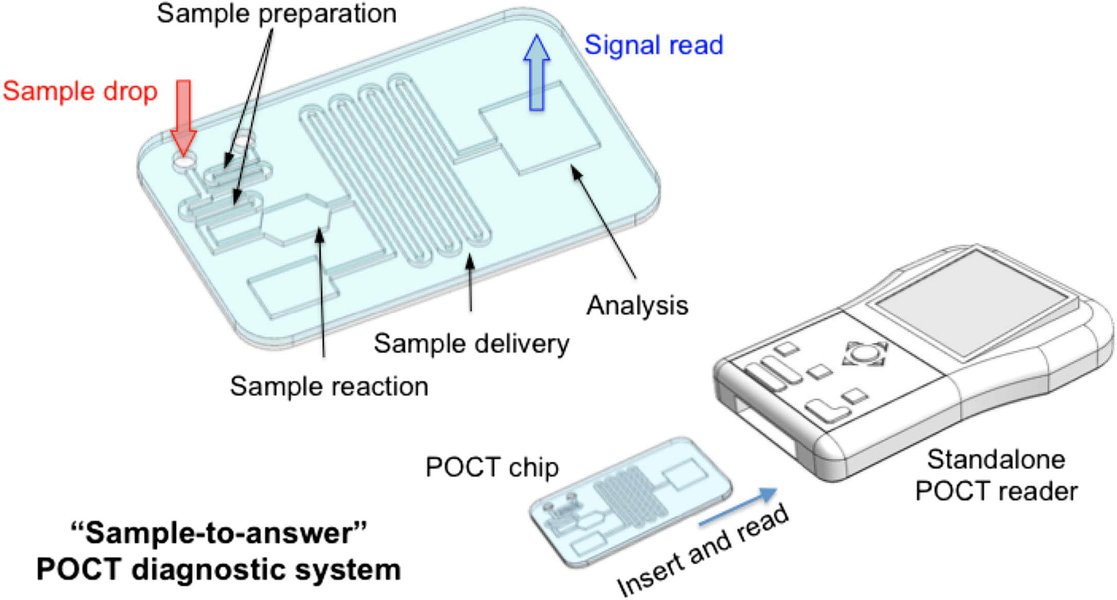
A conceptual diagram illustrating the components of a point-of-care testing device, highlighting the integration of sample input, processing, and result readout.
Reagent Management and Incorporation
Storing and handling LAMP reagents on-chip is crucial for user-friendliness and shelf stability. Common strategies include:
- Lyophilization (Freeze-Drying): LAMP reagents, including primers and colorimetric dyes, can be pre-loaded and lyophilized directly within the microfluidic chip. This allows for long-term storage at ambient temperatures and reagents are simply rehydrated by the sample fluid.
- On-Chip Storage and Mixing: Chips can be designed with reservoirs for storing liquid reagents, which are then mixed with the sample through passive (e.g., capillary flow) or active (e.g., micro-pumps, valves) mechanisms.
Precise Isothermal Temperature Control
LAMP reactions require a stable isothermal temperature, typically around 60-65°C. Microfluidic platforms integrate various heating mechanisms:
- Miniaturized Heaters: Thin-film resistive heaters, Peltier elements, or even chemical exothermic reactions can be incorporated into or beneath the chip to provide uniform and stable heating to the reaction chamber.
- Temperature Sensors: Integrated sensors monitor and regulate the temperature to ensure optimal reaction conditions.
The small thermal mass of microfluidic devices allows for rapid heating and precise temperature control.
Colorimetric Detection and Readout Mechanisms
The color change indicating a positive LAMP reaction needs to be clearly observable. Methods include:
- Naked-Eye Detection: The simplest form, where a visible color change in the reaction chamber is interpreted by the user. This is ideal for low-resource settings.
- Smartphone-Based Readers: The built-in camera and processing power of smartphones can be leveraged to capture images of the colorimetric result. Custom apps can then analyze the color intensity or changes over time, providing a more objective and potentially quantitative or semi-quantitative result, along with data logging and sharing capabilities.
- Portable Optical Sensors: Simple photodetectors or miniaturized spectrophotometers can be integrated with the microfluidic chip for automated and quantitative color measurement.
- Lateral Flow Assays (LFAs): Amplified LAMP products can be detected on a lateral flow strip integrated into the microfluidic device, providing a clear line-based visual result similar to a pregnancy test.
Efforts are focused on making the readout unambiguous and minimizing user variability in interpretation.
Visualizing the Potential: Capabilities of Integrated Platforms
The integration of colorimetric LAMP with microfluidics aims to bridge the gap between current diagnostic capabilities and the ideal requirements for point-of-care testing. The radar chart below provides an opinionated comparison of "Current Average Platforms" versus "Ideal Future Platforms" across several key performance indicators. This visualization helps to highlight areas where innovation is most needed.
This chart illustrates that while current platforms have made significant strides, there is room for improvement, particularly in areas like multiplexing capability and reliable quantitation, to reach the full potential envisioned for ideal POC diagnostic tools.
Mapping the Innovation Landscape: Key Components and Challenges
The development of novel detection platforms using colorimetric LAMP and microfluidics involves navigating a complex landscape of integration aspects, potential benefits, and persistent challenges. The mindmap below outlines these interconnected elements, providing a visual overview of the field.
(Materials: PDMS, Paper, Polymers)"] SamplePrepOnChip["On-Chip Sample Preparation
(Lysis, Nucleic Acid Extraction)"] ReagentsHandling["Reagent Handling & Storage
(Lyophilization, On-Chip Mixing)"] TempControlSystem["Isothermal Temperature Control
(~60-65°C, Miniaturized Heaters)"] DetectionMethods["Colorimetric Detection & Readout
(Visual, Smartphone-Assisted, Optical)"] Benefits["Advantages of Combination"] SpeedRapid["Rapid Results (15-60 min)"] SensitivitySpecificityHigh["High Sensitivity & Specificity"] CostEffective["Cost-Effectiveness & Affordability"] PortabilityField["Portability & Field Deployability"] AutomationWorkflow["Automation & Simplified Workflow"] ChallengesGaps["Critical Challenges & Gaps for Novel Platforms"] AdvSamplePrep["Advanced Sample Preparation
(Complex samples, Full automation)"] RobustMultiplex["Effective & Robust Multiplexing
(Multiple targets, Clear discrimination)"] ReliableQuant["Reliable Quantitative Analysis
(Beyond qualitative/semi-quantitative)"] EnhancedUserFriend["Enhanced User-Friendliness
(Minimal training, Intuitive interface)"] ScalableMfg["Scalable & Low-Cost Manufacturing
(Mass production for accessibility)"] PerformanceMicro["Maintaining Assay Performance at Microscale"] TruePortabilityPower["True Portability & Low/No Power Needs
(Battery-operated, Power-free heating)"] CommercializationPath["Translational & Commercialization Hurdles
(Regulatory approval, Market adoption)"] FutureOutlook["Outlook for Future Development"] FullyIntegratedSystems["Truly Sample-to-Answer Platforms"] SmartAIQuant["AI-Powered & Smartphone-Integrated Quantitative Readouts"] LowCostFabTech["Novel Low-Cost Fabrication Techniques
(e.g., 3D printing, Roll-to-roll)"] UserCentricDesignFocus["Emphasis on User-Centered Design"] ContaminationFree["Closed, Contamination-Free Cartridges"]
This mindmap illustrates the multifaceted nature of combining colorimetric LAMP with microfluidics. Success hinges on addressing the challenges in areas like sample preparation and multiplexing, while leveraging the inherent benefits to create impactful future diagnostic tools.
Critical Gaps and Opportunities for Novel Detection Platforms
Despite significant progress, several gaps and challenges persist, offering fertile ground for innovation in the development of next-generation colorimetric LAMP-microfluidic POC platforms.
Enhancing Sample Preparation Efficiency
Challenge: Many current systems still require off-chip sample processing or struggle with complex sample matrices (e.g., whole blood, soil, viscous fluids). Achieving efficient, rapid, and automated on-chip lysis and nucleic acid extraction without inhibition of the LAMP reaction remains a hurdle.
Opportunity: Development of novel microfluidic modules for universal sample preparation, integration of inhibitor-tolerant LAMP chemistries, and methods for direct amplification from minimally processed samples.
Achieving Robust Multiplexing Capabilities
Challenge: While single-target detection is common, simultaneously detecting multiple pathogens or genetic markers in a single sample (multiplexing) on a colorimetric microfluidic platform is complex. Distinguishing multiple colorimetric signals without cross-talk or complicated chip designs is difficult.
Opportunity: Innovative microfluidic architectures (e.g., spatial separation of reactions, droplet-based systems), novel colorimetric reporting strategies (e.g., distinct color palettes, spatially resolved readouts), and advanced primer design for multiplex LAMP.
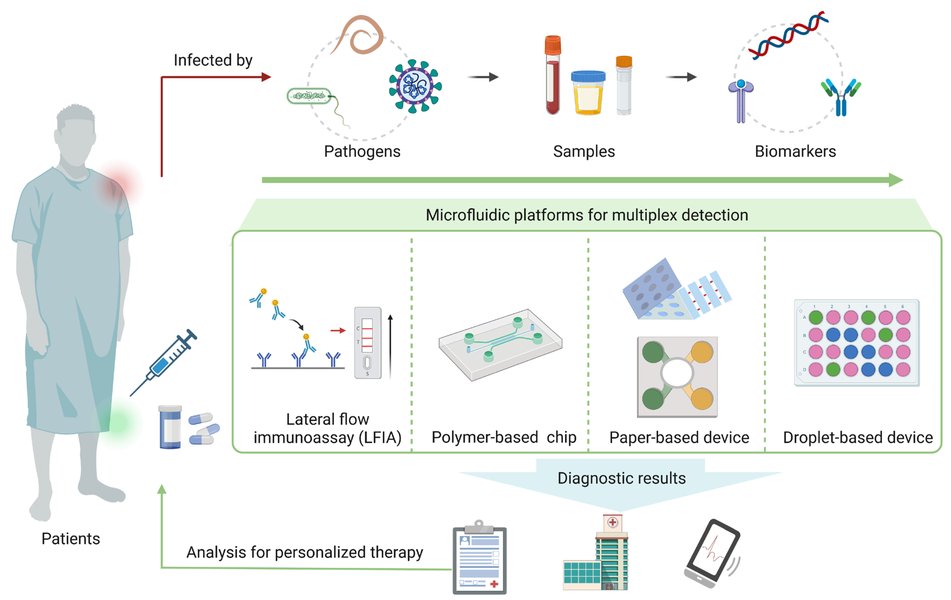
An example of a microfluidic chip designed for multiplex detection, showcasing separate reaction zones.
Advancing Quantitative Analysis
Challenge: Most colorimetric LAMP assays provide qualitative (yes/no) or at best semi-quantitative results. Achieving accurate and reliable quantification of target nucleic acids using simple colorimetric readouts is challenging due to factors like signal saturation and subjective visual interpretation.
Opportunity: Integration of sophisticated optical detection systems, development of new colorimetric indicators with a wider dynamic range, real-time colorimetric monitoring, and AI/machine learning algorithms for smartphone-based image analysis to achieve robust quantification.
Improving User-Friendliness and Automation
Challenge: Many microfluidic devices, despite their potential, still require multiple manual steps (e.g., sample loading, reagent introduction, initiation) or specialized training, hindering their adoption by non-experts.
Opportunity: Designing fully automated "sample-in-result-out" cartridges with intuitive interfaces, minimal user interaction (e.g., single-button operation), and clear, unambiguous result displays. This includes passive fluid control mechanisms (e.g., capillary action, vacuum-driven flow) to eliminate the need for external pumps.
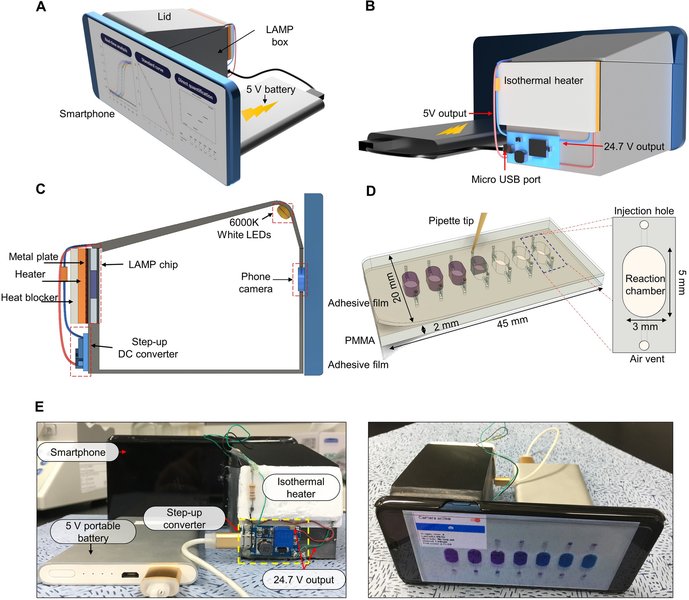
Illustration of a smartphone-integrated system for quantifying colorimetric LAMP results, enhancing user-friendliness and data capture.
Ensuring Cost-Effectiveness and Scalability
Challenge: While the goal is affordability, the fabrication of complex microfluidic chips and integration of components can still be costly, especially for sophisticated designs. Ensuring that these platforms are genuinely low-cost and manufacturable at scale is vital for widespread deployment, particularly in resource-limited settings.
Opportunity: Exploring ultra-low-cost materials (e.g., advanced paper-based systems), novel fabrication techniques (e.g., 3D printing, roll-to-roll manufacturing for paper microfluidics), and simplifying device architecture without compromising performance.
Maintaining Performance in Miniaturized Systems
Challenge: Miniaturizing reaction volumes to nanoliter or picoliter scales can impact reaction kinetics, sensitivity, and reproducibility. Inhibitory effects from chip materials or increased surface-area-to-volume ratios can also affect LAMP efficiency.
Opportunity: Optimizing LAMP chemistries for micro-scale reactions, careful material selection for biocompatibility, and precise control over fluid dynamics and thermal uniformity within the microfluidic chip.
Developing Truly Portable and Power-Efficient Systems
Challenge: While many systems are "portable," they may still rely on external power sources for heating or operation, limiting their use in off-grid locations. The need for stable temperature control (60-65°C) is a key power consumer.
Opportunity: Development of battery-powered or entirely power-free systems using, for example, chemical exothermic reactions for heating, phase-change materials for temperature stabilization, or solar power. Designing for robustness against environmental variations (temperature, humidity) is also critical.
Overcoming Translational and Commercialization Hurdles
Challenge: Moving a promising laboratory prototype to a commercially viable and regulatory-approved product is a significant leap. This involves extensive validation, meeting quality standards, navigating intellectual property landscapes, and establishing manufacturing capabilities.
Opportunity: Early consideration of design-for-manufacture, engagement with regulatory bodies, forming strategic partnerships, and focusing on assays with clear clinical or market needs to facilitate the translational pathway.
Spotlight on Microfluidic Innovation
The development of microfluidic platforms is a dynamic field, with companies and researchers continuously pushing the boundaries of what's possible for point-of-care diagnostics. The video below provides insights into how microfluidic-based solutions are being engineered for various assays, including molecular methods like LAMP, often with single-use applications in mind. This context is valuable for understanding the broader technological landscape in which integrated LAMP-microfluidic devices are evolving.
This video highlights the versatility of microfluidics in handling complex biological assays by miniaturizing and automating processes. Such advancements are pivotal in realizing the potential of combined colorimetric LAMP and microfluidic systems for diverse diagnostic applications, from infectious disease detection to personalized medicine.
Addressing Key Challenges: A Comparative Overview
The journey to developing optimal POC diagnostic platforms involves tackling several key challenges. The table below summarizes some of these critical areas, their descriptions, and potential innovative solutions being explored.
| Challenge Area | Description of Challenge | Potential Solutions / Innovations |
|---|---|---|
| Sample Preparation | Inefficient or complex on-chip lysis and nucleic acid extraction, especially from diverse sample types (blood, saliva, environmental). Risk of PCR inhibitors. | Integrated micro-solid phase extraction, acoustic lysis, inhibitor-tolerant enzymes, direct amplification protocols, paper-based filters. |
| Multiplexing | Difficulty in simultaneously detecting multiple targets with distinct colorimetric signals on a single chip without cross-talk or complex fluidics. | Spatially separated reaction chambers, droplet microfluidics, distinct colorimetric indicators, advanced primer design, LFA integration for multiplex readout. |
| Quantitative Readout | Colorimetric assays are often qualitative or semi-quantitative. Achieving reliable, precise quantification is difficult with simple visual or color-based detection. | Smartphone apps with AI-driven image analysis, real-time colorimetric monitoring, integrated optical sensors, calibration standards on-chip. |
| User-Friendliness | Systems may require multiple manual steps, precise pipetting, or trained personnel, limiting true POC applicability. | Fully automated "sample-to-answer" cartridges, intuitive interfaces, minimal user steps (e.g., "one-button" operation), passive flow control. |
| Cost & Scalability | Fabrication of microfluidic chips and integration of components can be expensive, hindering low-cost mass production. | Use of low-cost materials (e.g., paper, thermoplastics), scalable manufacturing (e.g., roll-to-roll, 3D printing, injection molding), simplified device designs. |
| Power Requirements | Need for stable heating (60-65°C for LAMP) can be power-intensive, limiting use in off-grid settings. | Chemical exothermic heating, phase-change materials for thermal buffering, low-power electronics, integration with portable power sources (batteries, solar). |
| Contamination Control | Risk of amplicon cross-contamination leading to false positives, especially in open or re-usable systems. | Closed-system disposable cartridges, integrated waste containment, physical barriers between reaction zones. |
Frequently Asked Questions
What is colorimetric LAMP?
Colorimetric Loop-Mediated Isothermal Amplification (LAMP) is a technique for rapidly amplifying DNA or RNA at a single, constant temperature. It incorporates visual indicators (dyes) that change color when the target genetic material is amplified, allowing for a simple, naked-eye detection of a positive or negative result without needing complex equipment.
What are microfluidic devices in diagnostics?
Microfluidic devices, often called "lab-on-a-chip," are miniaturized systems that handle and process very small volumes of fluids (microliters to nanoliters) within tiny channels and chambers. In diagnostics, they enable the automation and integration of various laboratory procedures like sample preparation, mixing, reaction, and detection onto a small, often portable, chip.
Why combine LAMP and microfluidics for POC testing?
Combining LAMP's rapid, isothermal amplification and simple colorimetric readout with the miniaturization, automation, and low-volume capabilities of microfluidics creates powerful point-of-care (POC) diagnostic tools. This synergy leads to tests that are fast, sensitive, user-friendly, portable, and potentially low-cost, making them ideal for use outside traditional laboratories, such as in clinics, at home, or in field settings.
What are the main advantages of this combined approach?
The main advantages include: Rapid results (often within 15-60 minutes); High sensitivity and specificity comparable to lab-based tests; Portability due to miniaturization and no need for bulky equipment; Reduced reagent and sample consumption; Potential for automation, simplifying the workflow; and Lower costs, making diagnostics more accessible, especially in resource-limited settings.
What does "sample-to-answer" mean in this context?
A "sample-to-answer" or "sample-in-result-out" platform is a fully integrated diagnostic device where a raw biological sample (like saliva, blood, or a swab) is directly introduced into the device, and all subsequent steps—sample preparation (e.g., cell lysis, nucleic acid extraction), amplification (e.g., LAMP), and detection—are performed automatically within the device, yielding a final diagnostic result without further manual intervention.
Recommended Further Exploration
- Explore the latest advancements in paper-based microfluidics for colorimetric LAMP assays.
- Investigate how smartphone technology can be effectively integrated for quantitative analysis of microfluidic LAMP tests.
- Learn about the regulatory pathways for approving novel point-of-care diagnostic devices based on LAMP and microfluidics.
- Compare the challenges of multiplexing colorimetric LAMP assays versus fluorescence-based LAMP assays on microfluidic chips.
References
Last updated May 21, 2025