
Unveiling the Most Common Cognitive Biases
Understanding and Mitigating Mental Shortcuts That Distort Our Thinking
Key Highlights of Common Cognitive Biases
- Confirmation Bias: The tendency to favor information that confirms existing beliefs, hindering objective evaluation.
- Availability Heuristic: Overestimating the likelihood of events that are easily recalled, leading to skewed risk assessments.
- Anchoring Bias: Heavily relying on the first piece of information received, impacting subsequent judgments and decisions.
Cognitive biases are systematic patterns of deviation from norm and/or rationality in judgment. They are mental shortcuts our brains use to simplify information processing, but they can lead to inaccurate judgments and irrational decisions. Understanding these biases is the first step in mitigating their impact on our thinking and behavior. These biases influence our beliefs, distort our thinking, and sway our decisions, often without us even realizing it.
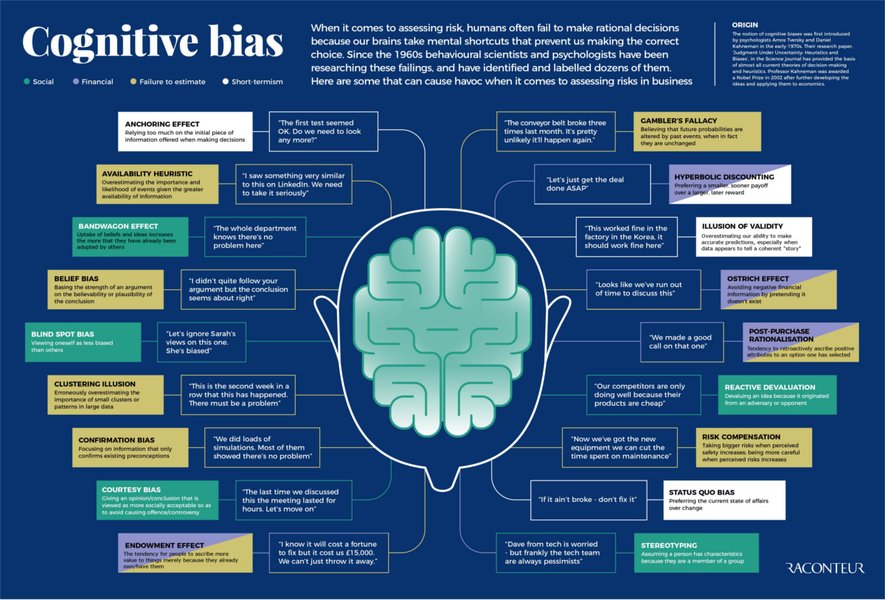
Visual representation of common cognitive biases.
Exploring the Landscape of Cognitive Biases
There are numerous cognitive biases, with estimates suggesting over 150 different types. These biases affect how we filter information, assign meaning, make decisions, and remember things. Recognizing these biases is crucial for making more rational and informed choices.
Confirmation Bias: Seeking Validation
Confirmation bias is our tendency to search for, interpret, favor, and recall information that confirms our existing beliefs or hypotheses. This bias can prevent us from objectively evaluating evidence and considering alternative perspectives.
For example, if you believe that a particular political party is inherently corrupt, you might selectively seek out news articles and opinions that support this belief, while ignoring or dismissing information that contradicts it. This can lead to a skewed perception of reality and reinforce existing prejudices.
Availability Heuristic: Relying on Memory
The availability heuristic is a mental shortcut where we estimate the likelihood of an event based on how easily we can recall examples of it. Events that are more vivid, recent, or emotionally charged tend to be more readily available in our memory, leading us to overestimate their probability.
For instance, people often overestimate the risk of dying in a plane crash because these events are widely publicized and easily come to mind. In reality, the probability of dying in a car accident is significantly higher, but this risk is often underestimated because car accidents are more common and less sensationalized.
Anchoring Bias: The Power of First Impressions
Anchoring bias occurs when we rely too heavily on the first piece of information we receive (the "anchor") when making decisions. This initial anchor can disproportionately influence our subsequent judgments, even if it is irrelevant or arbitrary.
Imagine you are negotiating the price of a car. The seller initially asks for $25,000. Even if you believe the car is worth less, this initial price can serve as an anchor, influencing you to offer a higher price than you would have otherwise. Similarly, in financial decisions, seeing an initial price can heavily influence how much people are willing to pay, regardless of the item's actual value.
Other Common Cognitive Biases
Beyond confirmation, availability, and anchoring biases, many other cognitive biases can impact our thinking. Here are a few notable examples:
- Halo Effect: The tendency to form a positive impression of someone in one area and extend that impression to other areas, even if unrelated. For example, if someone is physically attractive, we may also assume they are intelligent and good-natured.
- Bandwagon Effect: The tendency to do or believe things because many other people do or believe the same.
- Dunning-Kruger Effect: A cognitive bias in which people with low ability at a task overestimate their ability. It is related to the cognitive bias of illusory superiority and comes from the inability of people to recognize their lack of ability.
- Hindsight Bias: The tendency to believe, after learning an outcome, that one would have foreseen it.
- Actor-Observer Bias: The tendency to attribute one's own actions to external causes while attributing other people's behaviors to internal causes. For example, attributing your lateness to traffic but someone else's lateness to laziness.
- Gambler's Fallacy: The belief that if something happens more frequently than normal during a given period, it will happen less frequently in the future (or vice versa).
This video explains 12 cognitive biases, including anchoring bias, availability heuristic, bandwagon bias, and confirmation bias. Understanding these biases can help improve your thinking and decision-making skills by recognizing how these mental shortcuts can lead to errors in judgment.
The Impact of Cognitive Biases
Cognitive biases can have far-reaching consequences, affecting our personal lives, professional careers, and even societal outcomes. They can lead to poor decision-making, strained relationships, and inaccurate perceptions of the world around us. In business, cognitive biases can lead to flawed strategies and missed opportunities. In science, they can affect research design and interpretation.
Cognitive Distortions and Mental Health
Cognitive distortions, which are closely related to cognitive biases, can contribute to negative thinking patterns and mental health issues such as depression and anxiety. These distortions involve irrational or unhelpful ways of thinking about oneself, others, or the world. Common cognitive distortions include:
-
All-or-Nothing Thinking: Seeing things in black-and-white categories, with no middle ground.
-
Overgeneralization: Drawing broad conclusions based on a single event.
-
Mental Filtering: Focusing only on the negative aspects of a situation while ignoring the positive.
-
Catastrophizing: Exaggerating the potential consequences of an event.
-
Emotional Reasoning: Assuming that your feelings reflect reality.
Addressing these cognitive distortions is a key component of Cognitive Behavioral Therapy (CBT), a widely used therapeutic approach for treating mental health conditions.
Strategies for Mitigating Cognitive Biases
While it is impossible to eliminate cognitive biases entirely, there are several strategies we can use to minimize their influence:
- Increase Awareness: Learning about cognitive biases is the first step in recognizing them in ourselves and others.
- Seek Diverse Perspectives: Actively solicit opinions from people with different backgrounds and viewpoints.
- Challenge Assumptions: Question your own beliefs and assumptions, and be willing to consider alternative explanations.
- Use Data and Evidence: Rely on objective data and evidence rather than intuition or gut feelings.
- Slow Down Decision-Making: Avoid making hasty decisions, and take the time to carefully consider all available information.
- Employ Checklists and Decision-Making Frameworks: Use structured tools to ensure that you are considering all relevant factors and avoiding common biases.
- Practice Mindfulness: Cultivate awareness of your thoughts and emotions, allowing you to recognize when biases may be influencing your thinking.
Cognitive Biases in Statistics
Cognitive biases also play a significant role in statistical interpretation. It is important to be aware of them when drawing conclusions from data to ensure accuracy and avoid misinterpretations. The table below includes several cognitive biases and their effects on the process of statistical analysis:
| Cognitive Bias | Description | Impact on Statistical Interpretation |
|---|---|---|
| Confirmation Bias | Seeking out information that confirms existing beliefs. | Leads to selective interpretation of data, emphasizing results that align with preconceived notions and ignoring contradictory evidence. |
| Availability Heuristic | Overestimating the importance of information that is easily recalled. | Causes overemphasis on readily available data, potentially skewing analysis and leading to inaccurate conclusions. |
| Anchoring Bias | Relying too heavily on the first piece of information received. | Results in initial values unduly influencing subsequent statistical judgments, affecting estimates and predictions. |
| Overconfidence Bias | Overestimating one's own abilities or the accuracy of one's information. | Leads to misjudgments in statistical significance, improper modeling choices, and inadequate assessment of risks and uncertainties. |
| Framing Effect | Drawing different conclusions from the same information, depending on how it is presented. | Impacts how statistical outcomes are perceived, potentially leading to different decisions based on identical data framed in varying ways. |
FAQ: Understanding Cognitive Biases
What exactly is a cognitive bias?
A cognitive bias is a systematic pattern of deviation from norm or rationality in judgment. These biases are mental shortcuts that our brains use to simplify information processing, but they can lead to inaccurate judgments and irrational decisions.
Why do cognitive biases occur?
Cognitive biases arise from a variety of factors, including our limited capacity for information processing, our reliance on mental shortcuts (heuristics), and our tendency to seek out information that confirms our existing beliefs. They are a "by-product" of human processing limitations.
Can cognitive biases be completely eliminated?
No, it is impossible to eliminate cognitive biases entirely. They are deeply ingrained in the way our brains process information. However, we can learn to recognize and mitigate their influence through awareness, critical thinking, and structured decision-making processes.
How can I identify cognitive biases in my own thinking?
The first step is to educate yourself about common cognitive biases. Then, pay attention to your thought processes and decision-making patterns. Ask yourself whether you are selectively seeking out information, relying on gut feelings, or being unduly influenced by initial impressions. Seeking feedback from others can also help you identify biases you may not be aware of.
Are cognitive biases always harmful?
While cognitive biases can lead to errors in judgment, they are not always harmful. In some situations, they can be helpful shortcuts that allow us to make quick decisions with limited information. However, it is important to be aware of the potential pitfalls of cognitive biases and to use them judiciously.
References
Last updated April 17, 2025