
Unveiling Compact 266 nm Laser Solutions: From Fiber to DPSS
Discover a range of powerful and compact ultraviolet lasers for diverse industrial and scientific applications.
The quest for compact and efficient 266 nm lasers is driven by their crucial role in various high-precision applications, including semiconductor manufacturing, materials processing, and advanced scientific research. This deep ultraviolet (DUV) wavelength offers unique advantages due to its high photon energy and short wavelength, enabling fine-scale interactions with materials. While fiber lasers are a popular choice for their robustness and ease of integration, other technologies like Diode-Pumped Solid-State (DPSS) lasers also provide compelling compact solutions.
Key Highlights in 266 nm Laser Technology
- Versatile Applications: 266 nm lasers are instrumental in fields like micro-machining, UV curing, Raman spectroscopy, flow cytometry, and semiconductor inspection, requiring high precision and reliability.
- Technological Diversity: While fiber lasers offer excellent beam quality and integration flexibility, DPSS lasers, including Q-switched and continuous wave (CW) models, provide compact and powerful alternatives.
- Focus on Compactness and Integration: Manufacturers are increasingly developing compact, air-cooled, and turnkey systems that simplify integration into existing setups and reduce footprint.
Understanding 266 nm Laser Technology
Lasers operating at the 266 nm wavelength fall into the deep ultraviolet (DUV) spectrum. This specific wavelength is typically achieved through frequency conversion processes, most commonly fourth-harmonic generation (FHG) of a 1064 nm infrared laser, often a Nd:YAG or Nd:YVO4 laser. The high photon energy at this wavelength allows for precise material interaction with minimal thermal damage, making it ideal for applications requiring fine features and clean ablation.
The demand for 266 nm lasers stems from their ability to be strongly absorbed by a wide range of materials, including those transparent at longer wavelengths. This makes them particularly useful for:
- Micromachining: Cutting, drilling, and structuring of materials like glass, sapphire, ceramics, and polymers.
- Semiconductor Manufacturing: Wafer scribing, dicing, and direct-write lithography.
- Scientific Research: Applications in spectroscopy (e.g., Raman spectroscopy), fluorescence excitation, and particle image velocimetry (PIV).
- Medical and Biological Applications: Including flow cytometry and DNA analysis, where the 266 nm wavelength is strongly absorbed by nucleic acids.
While fiber lasers at 266 nm offer advantages like inherent fiber delivery, robustness, and potentially higher average powers, DPSS lasers remain a prevalent technology for achieving this wavelength, especially in compact and Q-switched configurations for high peak power applications.
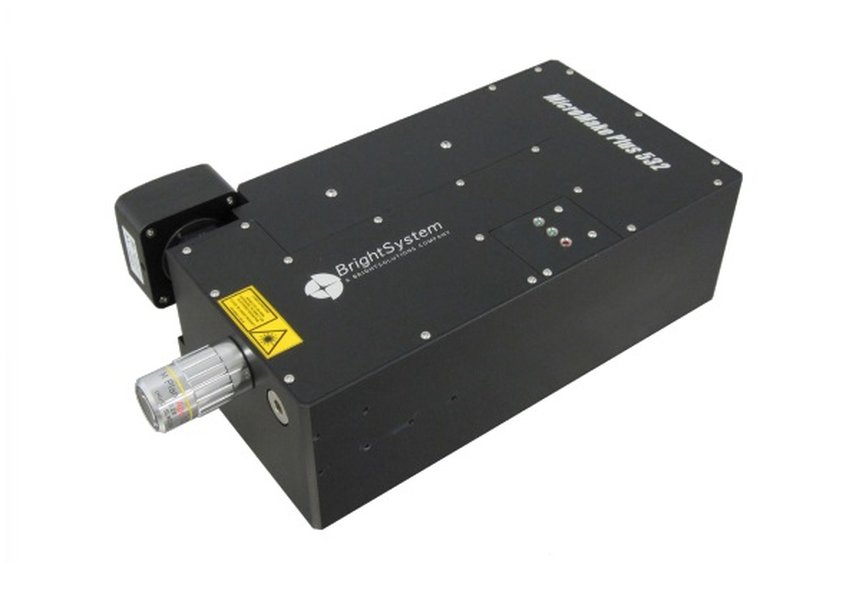
An example of a compact micromachining system utilizing 266 nm laser technology.
Key Performance Metrics for 266 nm Lasers
When selecting a 266 nm laser, several performance parameters are critical. These metrics determine the suitability of a laser for a specific application and impact its overall efficiency and effectiveness.
Power and Energy
Output power (for CW lasers) or pulse energy (for pulsed lasers) is a primary consideration. Higher power or energy generally translates to faster processing speeds or the ability to work with less sensitive materials. For 266 nm lasers, average powers can range from milliwatts (mW) to several watts (W), while pulse energies can range from microjoules (µJ) to millijoules (mJ).
Pulse Duration and Repetition Rate
For pulsed lasers, the pulse duration (typically nanoseconds or picoseconds) and repetition rate (Hz to MHz) are crucial. Shorter pulse durations can lead to cleaner ablation with less thermal damage. Higher repetition rates allow for faster processing in applications like marking or scanning.
Beam Quality (M²)
Beam quality, often quantified by the M² factor, indicates how well a laser beam can be focused to a small spot. A lower M² value (closer to 1) signifies a higher quality beam, which is essential for applications requiring high precision and resolution, such as micromachining and lithography.
Stability and Reliability
Power stability and pointing stability are important for consistent processing results. Industrial applications often demand lasers with high reliability and long operational lifetimes, minimizing downtime and maintenance costs. Many modern 266 nm lasers are designed with robust, sealed housings and efficient cooling systems (air or water cooling) to ensure stable operation in various environments.
Compactness and Integration
The physical size and ease of integration are significant factors, especially for OEM applications or when space is limited. Many manufacturers offer compact "plug and play" systems with integrated power supplies and control interfaces (e.g., USB, Ethernet) to simplify their incorporation into larger systems.
The radar chart above illustrates typical performance characteristics for 266 nm fiber lasers and DPSS lasers across key parameters. While fiber lasers often excel in stability and compactness, DPSS lasers can offer very high peak powers and specific pulse characteristics beneficial for certain applications.
Available 266 nm Laser Sources
Several manufacturers specialize in providing compact 266 nm lasers, including both fiber laser and DPSS laser options. Below is a table summarizing some of the available sources and their key features, drawing from various industry providers.
| Manufacturer / Brand | Model / Series | Laser Type | Output Power / Pulse Energy | Pulse Mode | Key Features | Integration / Delivery |
|---|---|---|---|---|---|---|
| IPG Photonics | ULPN-266 | Nanosecond Fiber Laser | Up to 10 W average | Nanosecond Pulsed | Deep UV fiber laser, robust industrial use, 1.5 ns pulse width, compact fiber-coupled design. | Fiber-coupled, compact head + remote unit |
| IPG Photonics | Deep UV Nanosecond Fiber Lasers | Fiber Laser | Variable (W scale) | Nanosecond Pulsed | Wavelength down to 266 nm, reliable power, operating stability, compact design. | Fiber-coupled, industrial environments |
| Roithner Laser | DIODE PUMPED SOLID STATE LASER SYSTEMS - 266 nm | DPSS Laser, Q-switched (Acousto-Optic Modulation) | Adjustable, e.g., 1-20 mW (MPL-F-266) up to 1-200 mW (AO-W-266); Pulse energies from 0.1 µJ to several mJ (DPS-266-Q) | Q-switched (Passive & Active), Picosecond Pulsed | Separate laser head, TEC cooled, adjustable output power, pulse duration 10-15 ns. Fiber coupling options available (MPL-F-266). Picosecond options (PS-R-266). | Fiber-coupled or free-space options |
| TOPTICA Photonics AG | TopWave 266 | CW Single-Frequency DPSS | Up to 300 mW | Continuous Wave | Narrow linewidth, low noise (<0.1% RMS), sealed UV beam path, industrial-grade with USB/Ethernet control. | Plug & play control options, compact |
| Coherent Inc. | Azure NX | CW Solid-State DPSS | Up to 1 W | Continuous Wave | Compact, low noise, industrial integration, semiconductor inspection, Raman spectroscopy. | Modular, turnkey system |
| RPMC Lasers | Lampo Series | Ultrafast DPSS nanosecond | Up to 1.5 W (266 nm) | Picosecond Pulsed | Compact ultrafast laser, pulse duration < 70 ps, selectable repetition rates (50 kHz – 40 MHz). | OEM compact design, versatile |
| RPMC Lasers | Onda Series | Nanosecond DPSS | Up to 800 µJ pulses | Nanosecond Pulsed | OEM industrial lasers for metals, glass, plastics; air-cooled; high peak power; multiple wavelengths. | Compact air-cooled unit |
| BeamQ Laser | RLTAOM-266 / AO-S-266 | Q-switched DPSS | 1–10 mW (pulsed µJ range) | Actively Q-switched | Fiber-pumped all-solid-state UV laser, compact, excellent lifetime, suitable for semiconductor processing. | Compact, easy to service |
| HJ Optronics | Various 266 nm models | DPSS UV Laser | 1 - 200 mW average | Passively & Actively Q-switched | Pulse width as short as ~5-10 ns, fiber coupled options, TEC cooling. | Fiber or free-space |
| Naku Laser | 266 nm DPSS Laser | DPSS UV Laser | ~30 mW | CW & Q-switched | Ultra compact, long lifetime, low cost, easy operation. Also available in fiber coupled system. | Compact module |
| CNI Laser | 266 nm Fiber Laser / DPSS Laser | Fiber Laser, DPSS Laser (CW and Q-switched) | Variable, mW to W scale | Pulsed, high frequency (Fiber); CW & Q-switched (DPSS) | Fiber-coupled, high output power stability, compact, long lifetime. DPSS options also available with high beam quality and internal/external triggering. | Fiber coupled industrial use / Benchtop |
| Opto Engine | Multiple UV laser models (including FQCW266) | DPSS UV Lasers (CW & Q-switched) | Up to 1000 mW | CW & Q-switched | Wavelengths from 257 to 397 nm, fiber coupled and free-space options. FQCW266 series offers 10 mW to 500 mW with stable output. | Bench-top and system integration |
| Big Lasers | 266 nm Q-switched DPSS | DPSS Q-switched laser | 1 uJ to 10 uJ pulse energy | Q-switched | Ultra-violet beam for varied applications, adjustable output. | Compact and configurable |
This table provides a snapshot of the market. Specific models and configurations can vary, and it's always recommended to consult directly with manufacturers or suppliers for the most up-to-date information and to discuss specific application requirements.
Considerations for Choosing a 266 nm Laser
Selecting the right 266 nm laser involves evaluating several factors beyond just wavelength and power. Here’s a breakdown of key considerations:
Type of Laser: Fiber vs. DPSS
Fiber Lasers: Generally offer excellent beam quality, high wall-plug efficiency, and robustness. Their all-fiber design can make them more resistant to environmental factors and easier to integrate, especially with fiber-optic beam delivery. IPG Photonics is a prominent provider of 266 nm fiber lasers.
Diode-Pumped Solid-State (DPSS) Lasers: A more traditional approach to generating 266 nm light, often involving frequency quadrupling of a 1064 nm Nd:YAG or Nd:YVO4 laser. These can achieve high peak powers in Q-switched mode and very narrow linewidths in CW mode. Many manufacturers like TOPTICA, Coherent, and Roithner Laser offer compact DPSS systems.
Operating Mode: Continuous Wave (CW) vs. Pulsed
CW Lasers: Provide a continuous, stable output beam. They are well-suited for applications like spectroscopy, interferometry, and some types of material processing where consistent energy delivery is key. TOPTICA's TopWave 266 and Coherent's Azure NX are examples of CW 266 nm lasers.
Pulsed Lasers: Deliver energy in short bursts, achieving high peak powers.
- Nanosecond (ns) Lasers: Commonly used for marking, ablation, and material processing. Companies like IPG Photonics and Roithner Laser offer nanosecond 266 nm lasers.
- Picosecond (ps) Lasers: Offer even shorter pulse durations, enabling "cold" ablation with minimal thermal damage, ideal for delicate materials. RPMC's Lampo series includes picosecond options at 266 nm.
Application-Specific Needs
The intended application heavily influences the choice of laser. For example:
- Micromachining: Often requires high peak power and good beam quality, favoring Q-switched DPSS or pulsed fiber lasers.
- Spectroscopy (e.g., Raman): Benefits from narrow linewidth and stable CW operation, such as that offered by TOPTICA's TopWave 266.
- Semiconductor Inspection: May require high stability, good beam quality, and potentially CW operation, as provided by Coherent's Azure NX.
- Medical/Bio-instrumentation: Might prioritize compactness, reliability, and specific pulse characteristics.
Visualization of Key Laser Parameters
To better understand the landscape of 266 nm lasers, a mindmap can illustrate the interconnectedness of different laser types, their features, and common applications.
This mindmap visually categorizes the different types of 266 nm lasers, highlights their key features, and lists their primary applications, providing a comprehensive overview to aid in selection.
Further Insights from the Industry
The development of 266 nm lasers is continuously evolving, with manufacturers focusing on increasing power, improving beam quality, enhancing reliability, and reducing the footprint and cost of these systems. The shift towards all-solid-state and fiber-based solutions reflects a broader trend in the laser industry towards more robust, user-friendly, and efficient technologies. For instance, companies like IPG Photonics are leveraging their expertise in fiber laser technology to push the boundaries of UV laser performance, offering high-power, compact solutions that are increasingly viable for demanding industrial applications.
Another important aspect is the method of UV generation. While fourth-harmonic generation (FHG) of 1064 nm Nd:YAG lasers is a common and mature technology, newer approaches and materials are continually being explored to improve conversion efficiency and the longevity of the nonlinear crystals used in the process. The choice between CW and pulsed operation also significantly impacts the laser's architecture and suitability for different tasks. CW lasers like the TOPTICA TopWave 266 are ideal for applications requiring stable, continuous illumination, such as Raman spectroscopy or certain types of metrology. In contrast, pulsed lasers, especially Q-switched and picosecond systems, excel in material processing tasks where high peak power is needed to ablate material with minimal thermal damage.
This video from Ekspla provides an overview of harmonic generation, a common technique used to achieve 266 nm wavelength from Nd:YAG lasers. It illustrates the process of frequency conversion (e.g., fourth-harmonic generation) which is fundamental to many DPSS UV lasers.
Conclusion
Choosing the right compact 266 nm laser involves a careful assessment of your specific application needs, including power requirements, pulse characteristics, beam quality, and integration constraints. Both fiber lasers and DPSS lasers offer viable solutions, each with its own set of advantages. Leading manufacturers provide a range of options, from high-power industrial systems to precise scientific instruments. By considering the features outlined and consulting with suppliers, you can select a 266 nm laser system that best fits your requirements for performance, reliability, and compactness.
Frequently Asked Questions (FAQ)
What are the main advantages of 266 nm lasers?
Are fiber-coupled 266 nm lasers common?
What is the difference between CW and Q-switched 266 nm lasers?
What are typical applications for 266 nm lasers?
How compact are these 266 nm lasers?
Recommended Further Reading
- What are the specific advantages of using fiber lasers for UV applications like 266 nm generation?
- How do DPSS lasers compare to fiber lasers for precision micromachining tasks at 266 nm?
- What are the typical maintenance requirements and expected lifetimes for compact 266 nm laser systems?
- What safety precautions should be considered when working with high-power 266 nm deep UV lasers?