
Illuminating Your Options: Finding Compact 532 nm Lasers for Precision Applications
A detailed guide to manufacturers and key considerations for selecting small-footprint green lasers, including fiber and DPSS technologies.
Essential Insights: Key Takeaways
- Diverse Technology Options: Compact 532 nm lasers are primarily available as Diode-Pumped Solid-State (DPSS) lasers and advanced Fiber Lasers, each offering unique advantages in terms of size, power, and beam characteristics.
- Wide Range of Suppliers: Numerous manufacturers specialize in compact green lasers, offering everything from OEM modules for integration to plug-and-play systems with varying output powers and features.
- Versatile Applications: These lasers are crucial in fields like fluorescence microscopy, Raman spectroscopy, material processing, flow cytometry, and holography, where their specific wavelength and compact form factor are highly beneficial.
Understanding Compact 532 nm Lasers: The Green Light Revolution
Lasers emitting light at a wavelength of 532 nanometers (nm) fall within the green part of the visible spectrum. This specific wavelength is highly sought after for a multitude of scientific, industrial, and medical applications due to its visibility and interaction with various materials. The demand for "compact" 532 nm lasers has grown significantly, driven by the need for smaller, more efficient, and easily integrable light sources in sophisticated instrumentation and portable devices. These compact lasers often boast features like small footprints, air-cooling, and robust designs suitable for diverse operating environments.

Representative image of a 532 nm green laser system.
The Significance of Compact Design
Compactness in laser technology refers not only to the physical dimensions (often "matchbox" sized or small OEM modules) but also to the integration of control electronics, thermal management, and power supply into a minimal volume. This allows for easier incorporation into larger systems, development of portable analytical tools, and reduction in the overall footprint of laboratory setups. Manufacturers achieve this through innovative optical designs, efficient cooling mechanisms, and the use of highly integrated components.
Key Technologies Behind 532 nm Green Lasers
The generation of 532 nm light in compact lasers predominantly relies on two main technologies: Diode-Pumped Solid-State (DPSS) lasers and Fiber Lasers. While direct green laser diodes are emerging, DPSS and fiber lasers remain the workhorses for reliable and high-performance 532 nm emission.
Diode-Pumped Solid-State (DPSS) Lasers
DPSS lasers are a mature and widely adopted technology for generating 532 nm light. The typical mechanism involves using a high-power laser diode (often emitting at 808 nm) to "pump" a gain medium, which is usually a neodymium-doped crystal like Nd:YVO4 (neodymium-doped yttrium orthovanadate) or Nd:YAG (neodymium-doped yttrium aluminum garnet). This crystal then lases at a near-infrared wavelength (commonly 1064 nm).
To achieve the desired 532 nm green light, a nonlinear optical crystal, such as KTP (Potassium Titanyl Phosphate), is placed within the laser cavity or externally. This crystal performs Second Harmonic Generation (SHG), effectively halving the wavelength (doubling the frequency) of the 1064 nm light to produce 532 nm light. DPSS lasers are known for good beam quality, power stability, and can be made very compact.

Example of a compact fiber-coupled 532 nm laser module from Integrated Optics.
Fiber Lasers
Fiber lasers represent a more recent and rapidly advancing technology. In a 532 nm fiber laser, the gain medium is an optical fiber doped with rare-earth elements (like Ytterbium for generating the fundamental IR wavelength). The laser light is generated and amplified entirely within the fiber, which offers advantages such as excellent beam quality, high efficiency, robustness, and often simpler thermal management. Similar to DPSS lasers, generating 532 nm light from a fiber laser typically involves frequency doubling an infrared output (e.g., from a 1064 nm Ytterbium fiber laser) using a nonlinear crystal, which can be integrated with the fiber output.
Fiber lasers can be designed to be exceptionally compact and rugged. They are available in both Continuous Wave (CW) and pulsed (e.g., nanosecond, picosecond) versions, catering to a wide array of applications. Their all-fiber or hybrid fiber-bulk optic designs contribute to their stability and maintenance-free operation.
Exploring the Landscape: Sources for Compact 532 nm Lasers
A variety of manufacturers offer compact 532 nm lasers, catering to different needs in terms of power, beam characteristics, form factor, and cost. The following table summarizes some prominent sources and their offerings, amalgamating information from current market availability. This includes both fiber lasers and other compact laser types like DPSS modules.
| Manufacturer | Model/Series Examples | Laser Type(s) | Typical Output Power | Key Compact Features & Notes | Fiber-Coupled Options | Primary Applications Highlighted |
|---|---|---|---|---|---|---|
| Integrated Optics | MatchBox series (e.g., 532 nm DPSS module) | DPSS (Free Space, SM/MM Fiber, SLM) | Up to 500 mW (HP DPSS), up to 50 mW (SLM) | "World's smallest plug-and-play," USB controllable, Peltier cooled, microprocessor electronics, high stability. | Yes (SM, MM, PM fibers) | Fluorescence excitation, scanning microscopy, spectroscopy, flow cytometry, LiDAR, RGB holography, interferometry. |
| Skylark Lasers | 532 NX | DPSS | >2 W | Compact footprint, single frequency performance, stable output power. | Not directly listed | High-power precision applications. |
| RPMC Lasers | Various 532nm Lasers | DPSS (Pulsed & CW), Fiber Laser options | mW to Watts | Customizable, OEM & plug-and-play, rugged designs, ns to ps pulses. | Yes (customizable) | Micromachining, flow cytometry, alignment, imaging, projection, research. |
| Thorlabs | DJ532 Series, CPS532 | DPSS Laser Modules | 10 mW to 200 mW+ | Nd:YVO4 & KTP crystals, built-in IR filter, hermetically sealed, compact, some USB controlled. | Yes (some models fiber-pigtailed or collimated for coupling) | General lab use, scientific setups, alignment. |
| Spectra-Physics | SPFL 532 series | Pulsed Green Fiber Laser | Up to 40 W average | Robust, compact assembly, high pulse repetition rates (up to 2 MHz), tunable short pulses (down to 3 ns). | Yes (inherently fiber-based) | Solar cell manufacturing, micromachining, silicon scribing, glass processing, thin film cutting. |
| IPG Photonics | GLPN series (e.g., GLPN-100-M), Green Nanosecond Fiber Lasers | CW Fiber Laser, Nanosecond Pulsed Fiber Laser | Up to 100 W (CW), up to 30 W (Pulsed) | High power, robust all-fiber design, options for pulsed/quasi-CW operation. | Yes (inherently fiber-based) | Industrial applications, marking, material processing, scientific research. |
| HÜBNER Photonics (Cobolt) | Cobolt Samba™, 06-DPL, 08-DPL, Cobolt Tor™ | DPSS (CW & SLM, Pulsed) | 25 mW to 1.5 W (CW), 50 µJ to 0.2 mJ (Pulsed) | Single frequency options, HTCure™ manufacturing for robustness, integrated isolator available. | Yes (fiber delivery options) | Atom trapping, particle analysis, metrology, semiconductor inspection, holography, quantum sensing. |
| Azurlight Systems | 532 nm VIS series | High Power Fiber Laser | Up to 10 W | Strictly single mode fiber, high power, low noise, <100 kHz linewidth. | Yes (single-mode) | Quantum technology, atom cooling, metrology, high-resolution spectroscopy. |
| MPB Communications (MPBC) | MPBC CW Visible Fiber Laser Series (VFL-P-532) | CW Fiber Laser | Up to 5 W | Compact laser head (e.g., 132x50x30mm), air-cooled, maintenance-free. | Yes (SM fiber with armored cable) | Flow cytometry, fluorescence microscopy, structured illumination, DNA analysis, cell sorting. |
| Edmund Optics | Fiber-Coupled Laser Modules | Fiber-Coupled Laser Module (likely DPSS source) | Up to 100 mW (50 mW nominal) | Cost-effective, long expected lifetime, easy operation. | Yes (pre-coupled) | Laser alignment, pointing, measurement. |
| HJ Optronics Inc. | FL-532-Nano, MGL-Z-532, FC-ML, OEM-I-532 | Nanosecond Pulsed Fiber Laser, All-Solid-State Green Laser (DPSS) | mW to Watts (OEM modules) | Ultracompact OEM modules, good beam profile, long lifetime, cost-effective. | Yes (fiber laser models) | Laser drilling, glass engraving, material processing, scientific research, laser marking. |
| QD Laser | QLD0593 series, QC4LD0593 series | Compact Visible Laser (DPSS) | Not specified in detail | "One of the world's smallest plug-and-play" with built-in driver, high-quality elliptical free-space beam. | No (free-space output) | Integrated systems, pointing applications. |
| Lumentum | CDPS532S, CDPS532M | CW DPSS Laser | Up to 50 mW | Extremely compact, cost-effective, efficient design by eliminating final collimating optics. | Free-space (collimated or uncollimated) | General applications, bioinstrumentation, metrology. |
| Civillaser | 532nm DPSS Green Laser Source | Diode Pumped Laser (DPSS) | 1~50 mW | High power stability, small volume, easy integration. | Yes (fiber-coupled options available) | Alignment, pointing, education, research. |
| Frankfurt Laser Company (FLC) | Green Laser Modules | Laser Modules (DPSS source, Fiber Coupled) | 10 mW to 100+ mW | Fiber coupled green laser modules (520-545 nm range), high beam quality, compact. | Yes | Alignment, sensing, biomedical. |
Note: Specifications such as output power and features can vary between specific models and configurations. Always consult the manufacturer for the most up-to-date information.
Visualizing Laser Characteristics: A Comparative Overview
Choosing the right laser involves balancing various performance metrics. The radar chart below offers a hypothetical comparison of different types of compact 532 nm lasers based on common desirable attributes. This is an opinionated analysis for illustrative purposes, as actual performance varies greatly by specific model and manufacturer.
This chart represents a generalized comparison; specific models will vary.
Navigating Your Options: A Mindmap for Selection
To further help visualize the landscape of compact 532 nm lasers, the following mindmap outlines key categories, considerations, applications, and some of the prominent manufacturers in this field. This can serve as a quick reference when evaluating your specific needs.
(Diode-Pumped
Solid-State)"] id1b["Fiber Lasers
(CW & Pulsed)"] id1c["Direct Green
Laser Diodes
(Emerging)"] id2["Key Selection Factors"] id2a["Output Power (mW to >100W)"] id2b["Form Factor & Size Constraints"] id2c["Beam Quality (e.g., M², TEM00)"] id2d["Pulsed vs. CW Operation"] id2e["Wavelength & Power Stability"] id2f["Cost & Project Budget"] id2g["Integration Needs (OEM vs. System)"] id2h["Fiber Coupling Requirements"] id3["Major Application Areas"] id3a["Scientific Research & Development"] id3b["Fluorescence Microscopy & Bio-imaging"] id3c["Material Processing & Micromachining"] id3d["Medical Diagnostics & Therapeutics"] id3e["Raman & Other Spectroscopies"] id3f["Holography & Interferometry"] id3g["Optical Alignment & Pointing"] id3h["Flow Cytometry & Cell Sorting"] id3i["LiDAR & Environmental Sensing"] id4["Example Manufacturers"] id4a["Integrated Optics"] id4b["Spectra-Physics (MKS)"] id4c["IPG Photonics"] id4d["Thorlabs"] id4e["RPMC Lasers"] id4f["HÜBNER Photonics (Cobolt)"] id4g["Skylark Lasers"] id4h["Azurlight Systems"] id4i["Edmund Optics"] id4j["Lumentum"] id4k["CNI Laser"]
Applications in Focus: Where Compact Green Lasers Shine
The versatility of compact 532 nm lasers makes them indispensable in a wide array of fields. Their bright green emission is easily visible and interacts favorably with many biological samples and materials.
- Biomedical Imaging and Flow Cytometry: Essential for exciting fluorescent dyes in microscopy, DNA sequencing, and cell sorting applications. The compact nature allows for integration into benchtop and even portable diagnostic instruments.
- Raman Spectroscopy: 532 nm is a common excitation wavelength for Raman spectroscopy, providing a good balance between signal strength and fluorescence avoidance for many samples.
- Material Processing: Pulsed 532 nm lasers, especially fiber lasers, are used for precise micromachining, scribing (e.g., silicon wafers for solar cells), marking, and cutting thin films or delicate materials.
- Holography and Interferometry: The coherence and stability of some 532 nm lasers, particularly single-longitudinal mode (SLM) versions, make them ideal for creating holograms and for high-precision interferometric measurements.
- Optical Alignment and Pointing: The high visibility of the green beam is useful for alignment tasks in complex optical setups or for pointing applications.
- Entertainment and Display: While professional applications dominate, 532 nm lasers are also known for their use in laser light shows and projection systems due to their brightness.
The following video demonstrates a 532 nm DPSS laser module being used for engraving, showcasing one of its material processing applications:
Laser engraving with a 532 nm DPSS laser module. This illustrates the precision possible with such lasers in material interaction.
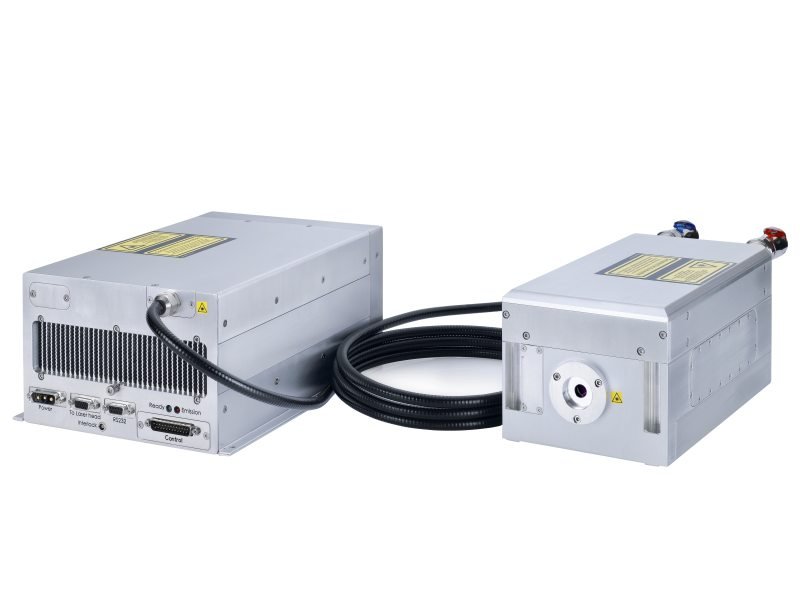
The Spectra-Physics SPFL 532, a compact pulsed green fiber laser, is designed for precision applications like micromachining.
Factors to Consider When Choosing Your Laser
Selecting the ideal compact 532 nm laser requires careful consideration of your specific needs:
- Application Requirements: What will the laser be used for? This dictates needs for power, beam quality, CW or pulsed operation, etc.
- Output Power: From milliwatts for alignment or some types of spectroscopy, to watts for material processing or high-throughput screening.
- Beam Quality (M²): A value close to 1 indicates a near-perfect Gaussian beam, crucial for focusing to small spot sizes or for applications requiring high spatial coherence. TEM00 mode is often desired.
- Pulse Characteristics: For pulsed lasers, consider pulse energy, pulse duration (nanoseconds, picoseconds), and repetition rate. For CW lasers, power stability and noise are key.
- Stability: Long-term power stability, pointing stability, and wavelength stability are critical for reliable and repeatable results.
- Form Factor and Integration: Ensure the laser's dimensions, mounting options, and control interfaces (e.g., USB, TTL) fit your system. OEM modules offer flexibility but require more integration effort than plug-and-play systems.
- Budget: Prices can vary significantly based on specifications and technology.
- Manufacturer Support and Customization: Some suppliers offer customization of output power, fiber termination, or control interfaces to meet unique application demands.
Frequently Asked Questions (FAQ)
What's the main difference between DPSS and fiber lasers for 532 nm?
Are compact 532 nm lasers expensive?
What does "M² value" mean for a laser beam?
Can I get a customized compact 532 nm laser?
How is the 532 nm green light typically generated in these lasers?
Conclusion
The market for compact 532 nm lasers offers a rich variety of options, leveraging sophisticated DPSS and fiber laser technologies. Whether your application demands the high power and robustness of a fiber laser or the established performance of a compact DPSS module, numerous suppliers provide solutions ranging from a few milliwatts to many watts, in both CW and pulsed formats. By carefully considering your specific application needs, key performance parameters, and integration requirements, you can identify a compact green laser source that will be an excellent fit for your project. Always consult directly with manufacturers for the latest product specifications and to discuss tailored solutions.
Recommended Further Exploration
- What are the intricate details of Diode-Pumped Solid-State (DPSS) laser technology for generating 532nm light?
- Explore the specific advantages fiber lasers offer compared to DPSS lasers for compact 532 nm applications.
- Discover key applications and real-world case studies of pulsed 532 nm fiber lasers in the field of micromachining.
- Learn how to select the optimal beam quality and M² value for a 532 nm laser intended for advanced microscopy techniques.