

Key Insights into Comparative and Superlative Adjectives
- Comparative adjectives are used to highlight differences between two specific items, people, or ideas, often structured with "than."
- Superlative adjectives identify the absolute extreme within a group of three or more, typically preceded by "the."
- The formation rules for these adjectives primarily depend on their syllable count, with irregular forms requiring memorization.
English grammar offers powerful tools for expressing comparisons and contrasts: comparative and superlative adjectives. These forms allow us to describe how things differ or how one stands out among a group. Understanding their correct usage and formation is crucial for clear, effective, and nuanced communication. While comparative adjectives focus on a direct comparison between two entities, superlatives elevate one entity to the highest or lowest degree within a larger context.
Defining the Degrees of Adjectives: Comparative vs. Superlative
At their core, comparative and superlative adjectives serve distinct purposes in English. They are both degrees of adjectives, but they function in different comparative contexts.
The Comparative Edge: Drawing Two-Way Comparisons
A comparative adjective is employed when you want to show a difference or a relationship between two subjects. It indicates that one item possesses a quality to a greater or lesser degree than another. The structure typically involves the comparative adjective followed by "than," though "than" can be omitted if the comparison is obvious from the context.
For instance, if you say "This car is faster than that one," you are explicitly comparing the speed of two cars. The focus is on the relative difference. Comparatives also show change, such as "The weather is warmer today."
The Superlative Summit: Identifying the Ultimate in a Group
Superlative adjectives, on the other hand, are used to highlight one item as the absolute extreme within a group of three or more. They designate the highest or lowest degree of a particular quality. Superlatives are almost always preceded by the definite article "the."
Consider the statement "She is the smartest student in the class." Here, the individual is being identified as possessing the highest level of intelligence among all students in that specific class. This form allows for a definitive ranking within a defined group.
Decoding the Formation Rules: From Simple to Complex
The method for forming comparative and superlative adjectives largely depends on the number of syllables in the base adjective. However, there are also irregular forms and specific rules based on adjective endings.
One-Syllable Adjectives: Simple Additions
For most adjectives comprising a single syllable, the formation is straightforward:
- Comparative: Add -er to the end of the adjective.
- Superlative: Add -est to the end of the adjective.
There are a few important spelling rules to observe:
- If the adjective ends in a single consonant preceded by a single vowel (CVC pattern), double the final consonant before adding -er or -est (e.g., big → bigger → biggest).
- If the adjective ends in -e, simply add -r for the comparative and -st for the superlative (e.g., wide → wider → widest).
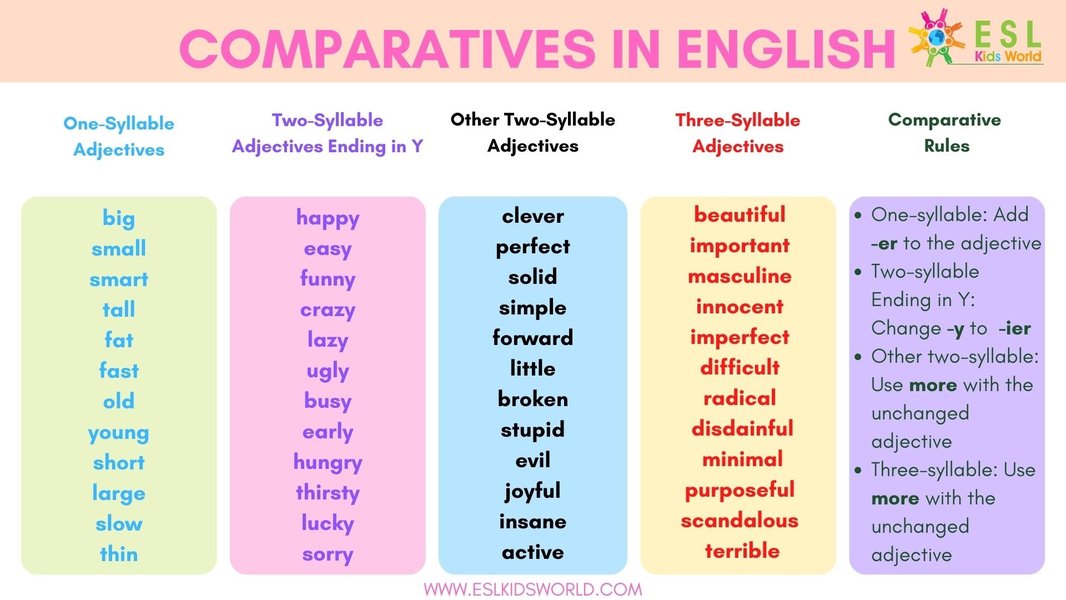 An illustrative poster demonstrating the use of comparative adjectives.
Two-Syllable Adjectives: A Split Path
Two-syllable adjectives can be a bit more complex, with rules depending on their ending:
- Ending in -y: Change the 'y' to 'i' and then add -er for the comparative and -est for the superlative (e.g., happy → happier → happiest).
- Other two-syllable adjectives: For most other two-syllable adjectives, you will use more for the comparative and most for the superlative (e.g., careful → more careful → most careful). However, some two-syllable adjectives, like "clever" or "simple," can sometimes take either form (e.g., clever → cleverer or more clever). In cases of doubt, using "more/most" is generally safer and more universally accepted.
Three or More Syllables: The "More/Most" Rule
For adjectives with three or more syllables, the rule is consistent and simple:
- Always use more for the comparative form.
- Always use most for the superlative form.
For example, beautiful becomes more beautiful and most beautiful; expensive becomes more expensive and most expensive.
The Maverick Words: Irregular Forms
English, known for its irregularities, has several common adjectives that do not follow the standard rules for forming comparatives and superlatives. These irregular forms must be memorized.
| Adjective | Comparative Form | Superlative Form |
|---|---|---|
| good | better | best |
| bad | worse | worst |
| far | further / farther | furthest / farthest |
| little | less | least |
| many / much | more | most |
| old | older / elder | oldest / eldest |
Note that "elder" and "eldest" are typically used for family members and often carry a slightly more formal tone than "older" and "oldest."
Contextual Usage and Common Pitfalls
Beyond formation, understanding the proper usage of comparatives and superlatives is key to avoiding grammatical errors.
The Importance of "Than" and "The"
- Comparatives are typically followed by "than" to complete the comparison (e.g., "She is taller than him").
- Superlatives are almost always preceded by the definite article "the" (e.g., "He is the fastest runner").
Avoiding Double Comparisons
A common mistake is using a "double comparative" or "double superlative." This occurs when both an -er/-est ending and "more/most" are used together. For example, "more better" or "most fastest" are incorrect. Only one form of comparison should be used at a time.
Absolute Adjectives
Some adjectives are considered "absolute" or "non-gradable" because they describe qualities that are already at their extreme or are absolute states. Examples include unique, perfect, complete, dead, or pregnant. These adjectives typically do not take comparative or superlative forms, as something cannot be "more unique" or "most dead." While some stylistic exceptions exist, it's generally best to avoid grading these terms.
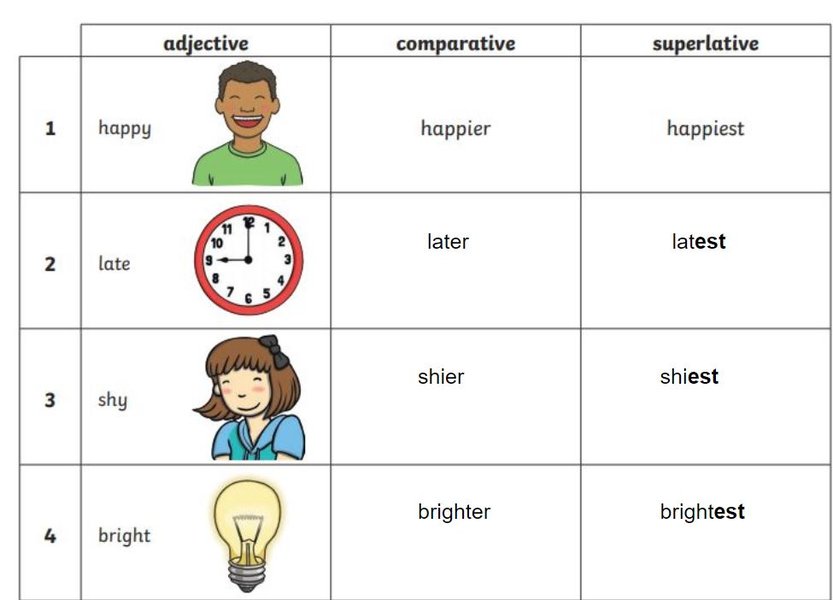 A visual aid illustrating the concept of superlative adjectives from the base form to the extreme.
Adverbs and Comparison
It's worth noting that many of the rules for adjectives also apply to adverbs when they are used in comparative and superlative forms. Adverbs that have the same form as adjectives (e.g., fast, hard) follow the adjective rules (faster/fastest, harder/hardest). For adverbs ending in -ly, "more" and "most" are typically used (e.g., quickly → more quickly → most quickly).
Visualizing Comparative and Superlative Adjectives
For a deeper understanding and to see these rules in action, the following video offers an engaging explanation of comparative and superlative adjectives, complete with practical examples.
This video, titled "Comparative & Superlative Adjectives - English Grammar," provides clear explanations and examples to help solidify your understanding. It covers how to form these adjectives, when to use them, and includes useful tips to avoid common errors. Watching the video can reinforce the textual information and offer auditory and visual learning cues, which are particularly helpful for grasping grammatical concepts.
Frequently Asked Questions
What is the main difference between comparative and superlative adjectives?
How do I know whether to use "-er/-est" or "more/most"?
- For one-syllable adjectives, add "-er" for comparative and "-est" for superlative (e.g., tall → taller → tallest).
- For adjectives with three or more syllables, use "more" for comparative and "most" for superlative (e.g., beautiful → more beautiful → most beautiful).
- Two-syllable adjectives vary: if they end in "-y," change 'y' to 'i' and add "-er/-est" (e.g., happy → happier → happiest). For others, use "more/most" (e.g., careful → more careful → most careful), though some may also take "-er/-est."
What are irregular comparative and superlative adjectives?
Can adverbs also have comparative and superlative forms?
Why shouldn't I say "more better"?
Conclusion
Mastering comparative and superlative adjectives is a fundamental step towards achieving precision and eloquence in English. By understanding their distinct roles—comparing two items versus identifying an extreme within a group—and applying the correct formation rules based on syllable count, including memorizing irregular forms, speakers and writers can convey subtle differences and emphatic statements with clarity. Avoiding common pitfalls like double comparisons and inappropriate grading of absolute adjectives further refines communication. These grammatical tools not only enhance the descriptive power of language but also contribute significantly to the overall sophistication of expression.
Recommended Further Exploration
- Advanced usage of absolute adjectives
- Comparative and superlative adverbs in detail
- Common grammatical errors in English comparison
- Historical evolution of comparative forms