
Unlocking the Chromatic Canvas: A Comprehensive Guide to 12-Tone Composition
Mastering the Art of Dodecaphony for Expressive and Innovative Music
- Systematic Organization: The 12-tone technique, also known as dodecaphony or serialism, provides a structured framework for composing atonal music by ensuring all twelve notes of the chromatic scale are used equally, preventing any single note from dominating.
- Tone Row as Foundation: The core of 12-tone composition is the "tone row," an ordered arrangement of the twelve chromatic pitches. This row, and its various permutations (prime, retrograde, inversion, retrograde inversion), forms the entire melodic and harmonic basis of a piece.
- Beyond Strict Rules: While the technique offers a rigid system, its application allows for immense creative freedom. Composers can manipulate the row, employ rhythmic and dynamic variations, and even subtly reintroduce tonal elements to craft engaging and expressive compositions.
Embracing the Twelve-Tone Technique: A Foundation for Modern Composition
The twelve-tone technique, often referred to as dodecaphony or serialism, is a revolutionary method of musical composition that emerged in the early 20th century. Developed primarily by Austrian composer Arnold Schoenberg, with contributions from Josef Matthias Hauer, this technique fundamentally shifted the paradigm of Western music by moving away from traditional tonality. Instead of revolving around a central key or tonic, 12-tone music gives equal importance to all twelve notes of the chromatic scale. This is achieved through the systematic use of a "tone row," an ordered arrangement of these twelve pitches, which serves as the foundational material for an entire composition. The goal is to ensure that no single note is emphasized over others, thereby creating an atonal, yet highly organized, musical landscape.
While often associated with atonality, it's important to note that some composers, like Alban Berg, have successfully integrated tonal elements within 12-tone structures, demonstrating the technique's versatility. The method gained significant influence among mid-20th-century composers and continues to be a vital tool for those seeking innovative approaches to musical expression. It pushes composers to think beyond conventional harmonic progressions and explore new possibilities in melodic and rhythmic development.
Crafting the Core: Designing Your Twelve-Tone Row
The very first and most crucial step in composing 12-tone music is the creation of your fundamental tone row. This ordered sequence of all twelve chromatic pitches will dictate the melodic and harmonic contours of your entire piece. The design of this row is a highly creative process, influencing the character and potential of your composition.
Step-by-Step Row Construction
To begin, consider the twelve notes of the chromatic scale: C, C#, D, D#, E, F, F#, G, G#, A, A#, B. You will arrange these notes in any order you choose, ensuring each note appears exactly once. A common approach involves using a 12x12 grid, often called a matrix, to visualize and derive permutations of your original row.
Here’s a general process:
- Choose Your Prime Row (P0): Select an initial order for the twelve notes. This is your "prime" row. The intervals between these notes will be crucial to the character of your music. Some composers aim for specific interval patterns or avoid certain traditional consonances (like perfect fourths or fifths) to maintain atonality, while others might deliberately include them for specific effects.
- Number the Notes: For easier manipulation, assign numbers 0-11 to the notes of the chromatic scale (e.g., C=0, C#=1, D=2, and so on). This numerical representation simplifies the process of creating row forms.
- Populate the Matrix: Write your prime row across the top row of a 12x12 grid. Then, populate the first column with transpositions of your prime row, starting with the first note of your prime row and applying the interval relationships of the prime row down the column. For example, if your prime row starts on C (0) and the second note is D (2), the first column would then be C (0), C# (1), D (2), and so on, with the intervals from your prime row applied downwards to generate the subsequent rows of the matrix.
- Fill the Remaining Rows: For each subsequent row in the matrix, apply the inversional relationship to the prime row, transposed to the starting note of that row. This essentially involves calculating the interval difference between the first note of your prime row and the first note of the current row, and then applying that same interval difference to every note of the prime row in reverse. The mathematical operations involve adding and subtracting numbers modulo 12. For example, if your prime row is P0, then P1 would be P0 transposed up one semitone, P2 up two semitones, and so on. Similarly, for inversions, I0 would be the inversion of P0, I1 would be I0 transposed up one semitone, and so forth.
The matrix will then contain 48 possible row forms: 12 prime forms (P), 12 retrograde forms (R), 12 inversion forms (I), and 12 retrograde inversion forms (RI). Each form can be transposed to any of the 12 chromatic pitches.
A visual representation of a twelve-tone matrix, illustrating the systematic derivation of row forms.
The Four Fundamental Row Forms: Tools for Variation
Once your prime row (P) is established, you can derive three other fundamental forms, which provide the building blocks for your composition:
- Prime (P): The original sequence of the 12 notes.
- Retrograde (R): The prime row played backward.
- Inversion (I): The prime row with all intervals inverted. For example, if the prime row moves up a major third, the inversion moves down a major third from its corresponding starting note.
- Retrograde Inversion (RI): The inversion form played backward.
These four forms, when transposed to any of the twelve chromatic pitches, generate a palette of 48 possible tone rows, offering immense variety while maintaining the underlying unity of the chosen prime row.
Composing with the Row: From Structure to Sound
The tone row is a framework, not a rigid straitjacket. The true art of 12-tone composition lies in how you apply and manipulate these rows to create musical texture, rhythm, dynamics, and expression.
Melodic and Harmonic Application
The notes of the row can be used melodically (sequentially) or harmonically (simultaneously as chords). When forming chords, notes can be taken from a single row form, or from different row forms played concurrently in different voices. Composers often create "trichords" (three-note chords), "tetrachords" (four-note chords), and "hexachords" (six-note chords) from sequential notes within a row. The key is to ensure that all 12 notes of a row are presented before any note is repeated, maintaining the principle of equal emphasis.
For example, a composer might take the first three notes of a prime row to form a chord, then the next three for another, and so on. Alternatively, different instruments or voices might each play a different permutation of the row simultaneously, creating a complex polyphonic texture.
Rhythm, Dynamics, and Expression
While the 12-tone technique dictates pitch organization, it offers tremendous freedom in other musical parameters. Rhythm, tempo, dynamics, articulation, and instrumentation are entirely at the composer's discretion. This allows for a wide range of expressive possibilities within the atonal framework. Alban Berg's Violin Concerto, for instance, despite its 12-tone structure, is known for its lyrical and emotionally charged character, contrasting with Schoenberg's more frenetic works.
Many composers find that working with tone rows can lead to a new kind of rhythmic freedom, as the absence of traditional harmonic pull encourages exploration of diverse rhythmic patterns and metric structures. Instead of being bound by the "tyranny of the barline" often associated with tonal music, 12-tone compositions can emphasize intricate rhythmic interplay and unconventional phrasing.
Alban Berg's Violin Concerto (1935), a prime example of 12-tone composition that incorporates lyrical and expressive elements, even subtly hinting at tonality.
Considerations for Effective Twelve-Tone Composition
While the theoretical framework of 12-tone music can seem strict, successful composition involves more than just adherence to rules. It requires musical intuition, careful crafting, and an understanding of how to make atonal music compelling.
Embracing Atonality and Avoiding Tonal Traps
The primary aim of 12-tone technique is to avoid a tonal center. Therefore, when composing, it's generally advisable to:
- Avoid outlining major/minor triads, which strongly suggest tonality.
- Aim for augmented triads or other dissonant sonorities that do not imply a key.
- Incorporate tritones, which are inherently unstable and avoid strong tonal pulls.
- Ensure that the complete tone row is presented before any note is repeated, maintaining the principle of equal importance.
Developing Thematic Coherence
Even without a tonal center, coherence is vital. The tone row itself provides a source of unity, as all musical material stems from its various permutations. Composers often exploit characteristic intervals or patterns within their chosen row to create recognizable musical ideas or motifs. The listener may not consciously perceive the underlying row, but its consistent application provides a logical and unified structure to the piece.
The Role of the Composer's Ear
While theory is important, the ultimate judge is the composer's ear. Experimentation is key. Play your tone rows, listen to how different permutations sound, and don't be afraid to deviate from strict textbook applications if it serves your musical vision. Many composers find that 12-tone composition is akin to solving an intricate puzzle, where the creative challenge lies in making the structured material sound spontaneous and expressive.
A Snapshot of Twelve-Tone Compositional Attributes
To better understand the various facets and perceived strengths of 12-tone composition, consider the following radar chart. This chart illustrates a qualitative assessment of different compositional attributes based on the typical characteristics and common interpretations of the 12-tone technique. It's a subjective representation to highlight areas where the technique tends to excel or poses specific challenges for composers and listeners.
As the radar chart illustrates, 12-tone music often shines in its structural coherence and its ability to achieve complete atonal freedom. It fosters harmonic innovation and can lead to highly complex rhythmic patterns. However, its perceived melodic interest and accessibility for general listeners can sometimes be lower compared to traditional tonal music, which is often built on more familiar melodic contours and harmonic resolutions. The expressive potential, while different, is certainly present, allowing composers to convey a vast array of emotions and ideas within its unique framework.
Key Characteristics and Historical Context
The 12-tone technique emerged from a desire to break free from the hierarchical nature of traditional tonality, which had dominated Western music for centuries. Schoenberg believed that the traditional system had been stretched to its limits and sought a new structural principle.
| Characteristic | Description | Implication for Composition |
|---|---|---|
| Atonality | Absence of a tonal center or key, ensuring no single pitch predominates. | Requires deliberate avoidance of traditional cadences and harmonic progressions. |
| Serialism | Organization of musical elements (primarily pitch, but can extend to rhythm, dynamics, etc.) into ordered sequences or "rows." | The tone row becomes the fundamental building block for all musical material. |
| Equal Importance of Pitches | All 12 notes of the chromatic scale are given equal weight, preventing hierarchy. | Demands careful management of note appearances to ensure no repetition before the full row is heard. |
| Tone Row Permutations | Use of prime, retrograde, inversion, and retrograde inversion forms of the row. | Provides systematic variation and extends the compositional palette while maintaining unity. |
| Mathematical Underpinnings | The creation of a 12-tone matrix often involves mathematical operations (e.g., modulo 12 arithmetic). | Offers a logical and systematic approach to generating compositional material. |
Historically, the first full-fledged 12-tone compositions appeared in the early 1920s, with Schoenberg's works like his Suite for Piano, Op. 25, being notable early examples. His pupils, Alban Berg and Anton Webern, also became prominent exponents of the technique, forming what is known as the "Second Viennese School." While controversial at times, the 12-tone technique profoundly influenced subsequent generations of composers, including Igor Stravinsky and Aaron Copland, who initially opposed it but later incorporated elements into their own styles.
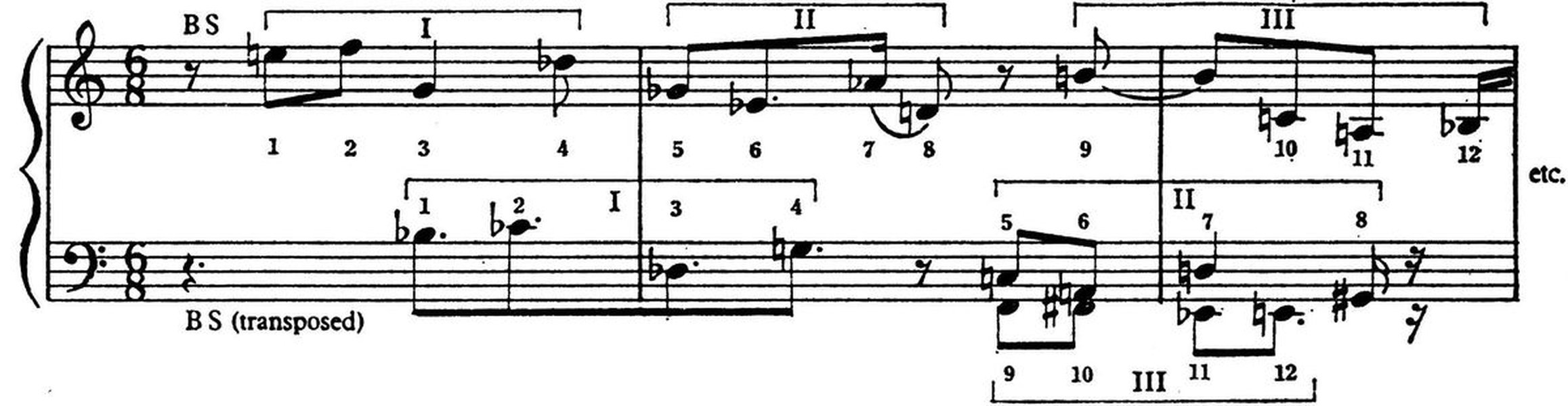
An example from a Schoenberg manuscript, illustrating the application of a twelve-tone row in a composition.
Famous Works and Further Exploration
To truly understand the potential of 12-tone music, listening is essential. Some of the most celebrated works employing this technique include:
- Arnold Schoenberg: Variations for Orchestra, Op. 31 (1928), Piano Concerto (1942)
- Alban Berg: Violin Concerto (1935), Wozzeck (opera, though not exclusively 12-tone, it contains strong atonal and serial elements), Lulu (opera)
- Anton Webern: Symphony, Op. 21 (1928)
- Pierre Boulez: Structures I (1952)
- Igor Stravinsky: Later works, such as Movements for Piano and Orchestra (1959)
These pieces demonstrate the diverse applications and expressive range achievable within the 12-tone framework. They range from the lyrical and emotionally resonant to the highly intellectual and fragmented, showcasing the versatility of the method in the hands of master composers.
Frequently Asked Questions
What is the main purpose of the twelve-tone technique?
Is twelve-tone music always atonal?
Who invented the twelve-tone technique?
How many variations of a tone row can be derived from a single prime row?
Can 12-tone music be expressive?
Conclusion: The Enduring Legacy of Dodecaphony
The twelve-tone technique, or dodecaphony, stands as a monumental achievement in 20th-century music, offering a powerful and systematic approach to composition that liberated music from the confines of traditional tonality. By providing a rigorous method for organizing pitches, it allowed composers to explore new sonic landscapes and expressive possibilities previously unimaginable. While initially controversial and sometimes perceived as overly intellectual, its influence on modern classical music is undeniable, and it continues to be a fertile ground for composers seeking structural coherence and expressive freedom. The "best method" for composing 12-tone music is not a single rigid formula, but rather a combination of rigorous theoretical understanding, systematic application of the tone row, and a deep well of creative intuition to imbue the structured material with compelling musicality.
Recommended Further Exploration
- How to construct a twelve-tone matrix step-by-step?
- Analysis of Alban Berg's Violin Concerto 12-tone elements?
- Comparison of Schoenberg's and Hauer's 12-tone methods?
- Rhythmic and dynamic considerations in atonal composition?