
Enhancing Bamboo-Polypropylene Composite Properties
In-depth synthesis of composite materials with nano aluminum oxide fillers
Key Insights
- Mechanical Enhancement: The addition of nano aluminum oxide significantly improves tensile strength, modulus of elasticity, and elongation at break.
- Improved Flame Retardancy: Incorporation of nAl2O3 increases fire resistance, reducing combustion rates and enhancing char formation.
- Application Potential: These novel composites show promise for use in construction, automotive, and other high-demand industries due to their reinforced mechanical and thermal properties.
Overview of the Study
The research article titled “Enhancing mechanical durability and flame retardancy in Bamboo-Polypropylene composites with nAl2O3 fillers” presents a thorough investigation into the development, testing, and performance analysis of a novel composite material. This composite is produced by blending bamboo fibers with polypropylene (PP), and further enhanced with nano aluminum oxide (nAl2O3) fillers. The motivation behind the work is to overcome limitations typically associated with traditional polymer composites, such as inferior mechanical durability and inadequate fire resistance. By integrating natural fibers and nano-sized fillers, the study aims to achieve a material that offers both improved strength and enhanced safety features.
Materials and Methods
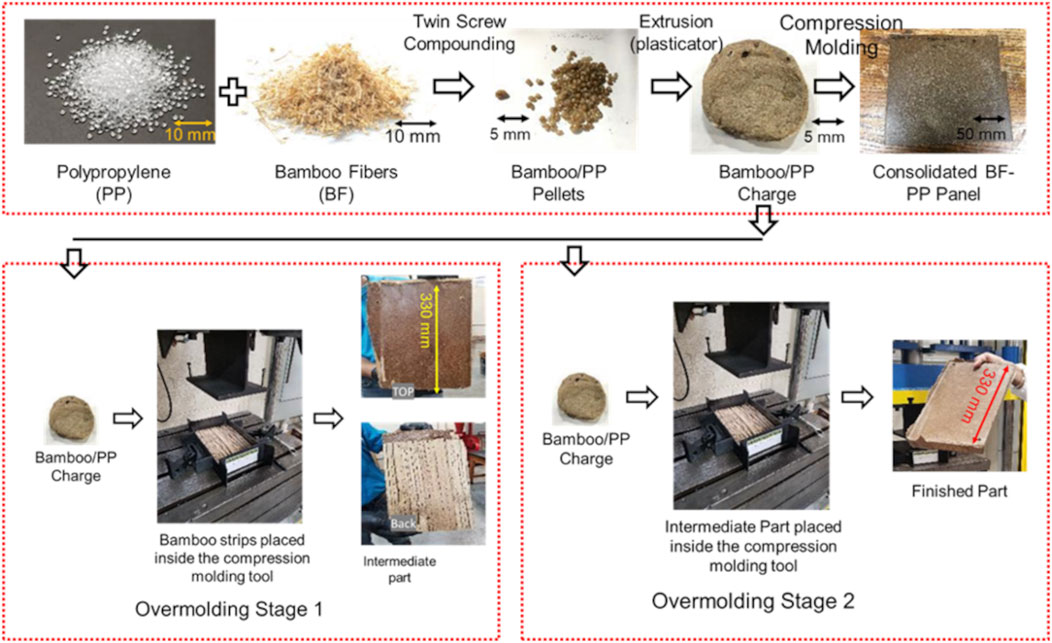
Composite Fabrication Process
The fabrication process begins with the preparation of bamboo fibers, which serve as the natural reinforcement in the composite structure. Polypropylene, known for its excellent processability and robustness, is chosen as the matrix material. The key innovative aspect of the research is the incorporation of nano aluminum oxide (nAl2O3) fillers into the composite formulation. These nano-fillers are mixed in controlled proportions with the bamboo fiber and PP matrix during the injection molding process, ensuring a uniform dispersion throughout the composite.
Injection Molding Technique
Injection molding is employed to mold the composite material. This method is chosen not only due to its efficiency in mass production but also because it ensures precise control over the composite’s microstructure. The uniform distribution of the nAl2O3 particles in the polypropylene matrix is crucial, as it directly contributes to the enhancement of the mechanical properties and flame retardancy. Through careful process parameters, such as temperature control and pressure adjustments, the composite achieves improved interfacial bonding between the fiber and matrix.
Mechanical and Thermal Property Assessment
The mechanical properties of the developed composite are evaluated through a series of standardized tests. These tests include the measurement of tensile strength (TS), modulus of elasticity, and elongation at break. The addition of nAl2O3 fillers is shown to increase the tensile strength and stiffness of the composite. For instance, an optimal concentration of nano fillers (around 9% by weight) can result in an improvement of tensile strength by approximately 43.1% while also increasing the modulus of elasticity significantly.
In addition to mechanical enhancements, the study places a strong emphasis on flame retardancy. Flame retardant properties are crucial for materials intended for use in high-risk environments such as construction and automotive applications. The composite material exhibits a reduced combustion rate (about 18 mm min-1) accompanied by a higher char residue percentage (approximately 30%), which is an important indicator of the material's ability to resist flame propagation.
Detailed Analysis of the Nano Fillers’ Role
Mechanical Reinforcement Mechanisms
Nano aluminum oxide particles play a multifaceted role in reinforcing the bamboo-polypropylene matrix. Due to their extremely small size and high surface area-to-volume ratio, these nano fillers provide more active sites for stress transfer between the bamboo fibers and the polypropylene matrix. This enhanced interaction results in improved load distribution across the composite material. The mechanical testing highlighted a modest increase in tensile strength and elongation at break, indicating that the composite not only becomes stiffer but also gains a slight improvement in toughness.
Interfacial Bonding
The presence of nAl2O3 fillers significantly enhances the interfacial bonding quality between the bamboo fibers and the PP matrix. This improved bonding is essential for preventing premature failure under load, thus ensuring the composite can sustain higher mechanical stresses before reaching the point of failure. The nano fillers act as a bridge, connecting the distinct phases of the composite, and thereby reducing the likelihood of debonding or crack propagation when the material is subjected to external stresses.
Flame Retardancy and Thermal Stability
A key aspect of the study was the enhancement of the composite’s flame retardancy. Nanoparticles such as nAl2O3 contribute to an improved barrier effect by forming a more insulating char layer upon exposure to fire. This layer acts as a physical shield, slowing down the burning process and reducing the rate at which heat is transferred to the underlying material. The measured combustion rate and char residue support the conclusion that the composite demonstrates superior flame retardant properties compared to conventional materials.
Thermal Decomposition Behavior
Thermal analysis techniques, such as Thermogravimetric Analysis (TGA), are used in the study to investigate the thermal stability of the composite. The data indicate that the composite material with nAl2O3 exhibits higher thermal decomposition temperatures. The incorporation of nano particles delays the onset of decomposition, thereby widening the safe operational temperature range of the composite. This characteristic is particularly beneficial for applications where exposure to high temperatures could pose a risk to safety and structural integrity.
Performance Data and Comparative Analysis
To provide a comprehensive view of the enhancements achieved by the addition of nAl2O3 fillers, the study presents a detailed comparison between composites with and without nano fillers. The following table summarizes key performance indicators observed during testing:
| Property | Composite without nAl2O3 | Composite with 9% nAl2O3 |
|---|---|---|
| Tensile Strength | Average baseline value | Increased by 43.1% |
| Modulus of Elasticity | Baseline stiffness level | Enhanced stiffness value (2124 MPa) |
| Elongation at Break | Slight improvement noted | Increased by 1.70% |
| Combustion Rate | Higher risk of flame propagation | Reduced to 18 mm min-1 |
| Char Residue | Lower char formation | Increased char residue (approx. 30%) |
The table clearly outlines the benefits derived from the nAl2O3 filler incorporation. The improvements in mechanical and thermal properties underscore the potential of these composites when applied in environments requiring rigorous performance standards.
Scientific Implications and Industrial Applications
Advancements in Composite Material Engineering
The findings from this study offer significant contributions to the field of composite material research. The successful integration of bamboo fibers and nano fillers into a polypropylene matrix paves the way for the development of sustainable, high-performance materials. One of the notable advancements is the demonstration of how natural fibers, often seen as environmentally friendly yet mechanically inferior, can be synergistically enhanced with modern nano-technology. This dramatically changes the outlook for green materials in industrial applications.
Enhanced Structural Applications
Given the improved mechanical durability and flame retardancy, these composites are highly attractive for use in the construction sector. Building materials that require fire resistance as well as structural integrity can greatly benefit from such innovations. Moreover, the automotive industry, which continuously seeks lightweight yet robust materials to improve fuel efficiency and safety standards, might also find these composites to be of considerable value. The higher char residue and lower combustion rate are especially appealing for applications where fire safety is paramount.
Sustainability and Environmental Considerations
Beyond performance improvements, the research emphasizes the environmental benefits of using bamboo fibers and other natural reinforcements. Bamboo is a rapidly renewable resource, and its integration with polypropylene not only reduces the reliance on purely synthetic materials but also contributes to a reduction in the environmental footprint of composite materials. The use of nAl2O3 fillers, while adding a sophisticated layer of performance, also suggests that sustainable alternatives can be merged with advanced nanotechnology to achieve materials that are both high-performing and eco-friendly.
Accessing the Full Article
While I am unable to directly open external links, you can access the full article through several methods:
Institutional Access
Often, universities and research institutions have subscriptions to academic journals. You may be able to log into your institution’s library portal or use a virtual private network (VPN) to access the article via SpringerLink.
Public and University Libraries
Many public and university libraries subscribe to journals published on Springer. Visiting one of these libraries could provide you with access either on-site or via their digital resources.
Purchase Options
If institutional access is not an option, SpringerLink also offers the ability to purchase individual articles or rent them for a limited period. This is a straightforward method to ensure you can read the full details of the research without needing a full subscription.
Additional Data and Insights
Comparative Analysis with Related Research
Similar research in the field has looked at various natural fiber composites integrated with nano fillers to enhance mechanical and thermal properties. Studies involving bamboo, jute, or other lignocellulosic fibers in a polymer matrix have demonstrated comparable improvements in tensile strength, impact resistance, and flame retardancy. What sets this particular study apart is its focus on optimizing the proportion of nAl2O3 fillers to achieve a balance between improved performance metrics and cost-effectiveness.
Moreover, further investigations have compared different types of nanoparticles, such as titanium dioxide, zinc oxide, and silicon dioxide. Each filler influences the composite performance in unique ways, with nano aluminum oxide being particularly effective in enhancing char formation and thermal stability. These improvements are critical for industries where rapid heat transfer, structural integrity, and flame resistance could determine the overall safety and efficiency of the material.
Future Research Directions
The study lays the groundwork for future explorations into the scalability of such composites and the longevity of their performance under various environmental conditions. Future research may focus on:
- Long-term durability tests: Comprehensive aging studies under varying environmental conditions to simulate real-world stresses.
- Optimization of filler loading: Fine-tuning the concentration of nAl2O3 to achieve maximum property enhancement without compromising cost-effectiveness or processing stability.
- Comparative studies with other nano fillers: Evaluating the performance of alternative nano additives and their synergistic effects with different types of natural fibers.
- Sustainable manufacturing processes: Innovating manufacturing methods that further reduce the environmental impact of composite production.
Summary Table of Key Enhancements
| Aspect | Standard Bamboo-PP Composite | Enhanced with nAl2O3 Fillers |
|---|---|---|
| Mechanical Strength | Moderate | Significantly increased (up to 43.1% improvement) |
| Modulus of Elasticity | Baseline value | Enhanced (e.g., 2124 MPa) |
| Elongation at Break | Lower ductility | Slightly improved (approx. 1.70% increase) |
| Flame Retardancy | Higher combustion rates | Improved with reduced combustion (~18 mm min-1) and increased char residue (~30%) |
| Thermal Stability | Standard decomposition temperatures | Higher decomposition temperature and improved thermal resistance |
References
- Enhancing mechanical durability and flame retardancy in Bamboo-Polypropylene composites with nAl2O3 fillers - Springer
- ResearchGate - Bamboo-PP Composites Study
- IEEE Xplore - Mechanical Properties of Nano-Treated Composites
- MDPI - Fire Behavior of Bamboo Composites
- MDPI - Review on Bamboo Fiber Materials
Recommended Related Queries
 fishthinkers.wordpress.com
Last updated March 14, 2025