
Comprehensive List of Cognitive Biases, Heuristics, Fallacies, and Distortions
An In-Depth Exploration of Human Cognitive Patterns and Their Impacts
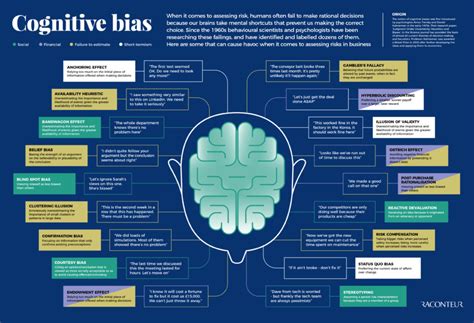
Key Takeaways
- Cognitive biases and heuristics significantly influence our decision-making processes, often leading to systematic errors.
- Understanding these biases is crucial for improving critical thinking, enhancing personal and professional relationships, and making more informed decisions.
- Categorizing biases into granular groups helps in identifying and mitigating their effects in various aspects of life.
1. Cognitive Biases
Cognitive biases are systematic patterns of deviation from norm or rationality in judgment. They often arise from the brain's attempt to simplify information processing, using mental shortcuts known as heuristics. While these biases can be adaptive, they frequently lead to perceptual distortion, inaccurate judgment, and illogical interpretation.
1.1. Memory Biases
Memory biases affect how we encode, store, and recall information, often distorting memories to align with our current beliefs and expectations.
1.1.1. Hindsight Bias
The tendency to believe, after an event has occurred, that one would have predicted or expected the outcome. This bias can lead to overconfidence in one's predictive abilities.
1.1.2. Confirmation Bias
The inclination to search for, interpret, and remember information that confirms preexisting beliefs while giving disproportionately less consideration to alternative possibilities.
1.1.3. Availability Heuristic
Overestimating the likelihood of events based on their availability in memory. Events that are more recent or vivid are often perceived as more common or probable.
1.1.4. Recency Bias
Giving greater weight to recent events or information over historical data, impacting judgments and decisions based on the most current information available.
1.1.5. Rosy Retrospection
Recalling past events more favorably than they occurred, often overlooking the negative aspects and focusing on the positive.
1.1.6. Selective Memory
Recalling information that aligns with current beliefs or emotions while ignoring contradictory data, leading to a biased understanding of past events.
1.2. Decision-Making Biases
These biases influence the choices we make, often leading to suboptimal or irrational decisions.
1.2.1. Anchoring Bias
The tendency to rely too heavily on the first piece of information encountered (the "anchor") when making decisions, even if it's irrelevant.
1.2.2. Overconfidence Bias
Overestimating one's own abilities, knowledge, or the accuracy of one's predictions, often leading to risky decisions.
1.2.3. Sunk Cost Fallacy
Continuing an endeavor because of previously invested resources (time, money, effort), even when it's no longer rational to do so.
1.2.4. Loss Aversion
Preferring to avoid losses rather than acquiring equivalent gains, leading to risk-averse behavior even when risk-taking could be beneficial.
1.2.5. Status Quo Bias
The preference for the current state of affairs, resisting change even when change could lead to improvement.
1.2.6. Framing Effect
Drawing different conclusions from the same information depending on how it is presented, such as emphasizing gains versus losses.
1.2.7. Gambler's Fallacy
Believing that past random events affect the probability of future random events, such as thinking a coin is "due" to land on heads after several tails.
1.3. Social Biases
Biases that arise from our interactions with others and our perceptions of social dynamics.
1.3.1. In-Group Bias
Favoring members of one's own group over those in other groups, often leading to unfair judgments and discrimination.
1.3.2. Out-Group Homogeneity Bias
Perceiving members of out-groups as more similar to each other than they actually are, ignoring individual differences.
1.3.3. Fundamental Attribution Error
Overemphasizing personal characteristics and underestimating situational factors when explaining others' behaviors.
1.3.4. Halo Effect
Allowing one positive trait of a person to influence the overall perception of them, potentially overshadowing other qualities.
1.3.5. Stereotyping
Assigning generalized attributes to individuals based on their group membership, often leading to inaccurate and unfair judgments.
1.3.6. Social Proof
Assuming that the actions of others reflect correct behavior, especially in ambiguous situations, leading to herd behavior.
1.4. Probability and Risk Biases
Biases that affect how we assess probabilities and risks, often leading to flawed risk management and decision-making.
1.4.1. Neglect of Probability
Ignoring statistical probabilities when making decisions under uncertainty, leading to misjudgments about event likelihoods.
1.4.2. Zero-Risk Bias
Preferring to eliminate small risks entirely rather than reducing larger risks, often resulting in inefficient risk management.
1.4.3. Optimism Bias
Underestimating the likelihood of negative outcomes and overestimating positive ones, leading to overly optimistic projections.
1.5. Attention and Perception Biases
Biases that influence what we notice and how we interpret sensory information.
1.5.1. Selective Perception
Allowing expectations and preconceptions to influence how we perceive the world, often filtering out contradictory information.
1.5.2. Change Blindness
Failing to notice significant changes in the environment due to focused attention on other aspects.
1.5.3. Inattentional Blindness
Noticing unexpected objects or events when attention is focused elsewhere, leading to oversight of critical information.
1.5.4. Contrast Effect
Shifting judgments based on comparison to a recent reference point, which can distort perception and evaluation.
2. Heuristics
Heuristics are mental shortcuts or "rules of thumb" that simplify decision-making processes. While often useful, they can sometimes lead to systematic errors or biases.
2.1. Judgment Heuristics
Heuristics used to make quick judgments about the likelihood or nature of events.
2.1.1. Representativeness Heuristic
Judging the probability of an event based on how much it resembles existing prototypes, often ignoring actual statistical probabilities.
2.1.2. Recognition Heuristic
Choosing options that are more familiar or recognized, assuming that familiarity correlates with correctness or preference.
2.1.3. Affect Heuristic
Making decisions based on emotional responses rather than objective analysis, which can lead to biased judgments.
2.2. Problem-Solving Heuristics
Heuristics employed to find solutions to complex problems efficiently.
2.2.1. Trial and Error
Trying various solutions until one proves successful, often used when there is no clear strategy.
2.2.2. Means-End Analysis
Breaking down a problem into smaller, manageable sub-goals and addressing each systematically to achieve the desired outcome.
2.2.3. Working Backwards
Starting with the desired outcome and determining the necessary steps to reach it, often used in planning and problem-solving.
2.2.4. Satisficing
Accepting a "good enough" solution rather than seeking the optimal one, balancing efficiency with adequacy.
2.2.5. Take-the-Best Heuristic
Using the first valid cue to make decisions, often prioritizing efficiency over thorough analysis.
2.3. Social Heuristics
Heuristics that guide social interactions and judgments, influencing how we relate to others.
2.3.1. Reciprocity
Responding to positive actions with another positive action, fostering mutual cooperation and social bonds.
2.3.2. Authority Bias
Trusting the opinions of authority figures without critical evaluation, often leading to unquestioning acceptance of directives.
2.3.3. Social Proof
Assuming that others' actions reflect correct behavior, especially in uncertain situations, leading to conformity.
3. Logical Fallacies
Logical fallacies are errors in reasoning that undermine the logic of an argument. They can be deceptive and often persuade through emotional appeal rather than sound logic.
3.1. Formal Fallacies
Errors in the structure of a logical argument, making the argument invalid.
3.1.1. Affirming the Consequent
Assuming that if the consequent is true, the antecedent must also be true. For example: "If it rains, the ground will be wet. The ground is wet, therefore it rained."
3.1.2. Denying the Antecedent
Assuming that if the antecedent is false, the consequent must also be false. For example: "If it rains, the ground will be wet. It did not rain, therefore the ground is not wet."
3.2. Informal Fallacies
Errors arising from the content or context of an argument, rather than its logical structure.
3.2.1. Ad Hominem
Attacking the person making the argument rather than addressing the argument itself, often undermining the opponent's credibility.
3.2.2. Straw Man
Misrepresenting someone's argument to make it easier to attack, often by exaggerating or distorting the original position.
3.2.3. False Dilemma
Presenting only two options when more alternatives exist, forcing a choice between limited possibilities.
3.2.4. Circular Reasoning
Using the conclusion as a premise in the argument, resulting in a loop without providing actual evidence.
3.2.5. Appeal to Authority
Using an authority figure's opinion as evidence for a claim without examining the validity of the authority or the argument.
3.2.6. Slippery Slope
Arguing that a minor action will lead to significant and often negative consequences without sufficient evidence to support the progression.
3.2.7. Post Hoc Ergo Propter Hoc
Assuming that because one event followed another, the first event caused the second, without considering other factors.
3.2.8. False Consensus Effect
Overestimating how much others share our beliefs, behaviors, and values, leading to inflated perceptions of agreement.
4. Cognitive Distortions
Cognitive distortions are irrational thought patterns that perpetuate negative thinking and emotions, often contributing to mental health issues.
4.1. Emotional Distortions
Distortions driven by emotions, affecting how we perceive and react to situations.
4.1.1. Catastrophizing
Expecting the worst-case scenario in any situation, leading to heightened anxiety and stress.
4.1.2. Minimization
Downplaying the significance of positive events or achievements, often undermining one's self-esteem.
4.1.3. Personalization
Attributing external events to oneself without evidence, taking undue responsibility for things beyond one's control.
4.2. Perceptual Distortions
Distortions that affect how we perceive reality, leading to inaccurate interpretations of events or information.
4.2.1. Illusory Correlation
Perceiving a relationship between two variables when none exists, often leading to false conclusions.
4.2.2. Selective Abstraction
Focusing on a single detail while ignoring the broader context, leading to a skewed understanding of situations.
4.2.3. Magnification and Minimization
Exaggerating the importance of negative events or downplaying positive ones, distorting the perceived reality.
4.3. Dichotomous Thinking
Seeing situations in black-and-white terms without recognizing the nuances or middle ground, leading to rigid thinking.
4.3.1. Overgeneralization
Drawing broad conclusions from limited or single instances, often perpetuating stereotypes and unrealistic expectations.
4.3.2. Emotional Reasoning
Believing that something is true simply because it feels true, disregarding evidence to the contrary.
5. Granular Categorization and Prioritization
To provide a more detailed and prioritized view, cognitive biases, heuristics, fallacies, and distortions are categorized based on their prevalence, relevance, social influence, emotional drivers, and logical validity.
5.1. Most Common and Broadly Applicable
- Confirmation Bias
- Anchoring Bias
- Availability Heuristic
- Hindsight Bias
- Overconfidence Bias
- Recency Bias
- Loss Aversion
- In-Group Bias
- Fundamental Attribution Error
- Halo Effect
5.2. Highly Relevant to Decision-Making
- Loss Aversion
- Sunk Cost Fallacy
- Status Quo Bias
- Framing Effect
- Gambler's Fallacy
- Prospect Theory
- Neglect of Probability
- Zero-Risk Bias
- Optimism Bias
- Overconfidence Bias
5.3. Socially Influential
- In-Group Bias
- Out-Group Homogeneity Bias
- Groupthink
- Authority Bias
- Social Proof
- Self-Serving Bias
- Actor-Observer Bias
- Straw Man
- False Consensus Effect
- Bandwagon Effect
5.4. Emotionally Driven
- Affect Heuristic
- Catastrophizing
- Personalization
- Optimism Bias
- Neglect of Probability
- Wishful Thinking
- Pessimism Bias
- Endowment Effect
- Belief Bias
- Emotional Reasoning
5.5. Logically Problematic
- Ad Hominem
- Straw Man
- False Dilemma
- Circular Reasoning
- Slippery Slope
- Affirming the Consequent
- Denying the Antecedent
- Post Hoc Ergo Propter Hoc
- Correlation vs. Causation
- Belief Bias
6. Additional Categories and Emerging Biases
As our understanding of cognitive processes evolves, new biases and distortions are identified, often influenced by technological advancements and societal changes.
6.1. Technological and Digital Biases
- Algorithmic Bias: Systematic and repeatable errors in a computer system that create unfair outcomes, such as favoritism or discrimination.
- Information Overload: The difficulty of understanding an issue and making decisions when one has too much information.
- Filter Bubbles: Personalized algorithms that isolate individuals from diverse perspectives, reinforcing existing beliefs.
- Cyberchondria: The unfounded escalation of concerns about common symptomatology based on online medical research.
- Digital Echo Chambers: Environments where a person only encounters information or opinions that reflect their own.
6.2. Environmental and Contextual Biases
- Contextual Bias: The influence of the context in which information is received on the interpretation and decision-making process.
- Environmental Priming: Subtle cues in the environment that influence behavior and perception without conscious awareness.
- Spatial Bias: The tendency to make judgments based on the physical space or layout of the environment.
- Temporal Bias: How the perception of time influences decision-making and judgments, such as preferring immediate rewards over long-term benefits.
6.3. Health and Well-being Biases
-
Health Halo Effect: Assuming that a product is healthy based on a single positive attribute, overlooking other potential negatives.
-
Survivorship Bias: Focusing on the successful cases while ignoring those that did not survive or succeed, leading to distorted conclusions.
-
Placebo Effect: Believing that a treatment is effective based on the belief in its efficacy, rather than the treatment itself.
-
Nocebo Effect: Experiencing negative side effects due to the expectation of harm, even if the treatment is inert.
6.4. Cultural and Societal Biases
- Cultural Bias: Interpreting and judging phenomena by standards inherent to one's own culture, often leading to misunderstanding and prejudice.
- Ethnocentrism: Evaluating other cultures according to the standards of one's own culture, often resulting in a sense of superiority.
- Stereotype Threat: The risk of confirming negative stereotypes about an individual's racial, ethnic, gender, or cultural group.
- Implicit Bias: Unconscious attitudes or stereotypes that affect understanding, actions, and decisions.
7. Practical Implications and Mitigation Strategies
Understanding cognitive biases, heuristics, fallacies, and distortions is essential for improving decision-making, enhancing critical thinking, and fostering more objective judgments in both personal and professional settings.
7.1. Enhancing Critical Thinking
Developing critical thinking skills involves recognizing and questioning one's own biases, seeking diverse perspectives, and evaluating evidence objectively.
7.2. Decision-Making Strategies
Implementing structured decision-making processes, such as considering alternative viewpoints, using statistical analysis, and delaying judgments until adequate information is available.
7.3. Educational Programs
Incorporating education on cognitive biases and logical fallacies into curricula to raise awareness and equip individuals with tools to identify and counteract these biases.
7.4. Organizational Policies
Establishing policies that promote diversity of thought, encourage critical evaluation, and minimize groupthink and other socially influenced biases within organizations.
7.5. Personal Development
Engaging in self-reflection, mindfulness practices, and seeking feedback from others to become more aware of and reduce personal biases.
8. Conclusion
Cognitive biases, heuristics, fallacies, and distortions are integral aspects of human cognition that influence how we perceive, interpret, and interact with the world. While they serve as mental shortcuts that aid in processing vast amounts of information, they can also lead to systematic errors in judgment and decision-making. By understanding and categorizing these cognitive patterns, individuals and organizations can implement strategies to mitigate their negative impacts, fostering more rational and objective thinking.
9. References
- List of Cognitive Biases and Heuristics - The Decision Lab
- List of cognitive biases - Wikipedia
- Cognitive Bias List: 13 Common Types of Bias - Verywell Mind
- Cognitive Biases (2024): Complete List of 151 Biases [Psychology]
- A List of Common Cognitive Biases (With Examples)
- What Is Cognitive Bias? 7 Examples & Resources (Incl. Codex) - Positive Psychology
- Cognitive Bias Codex [PDF]
- Guide to Most Common Cognitive Biases
- 30 Common Psychological Biases
- Cognitive Biases Visual Chart
- Complete List of 219 Biases
- Cognitive Biases and Heuristics in Decision-Making
This exhaustive categorization aims to provide a comprehensive understanding of the various cognitive biases, heuristics, fallacies, and distortions. By recognizing and addressing these cognitive patterns, individuals can enhance their decision-making processes, foster critical thinking, and improve interpersonal relationships.
Last updated January 18, 2025