
Revolutionizing Aquaculture: How Modern Fish Farming Is Shaping Our Global Food Future
Exploring the sustainable practices, innovative technologies, and environmental impact of fish farming in the evolving aquaculture industry
Key Insights About Fish Farming
- Global significance: Fish farming produces over 82 million tonnes annually, with China accounting for more than 60% of global production
- Sustainable innovation: Modern aquaculture is embracing technologies like RAS (Recirculating Aquaculture Systems), AI monitoring, and integrated multi-trophic systems
- Environmental balance: When done responsibly, farmed fish produces approximately one-sixth the emissions of beef, making it more sustainable than most land-based animal proteins
Understanding Fish Farming Methods
Fish farming, also known as pisciculture or aquaculture, involves the commercial breeding of fish in controlled environments primarily for food production. As wild fish populations decline due to overfishing and environmental changes, aquaculture has become essential to meet global seafood demand, with the industry experiencing an average growth of 5.3% per year between 2000-2018.
Common Fish Farming Techniques
| Method | Description | Common Species | Environmental Impact |
|---|---|---|---|
| Pond Culture | Traditional method using natural or artificial ponds with managed water levels and feeding | Catfish, Tilapia, Carp | Low to moderate, depending on waste management |
| Cage Culture | Metal cages submerged in deeper water bodies, allowing efficient feeding and growth | Salmon, Trout | Higher - potential waste issues and ecosystem disruption |
| Raceways | Long, narrow channels with continuous water flow providing oxygenation and waste removal | Trout | Moderate, requires proper wastewater management |
| Recirculating Aquaculture Systems (RAS) | Closed systems that filter and reuse water, allowing for tight environmental control | Tilapia, various high-value species | Low - minimal water usage and controlled waste |
| Integrated Multi-Trophic Aquaculture (IMTA) | Farming multiple species at different trophic levels, with waste from one becoming food for another | Fish, Shellfish, Seaweed | Low - designed to be environmentally balanced |
| Aquaponics | Combines aquaculture with hydroponics in a symbiotic environment | Tilapia, Leafy Greens | Very low - closed-loop system with minimal waste |
Visual Examples of Farming Methods
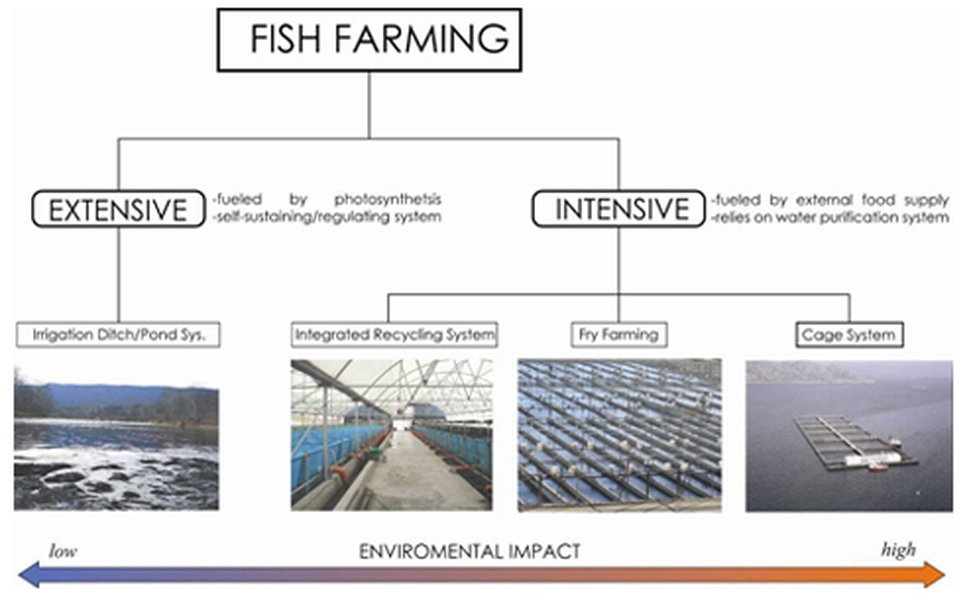
Environmental Impact and Sustainability Challenges
While fish farming offers solutions to overfishing and food security, it also presents significant environmental challenges that the industry must address for long-term sustainability.
Key Environmental Concerns
Modern fish farming faces several environmental challenges that vary significantly based on the farming method employed:
Pollution and Water Quality
Open-cage systems can release waste, uneaten feed, and chemicals directly into surrounding waters. This nutrient runoff may lead to algal blooms, oxygen depletion, and habitat degradation in natural ecosystems. Modern RAS systems help mitigate these issues by treating and recirculating water.
Fish Escapes and Genetic Contamination
Farmed fish that escape into the wild pose risks of disease transmission and genetic hybridization with wild populations. This is particularly concerning with non-native or genetically modified species that could disrupt local ecosystems.
Feed Sustainability
Carnivorous farmed fish like salmon typically require fishmeal and fish oil derived from wild-caught forage fish. This dependency creates pressure on wild fisheries, with approximately 20% of global wild fish catch being processed into feed for aquaculture.
Innovations in Sustainable Aquaculture
The aquaculture industry is rapidly evolving with technological advancements aimed at increasing sustainability, efficiency, and animal welfare. These innovations are reshaping fish farming practices worldwide.
Technological Integration
Modern fish farms are increasingly incorporating sophisticated technologies to optimize operations and reduce environmental impact:
AI and IoT Monitoring Systems
Artificial intelligence and Internet of Things (IoT) sensors now allow real-time monitoring of water quality parameters, fish behavior, and feeding efficiency. These systems can automatically adjust conditions to optimize growth while minimizing resource use and stress on the fish.
Advanced Recirculating Aquaculture Systems (RAS)
State-of-the-art RAS facilities recirculate up to 99% of their water, significantly reducing water consumption and minimizing discharge into the environment. These land-based systems also eliminate risks of escapes and can be located close to markets, reducing transportation emissions.
Offshore and Open Ocean Systems
Moving fish farms further offshore into deeper waters helps disperse waste more effectively and provides better conditions for fish growth. Companies like SalMar Aker Ocean are developing massive offshore structures capable of withstanding open ocean conditions while maintaining optimal farming environments.
Innovative Farming Practices
Beyond technological solutions, innovative farming approaches are helping to address sustainability challenges:
Alternative Feed Sources
Researchers and companies are developing more sustainable fish feeds using ingredients like insect protein, single-cell proteins, algae, and agricultural by-products. These alternatives reduce reliance on wild-caught fish while often improving nutritional profiles and reducing waste.
Selective Breeding and Genetics
Advanced breeding programs are developing fish strains with improved growth rates, disease resistance, and feed conversion efficiency. Unlike genetic modification, selective breeding uses traditional methods to enhance desirable traits over generations.
This video explores innovative sustainable aquaculture methods that protect our oceans while meeting increasing seafood demand. These emerging techniques demonstrate how the industry is evolving to address both environmental and production challenges.
Global Industry Outlook and Future Trends
The aquaculture industry continues to evolve rapidly, with significant developments expected in coming years as technology advances and sustainability becomes increasingly prioritized.
Major Industry Events in 2025
Several important aquaculture conferences are scheduled for 2025, highlighting the industry's global reach and commitment to innovation:
Aquaculture 2025 (New Orleans, USA)
This major national conference and exposition will host nearly 4,000 attendees from over 90 countries, combining annual meetings of the National Shellfisheries Association, the Fish Culture Section of the American Fisheries Society, the World Aquaculture Society, and the National Aquaculture Association.
World Aquaculture Safari 2025 (Kampala, Uganda)
As the largest aquaculture meeting in Africa, this event at Speke Resort Munyonyo will feature participation from countries throughout Africa and the world, focusing on the unique challenges and opportunities for aquaculture in developing regions.
5th World Aquaculture, Fisheries and Seafood Conference (Rome, Italy)
Scheduled for June 9-11, 2025, this conference will gather experts, researchers, academicians, and industry professionals to discuss aquaculture engineering, mariculture innovations, and applications in aquaponics technology.
Emerging Industry Trends
Several key trends are shaping the future of fish farming globally:
Urban Aquaculture Expansion
Fish farming is increasingly moving closer to urban centers, with innovative vertical farming systems and RAS facilities being integrated into urban food production. These systems reduce transportation costs and provide fresh seafood to urban markets with minimal environmental impact.
Blockchain and Traceability
Blockchain technology is being implemented to enhance transparency in seafood supply chains, allowing consumers to verify the origin, production methods, and sustainability credentials of farmed fish products.
Welfare Certification Programs
With growing recognition of fish sentience and welfare concerns, new certification programs are emerging to verify humane treatment throughout the production cycle, from hatching to harvest.
Frequently Asked Questions
References
- Top Aquaculture Trends in 2025 - StartUs Insights
- World Aquaculture Society Conference Information - WAS
- 5th World Aquaculture, Fisheries and Seafood Conference - WAC 2025
- The Most Common Fish Farming Methods: Ultimate Guide - BootstrapBee
- Fishing and Farming Methods - Seafood Watch
- Fish Farming - Wikipedia
- What Is Fish Farming? - Animal Equality
- Fish Farming and Aquaculture - Animal Welfare Institute
Recommended Searches
Last updated April 6, 2025