
Unlocking the Power of Speech Recognition: Inside FunASR's Revolutionary Toolkit
Discover how this open-source platform bridges academic innovation with industrial applications for advanced speech processing
Essential FunASR Highlights
- Comprehensive Toolkit: FunASR offers a full spectrum of speech processing capabilities, from recognition and voice activity detection to punctuation restoration and speaker diarization.
- Industrial-Academic Bridge: Designed to connect research innovations with practical applications, featuring pre-trained models on vast industrial datasets.
- Flagship Paraformer Model: Employs a non-autoregressive end-to-end architecture delivering superior efficiency and accuracy in speech recognition tasks.
What is FunASR?
FunASR (Fundamental End-to-End Speech Recognition) is an advanced open-source toolkit developed by Alibaba's Damo Academy, designed to revolutionize speech processing technology. It serves as a crucial bridge between academic research and industrial applications, offering a comprehensive suite of tools for various speech-related tasks.
The toolkit provides convenient scripts and tutorials for users to leverage pre-trained models, supporting both inference and fine-tuning operations. What sets FunASR apart is its extensive collection of pre-trained models developed on large-scale industrial data, which users can freely use, modify, and share under the Model License Agreement.
Core Capabilities
FunASR's functionality extends far beyond basic speech recognition, encompassing a wide range of speech processing capabilities:
- Automatic Speech Recognition (ASR): Converts spoken language into written text with high accuracy
- Voice Activity Detection (VAD): Identifies speech segments within audio signals
- Punctuation Restoration: Adds appropriate punctuation to enhance readability of transcribed text
- Language Models: Improves transcription accuracy through contextual understanding
- Speaker Verification: Confirms the identity of speakers based on voice characteristics
- Speaker Diarization: Distinguishes between different speakers in multi-person conversations
- Multi-talker ASR: Handles overlapping speech from multiple speakers
The radar chart above illustrates how FunASR's Paraformer model compares to traditional ASR systems and cloud-based ASR services across key performance metrics. FunASR demonstrates particular strengths in accuracy, processing speed, and customization options, making it suitable for a wide range of applications.
Key Components and Architecture
Flagship Model: Paraformer
At the heart of FunASR is Paraformer, a non-autoregressive end-to-end speech recognition model. Unlike traditional autoregressive models that generate outputs sequentially, Paraformer produces all tokens simultaneously, resulting in significantly faster inference times without sacrificing accuracy. The model has demonstrated exceptional performance, particularly on large-scale industrial datasets like the 60,000 hours of annotated Mandarin speech.
Enhanced Functionality
Paraformer includes several advanced features that enhance its usability in practical applications:
- Timestamp prediction for precise word-level timing information
- Hotword customization to improve recognition of specific terminology
- Support for both offline file transcription and real-time streaming scenarios
Voice Activity Detection
FunASR implements voice activity detection using the Feedforward Sequential Memory Network (FSMN-VAD). This component effectively distinguishes between speech and non-speech segments, enabling more efficient processing by focusing computational resources on relevant audio portions.
Punctuation Restoration
The toolkit includes a text post-processing punctuation model based on the controllable time-delay Transformer (CT-Transformer). Trained on industrial corpora, this model accurately adds punctuation to ASR outputs, significantly improving readability and facilitating downstream natural language processing tasks.
FunCodec Extension
FunASR extends its capabilities through FunCodec, a neural speech codec toolkit offering reproducible training recipes and inference scripts for models like SoundStream and Encodec. This extension enhances FunASR's versatility for applications requiring audio compression and reconstruction.
FunASR Ecosystem and Components
The following mindmap illustrates the comprehensive ecosystem of FunASR, highlighting its key components, deployment options, and applications:
Deployment and Usage
FunASR offers flexible deployment options to suit various application needs. Users can deploy the toolkit on local servers for applications requiring data privacy, or on cloud servers for scalability and accessibility. The toolkit supports both offline file transcription and real-time streaming transcription services.
Model Availability and Integration
FunASR leverages ModelScope to manage and host its pre-trained models, including Paraformer, FSMN-VAD, and CT-Transformer. These models are also available on platforms like Hugging Face, making them easily accessible to developers. The PyTorch-based pipelines are categorized for academic or industrial use, providing flexibility for different application scenarios.
| Deployment Type | Features | Use Cases | Requirements |
|---|---|---|---|
| Local Server | Full control, data privacy, offline operation | Healthcare, legal transcription, private enterprise applications | Computing resources, storage for models, PyTorch environment |
| Cloud Server | Scalability, accessibility, reduced local resource requirements | Large-scale transcription services, multi-user applications | Internet connectivity, cloud infrastructure, API integration |
| Real-time Service | Immediate transcription, streaming capability | Live captioning, interactive voice assistants, meeting transcription | Low-latency infrastructure, efficient processing pipeline |
| Offline Processing | Higher accuracy, batch processing, no time constraints | Media content transcription, archival audio processing | Storage for audio files, file handling capabilities |
Implementation Example
Here's a demonstration of FunASR in action, showcasing its real-time transcription capabilities:
This video demonstrates FunASR's capability to recognize and transcribe speech in real-time, converting audio from both microphone input and computer audio into text. The system's efficiency and accuracy make it suitable for applications requiring immediate text conversion from speech.
Applications and Use Cases
FunASR's versatility makes it suitable for a wide range of applications across various industries:
Telecommunications
In customer service centers, FunASR can transcribe calls in real-time, enabling automatic documentation and analysis of customer interactions. This facilitates quality monitoring, compliance, and the identification of trends or issues in customer communications.
Media and Entertainment
Content creators can utilize FunASR for automatic transcription and subtitling of audio and video content, enhancing accessibility and enabling efficient content indexing. The punctuation restoration feature ensures that the generated transcriptions are highly readable.
Healthcare
Medical professionals can employ FunASR for dictation and documentation purposes, reducing the administrative burden and allowing for more time with patients. The toolkit's accuracy in technical terminology recognition makes it particularly valuable in clinical settings.
Education
Educational institutions can implement FunASR to transcribe lectures and discussions, providing accessible materials for students with hearing impairments and enabling searchable archives of educational content.
Visual Insights: Speech Recognition Technology
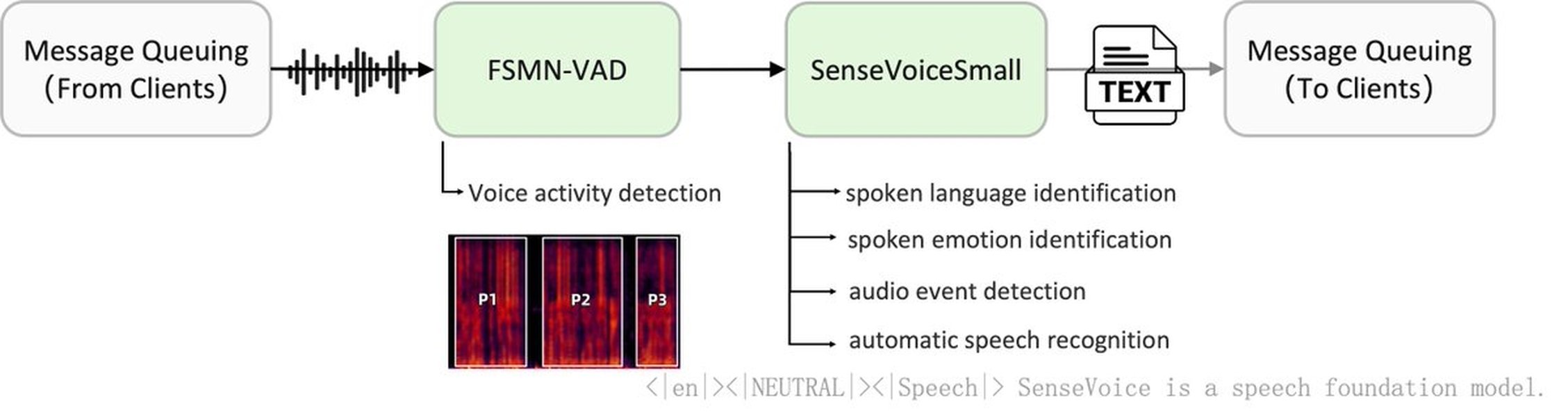
These images illustrate the diverse applications of speech recognition technology, the complexity of building effective ASR systems, and FunASR's recent innovations in multilingual speech recognition.
Frequently Asked Questions
References
- FunASR: A Fundamental End-to-End Speech Recognition Toolkit - GitHub
- FunASR: A Fundamental End-to-End Speech Recognition Toolkit - arXiv
- FunASR: A Fundamental End-to-End Speech Recognition Toolkit - ResearchGate
- FunCodec: A Fundamental Neural Speech Codec Toolkit - arXiv
- funasr/fa-zh Paraformer Model - Hugging Face
- funasr/paraformer-en Model - Hugging Face
- funasr 0.7.5 - PyPI
Recommended Topics
Last updated April 8, 2025