
Unlocking the Consumer Mind: How Purchase Decisions Are Really Made
A step-by-step journey through the psychology of buying, from initial need to final reflection.
Understanding how consumers decide what to buy is fundamental for businesses aiming to connect with their audience and drive sales. The consumer decision-making process provides a framework for mapping this journey. It's typically broken down into five distinct stages, though the time spent on each and the specific path taken can vary significantly based on the individual, the product's complexity, cost, and the buying context. Let's delve into this crucial process.
Essential Insights: The Buying Journey Simplified
Key Takeaways
- It's a Multi-Stage Process: Consumers generally move through five core stages: Need Recognition, Information Search, Evaluation of Alternatives, Purchase Decision, and Post-Purchase Evaluation.
- Context Matters: The complexity, cost, and personal importance of a purchase significantly influence how thoroughly a consumer engages with each stage. Routine purchases might skip steps, while major investments involve extensive research.
- Marketing Opportunities Abound: Each stage presents opportunities for businesses to engage, inform, and influence consumer choices through targeted strategies, content, and support.
The Five Stages of Consumer Decision-Making
Navigating the Path to Purchase
The consumer decision-making process outlines the typical steps an individual takes when faced with a purchase. While often presented linearly, modern influences, especially digital ones, can sometimes make this journey more circular or iterative.
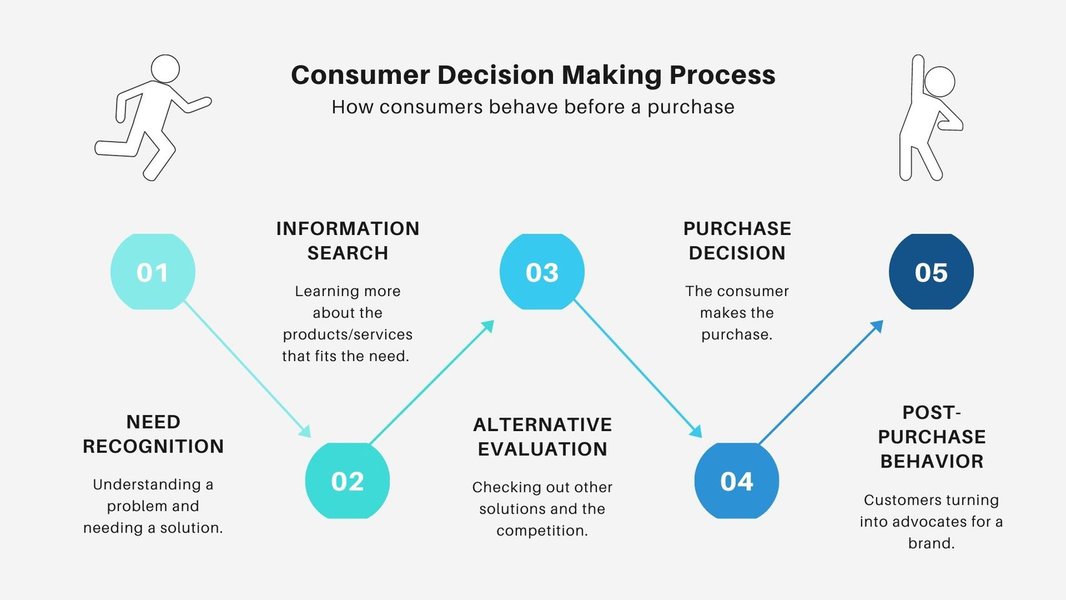
A visual representation of the common five-stage consumer decision-making process.
Stage 1: Need Recognition (The Spark)
This initial stage is where the process begins. The consumer identifies a gap between their current state and a desired state, recognizing a need, want, or problem that needs solving. This recognition can be triggered internally or externally.
- Internal Stimuli: Basic physiological needs (hunger, thirst) or psychological desires (status, self-improvement). Example: Feeling hungry triggers the need for food.
- External Stimuli: Exposure to external factors like advertisements, seeing a friend use a product, a recommendation, or even a malfunctioning current product. Example: Seeing an ad for a new smartphone highlights the limitations of one's current device.
Without recognizing a need, the purchasing process doesn't start. Marketers often focus on highlighting potential problems or unfulfilled desires to trigger this stage.
Stage 2: Information Search (Gathering Intel)
Once a need is recognized, the consumer starts seeking information about potential solutions. The depth and breadth of this search depend heavily on the perceived risk, complexity, and cost of the purchase.
- Internal Search: Recalling past experiences, knowledge, and feelings about products or brands stored in memory.
- External Search: Actively seeking information from various sources:
- Personal Sources: Friends, family, colleagues (often highly trusted).
- Commercial Sources: Advertising, websites, salespeople, packaging (informative but potentially biased).
- Public Sources: Mass media, consumer rating organizations.
- Experiential Sources: Handling, examining, or using the product (e.g., test drives, free trials).
- Online Sources: Search engines, review sites, social media, forums, blogs, comparison websites (increasingly dominant).
The goal is to gather enough information to make an informed decision and reduce uncertainty. Businesses need to ensure relevant information is readily available and easily accessible across multiple channels.
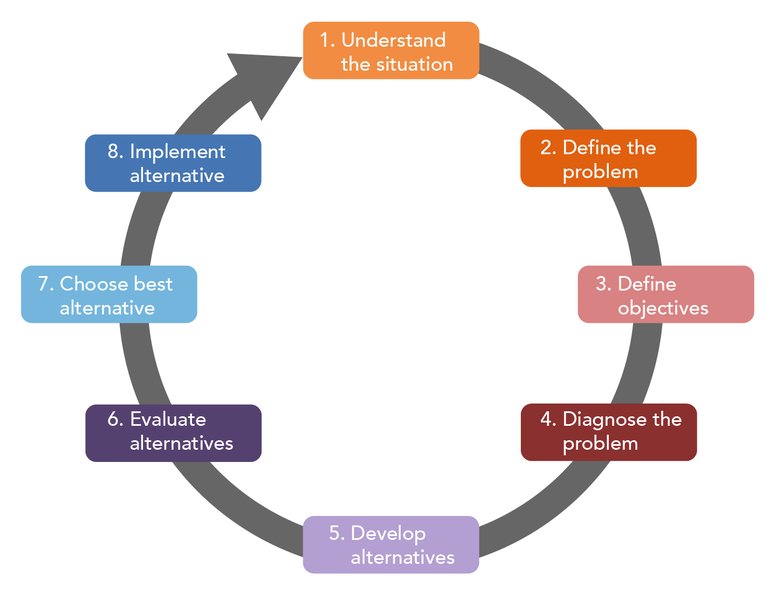
A general model illustrating the flow of decision-making steps, applicable to consumer choices.
Stage 3: Evaluation of Alternatives (Weighing Options)
With information gathered, the consumer evaluates the different products, services, or brands identified as potential solutions. They compare options based on various criteria or attributes that are important to them.
- Evaluation Criteria: These can be objective (price, features, warranty, performance) or subjective (style, brand image, perceived quality, social status).
- Consideration Set: Consumers typically narrow down the possibilities to a smaller group of viable options (the consideration set) before making a final choice.
- Ranking/Weighting: Consumers mentally (or sometimes physically) rank the alternatives or assign importance weights to different attributes based on their needs and priorities.
Marketers aim to understand the criteria consumers use and position their offerings effectively, highlighting unique selling propositions (USPs) and demonstrating superior value compared to competitors.
Stage 4: Purchase Decision (Making the Choice)
This is the stage where the consumer decides which product or brand to buy and where to buy it. The evaluation stage generally leads to a purchase intention, but several factors can influence the final decision:
- Attitudes of Others: Negative feedback from a trusted friend or family member might alter the decision.
- Unexpected Situational Factors: A sudden job loss, a competitor offering a surprise discount, or the preferred product being out of stock can change the outcome.
- Perceived Risk: Concerns about the product's performance, financial cost, or social implications can lead to hesitation or postponement.
- Purchase Implementation: This involves the actual transaction – choosing a retailer (online or offline), deciding on payment methods, and arranging delivery or pickup. A smooth and convenient purchase experience is crucial here.
Businesses focus on making the purchase process seamless, offering incentives (like discounts or free shipping), ensuring availability, and providing excellent customer service to convert intention into action.
Stage 5: Post-Purchase Evaluation (Reflecting on the Buy)
After acquiring and using the product or service, the consumer evaluates their decision. This stage is critical for customer satisfaction, retention, and loyalty.
- Satisfaction vs. Dissatisfaction: The consumer compares the product's actual performance and experience against their pre-purchase expectations.
- Satisfaction: Occurs when performance meets or exceeds expectations. This increases the likelihood of repeat purchases and positive word-of-mouth.
- Dissatisfaction: Occurs when performance falls short of expectations. This can lead to complaints, returns, negative reviews, and brand switching.
- Cognitive Dissonance: This is a state of psychological discomfort often experienced after significant purchases, where the consumer doubts whether they made the right choice. They might seek reassurance or justification for their purchase.
- Usage and Disposal: How the consumer uses the product and eventually disposes of it can also provide insights for marketers (e.g., opportunities for upgrades, recycling programs).
Businesses engage in post-purchase communication (follow-up emails, surveys), offer customer support, manage returns effectively, and encourage reviews to manage this stage, foster loyalty, and gather valuable feedback.
Visualizing the Influences: Factors Across the Buying Journey
Relative Impact of Key Factors at Each Stage
Different factors hold varying levels of influence as consumers move through the decision-making process. The radar chart below provides an illustrative estimation of how factors like price sensitivity, brand loyalty, peer influence, advertising impact, and the extent of online research might fluctuate across the five stages. For instance, advertising might be highly influential in triggering need recognition, while peer influence and online research often peak during the information search and evaluation stages.
This visualization helps illustrate the dynamic nature of consumer priorities and information sources throughout their buying journey.
Mapping the Consumer Journey
A Mindmap Overview
This mindmap provides a hierarchical view of the consumer decision-making process, breaking down each stage into its core components and influencing factors.
(Hunger, Desire)"] TriggerExternal["External Stimuli
(Ads, Social Cues)"] Gap["Awareness of Gap
(Current vs. Desired State)"] Stage2["2. Information Search"] Sources["Information Sources"] InternalSrc["Internal (Memory)"] ExternalSrc["External (Active Search)"] Personal["Personal (Friends, Family)"] Commercial["Commercial (Ads, Websites)"] PublicSrc["Public (Media, Reviews)"] Experiential["Experiential (Trials)"] Online["Online (Search, Social)"] Goal["Goal: Reduce Uncertainty"] Stage3["3. Evaluation of Alternatives"] Criteria["Evaluation Criteria"] Objective["Objective (Price, Features)"] Subjective["Subjective (Brand Image, Style)"] ConsiderSet["Consideration Set
(Shortlisted Options)"] Comparison["Comparison & Ranking"] Stage4["4. Purchase Decision"] Intention["Purchase Intention"] Influencers["Influencing Factors"] Attitudes["Attitudes of Others"] Situational["Situational Factors"] Risk["Perceived Risk"] Action["Purchase Action
(Choose Retailer, Pay)"] Stage5["5. Post-Purchase Evaluation"] ComparisonExp["Performance vs. Expectations"] Outcomes["Outcomes"] Satisfaction["Satisfaction --> Loyalty, Advocacy"] Dissatisfaction["Dissatisfaction --> Complaints, Returns"] Dissonance["Cognitive Dissonance (Doubt)"] Feedback["Feedback & Future Behavior"]
This visual map helps conceptualize the flow and interconnectedness of the steps involved in making a purchase decision.
The Modern Consumer: Process Evolution
Impact of the Digital Age
The rise of the internet, mobile devices, and social media has significantly impacted the consumer decision-making process. While the core stages remain relevant, how consumers navigate them has evolved. Information search is now often continuous and highly reliant on online reviews, social proof, and comparison engines. The evaluation phase is more complex with abundant choices and information overload. The journey itself can be less linear, with consumers potentially looping back between stages (e.g., finding new information during evaluation that triggers a refined search). The video below discusses how this process has changed in the modern era.
Video discussing the 5 stages and how the consumer decision-making process has evolved.
Stages, Actions, and Marketing Focus
A Summary Table
This table summarizes the key aspects of each stage in the consumer decision-making process, outlining typical consumer actions and corresponding areas of focus for marketers.
| Stage | Description | Consumer Actions | Marketing Focus |
|---|---|---|---|
| 1. Need Recognition | Consumer identifies a need or problem. | Becomes aware of a gap; feels a desire or lack. | Highlight unmet needs; create desire through advertising; identify problems consumers face. |
| 2. Information Search | Consumer seeks information about solutions. | Uses internal memory; searches online (reviews, websites); asks friends/family; consults media. | Provide accessible & comprehensive info (SEO, content marketing); build brand awareness; manage online reputation; use targeted ads. |
| 3. Evaluation of Alternatives | Consumer compares different options. | Assesses features, price, quality, brand; ranks alternatives; forms preferences; narrows down choices. | Communicate unique value proposition; differentiate from competitors; use comparison tools; leverage testimonials & reviews. |
| 4. Purchase Decision | Consumer decides which product/brand to buy and where. | Forms purchase intention; chooses specific product & retailer; considers payment/delivery options; completes transaction. | Simplify purchase process; offer incentives (discounts, bundles); ensure availability; provide excellent checkout/in-store experience; address perceived risks. |
| 5. Post-Purchase Evaluation | Consumer assesses satisfaction after purchase. | Uses product; compares performance to expectations; feels satisfaction or dissonance; decides on future actions (repurchase, review, return). | Engage with customers post-sale (emails, surveys); provide support & warranties; manage feedback & returns efficiently; encourage loyalty programs & advocacy. |
Frequently Asked Questions (FAQ)
Common Queries About Consumer Decisions
Recommended Reading
Explore Further Insights
- What psychological and social factors have the biggest impact on consumer choices?
- How do buying decisions differ for complex versus simple purchases?
- What specific digital marketing tactics can influence consumers at each stage of their journey?
- How can businesses effectively reduce customer doubt after a purchase?
References
Sources Used in This Analysis

Last updated April 30, 2025