
Unlock the Secrets: What Were the Coolest Ancient Inventions?
Journey back in time to explore ingenious devices and materials that were centuries ahead of their time.
The ancient world was a crucible of innovation, giving rise to technologies and concepts that fundamentally shaped human civilization. While we often associate advanced technology with modern times, many ancient inventions demonstrate remarkable ingenuity, sophisticated understanding of scientific principles, and a level of craftsmanship that continues to astound historians and scientists today. Some were practical tools that revolutionized daily life, others were complex mechanisms bordering on science fiction for their era, and some remain shrouded in mystery, their secrets lost to time. Let's delve into some of the "coolest" ancient inventions, celebrating the brilliance of our ancestors.
Essential Insights: Ancient Ingenuity
- Mechanical Marvels: Devices like the Antikythera Mechanism showcase astonishing complexity and predictive power, functioning as early analog computers far ahead of their time.
- Material Mastery: Ancient civilizations developed extraordinary materials like ultra-durable Roman concrete and legendary Damascus steel, whose properties are still studied today.
- Foundational Innovations: Seemingly simple inventions like the wheel, paper, and the compass had a profound and lasting impact, enabling advancements in transport, communication, and exploration.
Mechanical Wonders and Astronomical Calculators
The Antikythera Mechanism: An Ancient Analog Computer
Perhaps one of the most famous and awe-inspiring ancient inventions is the Antikythera Mechanism. Discovered in a Roman-era shipwreck off the Greek island of Antikythera in 1901, this intricate device dates back to roughly 150-100 BCE. Often described as the world's first known analog computer, it consists of a complex system of over 30 interlocking bronze gears. Its primary function was to predict astronomical phenomena, including the positions of the sun, moon, and likely some planets, lunar and solar eclipses, and even the timing of the four-year cycle of the ancient Olympic Games. The level of miniaturization and mechanical complexity displayed by the Antikythera Mechanism wouldn't be seen again for over a thousand years, highlighting the sophisticated understanding of astronomy and engineering possessed by ancient Greek artisans.
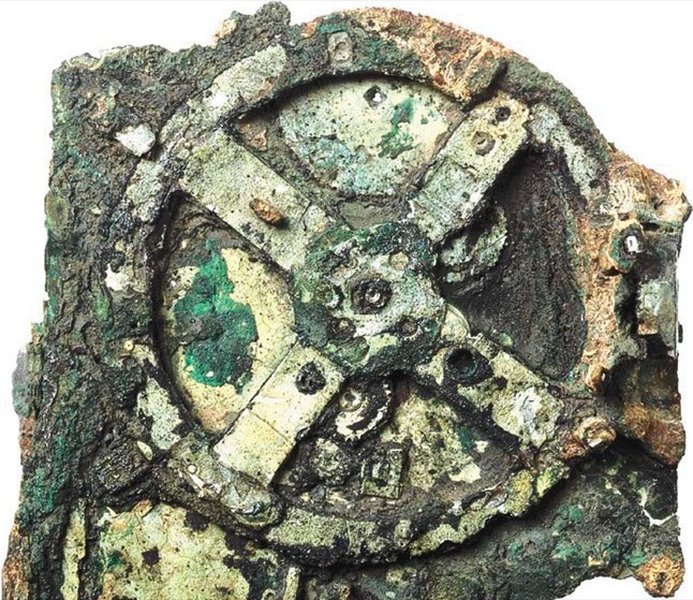
Reconstruction showing the intricate gear system of the Antikythera Mechanism.
Hero's Aeolipile: Harnessing Steam Power
Hero of Alexandria, a brilliant Greek mathematician and engineer living in the 1st century CE, is credited with inventing the Aeolipile, considered one of the earliest documented examples of a steam-powered device. It consisted of a sphere mounted on a pivot, with two bent nozzles protruding outwards. When water inside the sphere was heated, steam would escape through the nozzles, generating thrust and causing the sphere to rotate. While primarily demonstrated as a novelty or "temple wonder" rather than a practical power source, the Aeolipile represents a foundational understanding of harnessing steam for mechanical motion, predating the engines of the Industrial Revolution by centuries.
Early Timekeeping and Detection Devices
Water Clocks and Alarms
Ancient Greeks, like the engineer Ctesibius (3rd century BCE), developed sophisticated water clocks (clepsydras) that measured time using the regulated flow of water. Some versions were remarkably complex, incorporating mechanisms for alarms. These early automated devices show ingenuity in mechanical design long before the advent of modern clocks.
Zhang Heng's Seismoscope
In 2nd century CE China, the polymath Zhang Heng invented what is considered the world's first seismoscope. This impressive bronze instrument was reportedly capable of detecting earthquakes hundreds of kilometers away and indicating the general direction of the tremor's epicenter. It featured a central pendulum connected to levers activating eight dragon figures arranged around the vessel. During an earthquake, a bronze ball would drop from the mouth of the dragon facing the direction of the quake into the mouth of a bronze toad below, creating a sound and visual signal. This invention demonstrated advanced knowledge of mechanics and seismic activity detection.
Revolutionary Materials and Construction Techniques
Roman Concrete: Building for Millennia
The Romans were master engineers, and one of their most significant contributions was the development and widespread use of a unique form of concrete (opus caementicium). Unlike modern Portland cement-based concrete, Roman concrete often incorporated volcanic ash (pozzolana), lime, and volcanic rock (tuff). This mixture resulted in exceptional durability and longevity. Structures like the Pantheon in Rome, with its massive unsupported concrete dome, and numerous aqueducts and harbors, many still standing after nearly two millennia, attest to its incredible resilience. Remarkably, Roman marine concrete grew stronger over time through interaction with seawater, and some formulations even possessed self-healing properties, allowing minor cracks to seal themselves. The exact recipe and techniques for this superior concrete were largely lost after the fall of the Western Roman Empire and have only recently begun to be fully understood through modern scientific analysis.

Roman aqueducts, built with durable materials like concrete and stone, remain standing testaments to ancient engineering.
Damascus Steel: The Legendary Blade
Famed for its strength, sharpness, and distinctive wavy patterns (damask), Damascus steel was used to forge swords and other blades in the Near East from about the 3rd century CE to the 18th century. The steel originated from "Wootz" steel ingots imported from India and Sri Lanka. The specific forging techniques used by bladesmiths resulted in a microstructure containing carbon nanotubes and nanowires, contributing to the metal's legendary properties. These blades were reputedly able to cut through lesser swords or bend significantly without breaking. The exact methods for creating true Damascus steel were eventually lost, likely due to disruptions in trade routes supplying the necessary raw materials and the secrecy surrounding the craft. Modern metallurgists have attempted to replicate it, but the original process remains a subject of research and fascination.
Advanced Metallurgy: Beyond Steel
The Iron Pillar of Delhi
Standing in the Qutb complex in Delhi, India, this 7-meter (23-foot) tall pillar, constructed around 400 CE, is renowned for its remarkable resistance to rust despite over 1600 years of exposure to the elements. Made of 98% wrought iron, its corrosion resistance is attributed to a unique composition (including high phosphorus content) and a passive protective film that formed on its surface. It stands as a testament to the advanced ironworking skills of ancient Indian metallurgists.
Ancient Gilding
Research suggests that medieval artisans, building on techniques possibly developed even earlier, perfected methods for applying incredibly thin and durable layers of gold (gilding) to statues and other objects. Some ancient gilding techniques achieved results superior to modern electroplating in terms of adhesion and longevity, showcasing a sophisticated understanding of metallurgy and chemical processes.
Foundational Inventions Shaping Civilization
The Wheel: Mobilizing Humanity
Though seemingly simple, the invention of the wheel around 3500-4000 BCE (independently in Mesopotamia and regions of Europe) is arguably one of the most fundamental technological advancements in human history. Initially likely used for pottery, its application to carts and chariots revolutionized transportation, agriculture (plows, irrigation), warfare, and trade. Combined with the use of draft animals, wheeled vehicles dramatically increased the efficiency of moving goods and people, enabling the growth of larger settlements and more complex societies.
Paper: Spreading Knowledge
Credited traditionally to Cai Lun in China around 105 CE during the Han Dynasty, papermaking technology fundamentally changed communication and record-keeping. While earlier forms of paper-like materials existed (padding/wrapping paper from 2nd century BCE China), Cai Lun is celebrated for refining the process using materials like mulberry bark, hemp, rags, and fishnets to create a standardized, inexpensive, and effective writing surface. Paper gradually replaced more cumbersome materials like bamboo slips, wood tablets, papyrus, and parchment. Its invention facilitated the spread of literature, philosophy, scientific knowledge, and administrative records across Asia and eventually the world, underpinning education and cultural exchange.
The Compass: Navigating the World
Another pivotal invention from ancient China is the magnetic compass. Initially developed during the Han Dynasty (around 2nd century BCE) using naturally magnetic lodestone, it was first used for divination and geomancy (feng shui). By the Song Dynasty (around the 11th century CE), the Chinese had adapted it for navigation, using magnetized needles floated in water or suspended. This innovation allowed mariners to determine direction even when celestial bodies were obscured, enabling safer and more extensive sea voyages, exploration, and long-distance trade.
Twisted Rope: A Prehistoric Essential
While often overlooked, the invention of twisted rope, dating back potentially tens of thousands of years (evidence suggests as early as 17,000 BC), was a crucial prehistoric innovation. By twisting plant fibers, animal sinew, or hair together, early humans created strong, flexible cords essential for hunting (bowstrings, snares), fishing (lines, nets), toolmaking, construction (binding, lifting), transportation (pulling loads, rigging sails), and countless other tasks. This simple yet vital technology underpins much of subsequent technological development.
Infrastructure and Daily Life Innovations
Aqueducts and Water Management
Ancient civilizations, most notably the Romans, engineered sophisticated aqueduct systems to transport fresh water over vast distances, supplying cities with water for drinking, sanitation (baths, sewers), and fountains. These often monumental structures, utilizing gravity flow through precisely graded channels and bridges, were feats of engineering that significantly improved public health and urban living standards. Systems like Archimedes' Screw (3rd century BCE), a helical device for lifting water, also played vital roles in irrigation and drainage.

Displays of historical inventions highlight the long lineage of human ingenuity.
Central Heating Systems
Comfort wasn't neglected in the ancient world. Thousands of years ago, systems for central heating were developed independently in different cultures. In Korea, the *ondol* system (dating back possibly 7000 years) used smoke and heat from a furnace, channeled through flues under the floor, to warm rooms. The Greeks and Romans later developed the hypocaust system, where floors were raised on pillars, allowing hot air from a furnace to circulate underneath, providing radiant heat.
Early Security: Locks
The need for security is ancient. The earliest known examples of locks and keys date back to ancient Egypt and Mesopotamia around 4000 BCE. These early pin-tumbler locks, often made of wood, represent a fundamental invention for protecting property and controlling access.
Enigmatic Technologies and Lost Arts
Greek Fire: The Byzantine Superweapon
Used to devastating effect by the Byzantine navy from the 7th century CE onwards, Greek Fire was an incendiary weapon capable of burning fiercely, even on water, and adhering to surfaces. Launched from siphons mounted on ships, it struck fear into enemies and played a crucial role in defending Constantinople. The exact formula was a closely guarded state secret and remains unknown, though likely based on petroleum or naphtha mixed with other chemicals like sulfur and quicklime. Its effectiveness and mysterious composition make it one of the coolest, albeit terrifying, ancient military technologies.
The Baghdad Battery: Ancient Electricity?
Discovered near Baghdad, Iraq, and dating to the Parthian or Sassanian period (roughly 250 BCE – 640 CE), these terracotta jars contain a copper cylinder surrounding an iron rod, sealed with asphalt. While their exact purpose is debated, one controversial hypothesis suggests they may have functioned as galvanic cells, producing a low voltage electric current. Proposed uses include electroplating (gilding silver with gold) or therapeutic applications (mild electrotherapy). While definitive proof is lacking, the possibility that ancient cultures experimented with electrochemical principles long before Volta is intriguing.
Visualizing Ancient Innovation: A Comparative Look
To appreciate the diverse brilliance of ancient inventors, let's compare some of these remarkable creations across several subjective dimensions: Ingenuity (cleverness of design), Impact (effect on civilization), Mystery (how much remains unknown), Modern Relevance (direct or indirect influence today), and Technological Advancement (how far ahead of its time it was).
This chart provides a visual comparison, highlighting how different inventions excelled in various aspects, from the sheer technological leap of the Antikythera Mechanism to the enduring global impact of paper and the wheel.
Mapping Ancient Ingenuity
The breadth of ancient innovation spanned numerous fields. This mindmap categorizes some of the coolest inventions, illustrating the interconnectedness of technological advancement across different areas of life.
(Analog Computer)"] id2["Hero's Aeolipile
(Early Steam Device)"] id3["Water Clocks / Alarms"] id4["Zhang Heng's Seismoscope"] id5["Archimedes' Screw
(Water Lifting)"] id6["Locks & Keys"] Materials["Materials Science"] id7["Roman Concrete
(Durability, Self-Healing)"] id8["Damascus Steel
(Wootz, Patterned Blades)"] id9["Iron Pillar of Delhi
(Rust Resistance)"] id10["Advanced Gilding Techniques"] Infrastructure["Infrastructure & Daily Life"] id11["Aqueducts
(Water Transport)"] id12["Central Heating
(Hypocaust, Ondol)"] id13["Simple Suspension Bridges"] id14["Blast Furnaces (China)"] id15["Road Networks (Roman)"] Communication["Communication & Navigation"] id16["Paper (China)"] id17["Compass (China)"] id18["Early Printing Blocks (China)"] Tools["Fundamental Tools & Techniques"] id19["The Wheel
(Transport, Pottery)"] id20["Twisted Rope"] id21["Abacus
(Calculation Tool)"] id22["Plow"] Warfare["Military & Enigmatic Tech"] id23["Greek Fire
(Incendiary Weapon)"] id24["Baghdad Battery
(Potential Electrochemistry)"] id25["Archimedes' War Machines
(Claw, 'Death Ray'?)"]
This map shows how innovations in mechanics, materials, infrastructure, communication, basic tools, and even warfare demonstrate the diverse genius of ancient peoples.
Spotlight on Ancient Innovation
Many documentaries and discussions explore the marvels of ancient technology. The following video provides a glimpse into some inventions that were remarkably ahead of their time, showcasing the vision and skill of ancient inventors.
Video exploring 12 ancient inventions considered ahead of their time.
Watching explorations like this helps visualize the context and potential function of these ancient devices, bringing their ingenuity to life.
Summary Table of Key Ancient Inventions
Here's a quick reference table summarizing some of the most impactful and intriguing ancient inventions discussed:
| Invention | Approx. Date / Origin | Primary Function | Significance / "Cool Factor" |
|---|---|---|---|
| Antikythera Mechanism | ~150-100 BCE / Greece | Astronomical calculation | World's first known analog computer; incredible complexity for its era. |
| Roman Concrete | ~3rd Century BCE onwards / Rome | Construction material | Extreme durability, set underwater, potential self-healing; enabled massive structures still standing. |
| Damascus Steel | ~3rd-18th Century CE / Near East (Wootz from India) | Material for blades | Legendary strength, sharpness, unique patterns; lost manufacturing technique. |
| Greek Fire | ~7th Century CE / Byzantine Empire | Naval incendiary weapon | Burned on water, highly effective, secret formula lost to history. |
| Wheel | ~3500-4000 BCE / Mesopotamia, Europe | Transportation, pottery, machinery | Fundamental invention transforming nearly all aspects of life and technology. |
| Paper | ~2nd Century BCE - 105 CE / China | Writing material, communication | Revolutionized record-keeping, education, and the spread of knowledge globally. |
| Compass | ~2nd Century BCE - 11th Century CE / China | Navigation, divination | Enabled reliable navigation regardless of visibility, crucial for exploration and trade. |
| Central Heating (Hypocaust/Ondol) | Ancient Korea / Greece & Rome | Heating buildings | Early sophisticated methods for indoor climate control using channeled heat/smoke. |
| Aqueducts | Primarily Roman Empire | Water transport | Massive engineering projects supplying cities with fresh water, improving sanitation. |
| Baghdad Battery | ~250 BCE - 640 CE / Mesopotamia | Potential electroplating/therapy | Possible early form of electric battery, suggesting experiments with electrochemistry. |
Frequently Asked Questions about Ancient Inventions
What defines an invention as "ancient"?
Generally, "ancient inventions" refer to technologies, tools, materials, or techniques developed during historical periods typically classified as Antiquity. This broadly spans from the dawn of civilization (around 3000 BCE) up to the fall of major classical empires like the Western Roman Empire (around 500 CE). However, the term is sometimes used more loosely to include significant innovations from the early medieval period as well, especially if they represent lost knowledge or technologies far ahead of their time (like Greek Fire or Damascus Steel).
Are all ancient technologies fully understood today?
No, not all ancient technologies are fully understood. Some, like the precise formula for Greek Fire or the exact methods for forging true Damascus steel, remain mysteries due to lost records or closely guarded secrets. The full capabilities and construction details of devices like the Antikythera Mechanism are still being uncovered through advanced imaging and analysis. Similarly, the exact recipe and long-term chemical reactions that gave Roman concrete its exceptional properties are areas of ongoing research. These "lost technologies" highlight that ancient knowledge wasn't always passed down effectively.
How did ancient people invent such complex things without modern tools?
Ancient inventors relied on keen observation, experimentation, sophisticated mathematics (especially geometry), accumulated craft knowledge passed down through generations, and immense patience and labor. While they lacked modern precision machinery or computational power, they possessed deep understanding of materials, mechanics, and natural phenomena relevant to their work. They used simpler tools (hand tools, levers, pulleys, measuring devices like calipers and rulers) with great skill. Complex projects like aqueducts or the Antikythera Mechanism required meticulous planning, precise measurement, and highly skilled artisans working collaboratively over long periods.
Which ancient invention had the biggest impact?
It's difficult to single out one invention as having the "biggest" impact, as many were foundational. However, strong contenders include:
- The Wheel: Revolutionized transport, agriculture, and industry, fundamentally changing logistics and labor.
- Writing/Paper: Transformed communication, record-keeping, law, education, and the transmission of knowledge across time and space.
- Agriculture Innovations (Plow, Irrigation): Enabled settled societies, population growth, and the development of civilization itself.
- Control of Fire: While prehistoric, it was essential for cooking, warmth, toolmaking, and safety, paving the way for metallurgy and other technologies.
The impact often depends on the criteria used (e.g., geographical spread, longevity, influence on later technologies).
Recommended Reading
Explore related topics to deepen your understanding of ancient ingenuity:
- How did the Antikythera Mechanism actually work?
- What exactly made Roman concrete so durable compared to modern concrete?
- Discover other lost ancient technologies that still baffle scientists today.
- What were the most important inventions originating from ancient China?
References

Last updated May 5, 2025