
Copper-Based Catalyst Design for CO Electroreduction
Exploring innovative strategies for efficient CO conversion
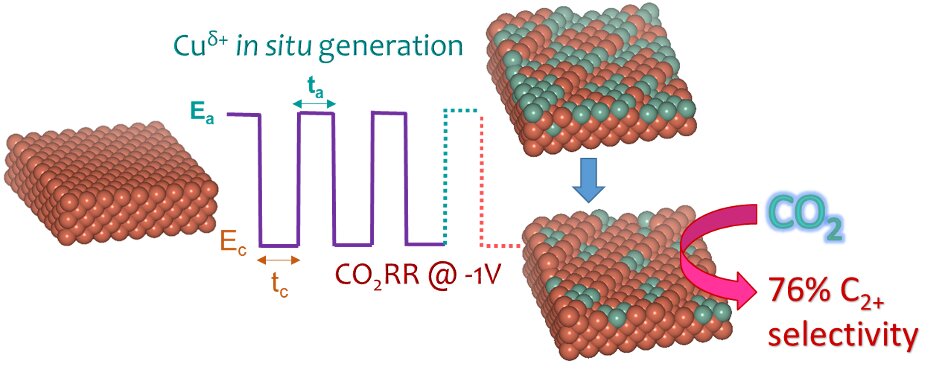
Highlights
- Surface Engineering & Facet Control: Optimizing copper facets to maximize active sites and enhance multi-carbon product formation.
- Alloying, Doping & Nanostructuring: Utilizing dopants, alloy components, and nanostructures to tune catalyst properties and improve selectivity.
- Advanced Synthetic and Characterization Techniques: Leveraging methods such as operando spectroscopy and MOF supports to refine catalyst performance and stability.
Introduction and Context
Copper-based catalysts have attracted significant attention for CO electroreduction due to their unique ability to convert CO into valuable chemicals and fuels. Unlike many other metals, copper demonstrates a balanced affinity for CO and hydrogen adsorption, enabling efficient multi-carbon (C2+) product formation through the C─C coupling of intermediates. The design of these catalysts involves careful consideration of the catalyst’s surface structure, composition, and morphology. Researchers are continuously exploring new strategies to optimize these materials to ensure high activity, selectivity, and stability under operational conditions.
Fundamental Aspects of Copper-Based Catalyst Design
Surface Structures and Active Sites
The surface structure of copper-based catalysts is pivotal in determining their reaction pathways and product distributions. Different crystallographic facets exhibit distinct adsorption behaviors for reaction intermediates:
Facet Engineering
Studies have revealed that certain low-coordinated sites on specific copper facets, such as Cu(100) and Cu(110), are more effective in coupling adsorbed CO intermediates, which is a crucial step in forming C2+ products. In contrast, the Cu(111) facet has been associated with the production of C1 products, such as methane, by facilitating different reaction intermediates.
Catalytic Mechanisms and Reaction Pathways
Copper-catalyzed CO electroreduction relies on a balance between the adsorption strength of intermediates and the catalyst’s ability to release products. The catalytic performance is often controlled by the rate-limiting C─C coupling step, where adjacent *CO(H) species react on the catalyst surface. Advanced mechanistic studies, often involving operando spectroscopy, have been pivotal in mapping out the critical reaction pathways that govern multi-carbon product formation. This improved understanding has guided the development of catalysts with enhanced selectivity by mitigating competitive reactions such as hydrogen evolution.
Synthetic Methods and Catalyst Preparation
The preparation of copper-based catalysts involves a variety of synthetic techniques aimed at controlling the catalyst’s active site distribution and surface morphology. Techniques such as electrodeposition, thermal reduction of copper oxides, and chemical vapor deposition (CVD) are frequently employed. Nanostructured materials, including hollow fibers, nanoparticles, and hierarchical micro/nanostructured catalysts, have shown improved performance. These structures not only increase the effective surface area but also favorably influence the adsorption properties and reaction kinetics.
Enhancement Strategies: Alloying, Doping, and Nanostructuring
Enhancing the performance of copper-based catalysts can be achieved through alloying and doping. By introducing other metals such as gold, silver, or zinc, it is possible to modify the electronic and geometric properties of the catalyst. These modifications can lead to altered adsorption behaviors and new active sites that promote more efficient CO conversion. Additionally, employing single-atom catalysts can significantly improve selectivity and activity by ensuring that each catalytic site functions at an optimal performance level.
Support Materials and Surface Functionalization
The stability and performance of copper-based catalysts also depend heavily on the choice of support materials. Carbon-based materials, metal oxides (e.g., TiO₂, CeO₂), and zeolites provide a robust support that can prevent agglomeration and enhance electron transfer. Moreover, surface functionalization with organic ligands or ionic species has the potential to further optimize the electronic properties and respect the desired catalyst selectivity. These modifications can moderate the interaction with intermediates, often suppressing undesirable side reactions.
Systematic Design Strategies for CO Electroreduction
Rational Catalyst Engineering
The design of copper-based catalysts is a multidisciplinary effort that combines insights from materials science, electrochemistry, and chemical engineering. Researchers focus on rational catalyst engineering by systematically studying the interplay between catalyst morphology, particle size, and active site configuration. This comprehensive understanding allows for:
Active Site Engineering
Engineering active sites, including the distribution and accessibility of catalytic sites, is crucial in achieving optimal performance. Advanced imaging and spectroscopic techniques have enabled the visualization of these sites at the atomic level, guiding adjustments in synthesis methods to preferentially expose the most active facets.
Strain and Electronic Modulation
Researchers have also explored using strain engineering to adjust the electronic properties of the copper lattice. By inducing controlled strain in the catalyst, one can modulate the binding energy of intermediates, directly influencing the reaction kinetics for CO reduction. This technique represents a novel approach to catalyst enhancement, providing a pathway to fine-tuning selectivity and activity.
Advanced Characterization Techniques
Operando characterization plays an essential role in understanding catalyst behavior under realistic reaction conditions. Techniques such as X-ray absorption spectroscopy (XAS), Fourier-transform infrared (FTIR) spectroscopy, and high-resolution transmission electron microscopy (HRTEM) have been instrumental in correlating catalyst structure with performance. The information obtained through these methods informs the rational design strategy, allowing researchers to iteratively improve catalyst formulations.
Integration with MOFs and Other Support Structures
Metal-organic frameworks (MOFs) have emerged as effective supports for copper catalysts due to their high porosity, tunable pore size, and robust physical structure. MOF-supported copper catalysts benefit from a high dispersion of catalytic sites and enhanced durability, which is particularly important in scaling up the catalysts for industrial applications. The integration of MOFs provides an opportunity to maximize the exposure of active sites while stabilizing the catalyst against morphological changes during prolonged electroreduction reactions.
Comparative Overview of Catalyst Design Elements
To provide a clear and comprehensive view, the table below summarizes key aspects of copper-based catalyst design strategies for CO electroreduction. Each design element is associated with its underlying rationale and the desired outcome in terms of activity, selectivity, and stability.
| Design Element | Key Aspect | Outcome/Impact |
|---|---|---|
| Facet Engineering | Selection of Cu(100), Cu(110), and Cu(111 facets | Enhanced C2+ product formation and selectivity towards desired intermediates |
| Nanostructuring | Creation of hierarchical micro/nanostructures | Increased surface area and improved mass transport properties |
| Alloying and Doping | Incorporation of other metals (Au, Ag, Zn) or single atoms | Modification of electronic properties to favor CO coupling and reduce H₂ evolution |
| Support Materials | Implementation of high surface area supports (carbon, oxides, zeolites) | Stabilization of catalytic sites and enhanced electron conductivity |
| Surface Functionalization | Attachment of organic ligands or ions onto copper surface | Optimized catalytic performance by modulating intermediate adsorption |
| Strain Engineering | Controlled lattice distortion | Altered binding energies of adsorbates, improved reaction kinetics |
| MOF Integration | Utilization of metal-organic frameworks | Enhanced active site distribution and improved catalyst durability |
Challenges and Future Directions
Scalability and Stability
While laboratory-scale experiments have demonstrated the high activity and selectivity of copper-based catalysts, scaling these systems to industrial levels remains challenging. Maintaining catalyst stability during long-term operation is critical as factors such as catalyst restructuring and oxide formation can degrade performance. Researchers are therefore investigating protective coatings and more robust reactor designs that shield the catalyst during extended use.
Mechanistic Understanding and Operando Studies
A deeper mechanistic understanding of CO electroreduction on copper surfaces is essential to guide the rational design of catalysts. Operando studies using advanced techniques such as high-resolution synchrotron X-ray spectroscopy provide insights into reaction intermediates and the dynamic evolution of the catalyst during operation. These studies are leading to the development of next-generation catalysts that can simultaneously optimize multiple performance criteria.
Environmental Considerations and Sustainable Design
Beyond improving efficiency, the sustainability of the entire catalyst system is of paramount importance. Developing catalysts that can operate under mild conditions with minimal energy input and under environmentally benign protocols is crucial to the widespread adoption of CO electroreduction technology. Researchers are, therefore, focusing on integrating copper-based catalysts within systems designed for carbon capture and utilization (CCU), which can reduce the overall carbon footprint.
Emerging Areas of Research
In addition to traditional synthetic routes, emerging techniques such as atomic layer deposition (ALD) and pulsed electrodeposition are being explored to precisely control catalyst morphology and composition. The field is also witnessing promising developments in bimetallic and molecular catalysts, where combining copper with other catalytically active components opens up new possibilities for enhancing performance and selectivity.
References
The following references offer detailed insights into the research and developments in the design of copper-based catalysts for CO electroreduction:
- Science Advances - CO Electroreduction on Single-Atom Copper
- Nature - Atomic-Scale Surface Restructuring of Copper Electrodes
-
ScienceDirect - Research Progress of Copper-Based Catalysts for CO Electroreduction
- Nature - Advances in Copper Catalysts for Electrocatalytic CO2 Reduction
- SciOpen - Copper-Based Catalysts for Electroreduction
Recommended Further Exploration
To delve deeper into the fascinating world of copper-based catalysts and CO electroreduction, consider exploring these related queries which can expand your understanding:
Last updated March 21, 2025