
Core Concepts of Abstract Algebra
Unveiling the Foundations of Algebraic Structures
Key Takeaways
- Abstract algebra explores fundamental structures like groups, rings, and fields, which form the backbone of modern mathematical theories.
- Understanding operations and their properties, such as associativity and commutativity, is crucial for analyzing and constructing algebraic systems.
- Applications of abstract algebra span diverse fields including cryptography, physics, and computer science, highlighting its interdisciplinary significance.
Introduction to Abstract Algebra
Abstract algebra is a pivotal branch of mathematics that delves into the study of algebraic structures, which are sets equipped with one or more operations that adhere to specific axioms. Unlike elementary algebra, which focuses on solving equations and manipulating numbers, abstract algebra abstracts these concepts to explore the foundational patterns and properties that underpin various mathematical systems. This abstraction allows for the unification and generalization of different mathematical fields, fostering advances in areas such as geometry, number theory, coding theory, and cryptography.
Fundamental Elements: Sets and Operations
Sets
A set is a collection of distinct objects, which can be anything from numbers to functions. Sets are typically denoted by capital letters, such as \( G = \{a, b, c\} \). The elements within a set are unique and unordered, forming the basic building blocks for more complex algebraic structures.
Operations
An operation is a rule that combines elements of a set to produce another element within the same set. Operations can be categorized as:
- Unary Operations: Apply to a single element, such as negation in integers.
- Binary Operations: Combine two elements, such as addition or multiplication.
Understanding the nature and properties of these operations is essential for defining and analyzing algebraic structures.
Properties of Operations
Operations in abstract algebra are characterized by several key properties:
- Associativity: The grouping of operations does not affect the outcome, e.g., \( (a \ast b) \ast c = a \ast (b \ast c) \).
- Commutativity: The order of operations does not affect the result, e.g., \( a \ast b = b \ast a \).
- Distributivity: Operations interact in a way that one distributes over the other, e.g., \( a \ast (b + c) = (a \ast b) + (a \ast c) \).
- Identity Element: An element that does not change other elements when combined, e.g., \( e \ast a = a \ast e = a \).
- Inverse Element: An element that reverses the effect of another, e.g., \( a \ast a^{-1} = a^{-1} \ast a = e \).
Algebraic Structures
Groups
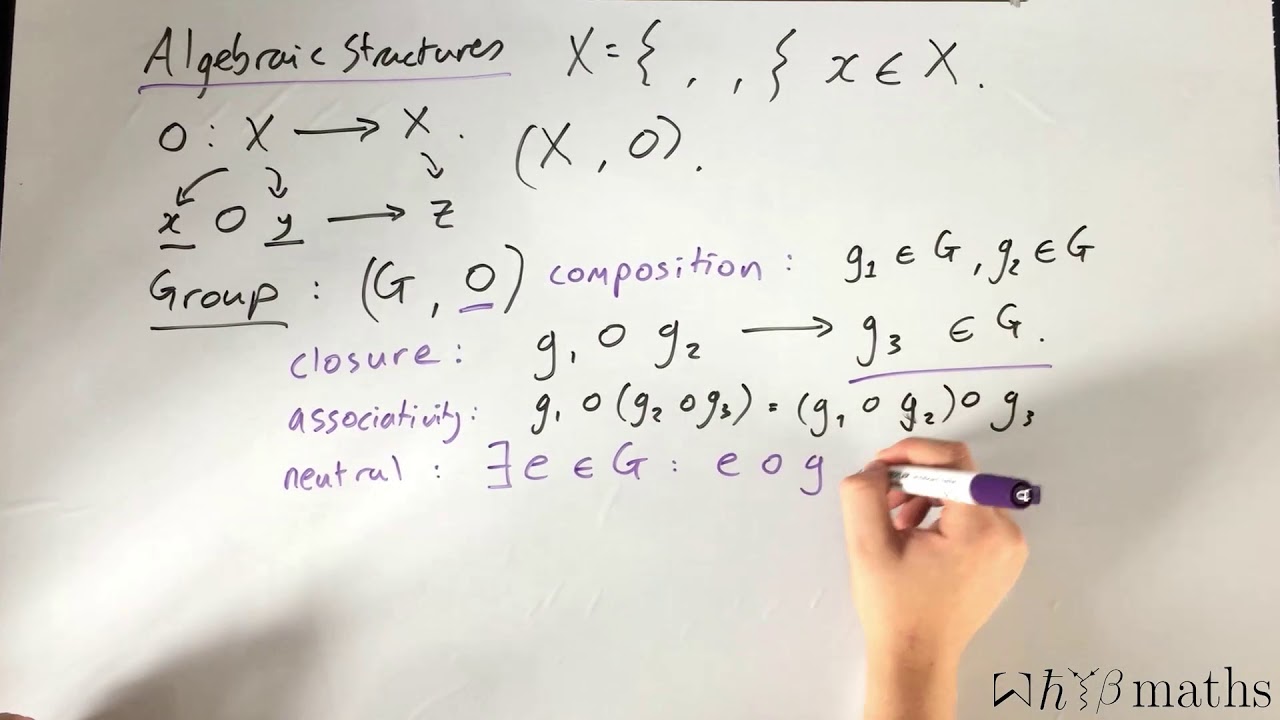
A group is one of the most fundamental algebraic structures in abstract algebra. It consists of a set \( G \) equipped with a single binary operation (\( \ast \)) that satisfies four essential axioms:
- Closure: For all \( a, b \in G \), the result of \( a \ast b \) is also in \( G \).
- Associativity: \( (a \ast b) \ast c = a \ast (b \ast c) \) for all \( a, b, c \in G \).
- Identity Element: There exists an element \( e \in G \) such that \( a \ast e = e \ast a = a \) for all \( a \in G \).
- Inverse Element: For every \( a \in G \), there exists an element \( a^{-1} \in G \) such that \( a \ast a^{-1} = a^{-1} \ast a = e \).
Groups are ubiquitous in various mathematical disciplines, including cryptography, physics, and chemistry. Subgroups, normal subgroups, homomorphisms, and isomorphisms are advanced concepts that extend the basic group theory, allowing for deeper analysis and applications.
Rings
A ring is a more complex structure that involves two binary operations: addition (\( + \)) and multiplication (\( \cdot \)). The set \( R \) must satisfy the following axioms:
- \((R, +) is an abelian group, meaning addition is associative, commutative, has an identity element, and each element has an inverse.
- Multiplication is associative: For all \( a, b, c \in R \), \( (a \cdot b) \cdot c = a \cdot (b \cdot c) \).
- Distributive Laws: Multiplication distributes over addition from both sides, i.e., \( a \cdot (b + c) = a \cdot b + a \cdot c \) and \( (a + b) \cdot c = a \cdot c + b \cdot c \).
Rings generalize the arithmetic of integers and polynomials. Important categories within ring theory include integral domains, principal ideal domains, and unique factorization domains. Concepts like ideals, subrings, and ring homomorphisms play a crucial role in understanding ring structures.
Fields
A field is an algebraic structure that extends the concept of a ring by ensuring that every non-zero element has a multiplicative inverse. Specifically, a field \( F \) satisfies all the ring axioms, and:
- \((F \setminus \{0\}, \cdot) forms an abelian group.
- Both addition and multiplication are commutative operations.
Fields are central to linear algebra and Galois theory. Classic examples include the set of rational numbers, real numbers, complex numbers, and finite fields. Field extensions and algebraic closures are advanced topics that explore the properties and applications of fields in greater depth.
Modules
A module generalizes the concept of a vector space by allowing the scalars to come from a ring rather than a field. Formally, a module \( M \) over a ring \( R \) is an abelian group equipped with a scalar multiplication \( R \times M \rightarrow M \) that satisfies the following conditions:
- Additivity in both arguments: \( r \cdot (m + n) = r \cdot m + r \cdot n \) and \( (r + s) \cdot m = r \cdot m + s \cdot m \).
- Compatibility with ring multiplication: \( r \cdot (s \cdot m) = (rs) \cdot m \).
- Identity element of ring acts as identity: \( 1 \cdot m = m \).
Modules are essential for understanding the structure of rings and their representations. They bridge the gap between ring theory and linear algebra, offering a versatile framework for various applications.
Vector Spaces
A vector space is a special case of a module where the scalars form a field. Formally, a vector space \( V \) over a field \( F \) consists of a set equipped with two operations: vector addition and scalar multiplication, satisfying the following axioms:
- Vector Addition: Commutative, associative, has an identity element (zero vector), and every element has an inverse.
- Scalar Multiplication: Distributive over both vector addition and field addition, associative with field multiplication, and respects the field's identity element.
Key concepts within vector spaces include linear independence, basis, and dimension. Linear transformations, which are mappings between vector spaces that preserve the vector space operations, are fundamental in linear algebra.
Homomorphisms and Isomorphisms
Homomorphisms
A homomorphism is a structure-preserving map between two algebraic structures, such as groups, rings, or fields. For example, a group homomorphism \( \phi: G \rightarrow H \) satisfies \( \phi(a \ast b) = \phi(a) \ast \phi(b) \) for all \( a, b \in G \). Homomorphisms allow mathematicians to study the relationships and similarities between different algebraic structures.
Isomorphisms
An isomorphism is a bijective homomorphism, meaning it is both one-to-one and onto. If there exists an isomorphism between two algebraic structures, they are considered isomorphic, implying that they are essentially the same in terms of their algebraic properties, despite possibly differing in appearance or representation. Isomorphisms are crucial for classifying and categorizing algebraic structures.
Substructures
Subgroups
A subgroup is a subset of a group that is itself a group under the same operation. Formally, a subset \( H \subseteq G \) is a subgroup if it satisfies the group axioms within \( G \).
Subrings
A subring is a subset of a ring that is itself a ring with the same addition and multiplication operations. This means that the subring is closed under both operations and contains the identity elements as defined in the larger ring.
Subfields
A subfield is a subset of a field that is itself a field under the same operations. Subfields maintain all the properties of the parent field, ensuring that they are closed under both addition and multiplication, and every non-zero element has a multiplicative inverse.
Normal Subgroups and Ideals
Normal subgroups are special kinds of subgroups that are invariant under conjugation by elements of the group. They are fundamental in forming quotient groups, which are essential in group theory.
Ideals are the ring-theoretic counterpart to normal subgroups. They are subsets of rings that are closed under addition and absorb multiplication by any element of the ring. Ideals are crucial for constructing quotient rings and studying ring homomorphisms.
Factorization and Cosets
Cosets
A coset is a partition of a group into equivalent subsets based on a subgroup. Given a group \( G \) and a subgroup \( H \), a left coset of \( H \) in \( G \) is a set of the form \( gH = \{gh | h \in H\} \) for some \( g \in G \). Cosets are instrumental in understanding the structure of groups and in proving important results like Lagrange's theorem.
Factorization
Factorization involves decomposing algebraic structures into simpler components. In rings, this often refers to expressing elements as products of irreducible elements or prime elements. The study of factorization leads to significant theorems such as the Fundamental Theorem of Arithmetic, which states that every integer greater than one can be uniquely factored into prime numbers.
Classification Theorems
Classification theorems are pivotal in abstract algebra as they provide a way to categorize and understand the various algebraic structures based on their properties.
- Fundamental Theorem of Finite Abelian Groups: Every finite abelian group can be expressed as a direct sum of cyclic groups of prime power order.
- Jordan-Hölder Theorem: Provides a unique composition series for finite groups, up to isomorphism and order of factors.
- Wedderburn's Little Theorem: Every finite division ring is a field.
These theorems help in breaking down complex structures into well-understood building blocks, facilitating deeper analysis and insights.
Advanced Topics
Galois Theory
Galois Theory bridges field theory and group theory to address the solvability of polynomial equations. It studies the symmetries of the roots of polynomials and connects them to group structures, providing profound insights into the nature of algebraic equations.
Representation Theory
Representation Theory examines how algebraic structures, particularly groups and rings, can be represented through matrices and linear transformations. This field is crucial for applying abstract algebra to physics and chemistry, where symmetries play a significant role.
Commutative Algebra
Commutative Algebra focuses on commutative rings and their ideals, laying the groundwork for algebraic geometry. It studies properties like Noetherian rings and dimension theory, which are essential for understanding geometric structures through algebraic means.
Applications of Abstract Algebra
Abstract algebra has a wide array of applications across various fields:
-
Cryptography: Utilizes group theory and finite fields to design secure cryptographic algorithms, ensuring data protection and secure communication.
-
Physics: Employs symmetry groups to understand and predict physical phenomena, particularly in quantum mechanics and particle physics.
-
Computer Science: Uses algebraic structures in coding theory to create error-detecting and error-correcting codes, enhancing data transmission reliability.
-
Engineering: Applies linear algebra and module theory in signal processing and control systems to design and analyze complex systems.
-
Coding Theory: Leverages ring and field structures to develop efficient encoding and decoding schemes for digital communications.
These applications demonstrate the practical significance of abstract algebra in solving real-world problems and advancing technological innovations.
Mathematical Structures Comparison
| Structure | Definition | Operations | Examples |
|---|---|---|---|
| Group | A set with one binary operation satisfying closure, associativity, identity, and inverses. | Single binary operation | Integers under addition, Symmetric groups |
| Ring | A set with two binary operations (addition and multiplication) where addition forms an abelian group and multiplication is associative. | Two binary operations | Integers, Polynomial rings |
| Field | A ring where every non-zero element has a multiplicative inverse and both operations are commutative. | Two binary operations, both commutative | Real numbers, Complex numbers |
| Module | An abelian group with a compatible action of a ring. | Addition and scalar multiplication | Vector spaces over rings |
| Vector Space | A module over a field, with operations of vector addition and scalar multiplication. | Addition and scalar multiplication | Euclidean spaces, Function spaces |
Properties of Algebraic Operations
Associativity
Associativity ensures that the grouping of operations does not affect the outcome. For instance, in a group \( G \), for any \( a, b, c \in G \), \( (a \ast b) \ast c = a \ast (b \ast c) \).
Commutativity
Commutativity dictates that the order of elements does not change the result of the operation. While addition in rings and fields is commutative, multiplication may or may not be, depending on the structure.
Distributivity
Distributivity describes how one operation distributes over another. In rings and fields, multiplication distributes over addition, i.e., \( a \cdot (b + c) = a \cdot b + a \cdot c \).
Identity and Inverse Elements
The identity element acts as a neutral element in operations, while inverse elements provide a means to reverse operations. These elements are fundamental in defining the structure and behavior of algebraic systems.
Recap and Conclusion
Abstract algebra serves as the cornerstone of modern mathematical thought, providing a unified framework to study and understand complex algebraic structures. By exploring groups, rings, fields, modules, and vector spaces, mathematicians can uncover deep interconnections between different areas of mathematics and leverage these insights for practical applications in technology, science, and engineering. The study of homomorphisms and isomorphisms further enriches this field, allowing for the classification and comparison of algebraic systems. As abstract algebra continues to evolve, its foundational principles remain integral to advancements across numerous scientific disciplines.
References
Last updated January 27, 2025