
Aleister Crowley's Importance to Tarot
Exploring the profound impact of Crowley's esoteric innovations on tarot practice
Key Takeaways
- Innovative Symbolism: Crowley revolutionized tarot by infusing it with complex esoteric symbolism rooted in diverse traditions.
- Thoth Tarot Deck: His creation, developed in collaboration with an artistic visionary, reshaped tarot iconography and interpretations.
- Modern Occult Influence: Crowley’s methodologies continue to guide contemporary tarot practices and spiritual explorations.
Introduction
Aleister Crowley is widely regarded as a transformative figure in modern occultism and tarot practice. His innovative contributions, particularly through the creation of the Thoth Tarot deck, have redefined how traditional tarot symbols are interpreted and used. Crowley’s work integrates elements from a variety of esoteric traditions, including Kabbalah, astrology, alchemy, and ancient mythologies, creating a rich tapestry of metaphysical meanings. This in-depth exploration delves into Crowley’s influence on tarot, how his ideas revolutionized traditional representations, and why his legacy persists in contemporary spiritual practice.
Crowley’s Esoteric Vision and Background
A Multifaceted Approach to Occultism
Crowley was not simply a tarot designer; he was an occult philosopher and practitioner whose interests spanned across both Eastern and Western esoteric traditions. His development of the religious philosophy known as Thelema emphasized individualism, discovery, and the pursuit of hidden knowledge. This multifaceted approach to spirituality enabled him to blend esoteric methodologies, thereby giving birth to modern occult practices that go well beyond traditional divination.
His work exemplified a deliberate move away from the more rigid, strictly divinatory uses of tarot toward a dynamic tool for spiritual enlightenment and self-discovery. Crowley sought to reframe tarot not only as a medium for predicting future events but also as a symbolic language that could be used in meditation, psychological introspection, and the understanding of cosmic principles.
Influence from Diverse Traditions
Crowley’s tarot innovations were deeply influenced by various historical and esoteric traditions. He drew upon knowledge from:
- Astronomy and Astrology – Applying cosmic correspondences to tarot cards.
- Kabbalah – Incorporating mysticism through Hebrew alphabet correspondences and tree of life symbolism.
- Alchemy – Using processes of transformation as metaphors for personal and spiritual evolution.
- Ancient Mythologies and Egyptian Symbolism – Infusing layers of historical and cultural lore into the tarot imagery.
By integrating these diverse elements, Crowley established a unique spiritual framework that channeled not only the mystical symbols of the past but also reinterpreted them to speak to contemporary seekers of truth.
The Thoth Tarot Deck: A Revolutionary Creation
Collaboration and Design Process
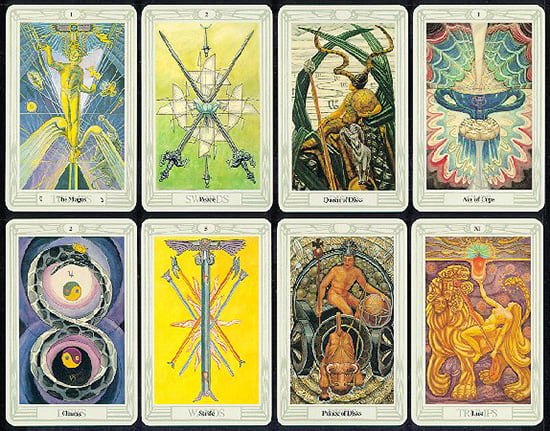
The Thoth Tarot deck stands as a monumental achievement in the history of tarot. Crowley collaborated with the talented artist Lady Frieda Harris over a period spanning from 1938 to 1943. Their collaboration entailed a careful integration of art, metaphysics, and symbolism, resulting in cards that were both visually striking and rich in layered meaning.
The design process was comprehensive, combining Crowley's esoteric insights with Harris's artistic talent. Each card in the deck is imbued with deliberate symbolism, where every element—from color choices to geometric forms—is intended to evoke mystical insights and psychological revelations.
Complex Symbolism and Card Interpretations
The symbolic complexity of the Thoth deck sets it apart from other traditional tarot decks. Crowley reinterpreted many of the cards by renaming and reassigning their meanings to shift the focus towards a deeper, more nuanced spiritual journey. For example:
- Major Arcana Redefined: Traditional cards such as “Strength” and “Temperance” are relabeled to reflect broader metaphysical principles—for instance, “Strength” is often viewed under the concept of “Adjustment,” suggesting the balance required between opposing forces.
- Astrological and Kabbalistic Connections: The cards are interwoven with astrological signs and Kabbalistic correspondences. This interconnection offers a multidimensional perspective, allowing users to decode the cards based on cosmic cycles, spiritual elements, and inner psychological states.
Each card is meticulously crafted to act as both a mirror for the psyche and a gateway to higher consciousness. This psychological depth explains why many modern tarot readers view the Thoth deck as an advanced tool for introspection and spiritual growth.
Innovative Elements in Card Design
In addition to its symbolic complexity, the Thoth Tarot deck is known for its distinctive artistic style. The artwork, rooted in an Art Deco aesthetic, incorporates abstract forms and detailed geometric patterns, which serve to underscore the deck's otherworldly themes. This blend of art and symbolism is a hallmark of Crowley’s vision. It challenges the user to look beyond surface-level interpretations and consider the broader metaphysical messages embedded within the imagery.
Comparative Analysis: Thoth Tarot vs. Traditional Decks
| Aspect | Thoth Tarot (Crowley) | Traditional Deck (e.g., Rider-Waite) |
|---|---|---|
| Symbolism | Multi-layered, integrating Kabbalah, astrology, and alchemy. | More straightforward, primarily focused on archetypical imagery. |
| Artistic Style | Complex, abstract Art Deco influences. | Classical, accessible illustrations. |
| Interpreted Use | Intended for deep mystical and psychological exploration. | Commonly used for general divination and fortune-telling. |
| Renaming of Cards | Many Major Arcana cards are renamed to emphasize abstract concepts (e.g., "Strength" becomes "Adjustment"). | Maintains traditional names and meanings. |
| Complexity | Highly intricate symbolism requiring extensive study. | Simpler symbolism for quicker intuitive readings. |
The table above provides a clear comparison between Crowley’s innovative Thoth Tarot and more traditional decks. This juxtaposition highlights the transformative nature of Crowley’s contributions, which not only refined the visual aesthetics of tarot but also deepened its interpretative potential.
Influence on Modern Tarot and Occult Practices
Evolving Tarot Interpretation
Crowley’s contributions have had a long-lasting effect on modern tarot. By reimagining the structure and purpose of tarot cards, he encouraged practitioners to approach tarot as a reflective art form that probes into the depths of the human condition. This evolution in tarot interpretation has led to a broad range of practices in contemporary occultism. Rather than serving only as a tool for divination, the tarot is now often used for meditation, psychological exploration, and as a medium to understand cosmic laws.
His work also fostered a new generation of tarot designers and occult writers who seek to build upon his legacy. Many modern decks and interpretive guides borrow from the symbolic lexicon that Crowley developed, thereby ensuring that his ideas remain an integral part of tarot practice.
Legacy Beyond the Cards
Crowley’s broader influence on occultism cannot be dismissed when evaluating his impact on tarot. His philosophical writings, particularly those that accompany his tarot work, have offered expansive interpretations of spiritual transformation. The Thoth Tarot deck is often accompanied by detailed texts that explain the esoteric underpinnings of its imagery, encouraging readers to consider the interplay between the microcosm (the individual) and the macrocosm (the universe).
This broader worldview has paved the way for a more integrative approach to spirituality—one that encourages individuals to use tarot as a guide in their quest for self-awareness and deep metaphysical insights. For many, the tarot becomes a meditative companion that aids in deciphering the complex symbolism of life, serving as a bridge between inner psychological experiences and the greater mysteries of the cosmos.
Application in Contemporary Practices
Modern occult practitioners often incorporate elements from Crowley’s teachings into their sessions and rituals:
- Meditative Practices: Users engage with tarot imagery as a focal point during meditation to access their subconscious mind and explore personal transformation.
- Psychological Analysis: The intricate symbolism within the Thoth Tarot provides ample material for introspection and understanding of archetypal patterns in the human psyche.
- Symbolic Rituals: Rituals and ceremonies often incorporate the card symbolism to align participants with cosmic cycles and deeper spiritual energies.
- Artistic Expression: Many tarot enthusiasts are drawn to the artistic aspects of the deck, using the imagery to inspire creative works and personal narratives that speak to their inner journeys.
This multidimensional application of the tarot, fostered largely by Crowley’s pioneering work, continues to shape the way practitioners navigate modern occult landscapes. His legacy lives on through ongoing reinterpretations and the continued study of his mystical philosophies.
Crowley’s Controversial Persona and Its Impact on Tarot
Controversial Reputation
Aleister Crowley’s personal life and controversial reputation have often shadowed his work. Known for his provocative lifestyle and outspoken views, Crowley attracted both fervent admiration and sharp criticism during his lifetime and beyond. However, despite the controversies, his intellectual contributions to occultism and tarot have been recognized as groundbreaking.
The debates surrounding his persona add a complex layer to his influence on the occult community. Critics often focus on his unorthodox methods and personal behavior, but many practitioners differentiate between the man and his work. The symbolism and innovative ideas embedded in the Thoth Tarot overshadow the controversies, ensuring that the deck remains respected and influential.
The Separation of Art from Artist
For contemporary tarot enthusiasts, the value of the Thoth Tarot deck lies primarily in its esoteric content rather than Crowley’s personal life. Many users and scholars approach the deck as a distinct work of art and philosophy. This separation has allowed Crowley’s contributions to persist independently, proving that art and intellectual legacy can endure even if the artist remains a controversial figure.
The enduring appeal of the Thoth Tarot deck is a testament to its ability to communicate complex ideas about spirituality, transformation, and the interplay of opposites. Its reception by modern audiences emphasizes a broader trend in occult studies: the willingness to engage with challenging content in the pursuit of deeper understanding.
Detailed Analysis of Tarot Symbols in Crowley’s Work
Integration of Multiple Occult Systems
One of the most striking aspects of Crowley’s tarot system is its interdisciplinary foundation. By blending elements from different occult and mystical traditions, Crowley transformed each card into a mosaic of symbolic meanings. For instance, a single card might incorporate:
- Kabbalistic references: Drawing on the Tree of Life structure, where Hebrew letters and sephirot systematize spiritual energy.
- Astrological correspondences: Identifying cards with specific zodiac signs and planetary influences, thereby creating a link between cosmic events and personal experiences.
- Alchemical symbolism: Illustrating processes of transformation and regeneration, symbolizing the journey from base matter to spiritual gold.
The fusion of these symbolic structures creates layers of meaning that invite rigorous study and personal interpretation. This multidimensional approach has enriched tarot reading by ensuring that each reading is not simply a mechanical process but an opportunity for the reader to explore universal truths about transformation, balance, and the nature of the self.
Psychological and Spiritual Dimensions
Beyond its esoteric content, Crowley’s tarot work also taps into the psychological realm. The Thoth Tarot deck is often considered a tool for psychological introspection, where the intricate symbols reflect inner conflicts, latent potential, and paths toward personal evolution. This psychological dimension encourages the user to view the tarot not merely as a predictive device but as a mirror that reflects the inner workings of the mind and spirit.
The practice of using tarot for meditation and self-reflection is in direct dialogue with modern psychological theories, where symbolism is used as a means to unlock the unconscious mind. In this regard, Crowley’s reinterpretation of card meanings broke new ground by integrating spiritual lessons with psychological realism.
Educational and Cultural Impact
Influence on Academic and Occult Studies
Crowley’s work on tarot has had a significant impact on both academic and practical realms of esoteric studies. His writings, particularly those elucidating the Thoth Tarot, have become essential reading for those studying Western esotericism. The intellectual rigor present in his analyses helped elevate tarot from a simple fortune-telling tool to a subject worthy of scholarly attention.
Courses, seminars, and workshops on modern occultism frequently incorporate Crowley’s insights, using the Thoth deck as a case study for the integration of art, symbolism, and mysticism. This academic validation has contributed to a broader cultural acceptance of tarot as a medium through which deeper metaphysical questions about existence, spirituality, and the dynamism of human consciousness may be explored.
Impact on Artistic Expression and Popular Culture
Beyond its spiritual and academic influence, Crowley’s contributions have left a lasting mark on popular culture. The Thoth Tarot deck, with its intricate, provocative images, has inspired a wide array of creative mediums including literature, music, film, and visual arts. Artists and writers frequently reference the deck’s symbolism as a metaphor for transformation and self-exploration. This cross-pollination between occult symbolism and the arts has helped to maintain a vibrant cultural dialogue centered on the mysteries of existence.
In modern media, tarot imagery is often used to evoke a sense of mystery and depth. Crowley’s legacy, therefore, extends well beyond esoteric circles, permeating the wider cultural imagination and appealing to both spiritual seekers and artistic communities alike.
Conclusion
In conclusion, Aleister Crowley’s influence on tarot is multifaceted and enduring. Through his groundbreaking creation of the Thoth Tarot deck, he introduced a new language of symbolism that integrates diverse traditions such as Kabbalah, astrology, alchemy, and ancient mythology. His work redefined the roles of traditional tarot cards, offering rich, alternative interpretations that invite users to embark on journeys of inner discovery and spiritual transformation.
Crowley’s visionary approach elevated tarot from a tool for mundane divination to an intricate art form that bridges the personal and the cosmic. His legacy is evident not only in his original designs and writings but also in the continued evolution of tarot practice and modern occultism. Despite his controversial persona, the profound impact of his esoteric contributions endures, continuing to inspire both scholarly study and practical application in the realms of spirituality, psychology, and art.
References
- Unraveling the Intricacies of the Enigmatic Crowley Thoth Tarot Deck - Tarot Ales
- Why Aleister Crowley's Thoth Tarot Deck Remains Influential - Cissetrading
- Discovering The Connection: Aleister Crowley And The Enigmatic World Of ... - Shunspirit
-
The Golden Dawn's Influence on Modern Tarot Interpretation - The Human Being Project
- Thoth Tarot - Wikipedia
- Aleister Crowley and the Metaphysical Thoth Tarot - Gaia
- The Book of Thoth | work by Crowley - Britannica
- 78 Tarot Cards base on THOTH Tarot Deck - Aleister Crowley - TarotX
- Understanding Aleister Crowley's Thoth Tarot by Lon Milo DuQuette - Hexwitch
More
Last updated February 19, 2025