
Unlocking Crypto Perps: A First-Principles Guide to Day Trading with Order Flow
Navigate the dynamic world of perpetual futures by understanding the very pulse of the market – the flow of orders.
Approaching day trading in short-term cryptocurrency perpetual contracts (perps) from an order flow and market microstructure perspective allows you to delve deeper than surface-level price charts. It's about understanding the mechanics of how trades occur, how liquidity shifts, and how these intricate interactions dictate price movements in real-time. This foundation is built from first principles, enabling precise and informed decision-making.
Essential Insights: Key Takeaways
- Market Microstructure is Key: Understanding the architecture of how orders are placed, matched, and how liquidity is formed in crypto perp markets is fundamental to interpreting order flow.
- Order Flow Reveals Real-Time Intent: Analyzing the actual sequence, size, and aggression of buy and sell orders provides insights into immediate supply and demand dynamics, often before price fully reflects these shifts.
- Data-Driven Decisions Trump Speculation: A first-principles approach focuses on observable market data (like Level 2 order books, time and sales, and volume profiles) to identify imbalances and potential trade opportunities.
Laying the Groundwork: Core Concepts
Before diving into strategies, it's crucial to grasp the foundational elements that underpin order flow trading in the context of crypto perpetual futures.
Understanding Perpetual Futures (Perps)
Perpetual futures, or "perps," are derivative contracts unique to cryptocurrency markets. Unlike traditional futures, they don't have an expiration date. This allows traders to hold positions indefinitely, speculating on the future price direction of an underlying cryptocurrency. Their value is designed to closely track the spot price of the asset through a mechanism called the "funding rate." This rate involves periodic payments exchanged between long and short position holders, incentivizing the perp price to stay aligned with the spot price. Perps are popular for short-term trading due to their potential for high leverage and 24/7 market availability, leading to significant liquidity and trading volume.
Market Microstructure in Crypto Perps
Market microstructure is the study of how trading mechanisms influence price formation, liquidity provision, and overall market dynamics. In the context of crypto perps, this involves examining:
- Price Discovery: How the collective actions of buyers and sellers, through placing and executing orders, establish the current market price.
- Liquidity: The ease with which assets can be bought or sold without causing significant price changes. This is often visualized through the order book's depth.
- Order Book Dynamics: The continuous interaction of limit orders (passive orders waiting to be filled) and market orders (aggressive orders seeking immediate execution).
- Trader Behavior: The impact of different market participants, from retail traders to institutional players and algorithmic high-frequency traders.
Crypto markets, being highly electronic and operating continuously, present unique microstructure characteristics, including high volatility and potential liquidity fragmentation across different exchanges.
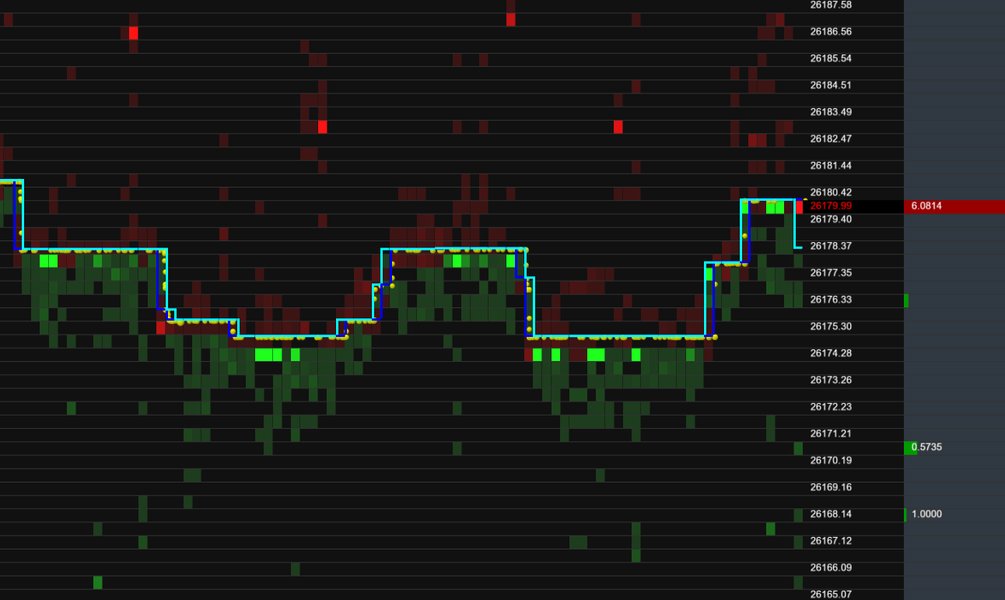
A visual representation of an order book depth chart, showing bid and ask liquidity at different price levels.
Order Flow Trading: The Essence
Order flow trading is a strategy that focuses on analyzing the real-time stream of buy and sell orders to identify imbalances in supply and demand that could lead to price movements. It goes beyond static price charts and indicators by looking at the *actual* transactions and order book events. Key aspects include:
- Advertised Liquidity: Limit orders visible on the order book representing potential supply and demand.
- Executed Trades: Market orders that consume available liquidity, indicating aggressive buying or selling pressure.
- Volume Analysis: The size of orders and trades, which can reveal the conviction behind market movements.
By observing order flow, traders aim to understand the immediate intentions of market participants and anticipate short-term price changes with greater precision.
Deconstructing Market Dynamics: The Order Flow Perspective
To effectively trade using order flow, one must understand how to interpret the raw data presented by the market.
Analyzing the Order Book (Level 2 Data)
The order book is a primary tool, displaying a real-time list of all outstanding buy (bid) and sell (ask) limit orders, organized by price level. Analysis involves:
- Depth of Market (DOM): Assessing the volume of orders at different price levels. Thick clusters of buy orders (bids) below the current price can act as potential support, while significant sell orders (asks) above can indicate resistance.
- Order Book Imbalance: Comparing the total volume of bids versus asks. A significant skew can suggest short-term directional pressure.
- Liquidity Walls & Spoofing: Identifying large orders (walls) that might absorb price movements. Traders must also be wary of "spoofing" – large, non-genuine orders placed to manipulate perception, which are typically quickly canceled.
Interpreting Time & Sales (The Tape) and Footprint Charts
Time & Sales (Tape Reading)
The "tape" shows a chronological record of every executed trade, including price, volume, and time. It reveals the aggressive side of the market:
- Aggressive Buyers: Market buy orders hitting the ask prices, lifting offers.
- Aggressive Sellers: Market sell orders hitting the bid prices, taking bids.
Footprint Charts (Volume Imprint)
Footprint charts offer a more granular view by displaying the volume traded at each specific price level within a candle or bar, often split into buy (aggressive buying) and sell (aggressive selling) volume. This helps to:
- Identify Imbalances at Price: Pinpoint where aggressive buyers or sellers are overpowering the other side at specific price points. Stacked imbalances (multiple consecutive price levels showing significant imbalance) can indicate strong conviction.
- Spot Absorption: See if large market orders are being absorbed by limit orders without significant price movement, potentially signaling a strong support or resistance level holding.
- Detect Exhaustion: A surge in volume at a price extreme with little follow-through can indicate that the aggressive side is losing momentum.
Recognizing Key Order Flow Patterns
Certain recurring patterns in order flow can provide trading signals:
- Absorption: When aggressive market orders are consistently filled by limit orders at a specific price level without the price moving significantly past it. This signals strong passive participation.
- Stacked Imbalances: Consecutive price levels on a footprint chart showing a clear dominance of aggressive buying or selling volume. This can indicate strong directional momentum.
- Exhaustion Gaps / Failed Auctions: When price attempts to move beyond a certain level, but volume dries up, and aggressive orders fail to push through, often leading to a reversal.
- Delta Divergence: When cumulative delta (net difference between aggressive buy and sell volume) diverges from price action. For example, price making higher highs while cumulative delta makes lower highs could signal weakening buying pressure.
This video, "Master ORDER FLOW TRADING in Less than ONE HOUR!" by Fractal Flow, provides a comprehensive overview of order flow trading concepts and strategies, which aligns well with understanding the core principles discussed here for approaching day trading from an order flow perspective.
Visualizing Order Flow Concepts
To better understand the interplay of various elements in order flow trading, a mindmap can illustrate the connections:
This mindmap outlines the core components, from understanding the instruments (perps) and market structure, through the tools used for analysis, to the patterns and strategic applications in day trading.
A Practical Framework for Order Flow Day Trading
Building on these principles, a systematic approach to day trading crypto perps using order flow involves several key steps:
1. Pre-Trade Analysis & Preparation
Identify Key Levels
Before the trading session, use tools like volume profile on higher timeframes to identify significant price levels where substantial trading activity has occurred previously (High Volume Nodes - HVNs, Low Volume Nodes - LVNs). Also, note major support and resistance levels from price action. Observe the current order book depth around these areas.
Monitor Contextual Factors
Be aware of prevailing market sentiment, open interest changes in perps, and funding rates. Extreme funding rates can sometimes precede liquidations or "squeezes."
2. Real-Time Order Flow Monitoring
Track Aggressive Orders
Use footprint charts and time & sales to watch for surges in aggressive buying (market buys) or selling (market sells), especially near your pre-identified key levels.
Observe Order Book Behavior
Note how the order book reacts to price approaches. Are large limit orders holding, being absorbed, or are they being "pulled" (potentially spoofing)? Is liquidity replenishing quickly after being taken?
3. Entry Criteria Based on Order Flow Confirmation
Confirmation Signals
Look for confluence. For example, if price approaches a key support level:
- Does aggressive selling decrease?
- Do large buy limit orders appear and hold (absorption)?
- Is there a shift with aggressive buy orders stepping in?
4. Trade Management with Order Flow Insights
Dynamic Stop Placement
Stops can be placed beyond areas where significant liquidity was observed or just beyond the price levels where the entry signal's logic would be invalidated (e.g., if absorption fails and price breaks through).
Profit Targets and Exits
Look for signs of counter-flow or exhaustion. If you're long and heavy aggressive selling appears at a resistance level, or buying volume dries up, it might be time to take profits. Partial exits can be made at subsequent liquidity zones.
5. Post-Trade Review
Analyze Your Trades
Review executed trades against the order flow data. What did the flow look like leading up to the entry? How did it behave during the trade? This helps refine pattern recognition and strategy execution.
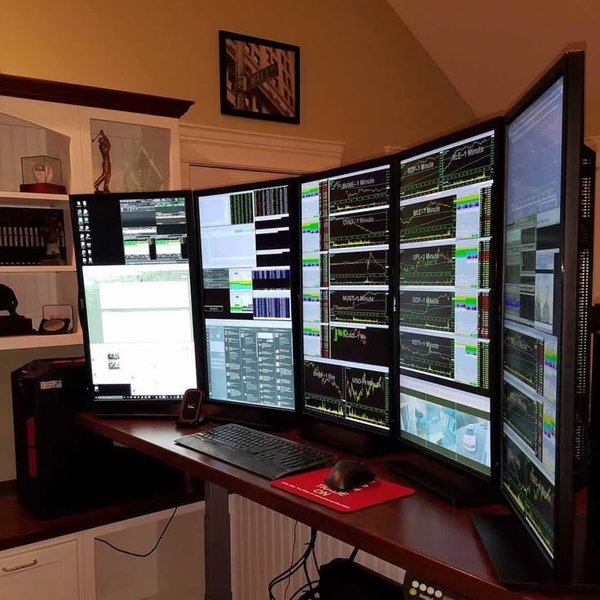
A typical day trader's workstation with multiple monitors, crucial for observing various data feeds like charts, order books, and time & sales simultaneously.
Comparative Analysis of Order Flow Tools
Different order flow tools provide unique perspectives on market activity. The radar chart below offers a subjective comparison of common tools based on several criteria relevant to day traders. The scores (1-5, where 5 is highest/best) reflect general characteristics and can vary based on individual proficiency and market conditions.
This chart highlights that while tools like Footprint Charts offer high granularity and predictive power for spotting imbalances and absorption, they may have a steeper learning curve. The Order Book (DOM) and Time & Sales are excellent for real-time responsiveness. Volume Profile, while crucial for structural context, is less about immediate order flow action.
Critical Considerations for Order Flow Traders
While powerful, order flow trading comes with its own set of challenges and requirements:
| Consideration | Description | Importance for Day Trading Perps |
|---|---|---|
| Data Quality & Latency | Access to reliable, low-latency Level 2 and trade data is paramount. Delays can render analysis ineffective. | Extremely high. Crypto markets are fast; stale data leads to poor decisions. |
| Platform and Tools | Choosing a trading platform and specialized order flow software (e.g., Bookmap, Sierra Chart, ATAS, ExoCharts) that provides clear visualization and analytical capabilities. | High. The right tools significantly enhance the ability to interpret complex flow data. |
| Leverage and Risk Management | Perps offer high leverage, which amplifies both profits and losses. Strict risk management (stop-losses, position sizing) is non-negotiable. | Critical. High leverage without discipline is a recipe for rapid account depletion. |
| Market Hours & Liquidity Periods | Crypto markets are 24/7, but liquidity can vary significantly. Trading during periods of higher liquidity generally offers better execution and more reliable flow patterns. | Moderate to High. Lower liquidity can lead to wider spreads and more erratic price moves (slippage). |
| Detecting Market Manipulation | Being aware of tactics like spoofing (placing large fake orders) or layering to manipulate price perception is crucial. | High. Misinterpreting manipulative activity as genuine flow can lead to significant losses. |
| Cognitive Demands & Learning Curve | Order flow analysis requires intense focus, quick decision-making, and a significant investment in learning to read the flow accurately. | High. It's not a "get rich quick" method and requires dedication to master. |
The table above summarizes key factors that any aspiring order flow trader in the crypto perp markets must address to build a sustainable approach.
Frequently Asked Questions (FAQ)
What exactly is "order flow" in crypto trading?
Order flow refers to the real-time stream of buy and sell orders being placed and executed in the market. It encompasses both the limit orders resting on the order book (passive supply and demand) and the market orders that actively consume this liquidity (aggressive buying and selling). Analyzing order flow helps traders understand the immediate buying and selling pressure and anticipate potential short-term price movements.
How does market microstructure affect crypto perpetual futures trading?
Market microstructure details how trades are executed, liquidity is provided, and prices are discovered. In crypto perps, factors like high leverage, 24/7 trading, the funding rate mechanism, and the behavior of algorithmic traders and market makers significantly shape the microstructure. Understanding these elements is vital for interpreting order flow correctly, as they influence order book depth, volatility, and the efficiency of price discovery.
What are the essential tools for order flow analysis?
Essential tools include:
- Order Book (Depth of Market - DOM): Shows resting limit orders.
- Time & Sales (Tape): Lists executed trades in real-time.
- Footprint Charts: Visualize volume traded at each price, broken down by buy/sell aggression.
- Volume Profile: Shows total volume traded at different price levels over a period, highlighting areas of high and low activity.
Is order flow trading suitable for beginners in crypto?
Order flow trading can be complex and has a steep learning curve. While it provides deep market insights, beginners might find it overwhelming initially due to the volume of data and the need for quick interpretation. It's generally recommended that beginners first develop a solid understanding of basic market principles, technical analysis, and risk management before venturing into advanced techniques like order flow analysis. Starting with a simulated trading account is advisable.
How can one effectively manage risk when day trading crypto perps with order flow?
Effective risk management is crucial, especially with leveraged perps. Key strategies include:
- Position Sizing: Never risk more than a small percentage (e.g., 1-2%) of your trading capital on a single trade.
- Stop-Loss Orders: Always use stop-loss orders placed at logical levels based on your order flow analysis (e.g., beyond an absorption zone or a liquidity cluster).
- Understanding Volatility: Be aware that crypto markets can be extremely volatile, and order flow can change rapidly. Adjust trade size and stop distances accordingly.
- Avoiding Over-Leverage: While high leverage is available, using excessive leverage significantly increases risk.
- Emotional Discipline: Stick to your trading plan and avoid impulsive decisions driven by fear or greed.
Recommended Further Exploration
- What are advanced techniques for identifying order flow absorption and exhaustion in volatile crypto markets?
- How can I effectively integrate volume profile analysis with real-time order flow data for crypto day trading strategies?
- What is the impact of algorithmic trading and high-frequency trading (HFT) on the market microstructure of crypto perpetual futures?
- Which software and platforms are considered best for professional order flow analysis in cryptocurrency trading, and what are their key features?
References

Last updated May 9, 2025