

Highlights of Constructive Solid Geometry and Boolean Operations
- Fundamental Building Blocks: CSG constructs complex 3D objects by combining basic primitive shapes (like cubes, spheres, and cylinders) using a set of powerful Boolean operations.
- Hierarchical Representation: CSG models are represented as binary trees, where primitive shapes are the leaves and Boolean operations are the internal nodes, enabling procedural and parametric modeling.
- Core Operations: The three primary Boolean operations are Union (combining volumes), Intersection (retaining overlapping volumes), and Difference (subtracting one volume from another), each serving distinct modeling purposes.
Constructive Solid Geometry (CSG) stands as a foundational technique in the realm of 3D modeling, revolutionizing how complex objects are designed and manipulated across various industries. From the intricate gears in CAD software to the immersive environments in video games, CSG provides a robust and intuitive method for creating sophisticated geometries from basic building blocks. This approach leverages the power of set theory, applying Boolean operations to combine, subtract, or intersect primitive shapes, thereby enabling designers and engineers to achieve unparalleled precision and flexibility in their digital creations.
The Essence of Constructive Solid Geometry (CSG)
At its core, CSG defines a solid object not by its boundary surfaces but by a series of constructive operations. This volumetric approach distinguishes it from other modeling paradigms like Boundary Representation (B-Rep), offering a unique set of advantages, particularly in areas requiring precise Boolean computations. The process begins with simple geometric primitives—such as boxes, spheres, cylinders, and cones—which are then transformed and combined using Boolean operators to form more elaborate structures. This methodology is particularly powerful because it maintains a clear, hierarchical history of how an object was constructed, facilitating easy modifications and parametric adjustments.
A Procedural Blueprint: The CSG Tree
Every CSG model is inherently represented as a binary tree, often referred to as a CSG tree. This hierarchical structure is pivotal to CSG's functionality and flexibility. The leaves of this tree are the fundamental primitive shapes, each defined by its geometry and position in 3D space. The internal nodes, conversely, represent the Boolean operations that act upon their child nodes. The root of the tree embodies the final, complex object. This tree-based representation means that modifying a primitive shape or an operation within the tree automatically updates the entire model, making CSG a highly efficient tool for procedural and parametric design.
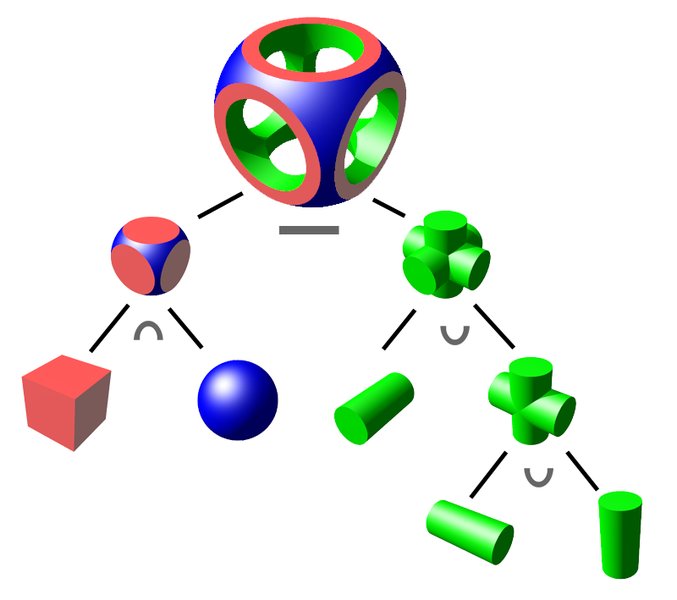
A typical CSG tree illustrating the hierarchical construction of a complex object.
Decoding the Boolean Operations: The Heart of CSG
The efficacy of CSG hinges on three fundamental Boolean operations, derived directly from set theory. These operations dictate how volumes of geometric objects interact, allowing for the creation of incredibly diverse shapes from a limited set of primitives.
Union: The Act of Combination
The Union operation (often denoted as ∪ or "JOIN") combines two or more solid objects into a single, cohesive entity. Conceptually, it encompasses all the volume occupied by any of the input shapes, effectively merging them. If the objects overlap, the overlapping volume is counted only once, resulting in a single continuous solid. This operation is indispensable for adding features to a base object or merging distinct parts into a unified model.
Practical Application of Union
Imagine constructing a spaceship. You might union a cylindrical fuselage with spherical cockpit components and rectangular wing sections to form the basic hull. This combines all individual elements into one seamless object, ready for further refinement.
Intersection: Extracting Commonality
The Intersection operation (denoted as ∩ or "intersect") retains only the volume that is common to all input objects. This means that any portion of an object that does not overlap with all other input objects is discarded. Intersection is particularly useful for creating precise fittings, defining complex outlines, or extracting shared geometries between different components.
Practical Application of Intersection
To create a rounded slot in a panel, you could intersect a rectangular prism (the panel) with a cylinder (representing the slot's desired profile). The resulting object would be only the part of the prism that overlaps with the cylinder, effectively carving out the desired shape.
Difference: Sculpting by Subtraction
The Difference operation (denoted as \ or "-") is used to subtract the volume of one or more objects from another. The result is the portion of the first object that does not overlap with the second. This operation is fundamental for carving holes, creating cavities, or removing unwanted material from a design. It's crucial to note that the order of operations matters significantly for difference, as A - B is generally not the same as B - A.
Practical Application of Difference
To create a bolt hole in a bracket, one would subtract a small cylinder (the bolt) from the larger rectangular block (the bracket). This precise removal of material forms the exact cavity required.
Beyond these three core operations, some advanced CSG systems may include others like Symmetric Difference (XOR), which keeps parts of objects that are not common to both, or a Merge operation, which can offer slightly broader combination capabilities.
Why CSG Matters: Advantages and Applications
CSG's appeal stems from several key advantages that make it a preferred modeling technique in numerous professional and creative fields.
Key Advantages
- Simplicity and Intuition: Building complex models from simple primitives is inherently straightforward and intuitive, making CSG accessible to a wide range of users, from novices to seasoned professionals.
- Precision and Accuracy: Because it relies on mathematically defined primitives and operations, CSG produces highly accurate and precise models, which is critical in engineering and manufacturing.
- Parametric and Procedural Modeling: The tree-based structure allows for easy modification of parameters (e.g., radius of a sphere, dimensions of a box) or the order of operations, enabling dynamic adjustments without rebuilding the model from scratch.
- Compact Representation: CSG models can be stored compactly as a tree structure, rather than a dense mesh of vertices and faces, which can be memory efficient.
Diverse Applications
The versatility of CSG is evident in its wide array of applications:
- Computer-Aided Design (CAD): CSG is a cornerstone of CAD software, used for designing mechanical parts, architectural elements, and consumer products where precision and the ability to define features like holes, slots, and interlocking components are paramount.
- Game Development: Game designers utilize CSG for rapid prototyping of level geometry, creating environments, walls, and obstacles. Many game engines support CSG-like workflows for efficient scene construction.
- 3D Printing and Manufacturing: The creation of watertight and manifold (solid) models through CSG is crucial for 3D printing, ensuring that objects can be manufactured without defects.
- Ray Tracing and Rendering: CSG models are efficient for ray tracing algorithms, as the tree structure can be traversed to determine ray-object intersections, simplifying the rendering of complex scenes.
A Glimpse into CSG's Inner Workings
Understanding how CSG models are constructed and evaluated provides deeper insight into their power and limitations. The process typically involves defining primitives, applying transformations, and then orchestrating Boolean operations within the CSG tree.
Modeling Workflow Example
Consider the creation of a simple bracket. The workflow would involve:
- Start with a base rectangular block (a primitive).
- Subtract cylinders from this block to create mounting holes (difference operation).
- Union smaller rectangular blocks or fillets to add structural supports or rounded edges (union operation).
- Potentially intersect with another shape to define a specific cut-out or feature.
This systematic approach ensures that every change propagates predictably, maintaining design integrity.
Challenges and Considerations
While powerful, CSG presents certain challenges:
- Computational Intensity: Evaluating complex CSG trees, especially for rendering or mesh generation, can be computationally demanding.
- Non-Manifold Geometry: Incorrectly performed operations or misaligned primitives can sometimes lead to non-manifold geometry (e.g., edges connected to more than two faces), which can cause issues in downstream processes like 3D printing or simulation.
- Limitations for Organic Shapes: CSG excels at mechanical and architectural forms but can be less intuitive for creating highly organic or fluid shapes, where techniques like sculpting or subdivision modeling might be more appropriate.
Understanding CSG's Operational Hierarchy
The sequence in which Boolean operations are applied in a CSG tree is critical and directly impacts the final geometric outcome. This hierarchical structure can be effectively mapped out using a mindmap to visualize the dependencies and transformations.
This mindmap provides a comprehensive overview of CSG, detailing its core components, operational principles, applications, advantages, and challenges. It visually organizes the interdependencies between Boolean operations and the CSG tree, highlighting how these elements work in concert to achieve complex 3D models.
CSG in Action: A Visual Demonstration
To further contextualize the power of CSG and its Boolean operations, let's explore a practical example using a widely recognized tool like OpenSCAD. This video provides a clear, concise demonstration of how these operations are applied to create tangible 3D models.
This video, "CSG Basics in OpenSCAD," demonstrates the fundamental Boolean operations (union, intersection, and difference) using OpenSCAD, a programmatic solid modeller. It showcases how simple code can generate complex 3D shapes, reinforcing the procedural nature of CSG.
This embedded tutorial offers a hands-on perspective, showing how users can leverage CSG principles in real-world modeling scenarios. Observing these operations in action solidifies the understanding of their impact on 3D geometry.
A Structured Comparison of Boolean Operations
To summarize the fundamental Boolean operations and their implications, the following table provides a clear comparison:
| Operation | Description | Set Theory Notation | Resulting Volume | Common Use Case |
|---|---|---|---|---|
| Union | Combines the volumes of two or more objects into a single one. | A ∪ B | All space occupied by A, B, or both. | Merging parts, adding features. |
| Intersection | Retains only the volume common to all input objects. | A ∩ B | Only the overlapping space between A and B. | Creating precise fits, defining shared features. |
| Difference | Removes the volume of the second object from the first. | A \ B (or A - B) | The part of A that is not in B. | Carving holes, creating cavities, subtracting material. |
This table succinctly captures the essence of each primary Boolean operation, highlighting their distinct effects on 3D geometry and their practical applications.
Evolution and Future of CSG
CSG, while a mature technology, continues to evolve. Advancements in computational power and algorithms are addressing some of its traditional limitations, such as performance for extremely complex trees and numerical stability issues that can arise from floating-point inaccuracies. Modern implementations often incorporate techniques like voxelization, BSP (Binary Space Partitioning) trees, or GPU acceleration to enhance performance and robustness. The future holds promise for even more sophisticated CSG applications, potentially integrated with AI-driven design tools for automated optimization and generation of complex geometries.
Frequently Asked Questions about CSG and Boolean Operations
What is the main difference between CSG and B-Rep modeling?
Can CSG be used for organic modeling?
Are Boolean operations always successful?
What software uses CSG?
Conclusion
Constructive Solid Geometry, underpinned by the powerful trio of Union, Intersection, and Difference, remains an indispensable tool in the diverse landscape of 3D modeling. Its hierarchical, procedural nature empowers designers to create complex and precise geometries with remarkable efficiency and flexibility. From enabling rapid prototyping in game design to ensuring critical accuracy in engineering, CSG offers a robust framework for digital fabrication. As technology continues to advance, the integration of CSG with modern computational techniques will only further cement its role as a cornerstone of 3D design.
Recommended Further Exploration
- Advanced CSG Techniques for Complex Assemblies
- Comparison of CSG vs. B-Rep in Modern CAD Software
- Implementing Boolean Operations in Real-time 3D Engines
- Procedural Generation of 3D Models using CSG