
The Brink of Armageddon: Unraveling the Cuban Missile Crisis
A 13-Day Standoff That Reshaped Global Diplomacy and Averted Nuclear Catastrophe
Key Insights into the Cuban Missile Crisis
- Escalation to the Brink: The Cuban Missile Crisis, lasting 13 intense days in October 1962, represented the closest the United States and the Soviet Union ever came to full-scale nuclear war during the Cold War. It was a direct and perilous confrontation driven by the Soviet Union's secret deployment of nuclear-armed missiles in Cuba.
- Tit-for-Tat Deterrence: The crisis was fundamentally a response to perceived threats and a strategic imbalance. The Soviet Union's placement of missiles in Cuba was, in part, a counter to the U.S. deployment of Jupiter nuclear missiles in Turkey and Italy, and a means to deter further U.S. aggression against Cuba after the failed Bay of Pigs invasion.
- Diplomacy as the Ultimate Safeguard: Despite the immense tension, both sides ultimately found a diplomatic resolution. The crisis ended with a secret agreement: the Soviets would remove their missiles from Cuba, and in return, the U.S. publicly pledged not to invade Cuba and secretly agreed to withdraw its missiles from Turkey. This pivotal event led to improved communication channels, like the Moscow-Washington hotline, and significantly influenced future arms control efforts.
The Cuban Missile Crisis, often referred to as the October Crisis in Cuba or the Caribbean Crisis in Russia, stands as a monumental chapter in the annals of the Cold War. For 13 harrowing days in October 1962, the world teetered on the precipice of nuclear annihilation as the two superpowers, the United States and the Soviet Union, engaged in a dangerous confrontation over the presence of Soviet nuclear-armed ballistic missiles on the island of Cuba, just 90 miles from U.S. shores. This dramatic standoff not only defined the presidency of John F. Kennedy but also left an indelible mark on international relations, fundamentally altering the trajectory of the Cold War and emphasizing the critical importance of diplomatic resolution in times of extreme tension.
The Genesis of a Global Standoff
Understanding the Underlying Tensions and Motivations
The crisis did not emerge in a vacuum but was the culmination of several geopolitical factors and historical grievances. The Cold War was characterized by an intense arms race and ideological struggle between the capitalist West, led by the U.S., and the communist East, led by the Soviet Union. Both superpowers sought to expand their spheres of influence and deter aggression from the other, often through the deployment of strategic weaponry and the formation of military alliances.
The Bay of Pigs Aftermath and Cuban Vulnerability
A significant precursor to the crisis was the failed U.S.-backed Bay of Pigs invasion in April 1961, an attempt to overthrow Fidel Castro's communist regime in Cuba. This event left Castro feeling vulnerable to future American aggression and strengthened Cuba's ties with the Soviet Union. In response to these perceived threats, and as a way to enhance its global standing, Soviet Premier Nikita Khrushchev saw an opportunity to secure Cuba and shift the strategic nuclear balance. Khrushchev believed that President Kennedy was weak and would not react forcefully to the presence of Soviet missiles in Cuba. This miscalculation, combined with the U.S. having previously placed its Jupiter nuclear missiles in Turkey and Italy, which directly threatened the Soviet Union, created a fertile ground for the crisis to unfold.
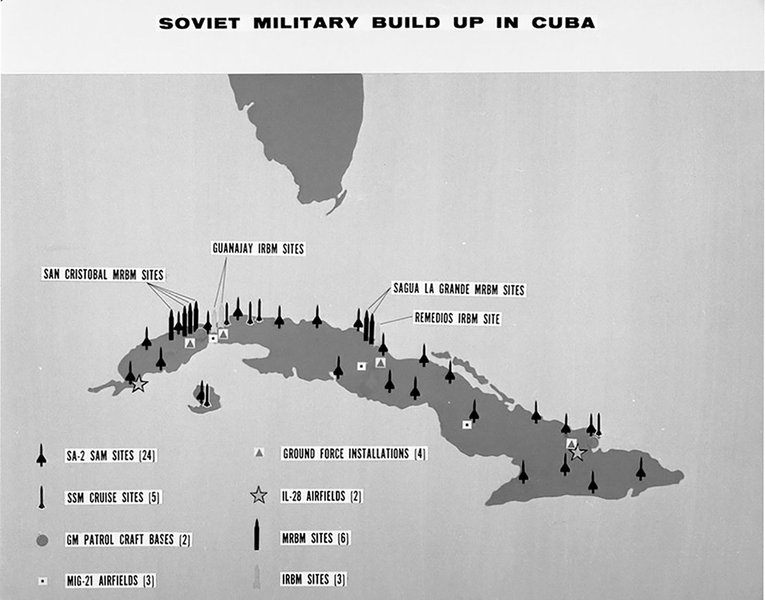
An aerial view illustrating the Soviet military buildup in Cuba during 1962.
The Strategic Imbalance and Missile Deployments
From the Soviet perspective, placing missiles in Cuba was a direct response to the U.S. deployment of nuclear-armed Jupiter missiles in Turkey, which bordered the Soviet Union. These U.S. missiles could hit Soviet targets within minutes, creating a perceived strategic disadvantage for Moscow. By deploying similar capabilities in Cuba, the Soviets aimed to achieve a nuclear parity or at least deter a U.S. first strike. This tit-for-tat dynamic in missile deployment underpinned the crisis's origins, transforming Cuba into a flashpoint for superpower confrontation.
The Fateful Discovery and Escalation
The Critical Days of October 1962
The crisis officially began on October 14, 1962, when a U.S. U-2 spy plane, piloted by Major Richard Heyser, secretly photographed several Soviet nuclear missile sites under construction in Cuba. These images, showing medium-range and intermediate-range ballistic missile (MRBMs and IRBMs) sites, were processed and presented to President Kennedy on October 15, immediately precipitating the onset of the crisis.
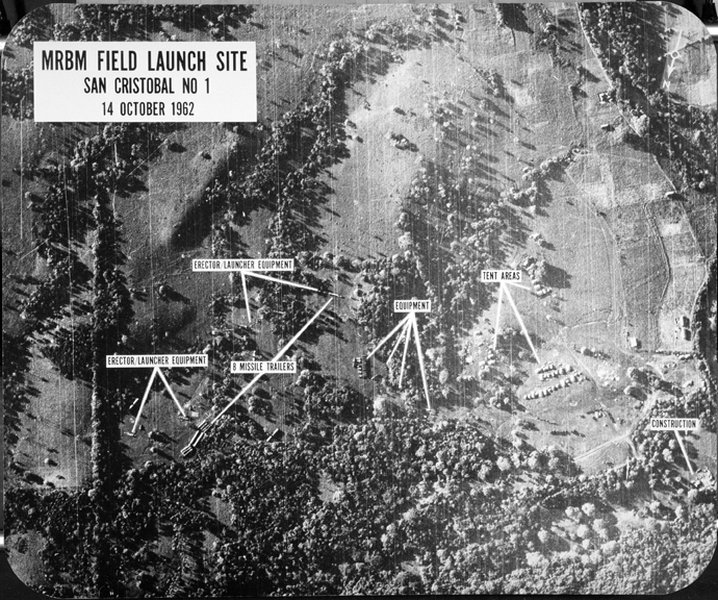
An aerial photograph from 1962 revealing missile installations in Cuba.
Kennedy's Executive Committee (ExComm) and the Options
Upon receiving this alarming intelligence, President Kennedy immediately convened a top-secret group of advisors known as the Executive Committee of the National Security Council (ExComm). For several days, from October 16, ExComm deliberated intensely over the possible responses. The primary options considered were:
- Air Strike and Invasion: A direct military attack on the missile sites, potentially followed by a full-scale invasion of Cuba. This option carried a high risk of immediate war with the Soviet Union and immense casualties.
- Naval Quarantine/Blockade: A naval blockade around Cuba to prevent further Soviet military shipments from reaching the island, coupled with a demand for the removal of existing missiles. This option was seen as a less escalatory military action, allowing for a diplomatic solution.
- Diplomatic Pressure: Engaging in direct negotiations with the Soviet Union through diplomatic channels, though this was initially seen as too slow and potentially ineffective given the urgency.
After intense debate, Kennedy opted for a naval quarantine, a decision publicly announced in a televised address on October 22, 1962. He declared that the U.S. would intercept all offensive military equipment bound for Cuba. This move raised global tensions dramatically, bringing the world to the brink of nuclear war, as Soviet ships approached the quarantine line.
The Thirteen Days of High Stakes Diplomacy
Navigating the Precipice of War
The period from October 16 to October 28, 1962, was marked by a series of tense exchanges, secret communications, and terrifying near-misses. The world held its breath as Soviet ships, some believed to be carrying further missile components, approached the U.S. naval quarantine line.
Key Events During the Standoff
The crisis was rife with miscommunications and critical moments that could have triggered full-scale conflict:
- October 24: Soviet ships carrying offensive weapons approached the quarantine line, but many turned back at the last minute, averting a direct confrontation.
- October 26: Khrushchev sent a long, emotional letter to Kennedy, offering to remove the missiles if the U.S. pledged not to invade Cuba.
- October 27: A U.S. U-2 reconnaissance plane was shot down over Cuba, killing pilot Major Rudolf Anderson. This incident dramatically heightened tensions, leading many to believe war was imminent. On the same day, Khrushchev sent a second, firmer letter, adding the demand that the U.S. remove its Jupiter missiles from Turkey.
The Back-Channel Deal and Resolution
Recognizing the extreme danger, Kennedy and his advisors crafted a shrewd response. They publicly accepted Khrushchev's first offer (the pledge not to invade Cuba) and ignored the second, harder demand. Simultaneously, Robert F. Kennedy, the President's brother and Attorney General, secretly met with Soviet Ambassador Anatoly Dobrynin, agreeing to remove the U.S. Jupiter missiles from Turkey in a few months, provided this concession remained secret.
This video provides a comprehensive overview of the Cuban Missile Crisis, detailing the events that brought the world to the brink of nuclear war and the intricate diplomacy that ultimately resolved the standoff. It highlights the strategic considerations and the sheer tension experienced by leaders on both sides.
On October 28, 1962, Khrushchev publicly announced that the Soviet Union would remove its missiles from Cuba, effectively ending the crisis. The naval quarantine was lifted on November 20, 1962, after the Soviets agreed to remove their IL-28 bombers from Cuba, and the U.S. Jupiter missiles were quietly withdrawn from Turkey in April 1963. While Fidel Castro was infuriated by the Soviet retreat, he was ultimately powerless to act against it.
The Far-Reaching Aftermath and Legacy
Shaping Future Cold War Dynamics
The Cuban Missile Crisis was a transformative event that profoundly reshaped Cold War policies and international relations. It served as a sobering lesson for both superpowers on the dangers of brinkmanship and the imperative of direct communication to avoid miscalculation.
Immediate and Long-Term Impacts
- Direct Communication Channels: A crucial immediate outcome was the establishment of the Moscow-Washington hotline in 1963, a direct communication link between the Kremlin and the White House. This allowed for instant dialogue during future crises, preventing delays and misinterpretations.
- Arms Control Initiatives: The crisis spurred a renewed commitment to arms control agreements. The Partial Nuclear Test Ban Treaty, signed in 1963, was a direct result, prohibiting nuclear weapons tests in the atmosphere, outer space, and under water. This marked the beginning of a series of arms limitation treaties.
- Nuclear Deterrence Strategies: The crisis reinforced the concept of Mutually Assured Destruction (MAD), where the catastrophic consequences of nuclear war for both sides served as a deterrent. Both superpowers continued to build their nuclear arsenals but also became more cautious in their direct confrontations.
- Leadership Changes: The crisis played a role in Nikita Khrushchev's eventual fall from power in 1964, as the Soviet Politburo viewed his handling of the crisis as a humiliation. For President Kennedy, the resolution significantly strengthened his image domestically and internationally.
- Shift in US-Soviet Relations: While tensions remained, the crisis ushered in a period of "détente," or easing of tensions, in the 1970s, as both sides recognized the need for greater stability and cooperation to avoid similar near-catastrophes.
Analyzing the Crisis Through a Radar Chart
To further illustrate the multifaceted nature of the Cuban Missile Crisis, let's consider a radar chart that evaluates various aspects of the event, based on the perceived strengths and weaknesses of the key players and the overall international context. This chart will highlight critical dimensions such as diplomatic effectiveness, risk management, strategic foresight, and the level of global tension.
This radar chart illustrates a subjective assessment of how the key parties performed across several critical dimensions during the Cuban Missile Crisis. The United States, under Kennedy, is depicted with strong scores in "Diplomatic Acumen" and "Military Restraint," reflecting their careful negotiation and avoidance of direct military confrontation. The Soviet Union, led by Khrushchev, also shows reasonable "Diplomatic Acumen" and "Military Restraint," indicating their willingness to de-escalate, though perhaps less "Strategic Foresight" in initiating the crisis. Cuba, under Castro, while a central player, had less direct control over the ultimate resolution, thus showing lower scores in "Risk Management" and "Public Communication" in the international arena. The "Global Tension Level" is consistently high for all parties, reflecting the shared universal fear during those 13 days.
Comparative Analysis of Key Events and Decisions
A Timeline of Crucial Moments
The Cuban Missile Crisis was a complex interplay of intelligence, high-level discussions, and carefully calculated maneuvers. Below is a comparative timeline highlighting the key events and decisions made by the principal actors.
| Date | Event/Discovery | U.S. Actions/Decisions | Soviet/Cuban Actions/Reactions | Significance |
|---|---|---|---|---|
| Oct 14, 1962 | U-2 spy plane discovers Soviet nuclear missile sites in Cuba. | Intelligence processed; presented to President Kennedy. | Missile construction underway; secrecy maintained. | The precipitating event; triggered immediate, top-secret U.S. response. |
| Oct 16, 1962 | Kennedy convenes ExComm. | Intense deliberations begin on response options (air strike, invasion, blockade). | Soviet intent to deploy confirmed. | Formal start of the "13 days"; critical decision-making period initiated. |
| Oct 22, 1962 | Kennedy announces naval quarantine of Cuba in televised address. | U.S. military forces put on high alert; naval blockade implemented. | Khrushchev condemns blockade as act of aggression; Soviet ships approach quarantine line. | Public revelation of crisis; direct military action initiated, raising global tension significantly. |
| Oct 24, 1962 | Soviet ships approach quarantine line. | U.S. Navy prepares for interception. | Many Soviet ships carrying offensive weapons turn back; others stop. | First major de-escalation; direct confrontation averted, offering a glimmer of hope for peaceful resolution. |
| Oct 26, 1962 | Khrushchev sends first letter to Kennedy. | Letter received, offering missile removal in exchange for U.S. non-invasion pledge. | Soviet Premier initiates diplomatic overture. | First clear sign of a potential diplomatic way out; a crucial step towards de-escalation. |
| Oct 27, 1962 | U.S. U-2 plane shot down over Cuba; Khrushchev sends second letter (demanding Turkey missile removal). | Tensions peak; U.S. prepares for potential invasion; Kennedy decides to accept first letter and address second through back-channel. | Major Rudolf Anderson killed; Khrushchev hardens demands; Castro urges pre-emptive strike. | The most dangerous day of the crisis; near-war scenario; secret negotiations become vital. |
| Oct 28, 1962 | Khrushchev publicly announces removal of missiles from Cuba. | Crisis resolution begins; U.S. pledge not to invade Cuba publicly affirmed; secret agreement to remove Jupiter missiles from Turkey confirmed. | Soviet Union agrees to withdraw missiles under UN verification. | Official end of the crisis; world steps back from nuclear war. |
Frequently Asked Questions About the Cuban Missile Crisis
What was the primary cause of the Cuban Missile Crisis?
How long did the Cuban Missile Crisis last?
What were the demands made by each side to resolve the crisis?
What was the role of the naval blockade during the crisis?
What were the long-term consequences of the Cuban Missile Crisis?
Conclusion: A Defining Moment in History
The Cuban Missile Crisis stands as a powerful testament to the fragility of peace in a nuclear age and the critical importance of statesmanship. It was a period when human decisions, rather than technological limitations, narrowly averted a global catastrophe. The crisis highlighted the immense dangers of ideological confrontation and the imperative of maintaining open lines of communication, even between adversaries. Its resolution, achieved through a combination of public pressure and secret diplomacy, provided valuable lessons that continue to resonate in contemporary international relations, particularly concerning nuclear proliferation and crisis management. The world learned that even at the brink of destruction, dialogue and compromise offer the only viable path to survival.
Recommended Further Exploration
- How did the Cuban Missile Crisis influence the Cold War arms race?
- What were the secret negotiations behind the Cuban Missile Crisis resolution?
- Compare the leadership styles of Kennedy and Khrushchev during the crisis.
- What was Cuba's perspective and role during the Cuban Missile Crisis?