
India's Leadership Unveiled: Who Holds the Reins in 2025?
Discover the current Prime Minister steering India's course, their tenure, and key responsibilities.
Key Insights
- Current Prime Minister: Narendra Damodardas Modi is the Prime Minister of India as of May 5, 2025.
- Historic Third Term: He commenced his third consecutive term on June 9, 2024, becoming the first Prime Minister since Jawaharlal Nehru to achieve this milestone.
- Head of Government: As the Prime Minister, he leads the Union Council of Ministers, holds executive authority, and oversees crucial government portfolios.
Meet India's Current Prime Minister: Narendra Modi
An Overview of His Tenure and Role
As of May 2025, the Prime Minister of India is Narendra Damodardas Modi. He assumed office for his first term on May 26, 2014. Following victories in subsequent general elections, he was sworn in for his second term on May 23, 2019, and began his historic third consecutive term on June 9, 2024.
Narendra Modi represents the Bharatiya Janata Party (BJP). Born on September 17, 1950, in Vadnagar, Gujarat, he has had a long political career. Before becoming Prime Minister, he served as the Chief Minister of Gujarat from 2001 to 2014, a period noted for its focus on economic development and infrastructure projects within the state. He is also associated with the Rashtriya Swayamsevak Sangh (RSS).
Constitutional Position and Responsibilities
In India's parliamentary system, the Prime Minister is the head of government. Appointed by the President of India, the Prime Minister must command a majority in the Lok Sabha (the lower house of Parliament). They lead the Council of Ministers, hold ultimate executive authority, and are responsible for the government's key policy decisions.
Prime Minister Modi, in addition to leading the cabinet, directly oversees several critical portfolios:
- Ministry of Personnel, Public Grievances, and Pensions
- Department of Atomic Energy
- Department of Space
- All important policy issues
- All other portfolios not allocated to any Minister
Historical Significance
Narendra Modi is the 14th person to hold the office of Prime Minister of India since the country's independence in 1947. His tenure is significant for several reasons:
- He is the longest-serving Prime Minister from a non-Congress party background.
- He is the first Prime Minister born after India gained independence.
- Securing a third consecutive term places him in a unique position, a feat only previously achieved by India's first Prime Minister, Jawaharlal Nehru (who served from 1947 to 1964).
The Pradhanmantri Sangrahalaya (Prime Ministers' Museum) in New Delhi commemorates the contributions of all Indian Prime Ministers, including Narendra Modi, towards nation-building.
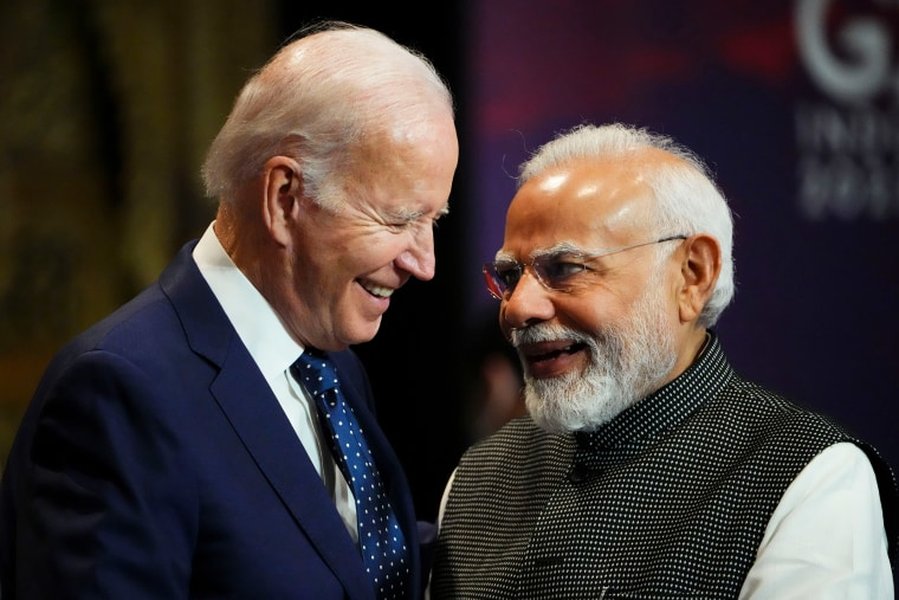
Prime Minister Narendra Modi meeting with US President Joe Biden, highlighting international diplomatic engagements.
Key Policies and Initiatives Under PM Modi
Prime Minister Modi's government has launched numerous initiatives aimed at transforming India's economy, infrastructure, social landscape, and global standing. Some prominent examples include:
Economic Reforms and Development
- Goods and Services Tax (GST): A major indirect tax reform aimed at unifying India into a single market.
- Make in India: An initiative to encourage domestic manufacturing, attract investment, and create jobs.
- Infrastructure Push: Significant investments in highways, railways, airports, and digital infrastructure.
Social Welfare and Governance
- Swachh Bharat Abhiyan (Clean India Mission): A nationwide campaign to improve sanitation and cleanliness.
- Swamitva Scheme: Uses drone technology to survey village lands and provide property cards to rural homeowners, aiming to reduce property disputes and enable access to credit. By early 2025, over 2 crore property cards were reportedly distributed.
- Digital India: Focused on improving online infrastructure and increasing internet connectivity to empower citizens digitally.
- Poverty Alleviation: Government reports highlighted lifting 25 crore (250 million) people out of multidimensional poverty over the preceding decade.
Health and Innovation
- TB Elimination Goal: Setting an ambitious target to eliminate Tuberculosis (TB) in India by 2025, ahead of the global goal.
- Youth Empowerment and Innovation: Emphasis on encouraging young Indians towards experimentation, excellence, and expansion, fostering a culture of innovation ("Create in India, Create for the World").
Government Focus Areas Assessment
The radar chart below provides a visual representation of the perceived emphasis placed by Prime Minister Modi's government across various key sectors since 2014. These are qualitative assessments based on policy announcements, government spending patterns, and public discourse, not precise quantitative measures. The scale represents the relative focus level, with higher numbers indicating greater emphasis.
This chart suggests a strong emphasis on areas like Infrastructure Development, National Security, Economic Reforms, Foreign Policy, and the Digital India initiative, with significant focus also on Social Welfare. Environmental focus, while present, appears relatively less emphasized compared to other key areas based on this qualitative assessment.
Visualizing the Prime Minister's Role and Reach
The mindmap below illustrates the central position of the Prime Minister within the Indian government structure, branching out to key responsibilities, significant initiatives, and the scope of their influence both domestically and internationally.
(Narendra Modi)"] id1["Head of Government"] id1a["Leads Council of Ministers"] id1b["Oversees Cabinet Secretariat"] id1c["Appoints Ministers (advise President)"] id2["Key Portfolios Held"] id2a["Personnel, Public Grievances & Pensions"] id2b["Department of Atomic Energy"] id2c["Department of Space"] id2d["Important Policy Issues"] id3["Major Initiatives (Examples)"] id3a["Make in India"] id3b["Swachh Bharat Abhiyan"] id3c["Digital India"] id3d["GST Implementation"] id3e["Swamitva Scheme"] id3f["Infrastructure Development"] id4["Constitutional Role"] id4a["Appointed by President"] id4b["Requires Lok Sabha Majority"] id4c["Link between President & Cabinet"] id5["Political Standing"] id5a["Leader of BJP"] id5b["14th PM of India"] id5c["Third Consecutive Term (since June 2024)"] id5d["Longest Serving Non-Congress PM"] id6["International Relations"] id6a["Represents India Globally"] id6b["Key Diplomatic Engagements"] id6c["Foreign Policy Direction"]
This mindmap highlights the multifaceted nature of the Prime Minister's role, encompassing leadership of the executive branch, direct oversight of critical departments, driving major national programs, fulfilling constitutional duties, maintaining political leadership, and shaping India's engagement with the world.
Key Facts Summary
The following table provides a quick summary of essential information regarding the current Prime Minister of India:
| Aspect | Details |
|---|---|
| Current Prime Minister | Narendra Damodardas Modi |
| Political Party | Bharatiya Janata Party (BJP) |
| Assumed Office (First Term) | May 26, 2014 |
| Current Term Start | June 9, 2024 (Third Term) |
| Position | 14th Prime Minister of India |
| Previous Major Role | Chief Minister of Gujarat (2001-2014) |
| Key Portfolios Held | Ministry of Personnel, Public Grievances & Pensions; Department of Atomic Energy; Department of Space |
Recent Engagements and Activities
Prime Minister Modi maintains an active schedule, engaging in various domestic and international activities. Recent examples from 2025 include:
- Addressing the World Audio Visual and Entertainment Summit (WAVES) in Mumbai (May 1, 2025), emphasizing India as a hub for global content creation.
- Holding diplomatic discussions, such as a call with the UK Prime Minister (April 25, 2025) concerning bilateral relations and counter-terrorism efforts.
- Undertaking domestic visits to states like Maharashtra, Kerala, Andhra Pradesh, Bihar, and Haryana in early 2025 for public addresses and policy implementation reviews.
- Speaking at events like the Republic Plenary Summit 2025, highlighting national achievements and future goals.
A Look at Recent Political Developments
The video below discusses Narendra Modi securing his third term as Prime Minister following the 2024 general elections, providing context on this significant political event.
This reelection solidified his position as a dominant figure in Indian politics, making him only the second Prime Minister in India's history to win three consecutive terms.
Frequently Asked Questions (FAQs)
Who is the current Prime Minister of India in 2025?
The current Prime Minister of India is Narendra Modi. He has been in office since May 26, 2014.
How many terms has Narendra Modi served as Prime Minister?
Narendra Modi is currently serving his third consecutive term as Prime Minister. His third term began on June 9, 2024.
What are the main responsibilities of the Prime Minister of India?
The Prime Minister is the head of the government. Key responsibilities include leading the Council of Ministers, overseeing government ministries and departments, making key policy decisions, representing India internationally, and advising the President.
Who was the first Prime Minister of India?
The first Prime Minister of India was Jawaharlal Nehru. He served from India's independence in 1947 until his death in 1964 and remains the longest-serving Prime Minister.
Has India ever had a female Prime Minister?
Yes, Indira Gandhi was the first and, to date, the only female Prime Minister of India. She served two terms in office.
Recommended Further Exploration
- What are the major policies implemented during Narendra Modi's tenure as Prime Minister?
- Can you provide a historical list and details of all Prime Ministers of India since independence?
- What are the specific constitutional powers and functions of the Prime Minister of India?
- What were the key outcomes of the 2024 Indian general election?
References
Last updated May 5, 2025