
The Hidden Culprit? Why Weak Glutes Might Be Causing Your Dancer's Hip Pain
An experienced PT and dancer explores the link between glute strength and anterior hip pinching during grand battements.
As a physical therapist and a ballet dancer with two decades of experience, I frequently encounter dancers grappling with hip pain. Your description of a dancer experiencing a "pinching" sensation at the front of her hip during repeated grand battement devants—especially given her strong quadriceps and hip flexors but weak glutes—raises immediate flags. The short answer is yes, weak glute strength can absolutely play a significant role in this type of pain.
Let's delve into the biomechanics and common issues dancers face to understand this connection more deeply.
Highlights: Key Connections
- Muscle Imbalance is Key: Over-reliance on strong hip flexors/quads due to weak glutes can lead to overuse, strain, and anterior hip pain.
- Glutes = Stability: The gluteal muscles (maximus and medius) are crucial for pelvic stability and proper hip mechanics during dynamic movements like grand battement. Weakness compromises this stability.
- Painful Compensations: Weak glutes often force compensatory movement patterns, increasing stress on structures at the front of the hip, potentially leading to conditions like hip flexor tendonitis or snapping hip syndrome.
The Grand Battement Dilemma: A High-Demand Movement
The grand battement devant (a large kick to the front) requires significant strength, control, and flexibility. The primary movers are the hip flexors (like the iliopsoas and rectus femoris, part of the quadriceps) which lift the leg. However, executing this movement correctly and safely relies on a coordinated effort from multiple muscle groups:
- Hip Flexors & Quads: Initiate and drive the upward movement of the leg.
- Gluteal Muscles: Stabilize the pelvis, control hip rotation (turnout), and assist in decelerating the leg's return.
- Core Muscles: Maintain trunk stability and prevent compensatory movements like overarching the back.
- Hamstrings: Control the extent of the leg lift and assist in stabilization.
When a dancer repeatedly performs this demanding movement with an underlying muscle imbalance—specifically, strong, active hip flexors/quads and weak glutes—the stage is set for potential problems at the front of the hip.
Unpacking the Connection: Why Glute Strength Matters
The relationship between weak glutes and anterior hip pain in dancers performing grand battements is multifaceted, primarily revolving around muscle imbalances, stability issues, and compensatory movement patterns.
The Muscle Imbalance Trap
Overworked Hip Flexors
Ballet training naturally strengthens hip flexors and quads. However, if the glutes aren't proportionally strong, the hip flexors have to work excessively hard not only to lift the leg but also to contribute to stabilization roles they aren't primarily designed for. This chronic overuse can lead to strain, inflammation (tendonitis), and irritation of the hip flexor tendons or the iliopsoas muscle itself, manifesting as pain or pinching at the front of the hip where these structures are located.
The Stability Factor
Pelvic and Hip Joint Control
The gluteus maximus is a powerful hip extensor, but it also plays a role in external rotation and stabilization. More critically for pelvic stability during single-leg movements like grand battement, the gluteus medius (located on the side of the hip) is essential. It prevents the pelvis from dropping on the non-weight-bearing side and helps maintain proper hip alignment.
Weak glutes, particularly the gluteus medius, lead to poor pelvic control and hip instability. This instability can cause:
- Altered Biomechanics: The femur (thigh bone) might not move optimally within the acetabulum (hip socket), potentially leading to irritation or impingement.
- Increased Joint Stress: Instability forces other structures, including the joint capsule, labrum, and ligaments around the anterior hip, to endure excessive stress. This can contribute to the pinching sensation your patient describes.
- Alignment Issues Down the Chain: Poor hip stability can affect knee and ankle alignment, disrupting the entire kinetic chain and potentially contributing to other injuries.
Compensatory Movement Patterns
Finding Stability Elsewhere
When the primary stabilizers (glutes) are weak, the body instinctively seeks stability elsewhere. Dancers might compensate by:
- Developing an Anterior Pelvic Tilt: Tilting the pelvis forward can further shorten and tighten already overworked hip flexors, increasing anterior hip stress.
- Using Spinal Muscles: Engaging lower back muscles (like the quadratus lumborum) to help lift the leg or stabilize the pelvis, which is inefficient and can lead to back pain.
- Altering Turnout Mechanics: Trying to force turnout from the knee or foot instead of controlling it from the hip, often due to weak external rotators (which include parts of the glutes).
Potential Conditions Linked to Glute Weakness in Dancers
The pinching pain described by your patient, in the context of weak glutes and repetitive grand battements, could be indicative of several conditions:
Hip Flexor Issues (Strain, Tendonitis, Iliopsoas Syndrome)
As discussed, overuse due to glute weakness can inflame the hip flexor tendons (tendonitis) or the iliopsoas muscle/tendon complex (iliopsoas syndrome). This often presents as pain deep in the front of the hip or groin, sometimes with clicking, exacerbated by hip flexion activities like grand battement.
Snapping Hip Syndrome (Dancer's Hip)
This condition involves a snapping or clicking sensation (which can sometimes be painful) as a muscle or tendon moves over a bony structure in the hip.
- Internal Snapping Hip: Often involves the iliopsoas tendon snapping over the front of the hip joint. Glute weakness and resulting hip flexor tightness/overuse can contribute.
- External Snapping Hip: Involves the iliotibial (IT) band or gluteus maximus tendon snapping over the greater trochanter (bony prominence on the side of the hip). While typically felt laterally, imbalances stemming from glute weakness can contribute to IT band tightness and altered mechanics that manifest pain anteriorly or relate to anterior issues.
Hip Impingement (Femoroacetabular Impingement - FAI) and Labral Issues
While often related to bony morphology, functional factors like muscle imbalance and instability from weak glutes can exacerbate FAI symptoms. Poor hip control allows the femoral head (ball) to move abnormally within the acetabulum (socket), potentially pinching the labrum (cartilage rim) or other soft tissues, especially during deep flexion like in a grand battement. This can cause a sharp, pinching pain in the front of the hip.
Visualizing the Imbalance: Muscle Roles in Ballet Movements
This chart illustrates the relative importance of different muscle groups for various aspects of demanding ballet movements like grand battement. It highlights how a "Weak Glutes Scenario" creates an imbalance, potentially leading to over-reliance on hip flexors and compromising stability and control.
Mapping the Connections: From Weak Glutes to Hip Pain
This mindmap provides a visual overview of how weak glutes can cascade into various issues culminating in anterior hip pain for a dancer performing grand battement devants.
Anatomy in Focus: Key Muscles Involved
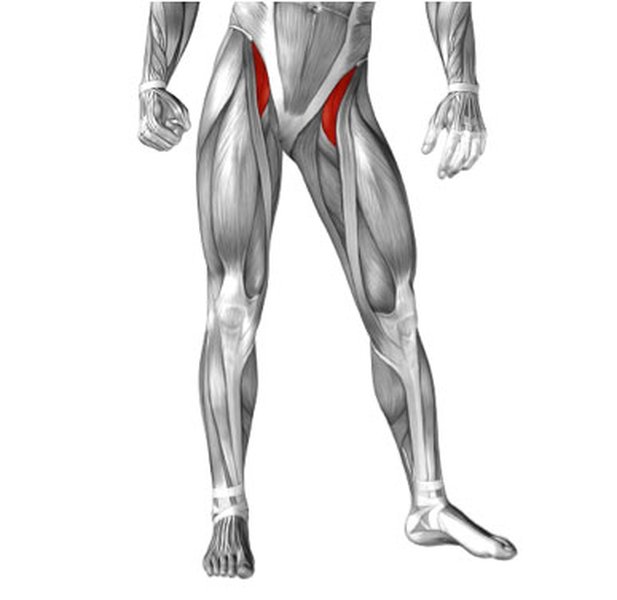
Understanding the location and function of the key muscles involved helps clarify the potential sources of pain and the importance of balance. The images below illustrate the hip flexors located at the front of the hip and the powerful gluteal muscles at the back and side, highlighting the opposing forces that need to be balanced for optimal function during movements like grand battement.

Common sites of hip pain often relate to the underlying musculature.

Anterior (front) view showing hip flexors like iliopsoas and rectus femoris.
Posterior (back) and lateral (side) views showing the gluteus maximus and medius, crucial for stability and power.
Understanding Common Hip Issues in Dancers
Hip injuries are unfortunately common in dancers due to the extreme ranges of motion, repetitive movements, and strength demands placed on the joint. This video discusses some of these common injuries and touches upon prevention strategies, which often involve addressing muscular imbalances like glute weakness.
Video discussing common hip injuries and prevention for dancers.
Muscle Roles in Grand Battement Devant & Effects of Glute Weakness
This table summarizes the key muscles involved in a grand battement devant, their roles, how weak glutes can negatively impact their function or lead to compensation, and where pain might arise as a result.
| Muscle Group | Primary Role in Grand Battement Devant | Impact of Glute Weakness | Potential Pain Location |
|---|---|---|---|
| Hip Flexors (Iliopsoas, Rectus Femoris, Sartorius) | Lifting the leg (hip flexion) | Become overworked and strained due to lack of gluteal support/stability; may compensate for weak rotation control. | Anterior hip (front), groin |
| Quadriceps (excluding Rectus Femoris) | Knee extension (keeping leg straight) | May become overly dominant if glutes aren't contributing sufficiently to overall leg control and power. | Anterior thigh (less commonly direct hip pain, but contributes to imbalance) |
| Gluteus Maximus | Hip extension (controls return), external rotation, pelvic stabilization | Reduced power for opposing movements, poor pelvic stabilization during lift, less control over turnout/rotation. | Posterior hip (less common for *anterior* pain, but weakness is the root cause) |
| Gluteus Medius/Minimus | Hip abduction, internal/external rotation (depending on fiber), CRUCIAL for pelvic stability on standing leg | Significant pelvic instability (hip drop), altered hip joint mechanics, increased stress on anterior structures. | Lateral hip (side), but instability contributes significantly to anterior impingement/strain |
| Hamstrings | Hip extension (controls return), knee flexion, stabilization | May become tight/overworked trying to assist weak glutes in stabilization or controlling leg descent. | Posterior thigh, potentially radiating near hip |
| Core Stabilizers (Transverse Abdominis, Obliques, etc.) | Trunk stability, preventing compensatory back/pelvic motion | May be unable to compensate adequately for poor pelvic stability originating from weak glutes, leading to inefficient movement. | Lower back, potentially groin if compensatory patterns stress abdominal attachments |
Addressing the Pain: A Physical Therapist's Perspective
As a physical therapist, addressing this dancer's pain would involve a comprehensive approach focusing on identifying and correcting the underlying imbalances. While I cannot provide specific medical advice here, the general strategy would include:
Comprehensive Assessment
A thorough evaluation is crucial. This involves:
- Detailed history of the pain (onset, nature, aggravating factors).
- Postural assessment.
- Range of motion testing for the hip, spine, and lower limbs.
- Manual muscle testing to quantify glute weakness and assess hip flexor/quad strength.
- Special tests to screen for specific conditions like FAI, labral tears, or snapping hip.
- Functional movement analysis, observing the grand battement technique itself to identify specific biomechanical faults.
Targeted Strengthening
The cornerstone of treatment would be a progressive glute strengthening program. This needs to focus on both the gluteus maximus and, critically, the gluteus medius. Exercises would likely start with basic activation (e.g., clamshells, bridges) and progress to more functional, weight-bearing exercises that mimic dance demands (e.g., single-leg deadlifts, controlled lunges, resisted band walks, specific turnout exercises focusing on deep rotator activation).
Flexibility and Mobility
Addressing tightness in the opposing muscles is vital. Stretching the hip flexors, quads, and potentially the IT band would be important. Techniques like PNF stretching or foam rolling might be incorporated. Ensuring adequate hip joint mobility is also key.
Movement Re-education
Simply strengthening the glutes isn't enough; the dancer needs to learn how to *use* them correctly during movement. This involves neuromuscular re-education to integrate glute activation into functional patterns like the grand battement. Cues might focus on pelvic alignment, core engagement, and initiating movement from the correct muscles.
Holistic View
Considering other factors is essential:
- Core Strength: A strong core provides a stable base for limb movement.
- Overall Alignment: Addressing any alignment issues throughout the kinetic chain.
- Training Load Management: Temporarily modifying the frequency or intensity of grand battements might be necessary while strength and control improve.
- Technique Refinement: Working with the dancer (and potentially their teacher) to refine technique for efficiency and safety.
By addressing the root cause—the glute weakness and resulting imbalance—it's often possible to alleviate the anterior hip pain and improve the dancer's performance and longevity.
Frequently Asked Questions
What exactly is a grand battement devant?
A grand battement devant is a classical ballet step where the dancer throws one leg straight up in front of the body as high as possible, keeping both legs straight, and then controls its return to the starting position. It requires significant hip flexor strength, hamstring flexibility, core control, and pelvic stability provided by the glutes of the standing leg.
Why are dancers prone to hip flexor dominance?
Many ballet movements emphasize lifting the leg forward (devant) and side (à la seconde), which heavily utilizes the hip flexors. Additionally, improper technique, lack of focus on posterior chain (glutes/hamstrings) strengthening, and attempts to force turnout can lead to the hip flexors becoming overactive and dominant compared to the stabilizing gluteal muscles.
Can weak glutes cause pain elsewhere besides the hip?
Yes, absolutely. Because the glutes play a critical role in stabilizing the pelvis and controlling leg movement, weakness can contribute to issues down the kinetic chain, such as knee pain (e.g., patellofemoral pain syndrome, IT band syndrome affecting the knee), shin splints, ankle instability, and even foot problems. It can also contribute to lower back pain due to compensatory movements and pelvic instability.
What's the difference between hip flexor strain and hip impingement?
A hip flexor strain is an injury to the muscle fibers or tendons of the hip flexor muscles (like the iliopsoas), usually caused by overuse or a sudden forceful contraction. Pain is typically muscular. Hip impingement (FAI) is a condition where there is abnormal contact between the femoral head (ball) and the acetabulum (socket) during movement, often due to the shape of the bones but exacerbated by functional factors. This contact can pinch soft tissues like the labrum or joint capsule, causing sharp pain, often deep within the joint, especially in deep flexion or rotation. While distinct, muscle imbalances like weak glutes can contribute to both conditions.
Are there specific exercises to strengthen glutes for dancers?
Yes, exercises should focus on activating and strengthening the gluteus maximus and medius, often incorporating elements relevant to dance like turnout control and single-leg stability. Examples include: variations of bridges (single-leg, banded), clamshells (with focus on form), side-lying hip abduction, standing fire hydrants (with resistance bands), single-leg Romanian deadlifts, controlled lunges, and band walks (side-stepping, monster walks). The key is proper form and integration into dance-specific movements under guidance.
References
- Keeping Up with the Count: Hip Health in Dancers - Scottish Rite for Children
- Snapping Hip Syndrome (Dancers Hip) explained by a Specialist - Flawless Physio
-
Part 3 | Irish Dance Injuries - the hips - Target Training Dance
- Anterior Hip Pain/Snapping Hip Syndrome in Dancers - Zion Physical Therapy
-
Iliopsoas Syndrome in Dancers - PMC (NCBI)
- Why do DANCERS get HIP PAIN? - Made to Move
- Are your hip flexors sore after grand battement? - The Body Series
Recommended
Last updated April 12, 2025