
The Dancing Links Algorithm: An In-Depth Explanation
Mastering exact cover problems with elegant backtracking techniques
Key Takeaways
- Efficient Backtracking: Doubly-linked circular lists enable quick insertion and deletion during the search process.
- Sparse Matrix Representation: Only the essential elements (1s) are stored, optimizing memory and performance.
- Versatile Applications: Ideal for solving a range of exact cover problems, from Sudoku to N-Queens.
Introduction
The Dancing Links (DLX) algorithm, introduced by Donald Knuth in his seminal paper, represents a sophisticated method for solving the Exact Cover Problem. This algorithm is renowned for its efficiency and elegance, particularly in applications like Sudoku solving, polyomino tiling, and various constraint satisfaction problems. By leveraging a combination of sparse matrix representations and doubly-linked circular lists, DLX optimizes the backtracking process, making it significantly faster than traditional approaches.
Understanding the Exact Cover Problem
Definition and Importance
The Exact Cover Problem is a fundamental combinatorial problem defined as follows: given a binary matrix (comprising only 0s and 1s), the objective is to select a subset of rows such that each column contains exactly one 1 from the selected rows. This ensures that every column is "covered" exactly once, with no overlaps or omissions. The problem is NP-complete, implying that no known polynomial-time algorithms can solve all instances efficiently. However, practical solutions like DLX make progress feasible for many real-world applications.
Applications
Exact Cover has a wide array of applications in computer science and mathematics, including:
- Sudoku Solving: Representing Sudoku constraints as an exact cover problem.
- Pentomino Tiling: Arranging pentominoes without overlaps to fill a given area.
- Polyomino Packing: Similar to pentomino tiling but with polyominoes of various sizes.
- N-Queens Problem: Placing N queens on an N×N chessboard such that no two queens threaten each other.
- Scheduling Problems: Allocating resources or time slots without conflicts.
Algorithm X: The Foundation
Overview
Donald Knuth's Algorithm X serves as a general-purpose backtracking algorithm designed to solve the Exact Cover Problem. It operates by recursively selecting and removing rows and columns from the binary matrix, effectively narrowing down the search space until a valid exact cover is found or all possibilities are exhausted. While inherently flexible, Algorithm X can be inefficient due to its brute-force nature, especially for large or complex matrices. This is where Dancing Links (DLX) enhances the performance by optimizing the underlying data structures and operations.
Dancing Links: Optimizing Algorithm X
Core Concepts
Dancing Links (DLX) is an optimized implementation of Algorithm X that uses a specialized data structure to represent the binary matrix. The primary innovation lies in the use of doubly-linked circular lists, which allow for efficient insertion and deletion of nodes representing the 1s in the matrix. This structure not only reduces memory usage by storing only the essential elements but also accelerates the backtracking process by minimizing the overhead associated with modifying the matrix during the search.
Data Structures in DLX
Doubly-Linked Circular Lists
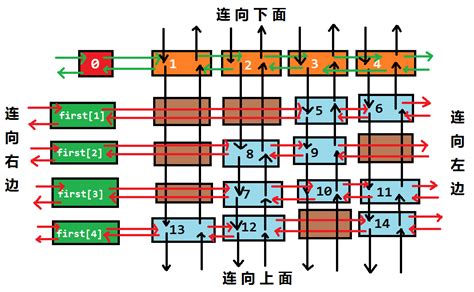
At the heart of DLX is the doubly-linked circular list. Each 1 in the binary matrix is represented as a node containing four pointers: left, right, up, and down. These pointers link the nodes horizontally and vertically, forming a grid-like structure that wraps around in a toroidal (doughnut-shaped) fashion. This circularity ensures that traversal can continue seamlessly without encountering null references, thereby enhancing the algorithm's robustness and efficiency.
Header Nodes
Each column in the binary matrix is associated with a special header node. These header nodes are also part of the circular linked lists and serve multiple purposes:
- Constraint Representation: Each header corresponds to a specific constraint that needs to be satisfied in the exact cover problem.
- Node Count Tracking: Headers maintain a count of the number of 1s present in their respective columns, facilitating heuristic optimizations.
- Traversal Entry Points: They act as entry points for traversing columns and their associated rows efficiently.
Core Operations
Cover Operation
The cover operation is a fundamental action in DLX that removes a column (constraint) and all rows that contain a 1 in that column from the data structure. This effectively eliminates conflicting possibilities, narrowing down the search space. The steps involved are:
- Remove the header node of the chosen column from the list of active columns by adjusting the
leftandrightpointers of its neighbors. - Iterate through each node in the column and, for each node, traverse its row to remove it from all other columns it belongs to.
This operation is performed in constant time, thanks to the doubly-linked structure, allowing for rapid modifications during the recursive search.
Uncover Operation
The uncover operation is the reverse of the cover operation. It restores a previously removed column and all associated rows back into the data structure. The steps are:
- Reinsert the header node into the list of active columns by readjusting the
leftandrightpointers of its neighbors. - Traverse each row in the column in reverse order, reinserting each node back into their respective columns.
This reversible nature of cover and uncover operations is what enables DLX to efficiently backtrack and explore different branches of the solution space without loss of data integrity.
Detailed Steps of DLX
Initialization
Before the algorithm can begin, the binary matrix must be transformed into the DLX data structure:
- Matrix Representation: Each row of the binary matrix is converted into a row of nodes linked horizontally, representing the 1s.
- Column Linking: Each node is also linked vertically within its column, maintaining the structure of the circular doubly-linked lists.
- Header Nodes Setup: Header nodes are initialized for each column, keeping track of the number of 1s and serving as anchors for column traversal.
Recursive Search
The core of DLX lies in its recursive search mechanism, which follows these steps:
- Select Column: Choose the column with the fewest 1s (using the Minimum Remaining Values heuristic) to minimize the branching factor.
- Cover Column: Execute the cover operation on the selected column to eliminate conflicting rows.
- Select Row: For each row that contains a 1 in the chosen column, attempt to include it in the solution.
- Cover Columns in Row: For every other column that the selected row covers, perform the cover operation to maintain the exact cover constraints.
- Recurse: Continue the search recursively with the updated matrix.
- Backtrack: If a dead end is reached, perform the uncover operations in reverse order to backtrack and explore alternative rows.
- Terminate: The algorithm concludes when all columns are covered (a valid exact cover is found) or when no solution exists.
Example: Solving Sudoku with DLX
Reduction to Exact Cover
Sudoku is a classic example of an exact cover problem. To apply DLX to Sudoku, the puzzle must be transformed into a binary matrix where each possible number placement corresponds to a row, and each constraint corresponds to a column. The constraints include:
-
Row Constraint: Each number must appear exactly once in each row.
-
Column Constraint: Each number must appear exactly once in each column.
-
Box Constraint: Each number must appear exactly once in each 3x3 subgrid.
-
Cell Constraint: Each cell must contain exactly one number.
Each row in the binary matrix represents a possible assignment of a number to a specific cell, with 1s indicating which constraints are satisfied by that assignment.
Applying Dancing Links
Once the binary matrix is established, DLX is employed to find a subset of rows that covers all columns exactly once, effectively solving the Sudoku puzzle. The algorithm navigates through possible number placements, using the cover and uncover operations to enforce constraints and backtrack when necessary.
Illustrative Example
Consider a partially filled Sudoku grid. Each filled cell reduces the problem space by eliminating certain rows (number placements) from the binary matrix. DLX systematically covers these constraints, narrowing down the possibilities until the complete solution is derived.
| Sudoku Cell | Possible Numbers | Constraints Covered |
|---|---|---|
| (1,1) | 1, 2, 3 | Row 1, Column 1, Box 1, Cell (1,1) |
| (1,2) | 2, 4 | Row 1, Column 2, Box 1, Cell (1,2) |
| (1,3) | 1, 3, 5 | Row 1, Column 3, Box 1, Cell (1,3) |
Advantages of Dancing Links
Efficiency
Dancing Links offers superior performance compared to naive implementations of Algorithm X. The use of circular doubly-linked lists ensures that both covering and uncovering operations are performed in constant time, significantly speeding up the backtracking process.
Memory Optimization
By employing a sparse matrix representation, DLX only stores the essential 1s, reducing memory consumption. This is particularly beneficial for large-scale problems with vast matrices, as it minimizes the overhead associated with unnecessary 0s.
Reversibility
The reversible nature of the cover and uncover operations allows DLX to efficiently backtrack without data loss or corruption. This makes the algorithm robust and reliable, ensuring that all potential solution paths are accurately explored.
Versatility
Dancing Links is not limited to a single type of problem. Its adaptable structure makes it suitable for a wide range of exact cover applications, from puzzle solving to scheduling and beyond.
Complexity Analysis
Time Complexity
The time complexity of DLX is influenced by the size of the problem and the branching factor at each step. While the worst-case complexity remains exponential due to the nature of exact cover problems, DLX significantly outperforms naive methods through efficient pruning and heuristic optimizations, such as selecting the column with the fewest 1s.
Space Complexity
DLX exhibits linear space complexity relative to the number of 1s in the binary matrix. The sparse representation ensures that memory usage is kept to a minimum, making it feasible to handle large and complex problems without excessive resource consumption.
Implementing DLX
Pseudocode
Initialize DLX structure with the binary matrix
Start recursive search process
    If all columns are covered, return the solution
    Select the column with the fewest 1s
    Cover the selected column
    For each row in the selected column:
        Add the row to the solution
        For each column in the row:
            Cover the column
        Recurse
        If solution found, return
        For each column in the row:
            Uncover the column
        Remove the row from the solution
    Uncover the selected column
End
Code Example
class DLXNode:
    def __init__(self):
        self.left = self
        self.right = self
        self.up = self
        self.down = self
        self.column = None

class DLX:
    def __init__(self, matrix):
        # Initialize header and construct the DLX structure
        pass

    def cover(self, column):
        # Implement cover operation
        pass

    def uncover(self, column):
        # Implement uncover operation
        pass

    def search(self, k, solution):
        if header.right == header:
            print("Solution found:", solution)
            return
        column = self.select_column()
        self.cover(column)
        for row in column.iterate_rows():
            solution.append(row)
            for node in row.iterate_columns():
                self.cover(node.column)
            self.search(k+1, solution)
            for node in row.iterate_columns():
                self.uncover(node.column)
            solution.pop()
        self.uncover(column)

    def select_column(self):
        # Heuristic for selecting next column
        pass
Conclusion
The Dancing Links algorithm stands as a testament to the power of clever data structures in solving complex computational problems. By optimizing the backtracking process through the use of doubly-linked circular lists and sparse matrix representations, DLX offers an efficient and versatile solution to the Exact Cover Problem. Its adaptability across various applications, from puzzle solving to scheduling, underscores its significance in the realm of algorithms. Mastery of DLX not only provides practical benefits but also deepens one's understanding of algorithmic optimization and combinatorial problem-solving.
References
Last updated January 19, 2025