
Understanding Dark Matter
Exploring the unseen forces that shape our universe
Key Highlights
- Invisible yet Influential: Dark matter is undetectable via light, observable only through gravitational effects.
- Cosmic Scaffold: It provides the gravitational framework crucial for the formation and evolution of galaxies.
- Mysterious Constituents: Its exact composition remains unknown, with leading hypotheses including WIMPs, axions, and other exotic particles.
What Is Dark Matter?
Dark matter is a theoretical form of matter that does not interact with electromagnetic radiation, meaning it neither emits, absorbs, nor reflects light. Because of its non-luminous nature, direct detection is extremely challenging. Instead, its existence is inferred from gravitational effects on visible matter, influencing the rotation of galaxies and the dynamics within galaxy clusters. Despite making up a significant portion of the universe's mass, dark matter remains elusive, propelling many scientific investigations and experiments aimed at understanding its properties.
Historical Perspectives and Discovery
The concept of dark matter first emerged in the early 20th century. In the 1930s, Swiss-American astronomer Fritz Zwicky noticed discrepancies in the observed velocities of galaxies in the Coma Cluster – the visible mass was insufficient to account for the gravitational forces acting upon them. Later, in the 1970s, astronomer Vera Rubin’s work on galactic rotation curves provided further evidence that galaxies were embedded in vast halos of unseen matter. These pivotal discoveries have since shaped our understanding of cosmic structure and underscored the significance of dark matter in maintaining the stability of galaxies.
Scientific Evidence for Dark Matter
The scientific community accepts dark matter’s existence based on several lines of evidence:
Galactic Rotation Curves
Galaxies rotate in such a manner that, without an additional unseen mass, the outer stars should fly away given their velocity. However, the observed flat rotation curves – where stars far from the galactic center move at comparable speeds to those closer in – suggest an additional gravitational influence from dark matter.
Gravitational Lensing
Dark matter’s gravitational effects bend the light from distant galaxies, a phenomenon known as gravitational lensing. The lensing observed around galaxy clusters cannot be explained solely by the luminous matter present, indicating significant additional mass from dark matter.
Cosmic Microwave Background and Large Scale Structure
Observations of the cosmic microwave background (CMB) provide insights into the early universe. The distribution of fluctuations in the CMB, when interpreted through cosmological models, supports the presence of dark matter. Furthermore, the manner in which large-scale cosmic structures have formed and evolved over billions of years aligns with models incorporating dark matter.
Role and Significance in the Cosmos
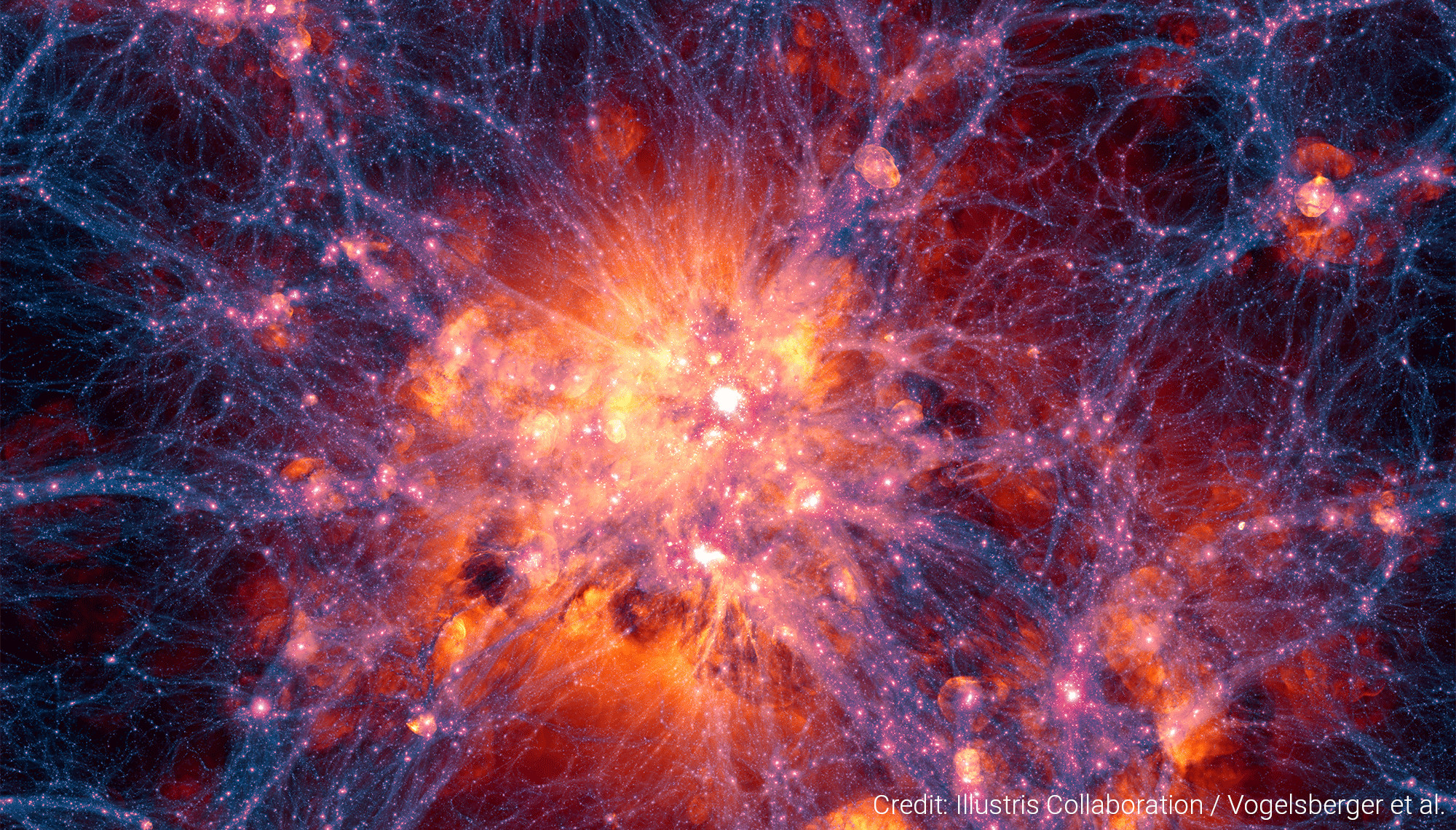
Dark matter is not merely an abstract concept; it plays a pivotal role in the structuring of the universe. The gravitational "scaffolding" provided by dark matter is indispensable for the formation of galaxies and clusters. The interplay between dark matter and ordinary matter gives rise to the cosmic web – a vast network of filaments and voids that defines the large-scale structure of the universe.
Galactic Formation and Evolution
In the early universe, slight density fluctuations in dark matter coalesced due to gravity, forming clumps around which ordinary matter could accumulate. This process eventually led to the birth of stars and galaxies. Without dark matter, the gravitational pull necessary to create these early structures would have been insufficient, dramatically altering the evolution of the universe.
Universe’s Mass-Energy Composition
Dark matter accounts for approximately 26.8% (in many contemporary models) of the total mass-energy content of the universe. In comparison, ordinary matter makes up around 5%. The remaining portion is attributed to dark energy, a mysterious force driving the accelerated expansion of the universe. This distribution implies that dark matter is a critical component in the cosmic balance, influencing both gravitational behaviors and the overall dynamics of the cosmos.
Theoretical Candidates and Composition
Despite comprehensive observations of its gravitational effects, the exact nature of dark matter remains unknown. Scientists have proposed several theoretical candidates that might constitute dark matter, each with varying characteristics and implications for our understanding of the universe.
Weakly Interacting Massive Particles (WIMPs)
One leading hypothesis is that dark matter consists of Weakly Interacting Massive Particles (WIMPs). These hypothetical particles interact only via the weak nuclear force and gravity, making them extremely challenging to detect. Many experiments, including those based underground and in space, are designed to detect these elusive particles, although conclusive evidence remains forthcoming.
Axions
Axions are another promising candidate. They are ultra-light particles that were originally proposed to resolve certain issues in quantum chromodynamics (QCD). Their interactions with ordinary matter are minimal, and despite numerous detection attempts, their elusive nature still spurs further technological developments in instrumentation.
Other Exotic Possibilities
Some scientists have also entertained the idea of dark matter being composed of entirely different entities such as sterile neutrinos or even primordial black holes from the early universe. While these candidates may explain specific observations, the majority of data currently favors particle-based hypotheses like WIMPs or axions.
Table: Comparison of Dark Matter Candidates
| Candidate | Mass Range | Interaction Mechanism | Detection Challenge |
|---|---|---|---|
| WIMPs | GeV to TeV scale | Weak nuclear force, gravity | Low interaction cross-section |
| Axions | µeV to meV scale | Minimal electromagnetic interaction, gravity | Very light; require sensitive detectors |
| Sterile Neutrinos | keV to GeV scale | Gravity, possibly some weak interactions | Difficult due to extremely feeble interactions |
Detection Techniques and Experiments
Since dark matter does not emit light and interacts very weakly with conventional matter, researchers have developed several indirect and direct detection methods to uncover its nature. The overarching goal is to detect any rare interactions between dark matter particles and ordinary matter.
Direct Detection
Direct detection experiments are designed to capture the elusive interactions between dark matter particles and atomic nuclei. These experiments are typically conducted deep underground in order to minimize interference from cosmic radiation. Sensitive detectors made from materials like xenon, germanium, or silicon are used to observe the rare collisions that may indicate the presence of dark matter particles.
Indirect Detection
Indirect detection involves searching for the by-products of dark matter self-annihilation or decay. Such processes can lead to the emission of standard particles, such as gamma rays or neutrinos, which can then be detected by astronomical observatories. This method has the potential to provide clues about the distribution and properties of dark matter in our galaxy and beyond.
Collider Experiments
Another promising avenue is collider-based investigations, where high-energy particle accelerators like the Large Hadron Collider (LHC) are employed to recreate the conditions of the early universe. In theory, these collisions could produce dark matter particles, which would be identified by missing energy and momentum in the studied events.
Implications for Cosmology
Dark matter is a cornerstone of modern cosmological models. Without its gravitational influence, the universe’s large-scale structure would not form in the observed manner. The balance between dark matter, dark energy, and ordinary matter shapes the evolution of the cosmos.
Matter Distribution in the Universe
Observing the cosmic microwave background (CMB) and the resulting matter distribution has led to robust cosmological models in which dark matter is integral. Its presence accounts for the formation of galaxy clusters, the cosmic web, and even the distribution of vast cosmic voids. Cosmic simulations incorporating dark matter give rise to structures that closely mirror those observed in deep-space surveys.
Enhancing Our Understanding of Gravity
Studying dark matter not only broadens our knowledge of cosmic composition but also tests our understanding of gravity. Discrepancies in gravitational observations have inspired some researchers to propose modifications to Einstein's theory of gravity. However, the majority of observational evidence remains consistent with models that incorporate dark matter as an additional gravitational component.
Current Research and Future Directions
The quest to understand dark matter is far from complete. Current research spans multiple disciplines including astrophysics, particle physics, and cosmology. New technologies and experiments continue to push the boundaries of detection, improving sensitivity and enhancing our ability to probe the deeper recesses of the universe.
Emerging Technologies
Advances in detector technology, such as cryogenic detectors and large-scale liquid noble gas experiments, are progressively increasing the possibility of directly observing dark matter particles. Furthermore, improvements in computational modeling allow for highly accurate simulations of dark matter's role in cosmic evolution.
Interdisciplinary Collaboration
The challenge of uncovering the secrets of dark matter fosters collaboration between research fields. Astrophysicists, particle physicists, and theoretical researchers work in tandem, sharing insights and methodologies. This interdisciplinary approach is critical to overcoming the limitations of current detection methods and to paving the way for a more comprehensive understanding of the nature of dark matter.
Resources and Further Reading
For those interested in exploring the topic of dark matter further, a number of reputable resources are available online. Researchers and enthusiasts alike can deepen their understanding by consulting scientific articles, astronomical data portals, and specialized literature.
Table: Key Resources on Dark Matter
| Source | Description | Link |
|---|---|---|
| Space.com | Explains dark matter concepts and significance | Space.com: What is Dark Matter? |
| Britannica | In-depth articles on dark matter discovery and theories | Britannica: Dark Matter |
| NASA Science | Overview of dark matter and its cosmic role | NASA Science: Dark Matter & Dark Energy |
| Wikipedia | Comprehensive background and current research | Wikipedia: Dark Matter |
| DOE Science | DOE perspectives and experimental insights | DOE: Explains Dark Matter |
Recommended Related Queries
 amazon.com.mx

Last updated March 7, 2025