
Understanding Data Encryption Techniques
A Comprehensive Guide to Protecting Your Data in 2025
Key Highlights of Encryption Techniques
- Encryption is the process of converting readable data (plaintext) into an unreadable format (ciphertext) to protect it from unauthorized access.
- There are primarily two types of encryption: symmetric, which uses a single key for both encryption and decryption, and asymmetric, which uses a pair of keys (public and private).
- Encryption is crucial for data security, protecting sensitive information during transmission and storage, and ensuring privacy in various digital interactions.
What is Encryption?
Encryption is a fundamental security method that scrambles data, rendering it unreadable to anyone without the correct decryption key. This process transforms readable plaintext into unreadable ciphertext, masking sensitive information from unauthorized users. Encryption is essential for protecting data during transmission and storage, ensuring that only authorized parties can access and understand the information. It plays a vital role in maintaining privacy, security, and data integrity across various digital platforms and applications.
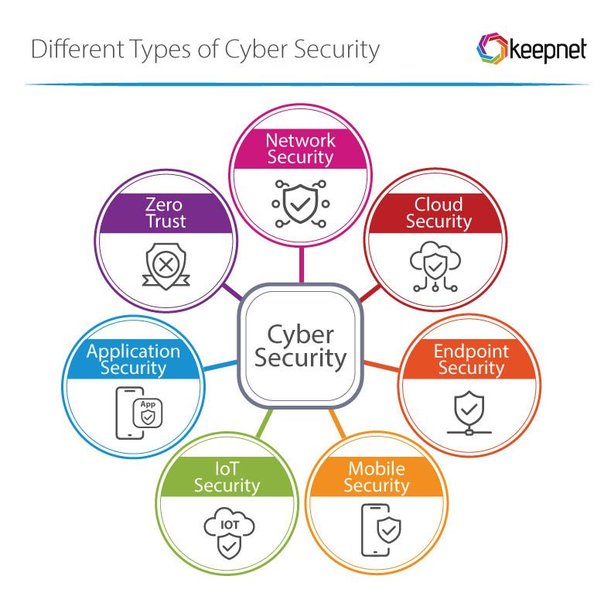
Visual guide to key cybersecurity threats.
Encryption techniques have a long history, dating back to ancient times when codes and ciphers were used to safeguard secrets. The Caesar cipher, one of the earliest known encryption methods, involved shifting characters in a message by a fixed number of positions. Today, encryption is a cornerstone of modern cybersecurity, protecting a wide range of sensitive data, from personal information and financial records to proprietary business data and government secrets.
Why is Encryption Important?
Encryption is a critical tool for businesses and individuals to protect data, establish customer trust, and maintain regulatory compliance. It ensures privacy, security, and data integrity, preventing unauthorized access, theft, tampering, and eavesdropping. In an era of increasingly frequent and sophisticated cyber threats, encryption is essential for safeguarding sensitive information and maintaining a secure digital environment.
Data Protection
Encryption protects sensitive data from being accessed by unauthorized personnel. If cybercriminals gain access to encrypted data, such as a database containing customer Social Security numbers, they cannot use or sell the data because they cannot interpret the information without the decryption key.
Establishing Trust
By implementing robust encryption measures, businesses can demonstrate their commitment to protecting customer data and maintaining privacy. This can help build trust and foster stronger relationships with customers.
Regulatory Compliance
Many regulations, such as GDPR, HIPAA, and PCI DSS, require organizations to implement data encryption to protect sensitive information. Compliance with these regulations is essential for avoiding penalties and maintaining legal and ethical standards.
Types of Encryption
Data encryption methods can be broadly grouped into two main categories: symmetric and asymmetric encryption. Each type has its own unique characteristics, advantages, and use cases. Understanding the differences between these methods is crucial for selecting the most appropriate encryption technique for a given situation.
Symmetric Encryption
Symmetric encryption, also known as secret key encryption, uses the same key for both encrypting and decrypting data. This means that the sender and receiver must share the same secret key via a secure channel before they can communicate securely. Symmetric encryption is generally faster and more efficient than asymmetric encryption, making it suitable for encrypting large volumes of data.
Symmetric Encryption process with a private key.
Common Symmetric Encryption Algorithms
- Advanced Encryption Standard (AES): AES is one of the most widely used symmetric encryption algorithms, known for its speed, efficiency, and strong security. It is the most readily employed form of symmetric encryption.
- Data Encryption Standard (DES): DES is an older symmetric encryption algorithm that uses a 56-bit key to encrypt data in 64-bit blocks. While it was once a standard, it is now considered less secure due to its short key length.
- Triple DES (3DES): 3DES is an advanced version of DES that encrypts data three times using a 56-bit key, making it a 168-bit key. While more secure than DES, it is slower compared to other encryption methods.
- Blowfish: Blowfish is a flexible encryption method that uses key lengths of up to 256 bits. It is known for its speed and efficiency.
- Twofish: Twofish employs key lengths of 128, 196, and 256 bits and has a complex key structure, making it difficult to decrypt. It is considered one of the quickest data encryption frameworks.
Advantages of Symmetric Encryption
- Speed and Efficiency: Symmetric encryption is generally faster than asymmetric encryption, making it suitable for encrypting large amounts of data.
- Simplicity: Symmetric encryption algorithms are relatively simple to implement and require fewer computational resources.
Disadvantages of Symmetric Encryption
- Key Distribution: The main challenge of symmetric encryption is the need to securely share the secret key between the sender and receiver. If the key is compromised, the security of the encrypted data is also compromised.
- Scalability: Symmetric encryption can be less ideal for situations involving many users or remote communications, as it requires secure key transmission for each pair of communicating parties.
Asymmetric Encryption
Asymmetric encryption, also known as public key encryption, uses two keys: a public key and a private key. The public key is used to encrypt the data, while the private key is used to decrypt it. The public key can be shared with anyone, while the private key must be kept secret by the owner. Asymmetric encryption provides a more secure framework due to its key distribution mechanism.
Common Asymmetric Encryption Algorithms
- Rivest-Shamir-Adleman (RSA): RSA is a widely used public-key encryption algorithm for secure data transmission. It is based on the mathematical properties of prime numbers and is considered highly secure.
- Elliptic Curve Cryptography (ECC): ECC is a modern public-key encryption algorithm that provides strong security with shorter key lengths compared to RSA. It is commonly used in mobile devices and other resource-constrained environments.
- Diffie-Hellman: Diffie-Hellman is a key exchange protocol that allows two parties to establish a shared secret key over an insecure channel. This key can then be used for symmetric encryption.
- Boneh-Franklin: The Boneh-Franklin scheme was the first practical identity-based encryption (IBE) scheme, based on bilinear maps between groups, such as the Weil pairing on elliptic curves.
Advantages of Asymmetric Encryption
- Secure Key Distribution: Asymmetric encryption eliminates the need to securely transmit the secret key, as the public key can be freely distributed.
- Scalability: Asymmetric encryption is well-suited for situations involving many users or remote communications, as each user has their own unique key pair.
Disadvantages of Asymmetric Encryption
-
Slower Speed: Asymmetric encryption is generally slower than symmetric encryption, making it less suitable for encrypting large amounts of data.
-
Computational Complexity: Asymmetric encryption algorithms are more complex and require more computational resources compared to symmetric encryption algorithms.
Encryption Algorithm Methods and Techniques
Within the categories of asymmetric and symmetric encryption methods are unique algorithms that all use different tactics to conceal sensitive data. Here's a comparison of encryption techniques:
| Technique | Type | Key Characteristic | Use Case |
|---|---|---|---|
| AES | Symmetric | Uses the same key for encryption and decryption | Encrypting large volumes of data, securing data at rest and in transit |
| RSA | Asymmetric | Uses a public key for encryption and a private key for decryption | Secure key exchange, digital signatures, secure email |
| 3DES | Symmetric | Encrypts data three times for increased security | Legacy systems, applications requiring higher security levels |
| ECC | Asymmetric | Provides strong security with shorter key lengths | Mobile devices, resource-constrained environments |
| Blowfish/Twofish | Symmetric | Flexible key lengths, fast encryption speeds | General-purpose encryption, hardware and software applications |
| Diffie-Hellman | Asymmetric | Key exchange protocol for establishing a shared secret key | Secure communication over insecure channels |
| Hashing | N/A | Uses a mathematical function to convert inputs into a fixed-size value | Verifying data integrity, password storage |
Other Encryption Techniques and Methods
Hashing
Hashing is a technique that uses a mathematical function to convert inputs of any size (files, messages, etc.) into a fixed-length value. Hashing is used to verify that data has not been altered from its previous state during transmission. It is also commonly used for password storage, where the password is hashed before being stored in the database.
End-to-End Encryption
Encrypting data for the duration of the transfer process, called end-to-end encryption, makes sure that if data is intercepted, it remains private. This is particularly important when transferring data over the internet, where it may pass through multiple network devices that are vulnerable to eavesdropping.
Data Encryption Standard (DES)
The algorithm uses a 56-bit key to encrypt data in 64-bit blocks. Difference between AES and DES ciphers Advanced Encryption Standard (AES) is a highly trusted encryption algorithm used to secure data by converting it into an unreadable format without the proper key while Data Encryption Standard (DES) is a block cipher with a 56-bit key length that has played a significant role in data security.
The Future of Encryption
As technology advances, new data encryption algorithm methods and techniques will be developed to safeguard sensitive data. Many of the recently developed algorithms have been designed with future needs in mind, such as the ability to withstand attacks using quantum computing techniques.
Quantum computing poses a significant threat to current encryption methods. Quantum computers can use quantum algorithms to factor the semiprime numbers used in public-key encryption in the same amount of time it takes for normal computers to generate them. This would make all data protected by current public-key encryption vulnerable to quantum computing attacks. Other encryption techniques like elliptic curve cryptography and symmetric key encryption are also vulnerable to quantum computing.
The National Institute of Standards and Technology (NIST) is actively working on developing new encryption standards that are resistant to quantum computing attacks. These new standards will likely be based on different mathematical principles than current encryption methods.
FAQ
What is the main goal of data encryption?
The main goal of data encryption is to protect information from being seen by unauthorized personnel by converting it into an unreadable format.
What are the two main types of encryption?
The two main types of encryption are symmetric encryption (using a single key for both encryption and decryption) and asymmetric encryption (using a pair of keys: a public key for encryption and a private key for decryption).
Why is encryption important for businesses?
Encryption is critical for businesses to protect data, establish customer trust, and maintain regulatory compliance. It ensures privacy, security, and data integrity, preventing unauthorized access, theft, tampering, and eavesdropping.
What is end-to-end encryption?
End-to-end encryption ensures that data is encrypted for the entire duration of the transfer process, so if the data is intercepted, it remains private.
How does quantum computing affect encryption?
Quantum computing poses a significant threat to current encryption methods because quantum computers can use quantum algorithms to break the mathematical problems on which many current encryption algorithms are based. This would make data protected by current public-key encryption vulnerable to quantum computing attacks.
References
Last updated April 13, 2025