
Place Value and Decimal Challenges
Deepen your understanding through interactive decimal activities
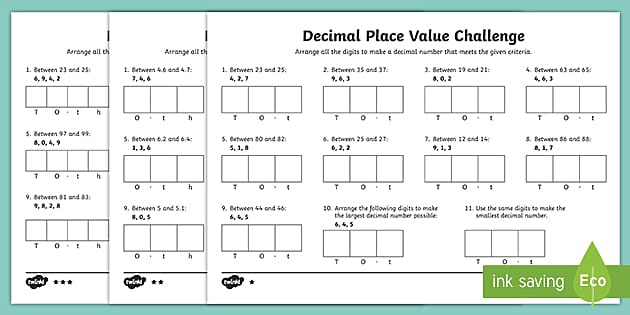
Highlights
- Interactive and Hands-On Activities: Engage with games, card challenges, and scavenger hunts that make decimals both fun and educational.
- Multi-Level Skill Development: Activities range from basic identification to advanced enrichment, catering to a broad range of learners.
- Real-World Connections: Incorporate practical applications of decimals, such as handling money and measurements, ensuring the challenges are relevant outside the classroom.
Overview of Decimal Place Value Challenges
Decimal place value challenges are a cornerstone of numerical reasoning, providing learners with opportunities to deepen their understanding of how digits function within numbers. These activities encourage students to examine the value of each digit within a decimal number, recognize the importance of positional notation, and develop strategies for comparing, expanding, and manipulating decimal numbers. By integrating a myriad of interactive approaches—from worksheets and digital puzzles to physical games—these challenges create a robust learning environment that caters to diverse learning styles.
Understanding Decimal Place Value
Decimals are a critical component of mathematics because they allow for precise representation of values, especially those that fall between whole numbers. The decimal system is based on powers of 10. For example, in the number \( 3.576 \), the digit 5 is in the tenths place, 7 is in the hundredths, and 6 is in the thousandths. Understanding this structure is essential for operations ranging from simple addition and subtraction to more complex problem-solving in real-world scenarios.
Place Value Concepts and Notation
When students engage with decimal place value challenges, they develop familiarity with several fundamental concepts including:
- Identification of Digits: Students learn to identify the value of each digit according to its position relative to the decimal point.
- Expanded Form Representation: Decimals can be broken down into sums of values, such as expressing \( 5.286 \) as \( 5 + 0.2 + 0.08 + 0.006 \).
- Changing Place Values: Activities that shift a digit's position helps students understand how the value of a number changes with the placement of the decimal point.
- Comparison and Rounding: Comparing numbers by evaluating digits in corresponding place values and applying rounding rules are key skills developed through these activities.
Types of Decimal Place Value Challenges
A variety of challenges are available to cater to different levels of mathematical proficiency. Whether you are a teacher seeking to supplement classroom instruction or a student looking to reinforce your learning, the following categories offer engaging approaches:
1. Interactive Worksheets and Digital Tools
Worksheets provide structured practice in identifying place values, expanding numbers, and comparing decimals. Online platforms offer digital worksheets that can be used for self-paced learning. These resources come equipped with interactive elements such as auto-grading and immediate feedback, which help in tracking progress. Interactive digital tools further enhance the experience by allowing manipulation of decimal points through visual aids, thus making abstract concepts more concrete.
Example Activities:
- Underlined Digit Identification: Students determine the value of a specific digit underlined in a decimal sequence, thereby reinforcing their understanding of place value.
- Expanding Decimals: Tasks that involve writing decimals in an expanded form, such as decomposing \( 7.492 \) into \( 7 + 0.4 + 0.09 + 0.002 \), build deeper numerical comprehension.
- Interactive Place Value Charts: These digital charts allow students to shift digits across different columns (tenths, hundredths, thousandths) and observe how the number's value changes.
2. Logic Puzzles and Card Games
Logic puzzles and card games add a competitive edge to decimal learning and promote strategic thinking. Use scenarios where students must form the highest or lowest possible decimal by rearranging given digits. Card games often involve a deck with numbers where players use cards to construct decimals, integrating both chance and skill.
Example Activities:
- Decimal Place Value Card Game: Students draw numbers from a deck and decide the order that creates the highest valid decimal, reinforcing understanding of positional value.
- Logic Puzzle Challenges: Puzzles may ask students to fill in missing digits in a decimal in order to complete a sequence, forcing them to think critically about the placement and significance of each digit.
- Riddle Challenge Cards: These cards contain clues that require solving decimal puzzles, ensuring that students engage with decimals in a fun, problem-solving context.
3. Real-World Applications and Scavenger Hunts
Understanding decimals in the context of everyday life is crucial. Real-world applications such as money handling or measurements provide context, making abstract concepts more tangible. Scavenger hunts that integrate word problems or tasks related to decimals encourage movement and collaboration, which can be particularly effective in a classroom setting.
Example Activities:
- Get Out the Money: Using coins and paper money, students practice writing monetary values in dollars and cents, converting them into decimals and expanded forms.
- Decimal Place Value Scavenger Hunt: Place cards with decimal problems around the classroom or school and have students solve each to move on to the next station. This activity reinforces problem-solving and ensures engagement through movement and exploration.
- Word Problems: Incorporate real-life scenarios where students must apply their decimal knowledge. For example, calculating change, measuring ingredients, or analyzing statistical data.
Comparing Different Decimal Challenges
It is beneficial to maintain a diversified approach to decimals, as each type of challenge emphasizes different aspects of understanding. The table below provides an overview of several decimal challenges, including their objectives, activities, and target skills:
| Challenge Type | Description | Example Activity |
|---|---|---|
| Interactive Worksheets | Structured exercises for identifying and expanding decimals. | Determine the value of underlined digits in numbers like 3.586. |
| Digital Tools | Interactive charts and web applications that facilitate self-paced learning. | Manipulate a digital place value chart to see how shifting decimals changes value. |
| Card Games | Games that require forming the largest or smallest decimal using a deck of cards. | Play a competitive game where players rearrange digits to form the highest decimal value. |
| Scavenger Hunts | Active classroom activities that integrate word problems into learning. | Find and solve decimal problems hidden around the classroom. |
| Logic Puzzles | Puzzles aimed at providing clues to complete decimal sequences using missing digits. | Solve a riddle card that requires placing digits in the correct order to complete a decimal. |
Additional Approaches for Enrichment
For advanced learners, decimal challenges can be extended to more enrichment activities that integrate deeper number analysis and complex problem-solving. Students who move beyond the basic place value activities might engage in:
Expanded Decimal Operations
These tasks require students to manipulate decimals in creative ways. They may include:
- Creating multi-step problems that involve adding, subtracting, and multiplying decimals.
- Developing and solving equations where decimals play an integral role, including the use of expanded notation and place value adjustments.
- Designing puzzles that include rounding rules and then analyzing how rounding affects numerical accuracy in real-life contexts.
Collaborative Challenges
Group work can amplify the learning experience. When students collaborate, they discuss different strategies for approaching decimal problems, debate the importance of place value, and sometimes even complete group-based tasks such as:
- Team-based card games where players compete to form decimals that represent real-life values, such as prices or measurements.
- Group scavenger hunts that require cooperative problem-solving and critical reasoning.
- Digital breakout rooms where students use interactive software to solve decimal puzzles under time constraints.
Implementing Decimal Challenges in the Classroom
Teachers play a vital role in facilitating these challenges. The key to success lies in selecting activities that match the learning objectives and the proficiency level of the students. Here are some strategies for effective classroom implementation:
Step-by-Step Integration
Initial Assessment: Identify the current level of understanding regarding decimal place values among students. Use quick quizzes or informal assessments to determine which areas require reinforcement.
Planning and Resources
Once assessment is complete, teachers can plan a series of activities that build gradually from simple identification tasks to more complex puzzles. Utilize a blend of printed worksheets and digital tools. Resources such as online interactive charts and printable activity cards are valuable assets. For instance, platforms that provide immediate feedback allow students to correct misconceptions while reinforcing proper understanding.
Differentiated Instruction
It is important to include activities that cater to students of varying abilities. While some learners may benefit from hands-on games like the playing card challenge, others might find digital worksheets or logic puzzles more appropriate. Differentiated instruction can be achieved by:
- Planning varied tasks that offer both simplicity for beginners and complexity for advanced learners.
- Utilizing pairing or small group work to encourage peer-to-peer learning and collaborative problem-solving.
- Assigning enrichment activities for students who quickly grasp the basics to ensure they remain engaged.
Real-World Application
Relate challenges to real-life situations such as money management, measurements in cooking, or scientific data interpretation. By discussing the importance of decimals in these circumstances, educators can demonstrate the practical relevance of the subject matter, thereby raising engagement and motivation among students.
Practical Tips for Engaging Students
Successfully incorporating decimal place value challenges requires creativity and adaptation. Here are some practical tips that have proven effective:
Incorporate Diverse Media
Use videos, interactive simulations, and physical manipulatives like coins and cards. These varied media can cater to auditory, visual, and kinesthetic learners, creating a more inclusive educational environment.
Maintain a Balanced Mix of Activities
Build lessons that use a mix of structured problem solving, open-ended exploration, and collaborative games. This balance not only ensures repetition of key concepts but also prevents monotony, keeping students consistently engaged.
Periodic Review and Feedback
Regular review sessions where students can discuss their strategies and thought processes help solidify learning. Providing immediate and constructive feedback during these sessions is essential for reinforcing accurate decimal comprehension.
Additional Resources and Further Exploration
A wealth of resources is available online to supplement decimal place value challenges. Educators can benefit from printable worksheets, digital games, and comprehensive puzzle packs designed for various grade levels. These resources not only offer additional practice but also enhance enjoyment in learning mathematics.
Some Recommended Online Tools and Worksheets
| Resource | Description | Link |
|---|---|---|
| K8 Worksheets | Worksheets focusing on identifying and breaking down decimal place values. | Visit Site |
| Math Worksheets 4 Kids | Interactive worksheets for decimal place value identification and comparison. | Visit Site |
| Teachers Pay Teachers | Enrichment activities including logic puzzles and decimal challenges. | Visit Site |
| Twinkl | Resources including challenge cards and interactive activities on decimal place value. | Visit Site |
| You've Got This Math | Decimal activities designed to challenge and engage students through applied learning. | Visit Site |
Additional Activity Ideas
Beyond the challenges already discussed, instructors and parents can explore numerous innovative ideas, from creating math-themed escape rooms to using everyday objects to represent decimal places. Incorporating these hands-on and creative methods ensures that mathematical precision becomes a dynamic part of learning rather than a static set of rules.
References
- Decimal Place Value Worksheets - K8Worksheets
- Decimal Place Value Worksheets - Math Worksheets 4 Kids
- Decimal Enrichment Activities - Teachers Pay Teachers
- Decimal Riddle Challenge Cards - Twinkl
- Decimal Activities - You've Got This Math
Recommended
Last updated March 6, 2025