
The Remarkable Evolution of Deep Learning: From Neural Beginnings to AI Revolution
A journey through 80 years of neural network development that transformed artificial intelligence forever
Key Highlights of Deep Learning History
- Early foundations were established in the 1940s with McCulloch-Pitts neurons, but the field faced significant setbacks during AI winters
- Backpropagation breakthrough in the 1980s by Geoffrey Hinton and others revitalized neural networks, enabling effective training of multi-layer networks
- 2012 ImageNet competition marked deep learning's watershed moment when Krizhevsky, Sutskever, and Hinton's neural network dramatically outperformed traditional computer vision approaches
The Early Foundations (1940s-1960s)
The journey of deep learning begins in the mid-20th century when scientists first attempted to create computational models inspired by the human brain. The earliest foundations were laid in 1943 when Warren McCulloch and Walter Pitts proposed a mathematical model of a neuron using "threshold logic" to mimic basic biological neurons. This conceptual breakthrough established the theoretical framework for artificial neural networks.
Building on this foundation, Frank Rosenblatt introduced the Perceptron in 1958, the first operational neural network capable of performing pattern recognition tasks. This single-layer neural network could learn to classify simple patterns, generating significant excitement about the potential of machine intelligence. During this early period, computers were rudimentary, and implementation was limited by technological constraints.
First Neural Network Models and Their Limitations
The excitement surrounding early neural networks was tempered in 1969 when Marvin Minsky and Seymour Papert published "Perceptrons," a book highlighting the fundamental limitations of single-layer neural networks. Most notably, they demonstrated that these networks couldn't solve basic non-linear problems like the XOR function. This critique, combined with limited computing power and the absence of effective training algorithms for multi-layer networks, led to the first "AI winter" where funding and interest in neural networks declined dramatically.
Despite these setbacks, researchers continued to make progress. In 1965, Soviet mathematician Alexey Ivakhnenko, along with his colleague V.G. Lapa, developed the Group Method of Data Handling (GMDH), which utilized a layer-by-layer approach with polynomial activation functions. This method is now recognized as one of the first implementations of deep learning principles.
Emergence and Challenges (1970s-1980s)
The 1970s witnessed the development of new neural network architectures. Notably, Kunihiko Fukushima introduced the Neocognitron in 1979, a hierarchical multilayered network designed for visual pattern recognition that laid groundwork for later convolutional neural networks. However, the field still struggled with effective training methods for complex networks.
The Backpropagation Breakthrough
The crucial breakthrough came in the 1980s with the refinement of the backpropagation algorithm. Though the concept had been described earlier by researchers like Henry J. Kelley and Stuart Dreyfus in the 1960s, it wasn't until 1986 that David Rumelhart, Geoffrey Hinton, and Ronald J. Williams published their influential paper demonstrating how backpropagation could efficiently train multi-layer neural networks.
This advancement solved a critical problem: how to assign credit or blame to neurons in hidden layers for the network's performance. By propagating error signals backward through the network and adjusting weights accordingly, backpropagation enabled the training of deeper, more complex neural architectures. This breakthrough reignited interest in neural networks and laid the foundation for modern deep learning.
Practical Applications Begin to Emerge
In the late 1980s and early 1990s, Yann LeCun at Bell Labs applied convolutional neural networks (CNNs) with backpropagation to the practical problem of handwritten digit recognition. His work on LeNet, a pioneering CNN architecture, demonstrated impressive performance on the MNIST dataset of handwritten digits and found real-world application in processing bank checks.
The Modern Deep Learning Renaissance (1990s-2010s)
The 1990s saw continued advancement but also challenges. The field progressed with innovations like Long Short-Term Memory (LSTM) networks developed by Hochreiter and Schmidhuber in 1997, which addressed the vanishing gradient problem in recurrent neural networks and enabled better handling of sequential data.
However, neural networks still faced competition from other machine learning methods like support vector machines, which often performed better with the limited data and computing power available at the time. The term "deep learning" wasn't yet broadly used, and the field remained somewhat specialized.
The Perfect Storm: Data, Computing Power, and Algorithms
The true deep learning revolution began in the mid-2000s due to a confluence of factors:
- The explosion of digital data available for training
- Dramatic increases in computing power, particularly with GPUs
- Algorithmic innovations that enabled more effective training of deep networks
In 2006, Geoffrey Hinton and Ruslan Salakhutdinov published a groundbreaking paper demonstrating how deep belief networks could be efficiently pre-trained layer by layer, making deeper networks more practical. The term "deep learning" gained popularity during this period, describing the training of neural networks with multiple hidden layers.
The 2012 ImageNet Revolution
The watershed moment for deep learning came in 2012 when Alex Krizhevsky, Ilya Sutskever, and Geoffrey Hinton's deep convolutional neural network, later known as AlexNet, won the ImageNet Large Scale Visual Recognition Challenge by a substantial margin. Their network reduced the error rate from 26% to 15%, demonstrating the unprecedented capabilities of deep learning models for complex visual recognition tasks.
This victory catalyzed a paradigm shift in artificial intelligence research and industry applications. Following this breakthrough, deep learning quickly became the dominant approach in computer vision, speech recognition, natural language processing, and many other domains.
Recent Developments and Current Landscape (2010s-Present)
Following the 2012 ImageNet breakthrough, deep learning has seen explosive growth and become central to modern AI. Key developments include:
Architectural Innovations
Researchers have developed increasingly sophisticated neural network architectures, such as:
- Residual Networks (ResNet) - Introduced by Microsoft Research in 2015, these networks use skip connections to train extremely deep networks with hundreds of layers
- Generative Adversarial Networks (GANs) - Proposed by Ian Goodfellow and colleagues in 2014, these networks can generate remarkably realistic images
- Transformer models - Introduced by Google researchers in 2017, this architecture revolutionized natural language processing and forms the foundation of modern language models like GPT, BERT, and LaMDA
Major Milestones
Deep learning has achieved numerous breakthrough moments in the past decade:
- 2016: Google DeepMind's AlphaGo defeated world champion Lee Sedol at Go, a game previously thought too complex for AI mastery
- 2018: BERT (Bidirectional Encoder Representations from Transformers) achieved state-of-the-art results across various natural language processing tasks
- 2020: OpenAI's GPT-3 demonstrated unprecedented language generation capabilities
- 2022-2023: Diffusion models like DALL-E, Midjourney, and Stable Diffusion transform AI image generation
| Era | Key Innovations | Notable Figures | Major Challenges |
|---|---|---|---|
| Foundation Era (1940s-1960s) |
McCulloch-Pitts Neuron, Perceptron, ADALINE | McCulloch, Pitts, Rosenblatt, Widrow | Limited to linear problems, single-layer networks |
| First AI Winter (1970s) |
Neocognitron, early forms of backpropagation | Fukushima, Kelley, Dreyfus | Training multi-layer networks effectively, lack of computational power |
| Backpropagation Era (1980s-1990s) |
Efficient backpropagation, CNNs, RNNs, LSTMs | Hinton, Rumelhart, Williams, LeCun, Hochreiter, Schmidhuber | Limited data, computational constraints, vanishing gradients |
| Deep Learning Revival (2000s-2012) |
Deep belief networks, unsupervised pre-training, GPUs for training | Hinton, Bengio, LeCun, Ng | Scaling to larger datasets, proving commercial viability |
| Modern Deep Learning (2012-Present) |
AlexNet, ResNet, GANs, Transformers, diffusion models | Krizhevsky, Sutskever, Goodfellow, Vaswani, Radford | Explainability, bias, safety, energy consumption |
The Evolution of Deep Learning: A Visual Timeline
The following mindmap illustrates the key developments, breakthroughs, and influential researchers that have shaped the field of deep learning from its inception to the present day:
Pivotal Figures in Deep Learning History
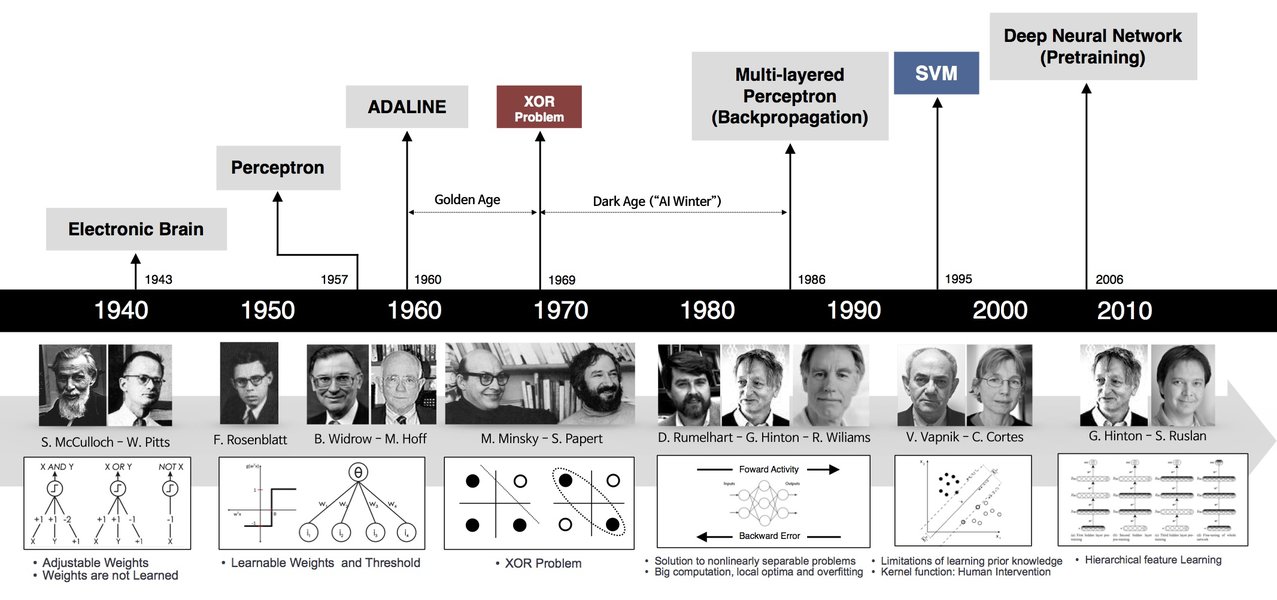
The development of deep learning has been driven by numerous brilliant researchers who have made crucial contributions at different stages of its evolution. Some of the most influential figures include:
- Warren McCulloch & Walter Pitts - Created the first mathematical model of a neuron in 1943
- Frank Rosenblatt - Invented the Perceptron in 1958, the first operational neural network
- Geoffrey Hinton - Often called the "Godfather of Deep Learning," his contributions include backpropagation, Boltzmann machines, deep belief networks, and numerous other innovations
- Yann LeCun - Pioneer of convolutional neural networks and their application to computer vision
- Yoshua Bengio - Made fundamental contributions to recurrent neural networks, language models, and unsupervised learning
- Jürgen Schmidhuber - Co-invented Long Short-Term Memory networks and made contributions to many aspects of neural network research
- Andrew Ng - Played a key role in popularizing deep learning and applying it at scale in industry
Deep Learning: From Origins to Revolution
This comprehensive video explores the fascinating journey of neural networks from their conceptual origins in 1943 to the deep learning revolution that has transformed artificial intelligence. It provides a detailed look at the key breakthroughs and setbacks that have shaped this remarkable field, explaining how these mathematical models inspired by the human brain evolved into the powerful AI systems we know today.
Frequently Asked Questions
References
- Deep Learning's Origins and Pioneers - McKinsey
- A Brief History of Deep Learning - Built In
- Designing Neural Networks Through Neuroevolution - Nature Machine Intelligence
- A Brief History of Deep Learning - DATAVERSITY
- Neuroevolution: Evolving Neural Network with Genetic Algorithms - Medium
- Neuroevolution - Wikipedia
- Brief History of Deep Learning from 1943-2019 [Timeline] - MLK
Recommended Searches
Last updated April 7, 2025