
Dissecting Deferred Tax on Land: Identifying the Incorrect Statement
A Comprehensive Analysis of Tax Bases and Deferred Tax Implications for Land under Different Accounting Models
Key Insights
- Deferred tax on land is influenced by the accounting model used (cost or revaluation) and the expected manner of recovery (use or sale). Temporary differences between the carrying amount of land and its tax base can give rise to deferred tax assets or liabilities.
- The tax base of land under the cost model is generally its historical cost, adjusted for certain tax-deductible expenses. It is not necessarily zero.
- Land accounted for under the revaluation model can lead to both deferred tax liabilities and, in specific circumstances related to revaluation decreases or tax losses, deferred tax assets. The statement that it can *only* lead to a deferred tax liability is incorrect.
Understanding the tax implications of land ownership, particularly in the context of different accounting models, is crucial for accurate financial reporting and tax planning. Deferred tax arises due to temporary differences between the carrying amount of an asset or liability in the financial statements (based on accounting rules like GAAP or IFRS) and its tax base (based on tax laws). These temporary differences are expected to reverse in future periods, leading to either a future tax liability or a future tax asset.
The Foundation: Temporary Differences and Deferred Tax
Bridging the Gap Between Accounting and Tax
Deferred tax is a consequence of the differences that arise between how items are recognized for financial reporting purposes and how they are treated for tax purposes. These differences can be temporary or permanent. Temporary differences are those that will reverse in future periods, while permanent differences will not. Deferred tax is only concerned with temporary differences.
A deferred tax liability represents the amount of income tax payable in future periods in respect of taxable temporary differences. Conversely, a deferred tax asset represents the amount of income tax recoverable in future periods in respect of deductible temporary differences and the carryforward of unused tax losses or unused tax credits.
The core concept revolves around the tax base of an asset or liability. The tax base of an asset is the amount that will be deductible for tax purposes against any taxable economic benefits that will flow to an entity when it recovers the carrying amount of the asset. If those economic benefits are not taxable, the tax base of the asset is equal to its carrying amount.
For land, the tax base is generally related to its cost and how that cost can be recovered or deducted for tax purposes upon sale. Unlike depreciable assets, land itself is typically not depreciated for tax purposes.
Examining the Statements on Land and Deferred Tax
Analyzing Each Assertion
Statement 1: The tax base of land accounted for in terms of the cost model is zero.
Under the cost model, land is initially recognized at its cost. The carrying amount of the land on the balance sheet is this historical cost, less any accumulated impairment losses. For tax purposes, the tax base of the land is generally its cost. This cost is typically the amount that will be deductible against the proceeds when the land is eventually sold to determine any taxable capital gain.
Consider the definition of a tax base: the amount deductible for tax purposes against future economic benefits. When land is sold, the proceeds from the sale are the economic benefits. The amount deductible against these proceeds for tax purposes is typically the original cost of the land, adjusted for certain expenses incurred during the purchase and potentially for improvements.
Therefore, the tax base of land accounted for under the cost model is generally its cost, not zero. The statement that the tax base is zero is incorrect.
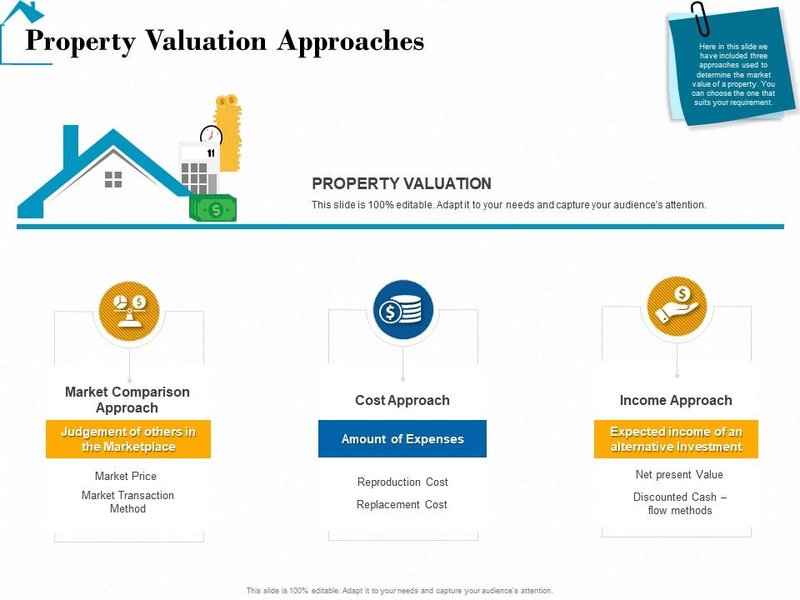
Visualizing different property valuation approaches.
Statement 2: The tax base of land accounted for in terms of the revaluation model is equal to the cost of the land.
Under the revaluation model, an asset is carried at a revalued amount, which is its fair value at the date of revaluation less any subsequent accumulated depreciation and impairment losses. While the carrying amount of land under the revaluation model changes with revaluations, the tax base is generally not affected by these revaluations.
Tax laws typically do not recognize upward revaluations of assets as taxable events. The tax base remains the historical cost (or indexed cost in some jurisdictions) that will be deductible upon the eventual sale of the land. Therefore, even if the carrying amount of land is revalued upwards, its tax base usually remains its original cost (plus permitted adjustments).
The statement that the tax base of land accounted for under the revaluation model is equal to the cost of the land is generally correct. The tax base reflects the amount that is deductible for tax purposes upon recovery of the asset's carrying amount, which, for land, is typically through sale, and the deductible amount is based on its cost.
Statement 3: Land accounted for in terms of the cost model will always be exempt from deferred tax.
Deferred tax arises from temporary differences between the carrying amount and the tax base. Under the cost model, the carrying amount of land is its cost less impairment. As discussed, the tax base is generally the cost of the land (plus allowable adjustments). In many cases, if there are no impairment losses, the carrying amount and the tax base might be the same, resulting in no temporary difference and therefore no deferred tax.
However, there can be scenarios where temporary differences arise even under the cost model. For instance, if certain costs associated with the land are capitalized for accounting purposes but immediately deductible for tax purposes, or vice versa, a temporary difference would be created. Also, if the land's carrying amount is impaired for accounting purposes, but this impairment is not immediately tax-deductible, a temporary difference arises. In such cases, deferred tax would be recognized.
Therefore, the statement that land accounted for in terms of the cost model will *always* be exempt from deferred tax is incorrect. While often the case, exceptions can occur due to differences in the timing of recognition of costs or losses for accounting and tax purposes.
Statement 4: Land accounted for in terms of the revaluation model can only lead to a deferred tax liability.
When land is revalued upwards, its carrying amount exceeds its tax base (which remains based on cost). This difference is a taxable temporary difference, leading to the recognition of a deferred tax liability. This deferred tax liability represents the tax that would be payable if the land were sold at its revalued amount.
However, deferred tax assets can also arise in relation to revalued land. For example, if a revaluation results in a decrease in the carrying amount below the original cost (a revaluation decrease), this decrease might not be immediately deductible for tax purposes. This could create a deductible temporary difference, leading to a deferred tax asset. Furthermore, if there are unused tax losses that can be offset against future taxable gains on the sale of the revalued land, a deferred tax asset related to those losses might be recognized.
Therefore, the statement that land accounted for in terms of the revaluation model can *only* lead to a deferred tax liability is incorrect. While upward revaluations primarily lead to deferred tax liabilities, other circumstances, such as revaluation decreases or the availability of tax losses, can result in deferred tax assets.
Synthesizing the Analysis
Identifying the Incorrect Statement
Based on the analysis of each statement:
-
Statement 1: "The tax base of land accounted for in terms of the cost model is zero." - Incorrect. The tax base is generally the cost.
-
Statement 2: "The tax base of land accounted for in terms of the revaluation model is equal to the cost of the land." - Generally correct. The tax base is typically based on cost, not the revalued amount.
-
Statement 3: "Land accounted for in terms of the cost model will always be exempt from deferred tax." - Incorrect. Temporary differences can arise under the cost model.
-
Statement 4: "Land accounted for in terms of the revaluation model can only lead to a deferred tax liability." - Incorrect. Deferred tax assets can also arise.
We are looking for the statement that is not correct. Both statements 1, 3, and 4 are incorrect. However, in the context of a multiple-choice question where only one option is typically incorrect, we should re-examine the nuances.
Statement 1 is definitively incorrect as the tax base is not zero under the cost model; it's the cost. Statement 3 uses the word "always," which makes it incorrect due to the possibility of temporary differences from factors other than depreciation. Statement 4 uses the word "only," which also makes it incorrect as deferred tax assets are possible under the revaluation model in certain situations.
Let's consider which statement is the most fundamentally incorrect or presents a clear misstatement of a general principle. Statement 1 asserts that the tax base is zero, which is a direct contradiction of how tax bases are determined for non-depreciable assets like land. Statements 3 and 4 are incorrect due to the use of absolute terms ("always" and "only"), but the core concepts they address (exemption under cost model, liability under revaluation model) are often the typical outcomes, even if exceptions exist.
Therefore, Statement 1 appears to be the most fundamentally incorrect statement based on the general principles of determining the tax base of land under the cost model.
Illustrative Comparison of Accounting Models and Tax Bases for Land
A Side-by-Side View
| Feature | Cost Model | Revaluation Model |
|---|---|---|
| Initial Measurement (Carrying Amount) | Cost | Cost |
| Subsequent Measurement (Carrying Amount) | Cost less impairment | Fair value at revaluation date less subsequent impairment |
| Tax Base (General Principle) | Cost (plus/minus certain adjustments) | Cost (plus/minus certain adjustments) |
| Impact of Changes in Value on Tax Base | Generally none, unless impairment is recognized differently for tax | Generally none, revaluations do not typically affect the tax base |
| Potential for Deferred Tax Liability (Upward Valuation) | Low (unless specific temporary differences arise) | High (carrying amount exceeds tax base) |
| Potential for Deferred Tax Asset (Downward Valuation/Losses) | Possible (e.g., from non-tax-deductible impairment) | Possible (e.g., from revaluation decreases below cost, tax losses) |
Delving Deeper: The Mechanics of Deferred Tax on Revalued Land
Why Upward Revaluations Lead to Liabilities
When land is revalued upwards under IAS 16, the carrying amount increases to fair value. However, the tax base remains at historical cost (or an adjusted cost). This creates a taxable temporary difference, calculated as:
\[ \text{Taxable Temporary Difference} = \text{Carrying Amount (Revalued Amount)} - \text{Tax Base (Cost)} \]This temporary difference indicates that when the land is eventually sold at an amount reflecting its revalued carrying amount, the taxable gain for tax purposes will be larger than the gain recognized in the financial statements (if no further revaluations occur). The tax on this future expected taxable gain is recognized as a deferred tax liability.
The deferred tax liability is calculated by multiplying the taxable temporary difference by the applicable tax rate expected to apply when the asset is recovered. For land, recovery is typically through sale, so the relevant tax rate is usually the capital gains tax rate.
Real estate valuation methods vary globally, impacting tax considerations.
Considering the Tax Base in Practice
What Determines the Deductible Amount?
The tax base of land is its cost, which includes the purchase price and certain costs incurred to acquire the land and prepare it for its intended use. These costs can include legal fees, title insurance, survey costs, and sometimes costs associated with getting the land ready for construction, such as demolition costs (which are added to the basis of the land).
When the land is sold, the capital gain (or loss) for tax purposes is generally calculated as the selling price minus the adjusted tax basis. The adjusted tax basis is the original cost basis plus the cost of any capital improvements made to the land, minus any decreases in basis (though decreases are less common for land compared to depreciable assets).
The determination of the tax base is governed by the tax laws of the relevant jurisdiction. These laws dictate which costs can be included in the basis and how gains or losses on the sale of assets like land are taxed.
Frequently Asked Questions
What is the difference between book income and taxable income?
Book income is the profit reported in a company's financial statements, calculated according to accounting standards like GAAP or IFRS. Taxable income is the income figure used to calculate the amount of income tax payable to the tax authorities, determined according to tax laws. Due to differences in recognition and measurement rules between accounting standards and tax laws, book income and taxable income often differ. These differences are the source of deferred taxes.
What is a temporary difference?
A temporary difference is a difference between the carrying amount of an asset or liability in the statement of financial position and its tax base. These differences will result in taxable amounts or deductible amounts in determining taxable profit (tax loss) of future periods when the carrying amount of the asset or liability is recovered or settled.
How is deferred tax measured?
Deferred tax assets and liabilities are measured at the tax rates that are expected to apply to the period when the asset is realized or the liability is settled, based on tax rates (and tax laws) that have been enacted or substantively enacted by the end of the reporting period. Deferred taxes are recorded at their cash value; the time value of money is not considered.
Can deferred tax assets expire?
Deferred tax assets related to temporary differences generally reverse when the temporary difference reverses and do not have an expiration date in themselves. However, deferred tax assets arising from the carryforward of unused tax losses or unused tax credits may have expiration dates depending on the tax laws of the jurisdiction.
Conclusion: Identifying the Incorrect Statement
Based on our analysis, the statement that is not correct is:
The tax base of land accounted for in terms of the cost model is zero.
The tax base of land under the cost model is its cost, not zero. The other statements, while containing nuances related to the terms "always" and "only," describe situations that can arise in deferred tax accounting for land, whereas the first statement fundamentally misrepresents the tax base of land under the cost model.
References
Last updated April 25, 2025